
Free Flight: Duration
Harry Murphy 3824 Oakwood Blvd. Anderson, IN 46011
Free Flight in 1992
The upcoming 1992 free flight season promises a very heavy schedule. Last word at this writing is that the USFFC (United States Free Flight Championships), which has been held at Taft over Memorial Day weekends for the past 20 years, is uprooting and moving to the Labor Day weekend at nearby Lost Hills. Reasons cited include shrinking site size and less favorable overfly conditions at Taft; Lost Hills is said to have better late-summer flying weather.
The NFFS (National Free Flight Society) has announced that the Nostalgia Gas Champs go west in 1992 and will be staged in conjunction with the USFFC, including a full complement of Nostalgia Gas events — Nos. Gas Ignition and PAA Load among them.
Key national events (1992):
- NFFS U.S. Indoor Championships: Johnson City, Tennessee — June 4–7.
- SAM (Society of Antique Modelers) Championships: Lawrenceville, Illinois — June 8–11 (host: SAM Chapter 57).
- AMA Nationals: Westover AFB, Chicopee, MA — June 20–28.
- Free Flight outdoor events: June 23–28.
- Indoor events: June 21–23.
- NFFS four-day USOC (United States Outdoor Champs): AMA Muncie site — Labor Day weekend (same weekend as USFFC); East and West officials have agreed to stage events simultaneously.
- FAI Team Finals: October 8–11 at Taft or Lost Hills, California.
Because the NFFS is heavily involved in several locales in 1992, no NFFS involvement is expected to complement the AMA rule-book events for this year. All dates are subject to change (this column written October 1991). Plan a free flight vacation in 1992 and take in one or more of the big events — chances are I'll see you there.
Niblite 584 (Norm Poti)
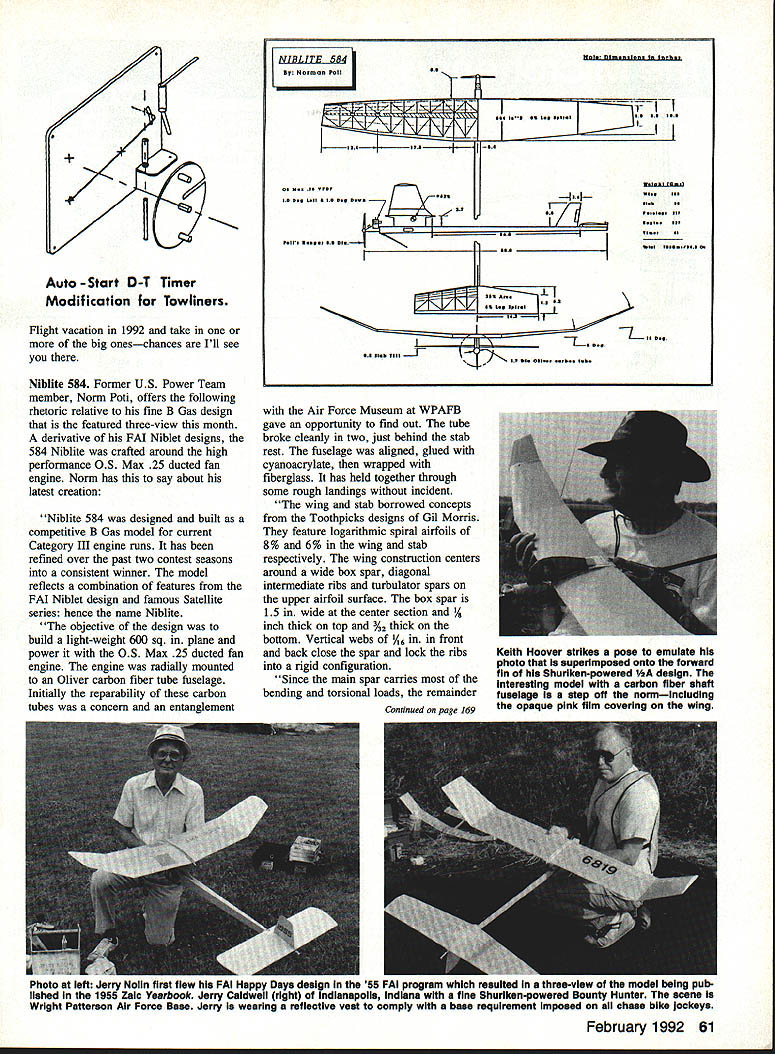
Former U.S. Power Team member Norm Poti offers the following on his B Gas design that is the featured three-view this month. A derivative of his FAI Niblet designs, the 584 Niblite was crafted around the high-performance O.S. Max .25 ducted fan engine. Norm describes the model:
- Objective: Build a lightweight 600 sq. in. plane powered by an O.S. Max .25 ducted fan engine.
- Fuselage: Oliver carbon-fiber tube, engine radially mounted. When a tube once broke cleanly just behind the stab rest, the fuselage was realigned, glued with cyanoacrylate, then wrapped with fiberglass — it has held through rough landings.
- Wing and stab: Borrow concepts from Gil Morris’s Toothpicks designs; logarithmic spiral airfoils of 8% (wing) and 6% (stab). Wing construction centers on a wide box spar, diagonal intermediate ribs, and turbulator spars on the upper surface.
- Box spar: 1.5 in. wide at center; top cap 1/8 in., bottom cap 3/32 in.
- Vertical webs: 1/16 in. front and back to close the spar and lock ribs.
- Leading edge: soft balsa with .003 carbon reinforcement sandwiched in for nick resistance.
- Trailing edge: 1.0 in. wide hollow structure built from 1/16 balsa.
- Ribs and turbulator spars: cut from light balsa.
- Initial wing: 139 grams, covered with Micafilm; flown one season but was too flexible (tips washed out causing early zeroing and pullouts).
- Rebuilt wing: added full-depth vertical webs to front and back of main spar; recovered with MonoKote. New wing weighs 188 grams and is rigid even on 12-second runs.
- Stab: light balsa covered with 1 mil Mylar.
- Overall: weight just under 25 ounces. Flown in a right/right pattern with absolute incidence rudder and stab. Very fast and performs well in strong winds. After resolving consistency problems with the beefed-up wing, the model has accumulated contest hardware. A Category III record attempt last year fell short: a string of 14 maxes totaling 31 minutes, 35 seconds. The model’s mission is to try to capture that record in the coming flyoff season.
For more information or a three-view, send a SASE to Norm Poti, 5695 Marshall Road, Dayton, OH 45429.
CO2 and Electric
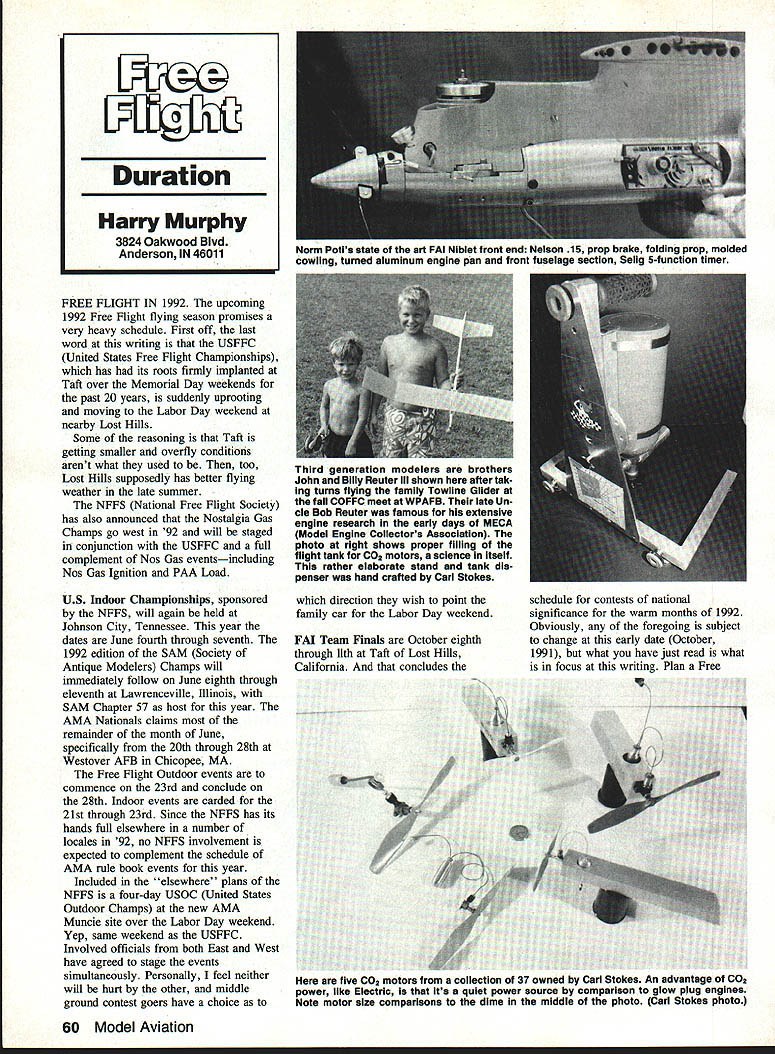
Carl Stokes recently took me to task for off-hand comments suggesting rule changes might be needed to prevent marathon flyoffs in CO2 events (notably where the prop continues running after the two-minute maximum). CO2 and Electric powerplants remain mysterious to many modelers who are used to glow engines — they are quieter and different in operation.
Issues and suggestions:
- Some CO2 advocates favor better matching of engine and tank sizes by adding competition classes. That becomes difficult when entries in those classes will be low and award budgets limited.
- Carl sent extensive material from his mentor Fritz Zweller. An apparent and practical solution is education: Carl is encouraging Fritz to produce a manual on CO2 operations.
- A beginner’s booklet on CO2 — explaining how to start, available engines, expected power outputs, model sizes and types, tank selection, and filling devices — would help broaden participation.
- Lack of accessible information discourages modelers from entering CO2 or Electric classes; education by the CO2 and Electric communities is essential to gain broader acceptance and influence AMA rule suggestions.
I thank Carl for his input and encourage others to share expertise. Correspondence to Carl: Carl Stokes, 14702 Eighth Ave. NE, Seattle, WA 98155.
Auto-Start DT Timer for Towline
Joel Chesler submitted a KSB timer revision to facilitate timely towline glider DT (dethermalizer) actuation. The modification is based on a concept previously published in the NFFS Digest but retains the original face plate and incorporates a more reliable start-stop mechanism.
Key points of the modification:
- The timing disk is removable from the face plate.
- A release pin pulls out to start the sequence.
- Three Phillips-head screws attach the face plate to the timing assembly.
- A spring-loaded start-stop arm (made from .025 piano wire) is held by two Phillips-head screws. It must be bent so it engages the brass cam in the timing mechanism when pushed in by the release pin and disengages when the release pin is removed.
- The spring action prevents the timer from activating during the towline release.
This modification is straightforward and can be accomplished with simple tools. For additional explanation, contact Joel Chesler at 17800 E. Colima Rd., Apt. 234, Rowland Heights, CA 91748.
Junior-Senior Column for FF Digest
Chris Weinrich, editor of the NFFS Free Flight Digest, reports that 15-year-old Ryan Lardinois wrote a special column for Juniors and Seniors. Ryan is new to the hobby and wants to continue writing as he gains experience. He needs input from other younger modelers about their free flight experiences, what and where they fly, problems encountered, etc.
Send contributions to: Ryan Lardinois 1424 Ponderosa Avenue Green Bay, WI 54313
(And yes, serious, constructive notes only.)
New Stuff
- Campbell’s Custom Kits: Proprietor Lee Campbell is offering a new Coupe d’Hiver model named the Souper Coupe — 38 in. wingspan, selected balsa, pre-cut parts, Japanese tissue, rolled plans, rubber, assorted hardwood, folding prop kit, etc. The design resembles Lee’s Souper P-30. Available through hobby dealers carrying the Campbell line. Price: $29.98 (add $3.50 for mail order). Campbell’s address: 401 Executive Center Drive, H-108, West Palm Beach, FL 33401. Tell ’Em Dirty Harry sent you.
- Al Lidberg’s Turbo-Porter Jumbo Scale: My October 1991 column included a photo of Al Lidberg’s shark-toothed 40-in. Turbo-Porter and referenced additional text that was cut by the publisher. The plane is based on the movie Air America’s Turbo-Porter: shark mouth, eyes, and teeth on a camouflaged transport/bush monoplane — an excellent rubber-powered scale subject. Al’s plan packet includes detailed plans, accurate three-views, a photo, and four pages of instructions. A plastic prop made from 3/16-in. plastic prop stock can be used instead of carving. The packet costs $7 postpaid. For the plan packet and catalog of other flying scale plans, contact Al (address omitted in OCR — request via the usual channels or NFFS listings).
Covering and Assembly Instructions (Profile Model)
These notes describe covering and assembly techniques for a profile-type model (canopy, wing, stab, profile body).
Covering:
- Cut canopy pattern from the plan copy; apply it after covering the profile body.
- To handle small tissue pieces: flip them face-down on clean newspaper, spritz each with 3M Spray-Mount aerosol rubber cement (or a thin coat of Craft Bond). Pick them up with the tip of an X-Acto blade, flip them over, and apply to the matching plan/profile location. Smooth down and mark corners for alignment on the balsa frame.
- To cover wing and stab outlines and root ribs: first apply Craft Bond (thinned one-third with water), then lay tissue on top and smooth out wrinkles.
- Cover the profile body on the left side only at first. Glue all uprights, outlines, and slot ribs to the covering. Spot-glue at the nose and tail to confirm alignment, then lift the tissue to glue the top and belly of the frame. When glue sets, trim excess tissue with a sharp X-Acto knife. Trim tissue from the stab and wing slots as needed.
- Add the canopy, align carefully, and trim any excess. Color the canopy frame to match the top of the profile body using a dark blue marker or a blue Sharpie for slim frames.
Assembly:
- Fit the stabilizer into its slot. Square it up, sighting from top and rear. Apply a drop of Hot Stuff (or equivalent CA) where the leading and trailing edges join the fin and hold until set.
- Slip a wing tip into the slot in the profile body and slide the wing in so the center rib is inside the slot. If using the underwing piece, tack-glue the bottom of the wing to the profile body — glue at the leading and trailing edges and at the root rib; full-length gluing is not necessary.
Notes:
- Check slot fit before final gluing.
- Use light, precise glue spots to preserve alignment and minimize warping.
Transcribed from original scans by AI. Minor OCR errors may remain.

