

Free Flight: Duration
Harry Murphy 3824 Oakwood Blvd. Anderson, IN 46011
The Dates — 1992 edition
The dates for the 1992 edition of the SAM CHAMPS (Society of Antique Modelers Annual Championships) are the first "fixit" for this column. Last time I reported the '92 dates as June 8–11 at Lawrenceville, IL, but due to an expected undesirable crop situation in June, the dates have been moved to July 7–10. A card of Nostalgia Gas events is slated for the two days prior to the official start of the SAM events. Note this revision on your 1992 contest calendars.
Other summertime multi-day championship affairs remain basically intact as presented in the February column:
- NFFS USIC, Johnson City, TN — June 4–7
- AMA Nationals, Chicopee, MA — June 20–28
- NFFS USOC and USFFC/NFFS Nostalgia Gas Champs at their respective locations of Muncie, IN and Lost Hills, CA — both scheduled for the Labor Day weekend
- FAI Team Finals, Lost Hills — October 8–11
In addition, the FAC (Flying Aces Club) and SAM Chapter 57 are adding a card of associated events to the Muncie USOC affair. It's a very loaded calendar of activity for the coming flying season — attend as many of these functions as you possibly can.
Stratogull P-30
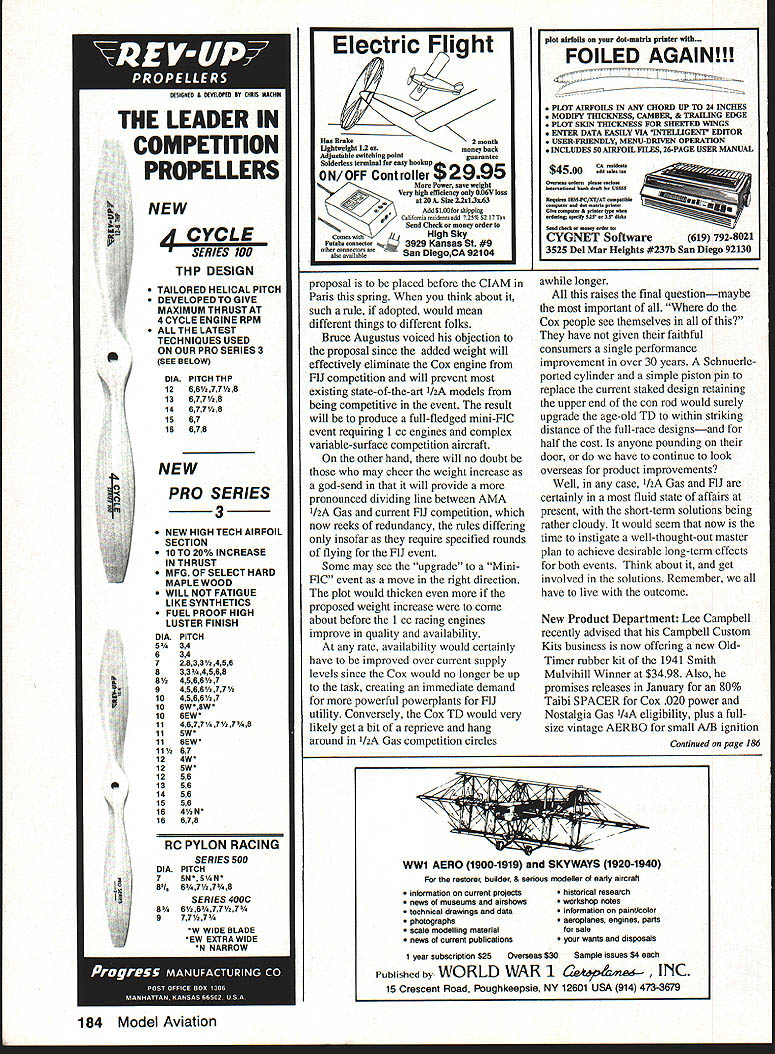
Frank Heeb's Stratogull has been the premier P-30 rubber model to beat at the weekend contests held at WPAFB, Dayton, OH, and it was also an AMA Nationals winner in 1988. A soft-spoken Frank says he has built five, lost three, and has number six in the oven. The basic rubber-model construction of wing and stab hides sophisticated airfoil choices, while the rolled-tube fuselage gives it a modern flair and shows the hand of an experienced Free Flight builder.
Key features:
- Wing airfoil: Benedek B6356-b, with a bit less undercamber to make it thicker. Frank uses a constant-chord layout and multi-spar configuration to maintain an accurate section across the full span at the maximum Reynolds number. End plates were added to reduce tip vortices (at the expense of some drag).
- Stab airfoil: a popular European undercambered section that provides lift, permits a more aft CG, and requires less downthrust up front.
- Dethermalizer: the whole stab separates from the fuselage when the dethermalizer activates but remains tethered by a thread attached to the right-hand endplate of the stab.
Construction details:
- Wing leading edge: 1/8 in. square
- Stab leading edge: 3/32 in. square
- Top and bottom spars: 1/16 in. square
- Trailing edges: tapered 1/16 in. sheet
- End plates: 1/32 in. sheet
- Wing ribs: cut from 1/20 in. sheet
- Stab ribs: 1/32 in. sheet
- Reinforcement: narrow 1/16 x .007 in. graphite strip cemented atop the center wing spar on the center panels
Fuselage and trimming:
- Frank fabricates the rolled-tube fuselage in two sections; the front portion that houses the rubber motor is 1/16 in. sheet balsa.
- Frank insists on maintaining 2° decalage. Determining pylon position should establish the CG at about 30% of wing chord. Six strands of 1/8-in. rubber make up the 10-gram motor. The pylon is taped in position; the model should produce a slight stall at high speed. Use glide tests and small moves fore or aft of the pylon to trim while maintaining 2° decalage. Attempt low-power flights before permanently securing the pylon to the fuselage.
Thanks to Frank for sharing the design. I have yet to observe a consistently flying P-30 design. For information, send a SASE to Frank, 485 Grange Hall Rd., Beavercreek.
F1J status
Looking at the box scores of the 1/2A Open event at the 1991 AMA Free Flight Nationals, it might appear that the 30-year reign of the Cox TD .049 has come to an end — you must look down to fourth place to find a Cox-powered entry. Two BV Shurikens and a Galbraeth setup CS took the top three positions, and the increased number of Fokker Red Shurikens used in the subsequent F1J event was notable.
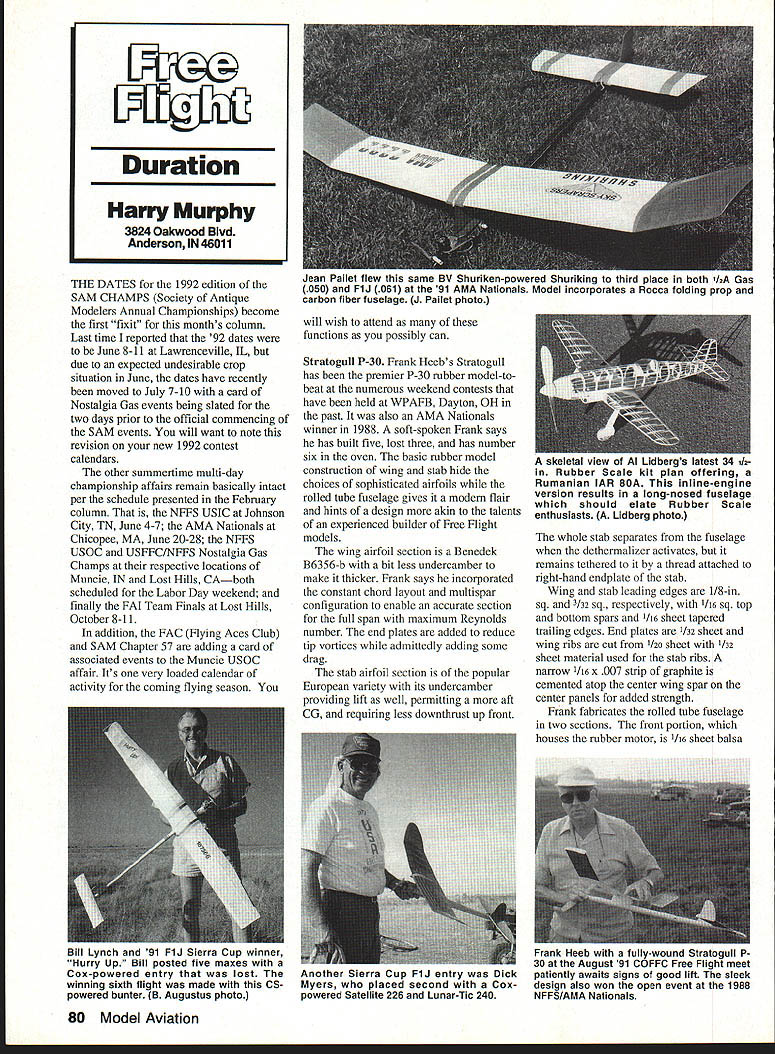
Jean Pailet's Shuriken-powered "Shuriking" won third place in both the Open 1/2A event and the F1J competition — strong performances among 84 Open 1/2A contestants and 26 F1J contestants.
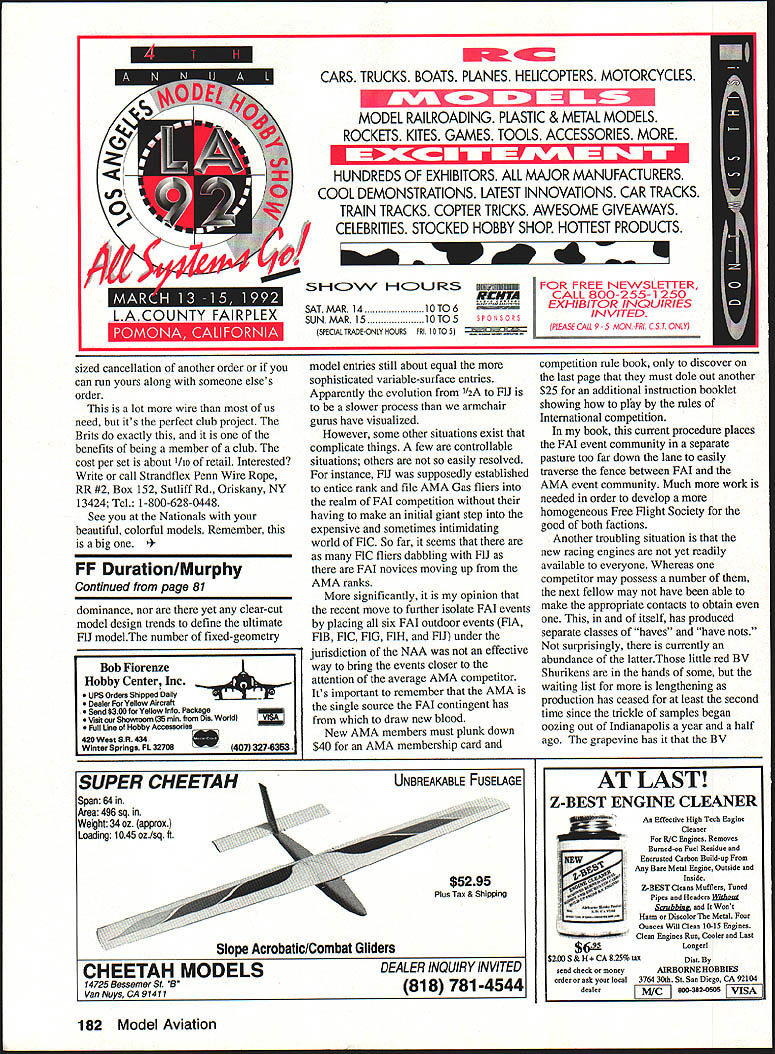
However, a report from Bruce Augustus on the FAI Sierra Cup (California) paints a different picture: in the Far West the Cox still held sway. At the Sierra Cup, which staged F1J for the fourth straight year, the event was won using an engine other than a Cox for the first time — but winner Bill Lynch used a Cox-powered model to max the first five rounds and only went to a CS bunter backup when the Cox entry was lost in the five-minute period. No Shuriken-powered model placed in the top ten. Dick Myers flew a stock Satellite 226 (Cox) in the sixth-round flyoff and lost to Lynch by 47 seconds.
Bruce opines that while many competitors are experimenting with the new 1 cc (.061 cu in) engines, no single engine has yet proven dominant, and there are no clear model-design trends defining the ultimate F1J model. Fixed-geometry entries still about equal the more sophisticated variable-surface entries. The evolution from 1/2A to F1J is slower than many expected.
Complicating factors:
- Participant mix: F1J was intended to entice AMA gas fliers into FAI competition without the leap to F1C, but many F1C fliers are dabbling in F1J as well, so the target audience is mixed.
- Administrative separation: the recent move to place all six FAI outdoor events under NAA jurisdiction has further isolated FAI from the AMA community. New AMA members pay $40 for membership and competition rule book, then discover they must pay an additional $25 for an instruction booklet for international competition — a procedure that places FAI events too far from the average AMA competitor. More work is needed to develop a more homogeneous Free Flight society for the good of both factions.
- Engine availability and class splits: new racing engines are not readily available to everyone. BV Shurikens are in the hands of some, but production has ceased at least twice and the BV partnership has reportedly dissolved, leaving supply uncertain. The Shuriken has become a rarity, and collector demand only tightens availability.
- CS engines: available through some domestic sources and direct from Shanghai, but out-of-the-box specimens sometimes fail to match a standard Cox, requiring expert work and additional expense to reach race quality. China has exported lighter crankcases for 1/2A and 1-cc engines, further complicating which version competitors should obtain.
A notable rule proposal: the U.S. Team Selection Committee approved a proposal to recommend a minimum weight of 300 grams (10.6 oz.) for F1J models; the proposal will be placed before CIAM in Paris this spring. If adopted, the rule would mean different things to different people. Bruce Augustus objects because the added weight would effectively eliminate the Cox engine from F1J competition and force many existing state-of-the-art 1/2A models out of contention, effectively creating a mini-F1C event requiring 1 cc engines and complex variable-surface aircraft. Others may welcome the clearer dividing line between AMA 1/2A Gas and F1J competition.
If the weight increase is adopted before 1 cc racing engines improve in quality and availability, it could create immediate supply and competitiveness problems. Availability will have to improve, since the Cox would no longer be up to the task for F1J; conversely, the Cox TD may get a reprieve and remain prominent in 1/2A Gas competition for a while longer.
A key question: where do the Cox people see themselves? There has been little performance improvement in over 30 years. Simple updates — a Schnuerle-ported cylinder and a piston-pin change to replace the staked design — could upgrade the TD into competitive range at relatively low cost. Will Cox respond, or must we continue to rely on overseas improvements?
In sum: 1/2A Gas and F1J are in a fluid state, with short-term solutions cloudy. Now is the time to work on a well-thought-out master plan to achieve desirable long-term effects for both events. Think about it, and get involved — we all have to live with the outcome.
Suppliers and plans
- If your favorite hobby shop cannot supply new engines or accessories, send an inquiry to Lee. For $1 you can receive his latest catalog and prices on numerous kits and accessories. Address: 401 Executive Center Drive, H-108, West Palm Beach, FL 33401.
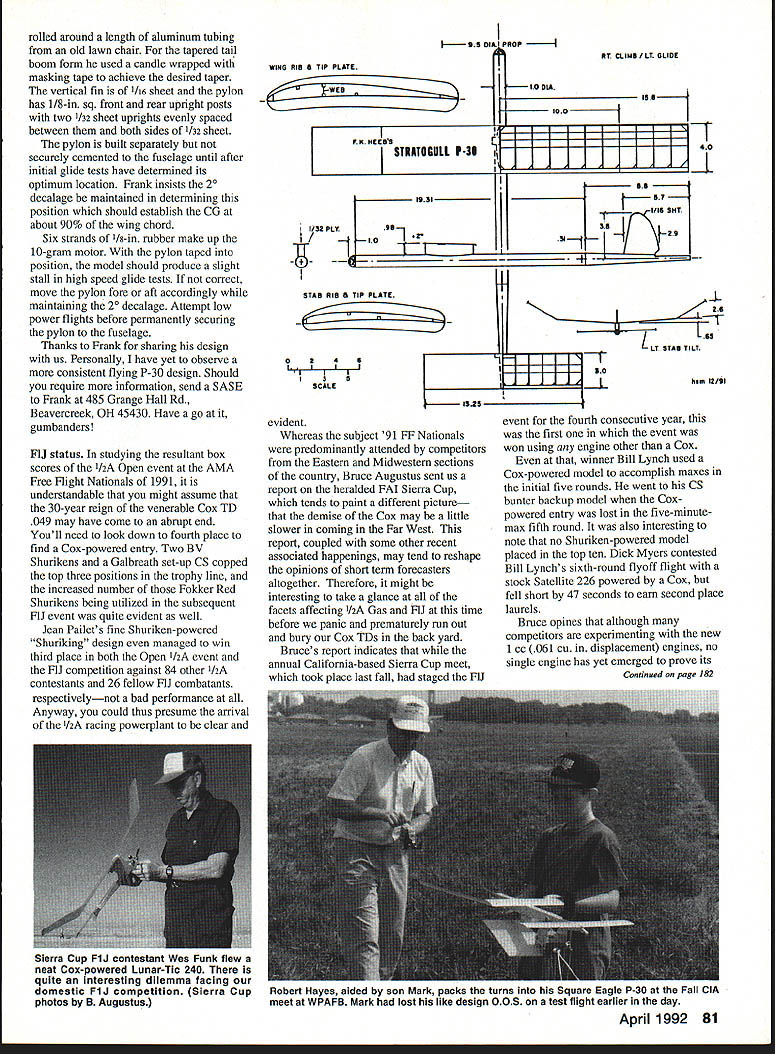
- Super draftsman Al Lidberg continues to release new rubber-scale plan kits. His latest is the little-known WWII Rumanian IAR 80A fighter, complete with super-detailed plans for a 3-1/2 in. model, colored insignia sheet, a six-page history, three-view drawings, and a knock-off wing option. The plan kit and Al's latest catalog are available for a flat $7.50 postpaid. Address: 614 E. Fordham, Tempe, AZ 85283.
Al supplies thorough histories of the full-scale subject with each project. Although the front-line IAR incorporated a radial engine, Al's longer-nosed version uses an inline V‑8 that is ideal for rubber flying scale purposes — a neat example of the less-famous variants that the scale buffs often prefer.
Order your packet today — you’ll get your money’s worth. Tell them DURATION sent you. See you downwind!
Transcribed from original scans by AI. Minor OCR errors may remain.

