
Free Flight: Duration
Jim Haught 3069 Sovereign Drive Cincinnati, OH 45251
PROJECT GRANDPA: Mentor
The January 1992 issue of Model Aviation featured the "PGM Trainer," an intermediate-level model in a building program designed by famous free flier Larry Conover. In the construction article, Larry provided an address for further details on the PGM program. I requested the latest information.
I received a manuscript for another model in the PGM series (a rubber-powered Fokker E‑II), a feature article on the program from a local newspaper, and a full program description from Education Research Group, of which Conover is a member.
The program has several goals. The primary idea is to bring retired adults together with young children so that the retirees can teach building and flying skills; this should stimulate student interest in math and science. Conover feels that the program will help create both a new grassroots modeling movement and a new talent base for scientists and aerospace engineers.
Conover writes that PGM is currently a pilot program, designed to be implemented through local senior citizen centers, TAG (Talented and Gifted) programs, churches, model clubs, and public service organizations. As the program matures, it could be introduced into science classes or provided as an alternate choice in manual training. Instruction can be a joint effort between teacher and layperson. Grandpa modelers have both time and expertise to contribute. The teacher can provide overview, counsel, and professional guidance through the course.
Conover views the program as an alternative to "the consequences of a long slide into an 'instant gratification' society. Kids today don't know how to apply themselves to a model. They are not prepared and haven't learned the work ethic."
The program has been successful for Larry on a local level, and he feels that the time is right for expansion. Curriculum plans, text, evaluations, and a full program guide are available from Conover Model Works, P.O. Drawer 1488, Silverthorne, CO 80489. Price is $2.00.
New Products
Poti's Hangar Products (5695 Marshall Rd., Dayton, OH 45429) announces a new Fibreglas 1/2A prop for CS engines and strong Tee Dees, proprietor Norm Poti describes it. The prop is an Ed Keck design, with a 5.6‑in. diameter and 2.7‑in. pitch. The prop costs $5, plus $3 for finishing.
I have not yet flown the samples I was sent, but have seen the prop flown by others with immediate, impressive results. This prop has tremendous pull and acceleration. When Dale Mateer used it on an old seven-ounce model, the plane gained so much momentum that, when the autorudder activated at the end of a five-second run, the model yawed so badly that it returned to the ground without quite pulling out before impact. The model flew much faster and gained more altitude than it ever had before, and this prop was the only difference.
Another consideration in purchasing PHP props is the reputation they have earned for quality in workmanship and performance. The samples I was sent are perfectly balanced and flawlessly finished, and I do not believe this is anything less than typical. I have seen a number of fliers use PHP props (available in 7‑in. through 10‑in. diameters) with superior results in all cases. A SASE to the above address will get you the full PHP products listing.
Rubber Powered Model Airplanes
As mentioned in the March 1992 "Duration," Don Ross's book is in its second printing. Don sent a copy for me to review, and I feel that it is a high-quality book, worthy of addition to any library. As the introduction states:
"This book is designed to take the new modeler through a series of practical, non-technical steps from a simple first model to a contest- or sport-level airplane capable of stable, sustained flight. A wealth of information, charts, photos and tips follows, with a progression from the Canarsie Canary, a simple, all-sheet model, through the AMA Racer and beyond to Scale and Duration models. A prop pitch table and a listing of sources for materials round out the volume."
Copies are $13.95 each, plus $1.05 postage, from Don Ross, 38 Churchill Rd., Cresskill, NJ 07626.
Half-A Backplate Mount
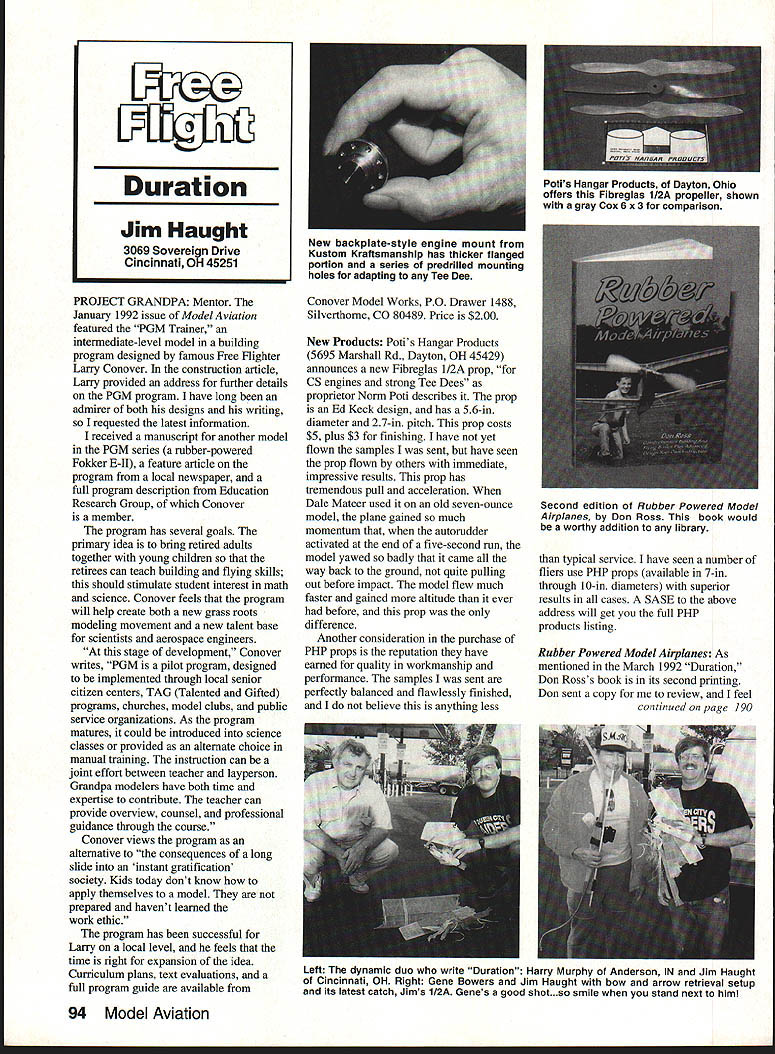
Joe Klause at Kustom Kraftsmanship has added an improved Tee Dee backplate mount to the KK product line. Improvements include a thicker flanged portion, which allows more positive mounting and thrust settings, and a series of predrilled mounting holes, which allow the mount to be adapted to virtually any Tee Dee.
Some previously marketed mounts of this type distorted undermounting bolt torque, thus negating thrust adjustments; others almost required a custom fit for each engine. Once the mount was drilled to fit an engine, no other engine would line up vertically when tightened. As Klause points out, "A different engine will not necessarily have the same radial orientation. This is because the threads on the mount and crankcase are generated at random. To correct for this, just remove the mount and rotate it to the holes that provide the desired orientation."
The new mount sells for $6.95 and is part #197. Send $1 to Box 3010, Fallbrook, CA 92028 for the latest KK catalog.
Gleason Enterprises
A recent search for Lucky Lindy MK II plans (the Nostalgia-legal version) led to a suggestion by Bob Beecroft that I contact Dick Gleason—"This guy seems to have everything," says Bob. He may be right!
In response to my inquiry I received a blue 11 x 17 plan as well as a full-size copy of the original plan. Also included were the fifth edition of The Gold Book of Model Plans, which covers all modeling categories; the sixth edition of a Scale model three-view plan source list; and Non-Scale Model Plan Sources, which lists where and when these designs were published and provides information on the designer, wingspan, power source, etc.
"I must point out," says Dick, "The Non-Scale list is not a plan catalog as some have interpreted it in the past. It is merely a list of where and when plans were published. Some I do have plans for, and have so indicated. Refer to the plan catalog for prices, etc., for those."
The plan catalog is currently being overhauled and revised to add even more plans. The Gold Book costs $2.75, the three-view catalog costs $1, and the Non-Scale list is $5. Contact Gleason Enterprises, 1106 10th Drive SE, Austin, MN 55912.
A supply of trading pins and decals remains from the 1991 World Champs FF team. These pins are being sold as a fund-raiser for the Junior FF Team. For a pin and two decals, send $5 to Walt Ghio, 1380 Elkhorn Dr., Stockton, CA 95209.
Speaking of the Junior team, the fund drive has barely crossed the halfway point as of late January 1992. Roughly $10,000 more must be raised in order for the U.S. to be able to send a full Junior team to Poland this summer. Donations are tax deductible and should be sent to the AMA Competition Department, 810 S. Van Buren St., Reston, VA 22090. Please indicate that the money is a donation to the Junior FF Team.
More Nostalgia Debate
In the January 1992 column I quoted a letter from Bob Larsh, one of the policymakers for the Nostalgia events, in which he indicated his dislike for the late-era British designs and their competitive advantage. I asked whether Bob's view—that these models should be banned—was that of the majority. The responses were lively.
Rudy Kluiber (Lakewood, Ohio) writes that "it is only natural that someone who is actively competing in any event will look to improve what he's using. I have built a half-dozen 1/2A Nostalgia models with that thought in mind, and I have had a great deal of fun doing it! I guess what I'm trying to get at is that while you may have a certain perception as to what is 'nostalgic' for you, it would be impossible to think the same perception could be applied to everyone else. It's different strokes for different folks."
Jim Moseley (Downsview, Ontario, Canada) gives a somewhat different perspective: "Bob may fail to see anything nostalgic about these ships, but as a Brit I certainly do! I've been flying them in England from the time they started to evolve. I have every respect for Bob... but I do think it a bit late in the day to start having second thoughts about types of models to be eligible. Different people, different airplanes, but the principle remains unaltered—fun to build and fly."
Frank Parmenter (Georgetown, Texas) offers a thoughtful commentary: "Only the armchair quarterbacks on the sidelines and not the actual fliers seem to be the nay-sayers of what we can or cannot legally do. In the '53 through '56 period of Nostalgia, great advances in design and model performance were achieved, partly due to interest in FAI participation and also engine performance improvement. U.S. fliers were no longer an island of model design and participation. Many of these models were pretty high-performance, and not to recognize this is sheer fallacy.
"You simply cannot completely turn back the clock. Improvements in model building material, techniques and building knowledge cannot be erased from the mind. In the process of building Nostalgia-era models today, we end up with more durable and safer models. Using some of these techniques today in no way changes the original design concept. I think that is the basic idea of Nostalgia."
No matter which side of this issue you are on, I believe that the biggest problem is the "fun" vs. "win" issue. What was originally intended to be a casual affair has developed into an intense competition. As in any competition, there will be those who will bend or break any rule in order to win. I've seen Nostalgia models with large amounts of carbon-fiber bracing, radically modified conventional construction, and other "I-dare-you-to-complain-about-this-to-the-CD" setups.
It seems that it may take more work to have a "fun" event than a "win" event. The shame of it all is that the handful who need to be policed are threatening the vast majority who really do enjoy the spirit of the event. As Frank Parmenter concludes, "Pedantic decisions are out of place in making Nostalgia fun and enjoyable."
Perhaps Rudy Kluiber's perspective is even better: "By the way, I'm looking for engines for Harry Murphy's 'Early 1/2A' Nostalgia event. I hope to have a reworked Wasp turning a specially re-modeled Kaysun plastic prop at 25K in a little-known Yugoslavian design of 1952 that looks just like current FAI models...hey, just kidding!"
Out to Launch?
As F1C flying has developed, more attention is being given to the ever-more-critical launch of these long-winged creatures. In the last World Champs, bad launches were a factor even in the final flyoff.
I asked a number of the top F1C fliers about the problem, and the consensus seems to be that the models operate somewhat backwards from conventional pylon models: they must not be launched to the right of the wind, as most AMA models are. They must go either straight into the wind, or, if an error is made, the launch should go slightly left.
One of the better fliers in my region had a problem with launch inconsistency, and my solution may be of interest. Like many good ideas, it is so simple that it should have been obvious, but I hadn't heard of its use before.
I set up a video camera on a tripod and shot several launches from various angles. Using a series of six or seven launches, the problem (a tendency to hook the model left at launch) became more noticeable, particularly to the flier, who hadn't seen the error from a detached perspective before.
Using freeze-frame on the VCR, we were able to stop the motion at various points and isolate the cause of the hook. Previously, all we had were naked-eye observations, which depended on memory and perspective; the tape gave us an unbiased, easily repeatable look.
Since so many of us have access to VCRs and video cameras, it makes sense to use these tools for a quick study of your launches. Further, since some fliers are equipped with VCRs at the field, it is possible to review tape almost immediately.
Retriever (Tree Recovery)
At the other end of the flight is the retriever. Not so long ago, a freak wind shift carried my 1/2A off our flying field into the last available branch of a tall tree. Of course, the branch was too high and too small to climb, and all sorts of retrieval methods failed, including the "wait-a-few-days-and-it'll-blow-down" trick. What to do? Gene Bowers of the Central Ohio FF Club had a rather unusual answer: he once encountered a similar situation and came prepared the next time with a modified bow-and-arrow setup that allows him to shoot his model out of a tree. His bow is equipped with a reel-in device for a line attached to an arrow.
After my model had spent two weeks in a tree, I was only interested in its engine and timer. I gave Gene the go-ahead, and he did his best Robin Hood impression; in a matter of minutes we had a sackful of pieces and hardware where all else had failed.
In easier situations, the arrow could have been shot over the offending branch, and the model shaken loose; however, my model was very firmly wedged in, making no other choice possible. It's tough to lose a model this way, but good engines and timers are even tougher to come by. Thanks, Gene!
Beginner Participation (omitted from March issue)
Doug Galbreath brings up another angle to the oft-discussed issue of beginner participation in our hobby. In a recent letter he mentioned the need for free fliers to be aware of beginning fliers of any age, and he listed steps that may help keep new blood.
"The time may have come for changing the way we classify fliers. As it is now, a new flier, who may be 40 years old when he is a beginner, has to fly against me, Randy Archer, Roger Simpson, and the like in northern California. He figures it's too hard if he doesn't have a chance to win, says 'the heck with it,' and goes back to RC cars or collecting stamps.
"I wouldn't mind seeing a Masters class as well as Expert and Junior. In competition, Juniors and Experts could elect to compete in Masters if they wanted. Masters would not be able to go down in rank unless they had not competed for two years; then they could fly Expert until they won an event — then it's back to Masters again."
Doug sees the necessary recordkeeping as the biggest drawback to this system. Is this a better system than the current one? What can be done to retain as many newcomers as possible—regardless of age or experience level? I believe Doug's idea has merit and deserves serious thought. Feedback, anyone?
Robbery in Progress
Credit Cincinnati's Bill Jackson for honesty. During a recent test flying session I photographed him as he was testing his new Coupe. I asked Bill for details about the model and whether it was an original design. "There aren't any really original designs anymore," he told me. "I stole features from so many other models that I named this one '10‑76.'"
Why 10‑76? That's Cincinnati Police radio code for robbery in progress.
New Wave Nordic?
Longtime glider fliers will recall Don Chancey as the designer of the Poacher, Pantera, Hyperion, and other designs. A versatile all‑around modeler, his first love was Nordic. During the 1970s he was a team member and top competitor. In recent years he has shifted his focus to RC soaring, but he still keeps up with the FF bunch.
I have tried to talk him into a comeback, and the following shows he's at least considering it:
"I was talking at break about Nordic, and you have the same problems that we do: make them strong enough to launch! Why not try a three-piece wing that bolts onto the fuselage? The advantages are: (1) you eliminate the weight of the wing joiner and can add that weight to the wing, and (2) there is no joint at the center of the wing to beef up.
"This is a very common practice now in soaring. The configuration would be a three-piece wing with removable tips which are joined with the appropriate size carbon-fiber rods. Picture this: a molded fuselage pod which mates with a carbon-fiber tail boom and a removable nose cone that would completely enclose the timer and controls! The timer would be mounted on a plywood keel in standard position. To set up for each flight you would simply slide off the nose cone, set the DT and the other goodies, then slide the cone back in place. With the wing off you would have complete access to the tow-hook, etc.
"This could be a very interesting project and one that would give you something a bit different from what everyone else has. The bottom line is that I know it will work. Three of the last four World Championship Sailplanes have had bolt-on wings."
Those who remember Don from his Nordic days remember his innovative tendencies, creative mind, and immaculate airplanes. With the techniques he's learned in mold making and materials from RC soaring, his ideas could usher in a new era in Nordic. Stay tuned.
Transcribed from original scans by AI. Minor OCR errors may remain.

