
Duration
Bob Meuser
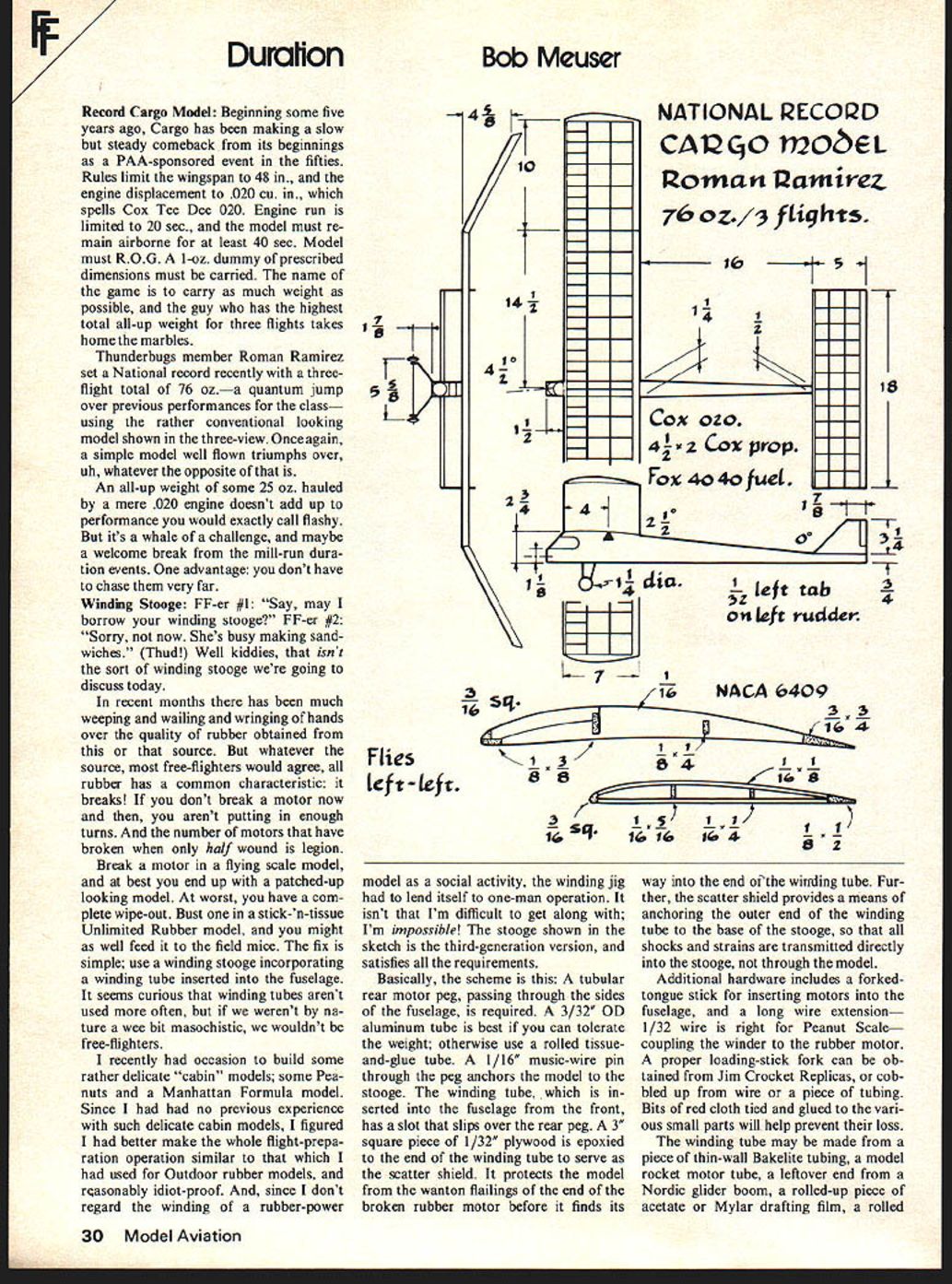
Record Cargo Model: Beginning some five years ago, Cargo has been making a slow but steady comeback from its beginnings as a PAA-sponsored event in the fifties. Rules limit the wingspan to 48 in., and the engine displacement to .020 cu. in., which spells Cox Tee Dee 020. Engine run is limited to 20 sec., and the model must remain airborne for at least 40 sec. Model must R.O.G. A 1-oz. dummy of prescribed dimensions must be carried. The name of the game is to carry as much weight as possible, and the guy who has the highest total all-up weight for three flights takes home the marbles.
Thunderbugs member Roman Ramirez set a National record recently with a three-flight total of 76 oz.—a quantum jump over previous performances for the class—using the rather conventional looking model shown in the three-view. Once again, a simple model well flown triumphs over, uh, whatever the opposite of that is.
An all-up weight of some 25 oz. hauled by a mere .020 engine doesn't add up to performance you would exactly call flashy. But it's a whale of a challenge, and maybe a welcome break from the mill-run duration events. One advantage: you don't have to chase them very far.
Winding Stooge: FF-er #1: "Say, may I borrow your winding stooge?" FF-er #2: "Sorry, not now. She's busy making sandwiches." (Thud!) Well kiddies, that isn't the sort of winding stooge we're going to discuss today.
In recent months there has been much weeping and wailing and wringing of hands over the quality of rubber obtained from this or that source. But whatever the source, most free-flighters would agree, all rubber has a common characteristic: it breaks! If you don't break a motor now and then, you aren't putting in enough turns. And the number of motors that have broken when only half wound is legion.
Break a motor in a flying scale model, and at best you end up with a patched-up looking model. At worst, you have a complete wipe-out. Bust one in a stick-'n-tissue Unlimited Rubber model, and you might as well feed it to the field mice. The fix is simple; use a winding stooge incorporating a winding tube inserted into the fuselage. It seems curious that winding tubes aren't used more often, but if we weren't by nature a wee bit masochistic, we wouldn't be free-flighters.
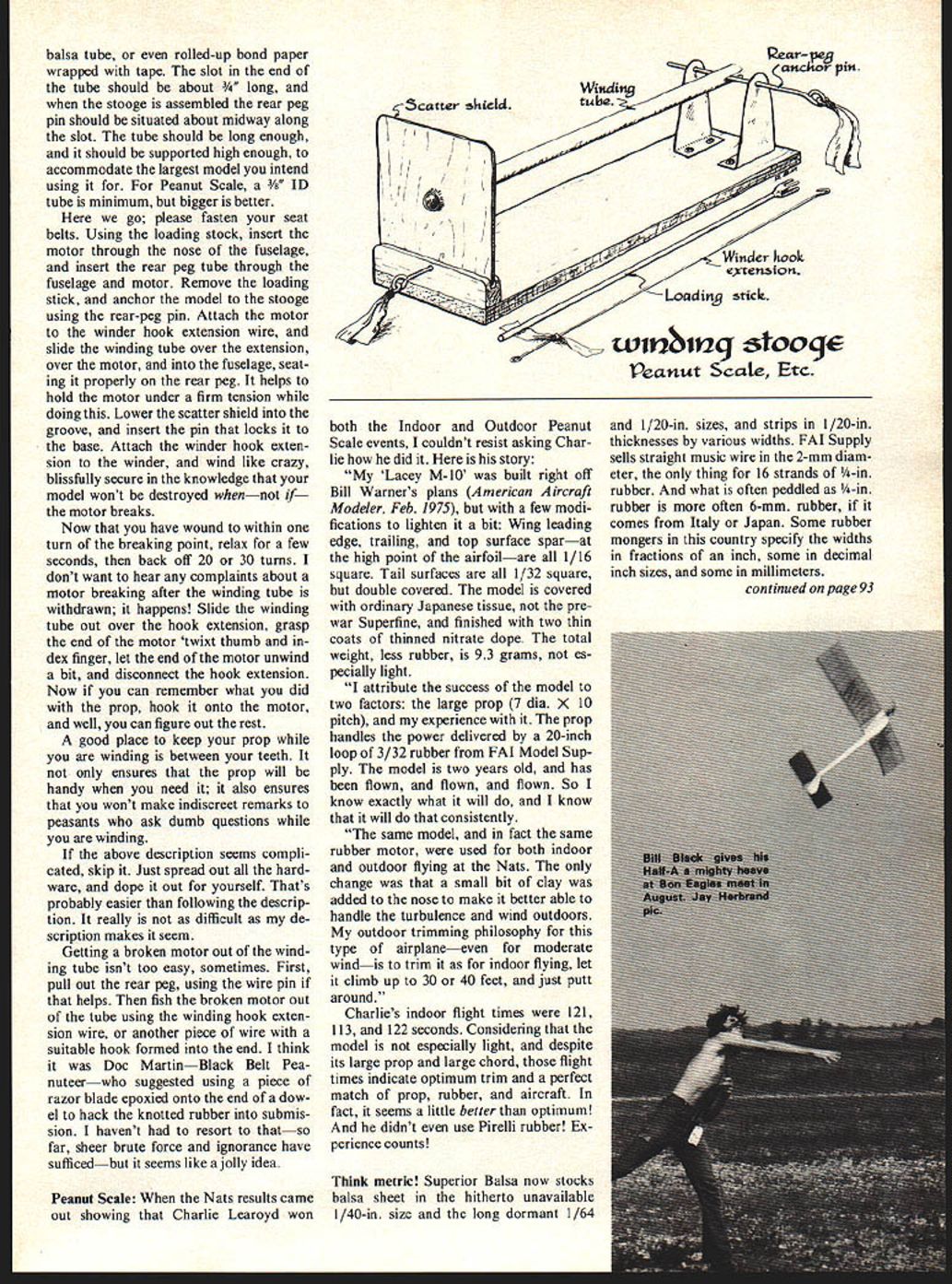
I recently had occasion to build some rather delicate "cabin" models; some Peanuts and a Manhattan Formula model. Since I had no previous experience with such delicate cabin models, I figured I had better make the whole flight-preparation operation similar to that which I had used for Outdoor rubber models, and reasonably idiot-proof. And, since I don't regard the winding of a rubber-power model as a social activity, the winding jig had to lend itself to one-man operation. It isn't that I'm difficult to get along with; I'm impossible! The stooge shown in the sketch is the third-generation version, and satisfies all the requirements.
Basically, the scheme is this: A tubular rear motor peg, passing through the sides of the fuselage, is required. A 3/32" OD aluminum tube is best if you can tolerate the weight; otherwise use a rolled tissue-and-glue tube. A 1/16" music-wire pin through the peg anchors the model to the stooge. The winding tube, which is inserted into the fuselage from the front, has a slot that slips over the rear peg. A 3/4" square piece of 1/32" plywood is epoxied to the end of the winding tube to serve as the scatter shield. It protects the model from the wanton flailings of the broken rubber motor before it finds its way into the end of the winding tube. Further, the scatter shield provides a means of anchoring the outer end of the winding tube to the base of the stooge, so that all shocks and strains are transmitted directly into the stooge, not through the model.
Additional hardware includes a forked-tongue stick for inserting motors into the fuselage, and a long wire extension—1/32" wire is right for Peanut Scale—coupling the winder to the rubber motor. A proper loading-stick fork can be obtained from Jim Crocket Replicas, or cobbled up from wire or a piece of tubing. Bits of red cloth tied and glued to the various small parts will help prevent their loss.
The winding tube may be made from a piece of thin-wall Bakelite tubing, a model rocket motor tube, a leftover end from a Nordic glider boom, a rolled-up piece of acetate or Mylar drafting film, a rolled-up bond-paper tube, or similar. The slot in the end of the tube should be about 3/4" long.
With the stooge assembled, the rear-peg pin should be situated about midway along the slot. The tube should be long enough and supported high enough to accommodate the largest model you intend using. For Peanut Scale a minimum tube diameter will do; but bigger is better. Now please fasten your seat belts.
Using the loading stick, insert the motor through the nose of the fuselage and insert the rear peg tube through the fuselage and motor. Remove the loading stick and anchor the model to the stooge using the rear-peg pin. Attach the motor-winder hook to the extension wire and slide the winding tube over the extension. over the motor, and into the fuselage, seating it properly on the rear peg. It helps to hold the motor under a firm tension while doing this. Lower the scatter shield into the groove, and insert the pin that locks it to the base. Attach the winder hook extension to the winder, and wind like crazy, blissfully secure in the knowledge that your model won't be destroyed when—not if—the motor breaks.
Now that you have wound to within one turn of the breaking point, relax for a few seconds, then back off 20 or 30 turns. I don't want to hear any complaints about a motor breaking after the winding tube is withdrawn; it happens! Slide the winding tube out over the hook extension, grasp the end of the motor 'twixt thumb and index finger, let the end of the motor unwind a bit, and disconnect the hook extension. Now if you can remember what you did with the prop, hook it onto the motor, and, well, you can figure out the rest.
A good place to keep your prop while you are winding is between your teeth. It not only ensures that the prop will be handy when you need it; it also ensures that you won't make indiscreet remarks to peasants who ask dumb questions while you are winding.
If the above description seems complicated, skip it. Just spread out all the hardware, and dope it out for yourself. That's probably easier than following the description. It really is not as difficult as my description makes it seem.
Getting a broken motor out of the winding tube isn't too easy, sometimes. First, pull out the rear peg, using the wire pin if that helps. Then fish the broken motor out of the tube using the winding hook extension wire, or another piece of wire with a suitable hook formed into the end. I think it was Doc Martin—Black Belt Peanutster—who suggested using a piece of razor blade epoxied onto the end of a dowel to hack the knotted rubber into submission. I haven't had to resort to that—so far, sheer brute force and ignorance have sufficed—but it seems like a jolly idea.
Peanut Scale
When the Nats results came out showing that Charlie Learoyd won both the Indoor and Outdoor Peanut Scale events, I couldn't resist asking Charlie how he did it. Here is his story:
"My 'Lacey M-10' was built right off Bill Warner's plans (American Aircraft Modeler, Feb. 1975), but with a few modifications to lighten it a bit: Wing leading edge, trailing, and top surface spar—at the high point of the airfoil—are all 1/16 square. Tail surfaces are all 1/32 square, but double covered. The model is covered with ordinary Japanese tissue, not the pre-waxed Superfine, and finished with two thin coats of thinned nitrate dope. The total weight, less rubber, is 9.3 grams, not especially light.
"I attribute the success of the model to two factors: the large prop (7 dia. X 10 pitch), and my experience with it. The prop handles the power delivered by a 20-inch loop of 3/32 rubber from FAI Model Supply. The model is two years old, and has been flown, and flown, and flown. So I know exactly what it will do, and I know that it will do that consistently.
"The same model, and in fact the same rubber motor, were used for both indoor and outdoor flying at the Nats. The only change was that a small bit of clay was added to the nose to make it better able to handle the turbulence and wind outdoors. My outdoor trimming philosophy for this type of airplane—even for moderate wind—is to trim it as for indoor flying, let it climb up to 30 or 40 feet, and just putt around."
Charlie's indoor flight times were 121, 113, and 122 seconds. Considering that the model is not especially light, and despite its large prop and large chord, those flight times indicate optimum trim and a perfect match of prop, rubber, and aircraft. In fact, it seems a little better than optimum! And he didn't even use Pirelli rubber! Experience counts!
Think metric!
Superior Balsa now stocks balsa sheet in the hitherto unavailable 1/40-in. size and the long dormant 1/64 and 1/20-in. sizes, and strips in 1/20-in. thicknesses by various widths. FAI Supply sells straight music wire in the 2-mm diameter, the only thing for 16 strands of 1/4-in. rubber. And what is often peddled as 1/4-in. rubber is more often 6-mm. rubber, if it comes from Italy or Japan. Some rubber mongers in this country specify the widths in fractions of an inch, some in decimal inch sizes, and some in millimeters.
FF Duration/Meuser
Solarbo, for some of its foreign customers, is required to cut balsa in metric thicknesses. But the widths and lengths remain 3 x 36 inches! As long as we let other countries win free flight world championships, we'll continue to see metric balsa dimensions called out on drawings of the winning models. And eventually we'll switch to metric ourselves, they say, but don't hold your breath.
While shopping at the local hardware store, a guy asked the clerk for "a six-inch metric ruler." The clerk knew exactly what he meant, sold him one, and the guy walked off happy as a clam, leaving me standing there laughing my silly head off.
We're converting to metric slowly, you may have noticed. But whenever a metric size replaces something that used to be judged up in quarts, they always seem to go to the next smaller metric size. The price remains the same.
Supplies Source: We finally got the scoop regarding the HLG kits formerly produced by American Balsa Corp., and M & P Enterprises before that. The models are currently produced by Aero Model Enterprises, 2215 S. Air Depot Blvd., Midwest City, OK 73110, operated by Gail and Matt Gewain. Current production includes Mathis's Flash, the scaled-down Mini-Flash, Lee Hines's Sweepette 19, Bill Blanchard's Poly, Don Chancey's Bo-Weevil, and Tom Peadon’s U.S. Kid. All have impressive track records. So far, over 1500 kits have been shipped. If your dealer doesn't have them in stock, tell him he is a fink, and order direct from A.M.E.
A.M.E. hopes to introduce dethermalizer versions of the Poly and the Sweepette early this year. Prices on the standard lines have not increased, despite increasing costs, and they hope to keep it that way. (Lots of luck!) Other items of interest marketed by A.M.E. include 2-oz. fuel syringes for $1.98, 1-oz. reusable mixing cups at 25 for 99¢, and low stretch, lightweight, strong towline at $3.50 for 165 feet.
Platitude of the Month: "An aspect ratio of 10:1 or even 12:1 should be used if possible." We hope you Nordic fliers take notice of this. "Nevertheless, some models with a very low aspect ratio make good fliers, owing to their extreme lightness." I'm sure that you indoor modelers will be glad to hear that. From V. E. Johnson, 1910.
Bob Meuser, 4200 Gregory St., Oakland, CA 94619.
Transcribed from original scans by AI. Minor OCR errors may remain.

