
Free Flight: Duration
Harry Murphy 3824 Oakwood Blvd. Anderson, IN 46011
SPECIAL EVENTS RULE BOOK
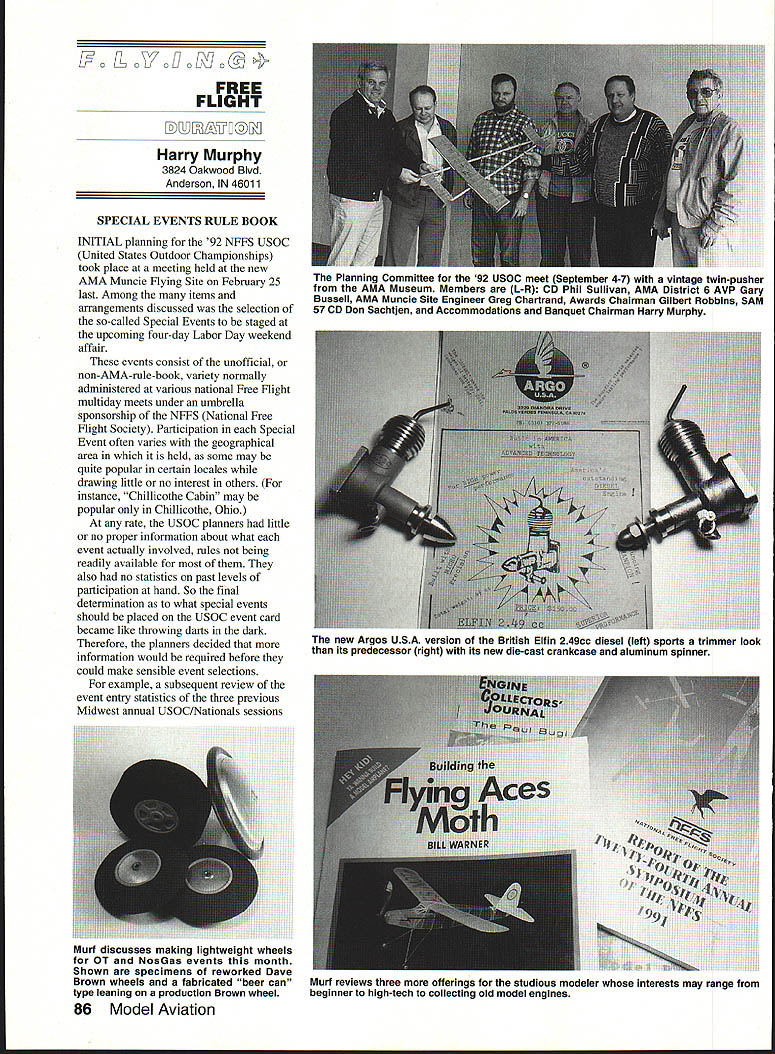
Initial planning for the '92 NFFS USOC (United States Outdoor Championships) took place at a meeting held at the new AMA Muncie flying site on February 25. Among the items discussed were arrangements and the selection of the so-called Special Events to be staged at the upcoming four-day Labor Day weekend affair. These events consist of unofficial, non-AMA-rule-book varieties normally administered at various national free flight multiday meets under the umbrella sponsorship of the NFFS (National Free Flight Society).
Participation in a Special Event often varies with the geographical area in which it is held; some events are quite popular in certain locales while drawing little or no interest in others. For instance, the "Chillicothe Cabin" event may be popular only in Chillicothe, Ohio. USOC planners, however, found they had little or no proper information about what many events actually involved—the rules were not readily available and there were no statistics on past participation. Final determination of what special events should be placed on the USOC event card thus became like throwing darts in the dark.
Planners decided more information would be required before sensible event selections could be made. For example, a review of entry statistics for the three previous Midwest USOC/Nationals sessions showed the Embryo Rubber event logged a respectable 30 entrants at the '89 USOC meet, yet that event was not staged by the NFFS in '90 and '91. A different special event substituted in its place drew only five and six entries respectively. That substitution appears to have been premature.
The upshot of the planning meeting was an obvious need for a single, compact booklet containing bona fide rules for the more popular Special Events, to be made available to contestants, contest directors, and planners alike. Such a booklet would make the often-hard-to-locate rules instantly available on long winter weekends when something offbeat to build might tickle one's interest. Its existence could raise interest levels in some events and allow less popular concepts to fade away.
Moe Whittemore, editor of the C/L Informer, has volunteered to collect rules for such events and take the necessary steps to include them in a single pamphlet. The pamphlet will be made readily available for a reasonable fee from NFFS sources. Moe needs to obtain information on every event that exists—he cannot include what he does not know about. This is the responsibility of anyone with a soft spot for a pet "Mickey Mouse" event: take a moment to send him bona fide copies of your Special Event rules. Duplicates will occur, but they will help indicate apparent popularity. (No—Chillicothe Cabin will probably not make the initial printing.)
Send rules for all such events except those under the auspices of SAM (Society of Antique Modelers), since most of SAM's special events are well documented within SAM's structure.
Send all rules to: NFFS Special Events Rules c/o Moe Whittemore 2348 South 700 West New Palestine, IN 46163
Do it today and the pamphlet will materialize before we know it! Support progress and your NFFS!
ELFIN 2.49 DIESEL
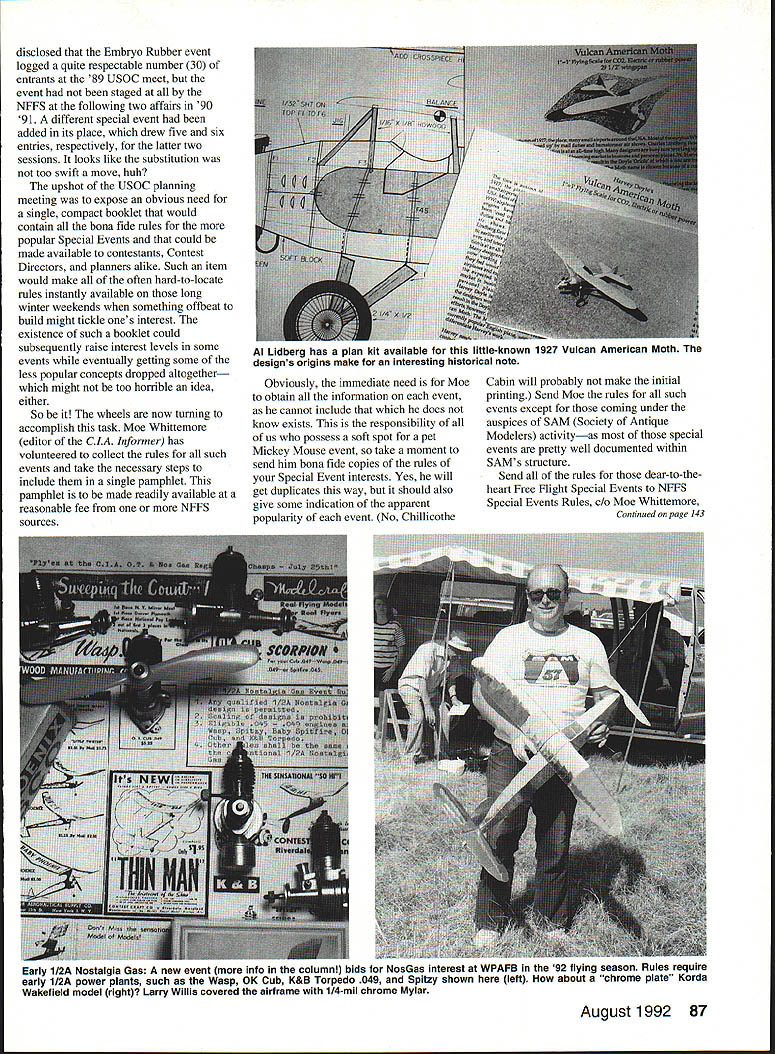
A new American-made version of the fine vintage Elfin 2.49 cc diesel (formerly made in England) is now in production and available from Argos U.S.A. for $150 plus $7.50 shipping and handling. Address: 3229 Dianora Drive, Palos Verdes Peninsula, CA 90274.
These engines appear to be excellent quality, with injection-molded die-cast crankcases replacing the older sand-cast housings. They tip the scales at about 4½ oz.—over half an ounce lighter than the former sand-cast versions. A solid aluminum spinner and an O.S.-type needle valve assembly add to the overall quality, appearance, and utility.
Approved for use in SAM events, these new versions are setting the pace in Class A events because of their power, dependability, simplicity of operation, and the ease they offer in keeping small models down to flying-weight minimums—no batteries, coil, wiring, etc., are required.
Anyone who thinks American industry standards are below world standards has not seen this work of American manufacturing art. They are beautiful specimens. John Targos is to be commended for taking the gamble in producing this tiny power plant.
Diesels were never very popular in the U.S. in years past, although they were the mainstay of model powerplants in European competitions before and after World War II. Leon Shulman's postwar Drome probably saw the greatest domestic following to date. The recent PAW effort is of note, but the Elfin 2.49 looks likely to increase interest in compression-ignition engines within SAM activity. Good show, John!
LIGHTWEIGHT WHEELS
"What this country needs is a good, lightweight wheel for vintage free flight utility." I have mentioned this before, and the need still exists. Suppliers of RC accessories produce wheels in myriad designs, most of which are too heavy or incorporate wide treads and spoked hubs that don't add any romance to the appearance of an otherwise-gorgeous vintage free flight model.
Suppliers like K&B once produced the epitome of class in their streamlined, smoothly contoured aluminum-hub, medium-hard-rubber-treaded competition wheels, but those have long been out of the marketplace.
Original kits of vintage designs often included "rims" to fabricate super-lightweight all-balsa wheels (such as those in the famous Comet kits). Megow and others supplied somewhat heavier streamlined sponge-rubber wheels with relatively wide hardwood hubs. These looked nice on early cabin designs but soon lost favor as the pylon Duration model demanded lighter weight, more streamlined appearance, and reduced drag.
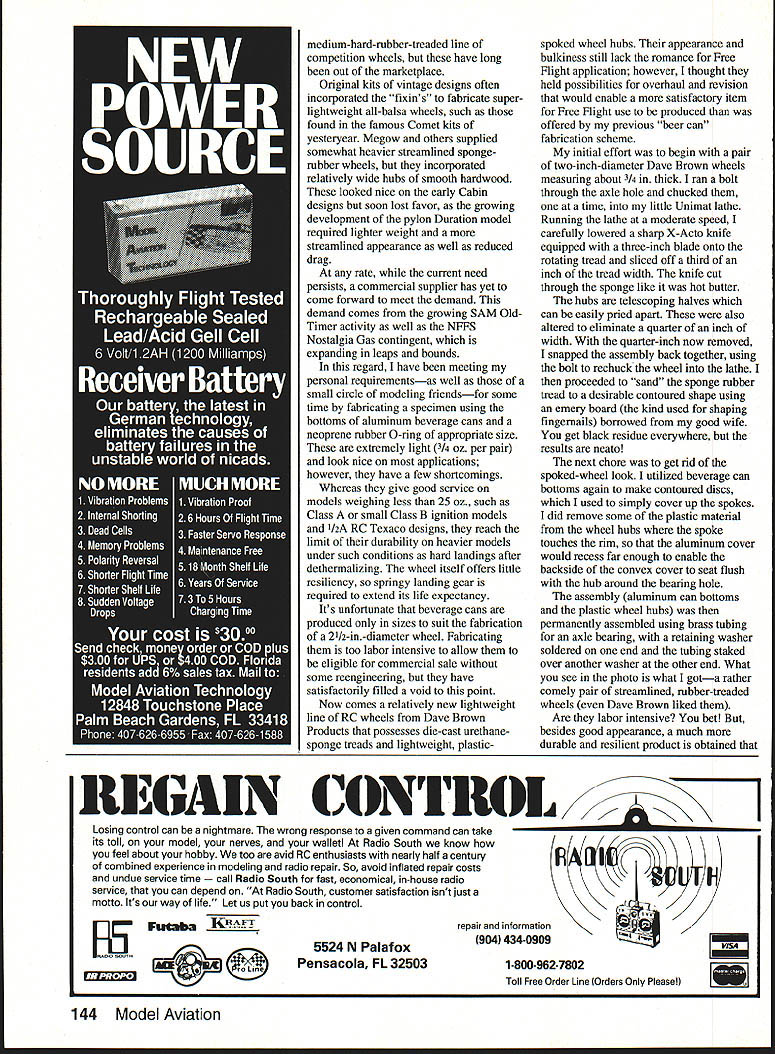
Despite the growing SAM Old-Timer activity and the expanding NFFS Nostalgia Gas contingent, a suitable commercial lightweight wheel for vintage free flight has yet to appear. To meet my own needs and those of a small circle of modeling friends, I have fabricated wheels from the bottoms of aluminum beverage cans with a neoprene rubber O-ring of appropriate size. These are extremely light (≈4 oz. per pair) and look nice on many applications, but they have shortcomings.
They work well on models weighing less than 25 oz.—Class A or small Class B ignition models and 1/2A RC Texaco designs—but reach durability limits on heavier models or after hard landings following detonations. The wheel itself offers little resiliency, so springy landing gear is required to extend life expectancy. Beverage cans are only made in sizes suitable for a 2½-inch-diameter wheel, and fabrication is labor intensive, so commercial sale would require reengineering.
A relatively new lightweight line of RC wheels from Dave Brown Products, with die-cast urethane-sponge treads and lightweight plastic-spoked hubs, held possibilities for modification. Their appearance and bulkiness still lack the romance for Free Flight, but they can be overhauled.
My modification process:
- Start with a pair of two-inch-diameter Dave Brown wheels about 3/4 in. thick.
- Run a bolt through the axle hole and chuck each wheel in a Unimat lathe.
- Using a sharp X-Acto knife with a three-inch blade, carefully slice off about 1/3 in. of tread width.
- Pry apart the telescoping hub halves and remove about 1/4 in. in width from the hub.
- Reassemble and rechuck the wheel in the lathe, then contour the sponge rubber tread using an emery board (fingernail file). Expect black residue everywhere, but the results are dramatic.
- To eliminate the spoked look, form contoured discs from beverage-can bottoms and glue them over the spokes. Remove some plastic from the hub rim where spokes meet so the aluminum cover seats flush.
- Assemble permanently using brass tubing for the axle bearing, with a retaining washer soldered on one end and the tubing staked over another washer at the other end.
The result is a comely pair of streamlined, rubber-treaded wheels (even Dave Brown liked them). They are labor intensive, but you get good appearance plus a more durable, resilient product that makes the effort worthwhile.
NEW PUBLICATIONS DEPARTMENT
NFFS material:
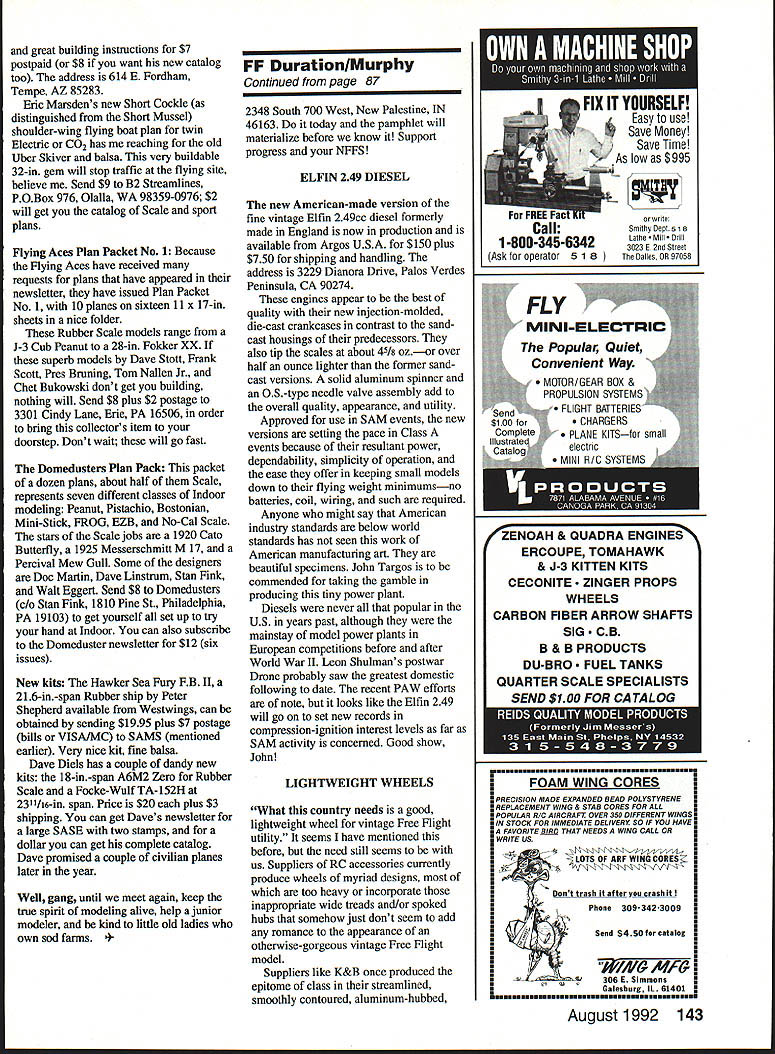
- The 1991 Annual Symposium of the NFFS (National Free Flight Society) is now available. This year's report was delayed six months while a volunteer editor was found, but new editor Les Garber has produced a fine addition to the ongoing series—the 24th consecutive volume.
- Contents include three-view drawings and articles on the NFFS Ten Models of the Year, write-ups on five new NFFS Hall of Fame inductees, and numerous technical articles of interest to glider-, rubber-, and gas-powered free flight competition modelers.
- Price: $16 for NFFS members ($18 for nonmembers), plus $2.50 mailing. Order from NFFS Publications, c/o Fred Terzian, 4858 Moorpark Avenue, San Jose, CA 95129.
Fred Terzian is custodian of past issues of the NFFS Symposia (those still available) and offers associated classic free flight publications, including:
- Don Ross's Rubber Powered Model Airplanes
- Jerry Nolin and Ed Knight's Winning Indoor Designs (now back in stock)
- Fred Pearce's '79 World Champs Technical Report
- NFFS T-shirts and lapel pins
Send for your '91 Sympo or send an SASE for a list of available NFFS printed matter. Adult NFFS membership is $15 per year; age 18 and under is $7.50. Send membership dues to NFFS, 12324 Percival Street, Chester, VA 23831.
Other publications and plans:
- Bill Warner's new 100-page book on how to build a Flying Aces Moth is an excellent self-teach publication. It includes getting-started advice, extensive planing diagrams, instructions from building to finish, and a chapter on initial flight care. Bonus: a chapter on building a Lacey M-10 from a Peck-Polymers kit for Peanut Scale flying and a helpful glossary of free flight terms. Price: $9.95 at bookstores; for information write TAB Books, Blue Ridge Summit, PA 17294-8050, Attn.: Kimberly Martin.
- Al Lidberg's latest flying scale design is a 1927 Vulcan American Moth—a 29½-in. parasol-mounted-wing monoplane for CO2, electric, or rubber power. Al covers the aircraft's history; only seven were built and one remains. Al's plan offering sells for $7 postpaid; his latest catalog is $8. Order from A.A. Lidberg, Model Plan Service, 614 East Fordham, Tempe, AZ 85283.
- Tim Daniels's Engine Collector's Journal (ECJ) has been published for about 30 years and is a crown jewel for history and background on model engines. The ECJ is a valuable reference for authenticating engines and dating them for SAM Antique and Old-Timer classifications and NFFS Nostalgia Gas use. Subscribe by sending $8.50 to the Model Museum, 1265 Yates Street, Denver, CO 80204-1027, for six issues ($9 Canada, $12 foreign). Issues are irregular but you will receive six issues. Tell Tim that Duration sent you.
EARLY 1/2A NOSGAS EVENT
Nostalgia Gas events, like other restricted events, eventually require rule tightening to plug loopholes and preserve the original concept. The 1/2A NosGas event has been a prime example. Controversies arose over how far contestants could "hot up" Holland Hornet or Cox reed-valve engines. Certain glow plugs were restricted, designers scaled models to the power advantages of these engines, prices of out-of-production Hornets escalated, and the Hornet has been retooled for production. Some have suggested adding the Cox Medallion series to the approved engine list. The quest for more power is a pressure cooker looking for a weak spot.
To restore the original Nostalgia Gas intent, the C.I.A. (Central Indiana Aeromodellers) has developed the Early 1/2A Nostalgia Gas event. The concept outlaws higher-performance Holland Hornets and later Cox engines and promotes the weaker 1/2A powerplants of the early era, such as the K&B .049 Torpedo, Wasp, Spitzy, and the OK .049. These early engines were paired with wing areas of about 200 sq. in. or less, and the event enforces a no-scaling restriction. Typical performance is about 16,000 rpm on a 5 x 3 prop for those engines. Many of the simple model designs of the era could be taken from kit boxes on Friday evening and be airborne by Sunday afternoon—back when instant-setting adhesives were not available.
If this summer's entry in Early 1/2A NosGas matches the interest shown during the past winter, the event should make a stellar initial showing. Anyone—or any group—wishing additional information may send an SASE for a rules copy and answers to questions about the event.
Meanwhile, clean up your crusty old OK .049 and start thumbing through those moldy magazines. Free flight fun may break out in a new place before you know it.
See you downwind!
Transcribed from original scans by AI. Minor OCR errors may remain.

