
Free Flight: Duration
Jim Haught, 3069 Sovereign Dr., Cincinnati, OH 45251
When in Doubt... bunt!
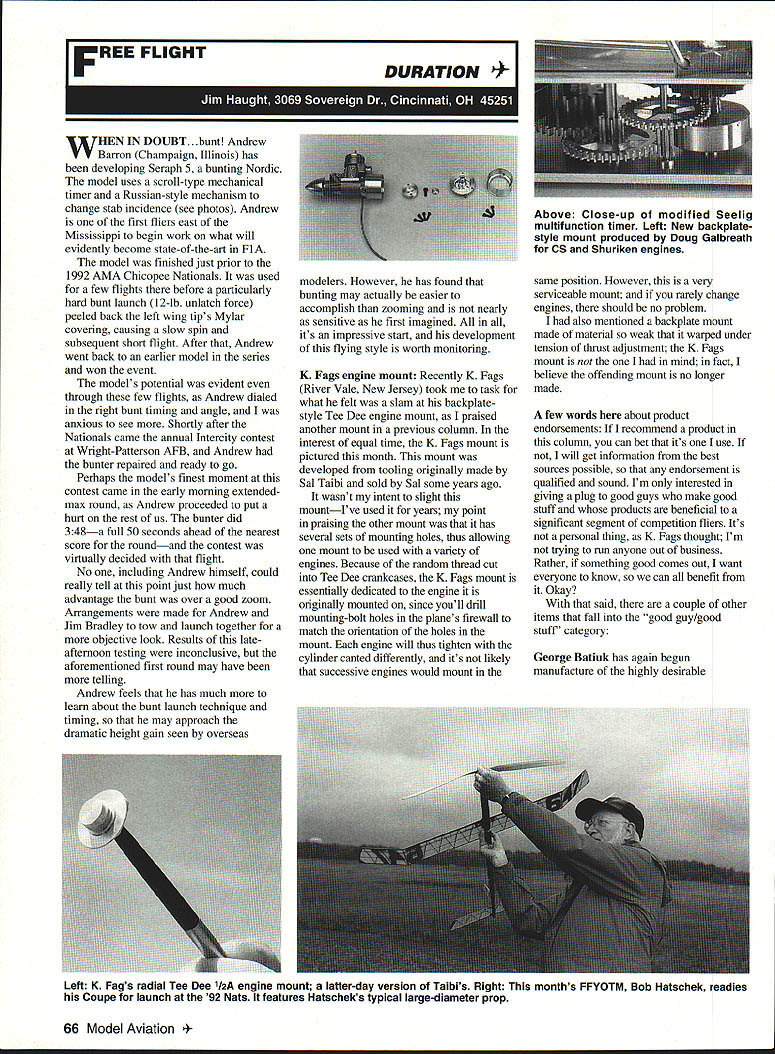
Andrew Barron (Champaign, Illinois) has been developing Seraph 5, a bunting Nordic. The model uses a scroll-type mechanical timer and a Russian-style mechanism to change stab incidence (see photos). Andrew is one of the first fliers east of the Mississippi to go with what will evidently become state-of-the-art in F1A.
The model was finished just prior to the 1992 AMA Chicopee Nationals. It was used for a few flights there before a particularly hard bunt launch (12-lb. launch force) peeled back the left wing tip's Mylar covering, causing a slow spin and a subsequent short flight. After that, Andrew went back to an earlier model in the series and won the event.
The model's potential was evident even through these few flights, as Andrew dialed in the right bunt timing and angle, and I was anxious to see more. Shortly after the Nationals came the annual Intercity contest at Wright-Patterson AFB, and Andrew had the bunter repaired and ready to go.
Perhaps the model's finest moment at this contest came in the early morning extended-max round, as Andrew proceeded to put a hurt on the rest of us. The bunter did 3:48—a full 50 seconds ahead of the nearest score for the round—and the contest was virtually decided with that flight.
No one, including Andrew himself, could really tell at this point just how much advantage the bunt was over a good zoom. Arrangements were made for Andrew and Jim Bradley to tow and launch together for a more objective look. Results of this late-afternoon testing were inconclusive, but the aforementioned first round may have been more telling.
Andrew feels that he has much more to learn about the bunt launch technique and timing so that he may approach the dramatic height gain seen by overseas modelers. However, he has found that bunting may actually be easier to accomplish than zooming and is not nearly as sensitive as he first imagined. All in all, it's an impressive start, and his development of this flying style is worth monitoring.
K. Fags engine mount
Recently K. Fags (River Vale, New Jersey) took me to task for what he felt was a slam at his backplate-style Tee Dee engine mount, as I praised another mount in a previous column. In the interest of equal time, the K. Fags mount is pictured this month. This mount was developed from tooling originally made by Sal Taibi and sold by Sal some years ago.
It wasn't my intent to slight this mount—I've used it for years. My point in praising the other mount was that it has several sets of mounting holes, thus allowing more than one to be used with a variety of engines. Because of the random thread cut into Tee Dee crankcases, the K. Fags mount is essentially dedicated to the engine it is originally mounted on, since you'll drill mounting-bolt holes in the plane's firewall to match the orientation of the holes in the mount. Each engine will thus tighten with the cylinder canted differently, and it's not likely that successive engines would mount in the same position. However, this is a very serviceable mount; if you rarely change engines, there should be no problem.
I had also mentioned a backplate mount made of material so weak that it warped under the tension of thrust adjustment; the K. Fags mount is not the one I had in mind. In fact, I believe the offending mount is no longer made.
Product endorsements
A few words here about product endorsements: if I recommend a product in this column, you can bet that it's one I use. If not, I will get information from the best sources possible, so that any endorsement is qualified and sound. I'm only interested in giving a plug to good guys who make good stuff and whose products are beneficial to a significant segment of competition fliers. It's not a personal thing, as K. Fags thought; I'm not trying to run anyone out of business. Rather, if something good comes out, I want everyone to know, so we can all benefit from it.
Free Flighter You Ought to Meet: Bob Hatschek
"I make enemies that way—even though that's not my intention. I get my rush by trying to do a better job of defeating Mother Nature and her law of gravity than you do. Competition turns me on. Competition is the distilled essence of sport."
If that gives you the idea that this is some hell-bent character who tramples everybody on his way to first place, consider his response when asked for his most memorable moments in free flight:
"There really are two," he said. "One was the Wakefield flyoffs in 1959: to be in the flyoffs, come in second, and have the team win. The other was at one of the Glenview AMA Nationals. My son and I were jogging along chasing a thermaling rubber model, with the sun shining through the tissue. There we were, the two of us, and I got such a thrill—it was my son's model."
"In my opinion," states Langenlus, "Bob Hatschek is the consummate modeler. Inquisitive, intelligent, articulate, and demanding, he demands the most from himself, but not selfishly; he loves this hobby!"
"I do feel passion about free flight model aviation, and it still stirs me after more than 50 years of competing at the sport," Hatschek says.
He's still motivated and opinionated—and quite a guy. If you see him on the flying field, stop and say hello; this is truly a Free Flighter You Ought to Meet.
If there are others you'd like to see profiled as FFYOTMs, drop me a line, and I'll get to work on it.
Transcribed from original scans by AI. Minor OCR errors may remain.

