
Free Flight: Duration
Harry Murphy, 3824 Oakwood Blvd., Anderson, IN 46011
USOC at Muncie and NFFS organizational changes
The conclusion of the NFFS-sponsored USOC (United States Outdoor Championships) occurred just as the deadline for this column approached. The event will be covered separately, but the first organized free flight activity at the new AMA Muncie site was a successful affair. The AMA was a gracious host, and the contest officials are to be commended for a well-run meet. Many events and disciplines were crammed into four days over the Labor Day weekend.
At the Friday night USOC banquet, Tony Italiano, then NFFS president, announced that voting for four newly created district director posts had been completed. Those assuming these posts in January 1993 will be:
- Jim Haught — Northeast
- Louis Joyner — Southeast
- Hector Diaz — West
- Jim O'Reilly — Central
Bob Waterman will replace Tony as president of the NFFS. Congratulations to all, and a "very well done" to Tony and his crew.
As the NFFS reorganizes toward a more representative structure for the 21st century, free fliers are urged to renew annual memberships. If you are not a member, join by sending $15 to: NFFS, 12324 Percival St., Chester, VA 23831 (Youth rate: $7.50 if you are 18 or under).
1992 NFFS Symposium — Power Models book
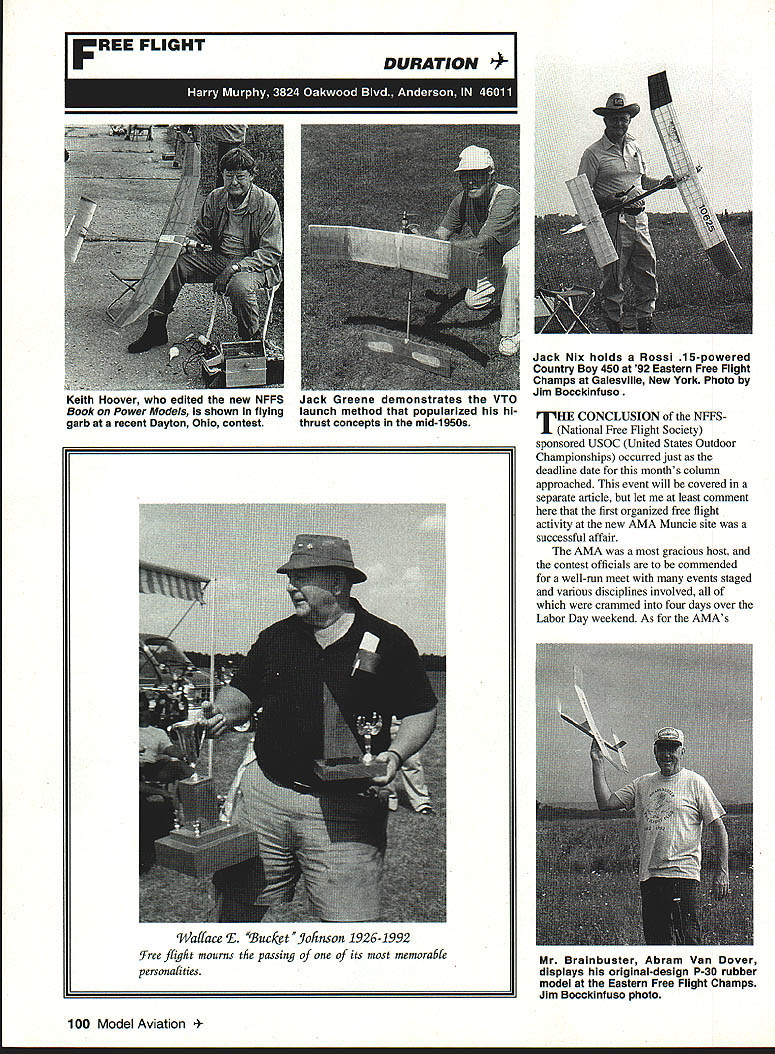
The 1992 NFFS Symposium book on Power Models (assembled in England that year) was not quite complete at the time, but first copies of Keith Hoover's 1992 NFFS book on Power Models were offered at the USOC banquet. The 128-page book covers state-of-the-art information for various classes of free flight power, from classics to modern FAI concepts. It includes three-views, theories, design practices, and articles by field experts.
Order information:
- Price: $19.95 plus postage
- From: NFFS Publications, 4858 Moorpark Ave., San Jose, CA 95129
Shuriken (Van Arsdall Enterprises) — engine report
A midsummer visit to the "Shuriken Works" in Indianapolis found activity in full swing: bench tests, stamping, and packaging for shipment.
Key points:
- The company reorganized since early June. The BV label has been revised to VE (Van Arsdall Enterprises, Inc.). The crankcase now bears a "VE" logo on the left side and is anodized gold instead of the original red.
- Bench tests used three copper head gaskets, a Tornado black plastic Magnum 5x3 prop, 35% nitro fuel, and lots of castor oil. Initial out-the-door speeds were about 26,000–27,000 rpm; with additional running time and gasket/fuel tuning, around 29,000 rpm might be expected on that prop.
- Models offered: three .049s and two .061s, all priced at $169 plus $5 shipping (add 5% sales tax in Indiana).
- Both side- and rear-exhaust .049 versions are available for free flight; the same choices are offered in .061 displacement.
- A rear-exhaust .049 for control-line speed and left-hand rotation crankshafts are available.
- All use a GloBee 5RX Glow Button.
- Options and accessories:
- Radial mount kit: additional $11
- Venturi orifices: .135, .150, .160, .180 (engines likely come with a .150 venturi, though the author could be in error)
- Unique spanner wrench and packaged earplugs included with each engine
- VE supplies information sheets and parts lists on request (send an SASE).
Shuriken engines topped both the AMA 1/2A Gas and F1J events at the '92 USOC. Address: Van Arsdall Enterprises, Inc., 1205 County Club Rd., Indianapolis, IN 46234
Shuriken note
A quality, made-in-the-USA product for AMA 1/2A Gas and F1J competitors. Tell them "Duration" sent you.
The Greene Hornet — who invented hi-thrust?
There have been many significant firsts in free flight gas: Maxwell Bassett's gas model entry in national competition (mid-1930s), the "pylon" Zipper era ('38–'39), the dethermalizer, early mechanical timers (from toaster mechanisms), pneumatic timers, the Tatone mechanical timer, and later the Seelig multifunction timer. The glow plug (introduced by Ray Arden circa 1948) and engine design advances such as Schnuerle porting also transformed the hobby.
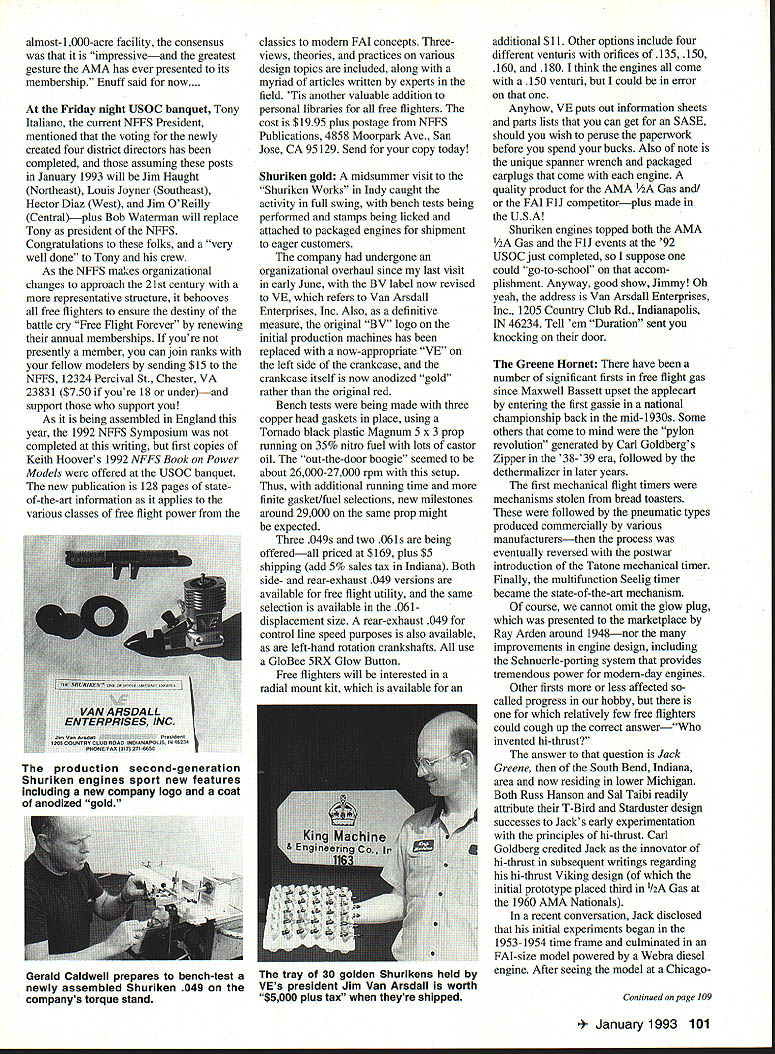
One lesser-known but important first is the invention of hi-thrust. Credit goes to Jack Greene of the South Bend, Indiana area (now residing in lower Michigan). Designers Russ Hanson and Sal Taibi attribute their T-Bird and Starduster successes to Jack's early hi-thrust experiments. Carl Goldberg also credited Jack as an innovator in hi-thrust in writings about his hi-thrust Viking design.
Jack's timeline:
- Initial experiments: about 1953–1954, culminating in an FAI-size model powered by a Webra diesel.
- Russ Hanson requested plans after seeing Jack's model at a Chicago-area FAI contest.
- The 1/2A size appeared around 1955–56, first powered by an Atwood .049 and then a Holland Hornet; it was essentially a scaled-down version of the original FAI model.
- Jack reportedly flew a hi-thrust model with a Civy Boy 61 wing and stab around 1957.
Jack Greene and his Greene Hornets deserve a hallowed place in free flight history. A three-view of the 1/2A version will be included when next we meet.
Review of some basics — ROG (rise-off-ground) for rubber models
No two flights are identical. Even the best-trimmed models can crash and erratic models can sometimes fly away. To achieve consistent, high performance, free flight modelers need experience and understanding of many small influences. Knowledge comes from trial and error, research, and learned peers. Occasional reviews of fundamentals help.
A recent personal example: after years flying gas models, I built a simple rubber-powered 10-cent Comet scale and struggled to get it to ROG from a ground launch. A timely newsletter article by rubber-power elder Ed Lidgard provided the needed basics. Key points from Ed:
- Release the prop a fraction of a second before releasing the model to avoid an upsetting torque burst on the flying surfaces.
- Eliminate unplanned warps. Planned washout at tips and panel wash-in are acceptable, but unwanted warps should be removed. If surfaces aren't correct, don't fly.
- Offset thrust is a low-speed adjustment; aerodynamic balance handles initial torque.
- Gain confidence in the physical launching movements through practice.
Ed's practical trimming sequence:
- Prepare a warp-free model. Measure intentional warps and eliminate unwanted ones. Know angular differences, offset thrust, and CG before flying so trimming isn't guesswork.
- Test-fly at maximum power to establish baseline trim.
- In calm conditions and tall grass, make a one-half-power ROG. If zoom occurs, retrim CG rearward or add downthrust as needed.
- Fly at this reduced power until trim is confirmed. Then try 3/4 power; continue trimming until the model handles wind and full power.
- If trim has been found correctly, full power should be manageable even in wind.
Ed also noted:
- Short motor runs can cause zoom problems because the torque curve transition is too abrupt.
- Models with "Dutch roll" problems (e.g., Midwest Jabberwock) are hard to ROG with conventional tactics. For very high-powered models, take off to the left of the wind, trim for a steep left bank, and let the initial torque set the model downwind so it climbs above ground turbulence before turning.
This is another example that little in free flight becomes obsolete. Document your knowledge — you may need it later.
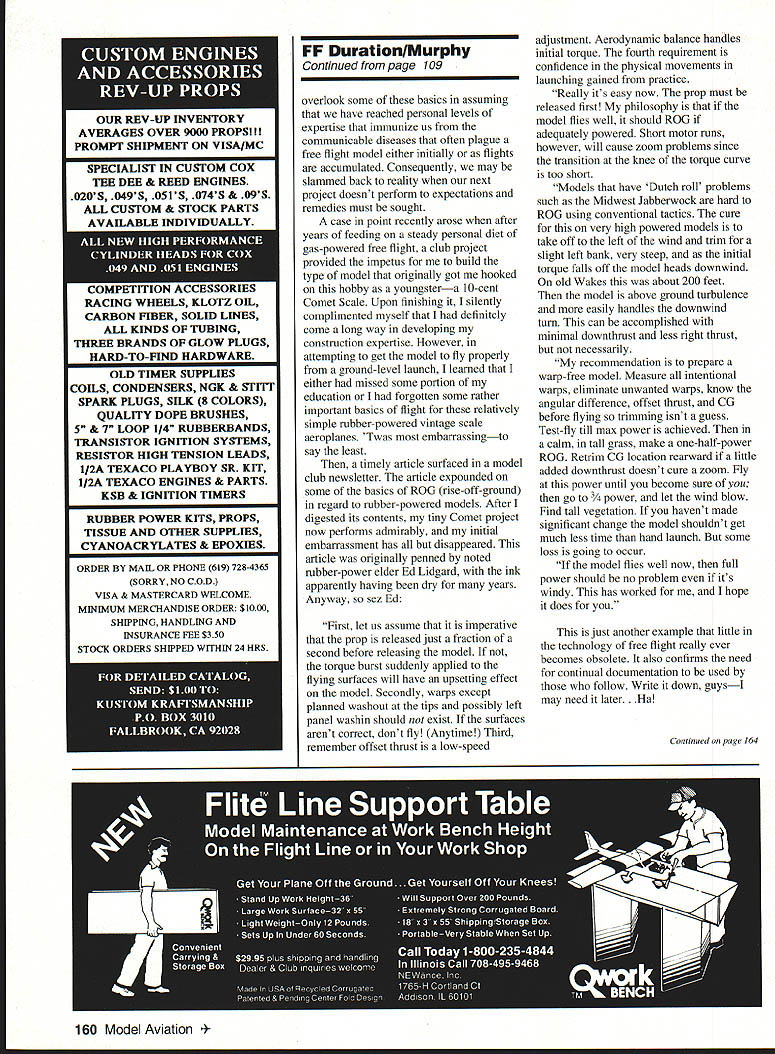
Good-bye, Bucket! — eulogy for Wallace E. "Bucket" Johnson
Longtime friends Louis Joyner and Jim Larkin (Birmingham, Alabama area) sent this eulogy to be included in the "Duration" column so all Bucket's many friends may pay their final respects.
"You could always find 'Bucket' Johnson at the contest field. It was easy. Just look for the big brown van, or the biggest chrome bike on the field (no dinky Trail 90 for Bucket). Or look for the most bubbles. When most people would set up a single bubble machine, Bucket would set up two or three and fill the air with soap bubbles. Or look for the fastest-climbing gas models on the field. Chances are, they were Bucket's.
"You could always tell Bucket's models. He was never one to copy the latest design trends. Years after elliptical tips were out, he kept building elliptical-tipped Centaurs, modifying and stretching the wing, changing the airfoil, improving, refining. For years, he decorated his models with a distinctive X stripe running from dihedral break to dihedral break. Sometimes stars were added to give it the look of the Confederate flag. But Bucket stressed that it was structural, not just decoration. Perhaps it was—I don't ever remember seeing one of his models flutter.
"Bucket could get more out of a gas model than just about anybody I know. And he was always ready to share that knowledge—even with a Wakefield flier. His suggestions were like the man—simple, direct: 'Needs a bigger rudder' or 'Add some downthrust.' I'll always remember those trimming sessions and try to ask myself, 'What would Bucket do?'"
Good-bye, Bucket. You will be missed.
Transcribed from original scans by AI. Minor OCR errors may remain.

