
FREE FLIGHT: DURATION
Jim Haught, 3069 Sovereign Dr., Cincinnati, OH 45251
Gaining popularity in free flight contests is the Hand‑Held Catapult Glider event. Although rules vary regionally, the basics are similar: a single loop of rubber—perhaps eight or nine inches maximum length—and unrestricted model design. Scoring is as in standard Hand‑Launched Glider (HLG): the best three of six flights count, with a two‑minute max.
Vic Nippert’s Zip‑A‑Do, Too
Vic Nippert’s Zip‑A‑Do, Too won this year’s Nationals and East Coast Free Flight Championships and has taken several Sky‑Scraper monthly contests. One unusual feature is the launch grip under the center‑of‑gravity rather than behind the stab. The catapult hook is built into the nose (a common, though not universal, position). Some designs use multiple hooks to tailor the launch/climb pattern.
Construction and finish:
- Wing: 3/16" quarter‑grain balsa, tapered to 1/16" at the tips.
- Finish: one coat of sanding sealer followed by two coats of Sig Lite‑Coat on the wing; stab and rudder one coat of Lite‑Coat; fuselage three coats.
- Center‑of‑gravity (CG): about 60% on the fuselage.
- All‑up weight: 18 grams.
Vic builds a couple at a time because of their thermaling ability.
Flap Dethermalizer (DT)
No DT is shown on the plans, and I assume Vic doesn’t use one. It seems a shame to lose good models, though, when a simple flap DT can prevent losses. It takes only five minutes to install and can save you from having to replace lost models.
To make the flap DT:
- Cut a strip of aluminum horizontally from a drink can, leaving its natural curl.
- Trim the strip to match the profile length of your fuselage nose (about two inches or so).
- Epoxy the back end of the strip to the fuselage, leaving room for the snuffer tube. Orient the strip so it curls out toward one wing tip.
- When the epoxy dries, rubberband the free end of the strip to the fuselage and DT fuse.
When the DT fuse burns through the rubberband, the flap will open because of the spring action of the curled strip, and the model will descend in a slow spiral. It’s wise to test the DT over tall grass or weeds in case the descent is steeper than expected; trim a bit off the flap and try again if necessary. Several Cleveland‑area modelers report definite success with this method.
Catapult — my experiments and conclusions
Over the past couple of years I’ve experimented with catapult gliders in various sizes—for competition and for models my seven‑year‑old son Robby could build. I tried very small models (to blast into orbit); ultraslick MonoKote‑covered models (for higher launch altitude); and very thin wings (again to maximize launch height). After enough losses and studying other successful designs, I’ve drawn a few conclusions:
- Thin wings just don’t get it. Catapult gliders need to “fly up” on the wing. Most successful models, like Vic’s, use 3/16" wings with the high point around the 30% chord range and a moderately light finish.
- Many successful designs have about a 16" wingspan, weigh about 18–20 grams, and have the CG near 65%. I built models of that size lighter than this and got much less height on launch.
- Very small models can really climb but are highly sensitive to launch technique and adjustments; they’re hard to fly consistently, especially for inexperienced juniors.
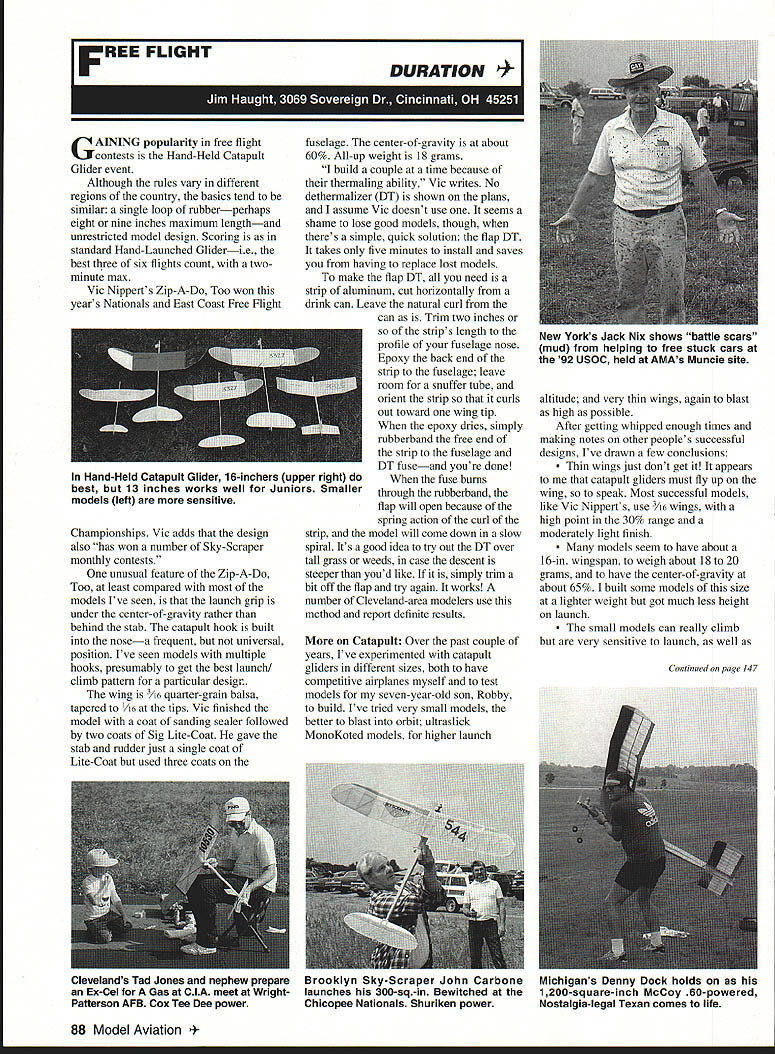
Hand‑Held Catapult Glider 16‑inchers work well; about 13‑inch span models are a good compromise for juniors.
Recommendations for juniors
For juniors, try a model about 80% of normal size. Build wings from 3/32" sheet—easier for a novice to shape than larger sizes. Such a model offers real performance and is less sensitive than 10–12" span “terrors.” Robby can handle this size with no problems; it performs a step above the Crusher beginner’s model (see my January 1992 column for the Crusher).
NOFFA scoring variation
The Northern Ohio Free Flight Association (NOFFA) offers a variation on the traditional best‑three‑of‑six scoring: incremental max times starting at 30 seconds. A flier qualifies for each higher max by making the previous time in a limited number of attempts (say, three per level). Fliers continue until they fail at a particular max time, the goal being to progress to the final 60‑second max, at which point flyoffs begin. Flyoffs can also be stair‑stepped in time.
NOFFA uses this system (also in standard HLG) to encourage consistency, reduce luck, and give more fliers a chance to win. It can also be chastening: Robby has soundly thrashed me two years running.
Catapult glider eliminates two variables that can influence HLG outcomes: physical ability and powerplant differences. In many areas the event is quite competitive—and not, as Tad Jones’ kids joked, “an event for old men with no arms.”
NFFS restructuring
Voting on four regional vice presidents for the National Free Flight Society (NFFS) has been completed:
- West Region VP: Hector Diez
- Central Region VP: Jim O’Reilly
- Southeast VP: Louis Joyner
- Northeast VP: Jim Haught
As of early October 1992, a new president to replace the outgoing Tony Italiano had not yet been elected. This is part of a major NFFS overhaul that includes bylaw revisions and management realignment. We have a capable VP team but need a stronger base of volunteers for key functions.
DURATION
Fuselage center‑of‑gravity about 60%. All‑up weight, 18 grams. Build a couple at a time because of thermaling ability, Vic writes. No DT shown on the plans; assume Vic doesn’t use one. A simple flap DT takes five minutes to install and saves having to replace lost models.
(Procedure for the flap DT is as described above: cut a curled strip from a drink can, trim to nose profile length, epoxy the back end to the fuselage leaving room for the snuffer tube, orient the curl toward a wing tip, and rubberband the free end to the fuselage. When the DT fuse burns through the band the flap springs open and the model spirals down. Test over tall grass and trim the flap if the descent is too steep. Cleveland‑area modelers report good results.)
Catapult (summary)
After experimenting with different sizes and finishes I concluded:
- Thin wings are a poor choice for catapult gliders; 3/16" wings with a 30% high point work well.
- Typical successful catapult gliders: ~16" wingspan, 18–20 grams, CG ~65%.
- Smaller models climb well but are very sensitive to launch and adjustments.
Hand‑Held Catapult Gliders in the 16" range are effective; 13" models suit juniors.
An .010 event
Responding to requests for plans for the little Grave Digger (Sept. 1992), Bob Stalick has built and lost Pee Wee‑B vintage models and proposed rules for an .010 event similar to Pee Wee 30. I think his rules are a bit harsh, so I propose:
- No model dimension larger than 25 in.
- Ten‑second engine run — no mechanical timers allowed. Overruns penalized five seconds of flight time for each second of engine run over 10.
- Two‑minute max (three minutes for flyoffs, with no overrun provision).
I intend to try this unofficially at a local contest next spring. Input welcomed: leave model size unrestricted or adopt a minimum‑weight rule? Any other factors to consider? Meanwhile, dig out that old .010 or buy a new one and build a fun airplane.
Nelson/Tee Dee glow head
Reports continue about the Kustom Kraftsmanship/Nelson glow head. Nat Comfort (Virginia) tried the head on three engines and found none would run right with more than one plug shim—similar to the stock head. KK’s instructions suggest one head shim for each 5% of nitro over 20%. My experience matches Nat’s and others’.
Observations:
- No appreciable increase in rpm was noted, but there was no rpm drop, and plug cost savings make the adapter attractive.
- The biggest improvement is in needle valve action: smoother and easier to get a steady setting. Doug Galbreath attributes this to the Nelson plug’s heat range being more congruent with Tee Dee pressures.
Nat also tested Poti’s Hangar Products’ 1/2A prop with the Nelson head:
- CS engine with an APC 6x2 achieved 29,500 rpm.
- With Poti’s prop he got 27,000 rpm, and the airplane went 100 feet higher with the Poti prop—so static rpm is not the whole story.
Static rpm figures have limited value. What matters is altitude gained. There’s a "saddle point" where rpm gains become less effective; this varies by engine and how prop changes affect model performance. Some props sound impressive on the ground but “fan” in the air; others show lower static rpm but unload better and produce better overall results. The only way to know if a prop/engine is right for your model is to fly it.
Transcribed from original scans by AI. Minor OCR errors may remain.

