
Free Flight: Duration
Harry Murphy, 3824 Oakwood Blvd., Anderson, IN 46011
FAI TEAM FINALS
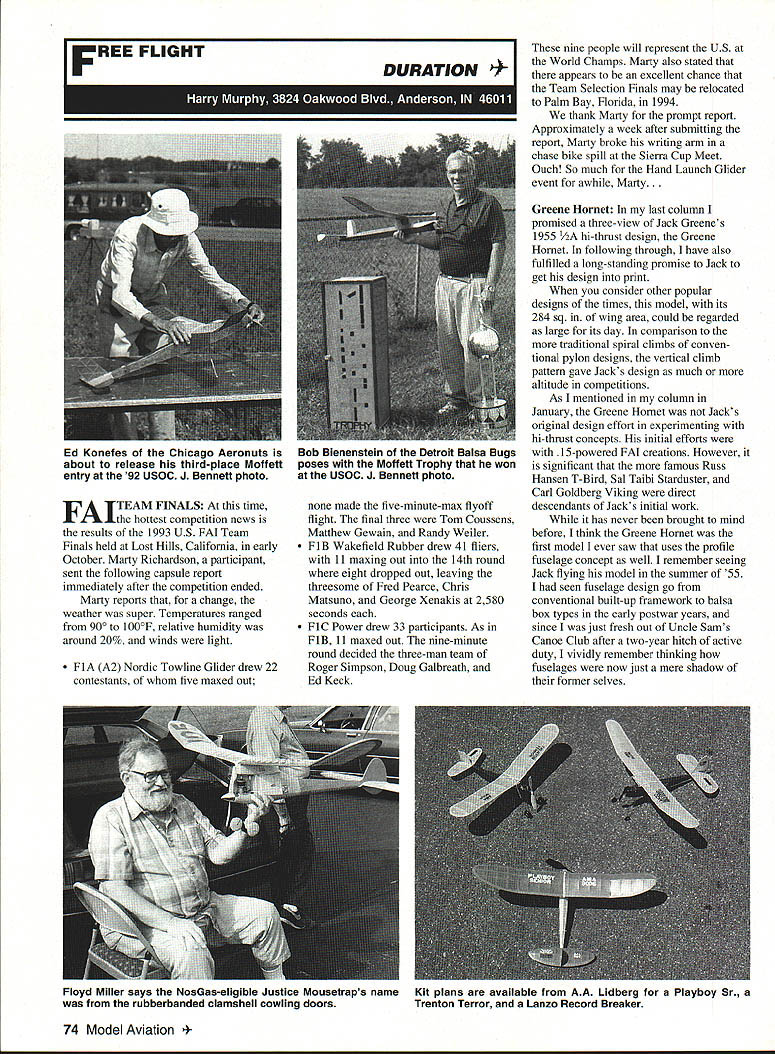
At this time, the hottest competition news is the results of the 1993 U.S. FAI Team Finals held at Lost Hills, California, in early October. Marty Richardson, a participant, sent the following capsule report immediately after the competition ended. Marty reports that, for a change, the weather was super. Temperatures ranged from 90° to 100°F, relative humidity was around 20%, and winds were light.
- F1A (A2) Nordic Towline Glider drew 22 contestants, of whom five maxed out; none made the five-minute-max flyoff flight. The final three were Tom Coussens, Matthew Gewain, and Randy Weiler.
- F1B Wakefield Rubber drew 41 fliers, with 11 maxing out. The 14th round saw eight drop out, leaving a threesome of Fred Pearce, Chris Matsuno, and George Xenakis at 2,580 seconds each.
- F1C Power drew 33 participants. As in F1B, 11 maxed out. The nine-minute round decided the three-man team of Roger Simpson, Doug Galbreath, and Ed Keck.
These nine people will represent the U.S. at the World Champs. Marty also stated that there appears to be an excellent chance that the Team Selection Finals may be relocated to Palm Bay, Florida, in 1994.
We thank Marty for the prompt report. Approximately a week after submitting the report, Marty broke his writing arm in a chase-bike spill at the Sierra Cup Meet. Ouch! So much for the Hand Launch Glider event for awhile, Marty...
Greene Hornet
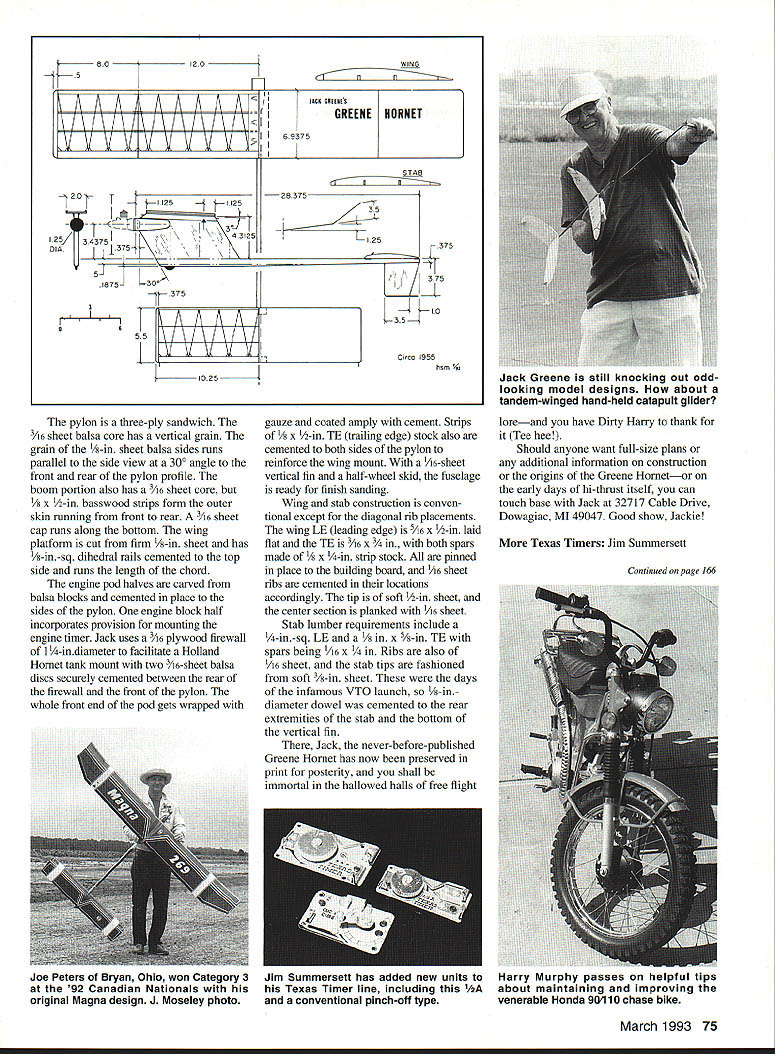
In my last column I promised a three-view of Jack Greene's 1955 1/2A hi-thrust design, the Greene Hornet. In following through, I have also fulfilled a long-standing promise to Jack to get his design into print.
When you consider other popular designs of the times, this model, with its 284 sq. in. of wing area, could be regarded as large for its day. In comparison to the more traditional spiral climbs of conventional pylon designs, the vertical climb pattern gave Jack's design as much or more altitude in competition.
As I mentioned in my January column, the Greene Hornet was not Jack's original design effort in experimenting with hi-thrust concepts. His initial efforts were with .15-powered FAI creations. However, it is significant that the more famous Russ Hansen T-Bird, Sal Taibi Starduster, and Carl Goldberg Viking were direct descendants of Jack's initial work.
While it has never been brought to mind before, I think the Greene Hornet was the first model I ever saw that uses the profile fuselage concept as well. I remember seeing Jack flying his model in the summer of '55. I had seen fuselage design go from conventional built-up framework to balsa box types in the early postwar years, and since I was just fresh out of Uncle Sam's canoe club after a two-year hitch of active duty, I vividly remember thinking how fuselages were now just a mere shadow of their former selves.
Construction notes:
- The pylon is a three-ply sandwich. The 3/16-inch sheet balsa core has a vertical grain. The grain of the 1/16-inch sheet balsa sides runs parallel to the side view at a 30° angle to the front and rear of the pylon profile.
- The boom portion also has a 3/16-inch sheet core, but 3/16 x 1/2-inch basswood strips form the outer skin running from front to rear. A 3/16-inch sheet cap runs along the bottom.
- The wing platform is cut from firm 1/8-inch sheet and has 1/8-inch square dihedral rails cemented to the top side and running the length of the chord.
- The engine pod halves are carved from balsa blocks and cemented in place to the sides of the pylon. One engine block half incorporates provision for mounting the engine timer. Jack uses a 1/8-inch plywood firewall and a 1/4-inch diameter provision to facilitate a Holland Hornet tank mount with two 3/16-inch sheet balsa discs securely cemented between the rear of the firewall and the front of the pylon. The whole front end of the pod gets wrapped with gauze and coated amply with cement.
- Strips of 1/8 x 1/2-inch trailing-edge stock are cemented to both sides of the pylon to reinforce the wing mount. With a 1/16-inch sheet vertical fin and a half-wheel skid, the fuselage is ready for finish sanding.
Wing and stab construction is conventional except for the diagonal rib placements. The wing leading edge is 5/16 x 1/2 inch, and the trailing edge is 3/16 x 3/4 inch, with both spars made of 1/16 x 1/8-inch strip stock. All are pinned in place on the building board, and 1/16-inch sheet ribs are cemented in their locations accordingly. The tip is made of soft 3/16-inch sheet; the center section is planked with 1/16-inch sheet.
Stab lumber requirements include 1/8-inch square leading-edge and 5/16 x 1/8-inch trailing-edge spars. Ribs are of 1/16-inch sheet, and the stab tips are fashioned from soft 3/16-inch sheet. These were the days of the infamous VTO launch, so 5/16-inch diameter dowels were cemented to the rear extremities of the stab and the bottom of the vertical fin.
There, Jack—the never-before-published Greene Hornet—has now been preserved in print for posterity, and you shall be immortal in the hallowed halls of free flight lore — and you have Dirty Harry to thank for it (tee hee!).
Should anyone want full-size plans or additional information on construction or the origins of the Greene Hornet—or on the early days of hi-thrust itself—contact Jack at 32717 Cable Drive, Dowagiac, MI 49047. Good show, Jackie!
Timers and Products (FF Duration / Murphy)
I have added a 1/2A-size timer and squeeze-off type to my product line of high-quality Texas Timers. The original ABC Texas Timer, as well as the new 1/2A, is designed to work with a remote fuel cutoff valve and can easily be rigged for quick DT and/or autorotative functions. The timers run for about 30 seconds and are quite suitable for Nostalgia Gas and Old-Timer utility as well as for more modern power competitions.
Prices:
- Timers: $27.50 for either the ABC or 1/2A Timers.
- Cutoff: $4.50 each.
- Squeeze-off: $18.95.
- Add $2 for packing and postage.
Jim's address is Route 4, Box 365K, Canyon Lake, TX 78133. Order yours today—there are none better!
A footnote on toy mechanisms: I have been buying mechanical toys at various department stores and toy outlets for years—then rushing home to smash them with a hammer to get at the mechanisms inside. I probably have about as large a boneyard of plastic toy parts as anybody, with fruit jars of Tomy, Mad Bull, and various other mechanisms sitting about my shop.
Of all the plastic-geared mechanisms, I find the one in the Teenage Mutant Ninja Wacky Action Rock-N-Roll Michelangelo to be the best by far. The mechanism is a bit larger than most of the other varieties, with the spring therein twice as wide as the spring in many other specimens, and the force exerted approaches that of the old Tatone pinch-off timers. I have been using them in 1/4A and 1/2A applications and have yet to have a failure. Retail is about seven bucks around here, but they are being phased out and I have been picking them up for $3–$4 apiece lately. I hope this is not the end of "toy timers," as I am about to run out of fruit jars.
FF plans and stuff
At this writing the outdoor contest season is closed, and modeling activity is being confined to the workshop for the most part. Last year's models get repaired, and the drawing boards and workbenches get cleared off for winter repair and construction projects. Should you still be scratching your head as to what projects will activate your jollies, here are a few suggestions:
- Frank Parmenter is now making available full-size plans of his 1956 NFFS NosGas-legal FAI/Alt Charmer. Plans orders go to Dick Gleason Enterprises, 1106 10th Drive SE, Austin, MN 55912. The $7.50 cost includes postage and handling. If you want plans rolled up in a mailing tube, the cost goes up to $11.65 postpaid. Dick also has a large selection of old Air Trails Hobby Helper plans; his catalog listing is an additional $2.75.
- I finally got around to tracing off Lew Mahieu's $75 Zeek from an original print so easier-to-read copies are now available at $7 postpaid. Previous copies were made from the only known available blueprint, which resulted in some rather faded lines on print copies. Other Zeek plan sizes are also available; some are scaled to allow sizing the model to popular legal NosGas engines. Send an SASE for the listing.
- Al Lidberg has a trio of miniature 22-inch oldies intended for small electric, CO2, or rubber-powered use: a Playboy Sr. (pylon model), a Trenton Terror (cabin model), and a Lanzo Record Breaker (parasol model). A semikit is offered on each model for $7.20 postpaid, or $21 postpaid will get you all three in a single box with rolled plans and printwood. Another $1.50 adds a 16-page catalog. Address: A. A. Lidberg Model Plan Service, 614 E. Fordham, Tempe, AZ 85283.
- Bill Hannan has compiled and published the second volume of his Stick and Tissue series. The book concentrates on model-building history and nostalgia, with photographs, sketches, plans, scale drawings, and answers to mysteries raised in the previous volume. Get yours for $9.95 plus $2.50 postage from Hannan's Runway, Box 210, Magalia, CA 95954.
It is probably well past the due dates to resubscribe to most of your favorite free flight newsletters. Don't fail to keep your subscriptions alive and updated. Newsletters are the lifeline of our hobby, and it is up to all of us to support as many as we can. Most are reasonably priced for the service they provide and keep alive the adage that communication is the name of the game. So, support your area gunfighters!
The four-day United States Outdoor Champs (USOC) held on the Labor Day weekend of '92 was so well received by the 300 contestants who attended the event at the AMA Muncie site that the NFFS cannot escape a command performance for the same weekend in '93. Therefore, it is now nailed to the calendar with Jim Kutkuhn as overall Contest Manager. Be sure to get your motel reservations early as there is an annual softball tournament in Muncie that vies for pillows and sheets as well. Contest packets should be available sometime in the March/April time frame. See you there!
Model finders
The subject of fuel shut-off timers is never exhausted, since new versions or mechanism sources often come to the forefront. A similar thing is now occurring with an entirely new type of item for which interest seems to be gathering momentum: model finders.
There are several different types, so selecting a satisfactory device for use with all models is not a simple task. Devices vary in cost, size, weight, function, effectiveness, and utility. Costs range from less than ten cents to $700 or more. Size and weight are of considerable consequence to the smaller model, which is obviously the most elusive in downwind chase situations. Just as important is effectiveness—functions vary from simple buzzer tones to full-fledged electronic radio transmitters.
After combating the downwind cornfields of Lawrenceville, Illinois, and Muncie, Indiana, this past summer at the week-long SAM Champs and USOC respectively, I have suddenly made model finders a priority investigation this winter and will be certain to use one or more of these in the coming outdoor flying season. I fully intend to spend less time surveying the terrain by clumping around in the corn and soybean fields of the Midwest. The farmers will surely appreciate the gesture as well.
At present you can separate model finders into two main groups:
- Audible buzzer or beep devices that give off sounds from a device carried in the model.
- Electronic devices that transmit a radio signal to some sort of hand-held radio receiver.
Since some of us older fellows have hearing problems to some degree or another, I personally would like to see a third type become available: an electronic system that emits a signal that could be picked up on a visual meter or the like. That would be the epitome of model-finder devices.
You may look forward to reviews of various devices and systems in future columns. I will commence next time with a couple of beeper systems that anyone can fabricate for less than $10 from items you can purchase at your neighborhood Radio Shack.
Electronic concepts also vary greatly in effectiveness and price—from inexpensive walkie-talkies to $100 scanners or up to $400–$500 specialty receivers. Model-toteable transmitters vary in size and weight from those that are the size of a quarter and weigh only a few grams to something bigger than a bread box that weighs a few ounces.
As each type of system has both advantages and shortcomings, it would be difficult to recommend one single system over the others. Choice must remain with the individual and his assessment of his own minimum requirements. We would welcome literature from any individual or company that produces home-built devices or commercial systems they would care to have reviewed on these pages. Our purpose will be to review, not to rate or state preference.
Honda 90 fixits
One of the most important support requirements for today's competition free flier is a good, reliable motorized chase bike.
Years ago we chased models around the countryside by hanging to the sides of a Model A Ford—or similar vehicle—while standing on the running board. When running boards disappeared, we climbed onto the front fenders, dug our heels in behind the front bumper, and hung onto the hood ornament. Then bumpers got faired into the car body and hood ornaments became passé. After this, modelers began to use small trail bikes to accomplish the chore.
Over the years the Cadillac of chase bikes became the Honda Trail 90 (and later, the model 110), which enjoyed good domestic sales for around 10 years into the early '80s. The Trail 90 then went out of production, with no substitute really satisfying the future needs of free fliers. However, the Trail 90s and 110s are still the preferred chase vehicle of most free fliers, who tote them to contests or trailers, on front or rear bumper racks, inside vans, etc. Even the newest of them are now at least 10 years old, but they remain the prestige chase vehicles.
My personal 90 is a 1979 and has had pretty good care, with average mileage of only about 100 miles per year. However, many of the earlier bikes are beginning to show wear and tear and spend an occasional vacation in a bike repair shop for tune-ups or other mechanical or electrical problems.
Hank Nystrom recently volunteered some information that may be of interest to those who have one of the scratched-and-dented variety Hondas. After acquiring a mid-'70s 90, he decided to return it to some of its original luster by removing all the plastic parts. He stripped the paint down to the bare plastic, primed it with an automotive flexible bumper paint, and then applied eight coats of epoxy paint. Now it looks great and is as durable as his models, which are sure to drip raw fuel on the new paint next season.
More importantly, noticing that the battery would go dead in a couple of weeks if the bike was left on its kickstand, Hank discovered that the '60s-technology selenium rectifier on the output of the AC generator was leaking current out of the battery. After making inquiries, he found the situation to be typical of selenium configurations and a probable reason selenium is no longer used today. Hank replaced the selenium rectifier with a silicon bridge rectifier, and the leakage went to almost zero. If you have similar problems—even with the key off—you may wish to consider this possibility, since the rectifier can still be in the circuit.
Although my 90 is over 12 years old and only boasts a little over 2,000 miles on the odometer, battery attrition has been running high. Because the battery runs down rather quickly if the bike sits idle for a long time, I remove the battery after each flying season and bring it indoors every winter, giving it a midwinter recharge and keeping an eye on the fluid level. This seems to give me a couple of extra seasons with the tiny 6V power source, which is seldom in stock on dealer shelves and often must be special ordered.
Since I am not an electronics wizard, I have considered whether one could accomplish somewhat of a remedy by putting another on-off switch in the circuit at the battery. I feel a bit ridiculous running across the grassy fields of WPAFB on nice sunny days with my lights on, so I have one in my headlamp circuit. On the road it's a different story and it is a simple task as I ride along to flip the switch when necessary.
Hank also compliments the Honda folks for an electronic design feature that automatically kicks in a booster coil that triples the charging rate when the headlamps are turned on. Also, the generator is designed to match the normal battery drain when the bike is in use, so no regulator is required in the system.
Well, anyway, as Roy Rogers always said, "Happy trails to you," and thanks to Hank for the info.
See ya downwind!
Transcribed from original scans by AI. Minor OCR errors may remain.

