
Free Flight: Duration
Harry Murphy 3824 Oakwood Blvd., Anderson, IN 46011
AMA FF Nats / NFFS USOC merger
Some significant happenings have occurred regarding the proposed 1993 AMA National Championships. An initial plan to hold the event in Lubbock, Texas, the week of July 17–25 fell through when the FAA declined approval because of possible airspace conflicts between full-scale and model aircraft. The AMA reacted quickly, relocating the RC and CL portions to Lawrenceville, Illinois, for the same dates. The outdoor free flight portion was originally scheduled for the AMA Muncie site that week.
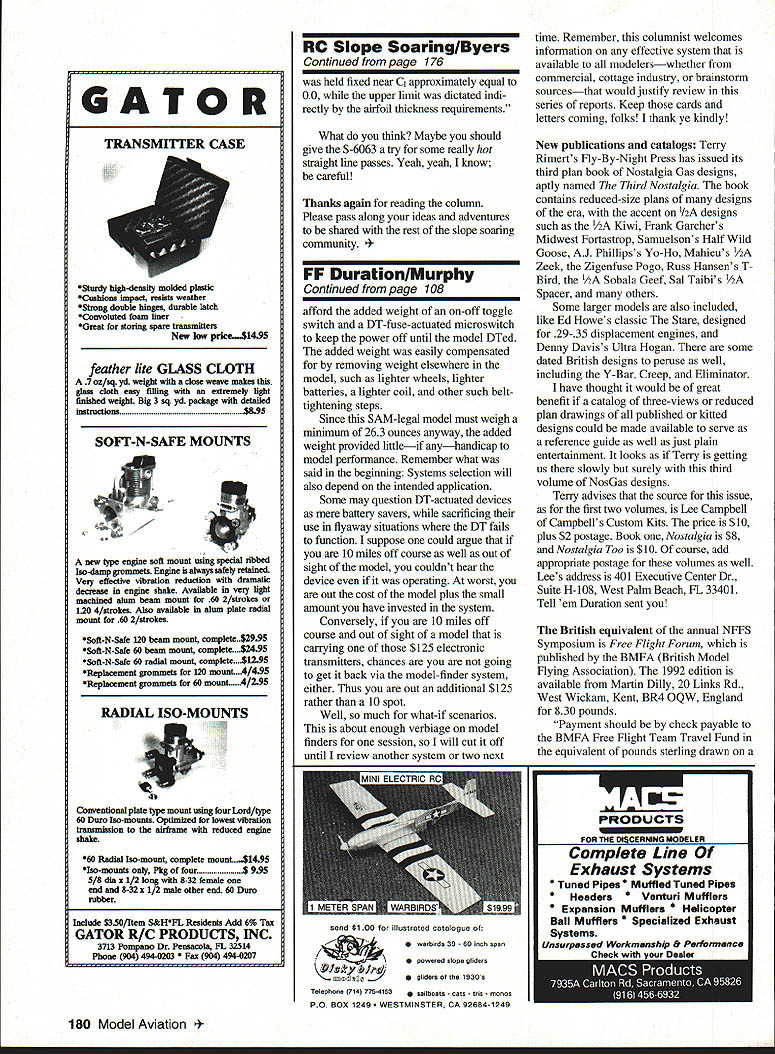
Subsequently, arrangements were made to merge the AMA Free Flight Nats with the already scheduled NFFS (National Free Flight Society) USOC (United States Outdoor Championships) over Labor Day weekend at the Muncie site. The former four-day USOC schedule was extended to five days to accommodate the added AMA events; the new dates are Wednesday through Sunday, September 1–5.
- SAM (Society of Antique Modelers) Chapter 57 will stage a full four-day Old-Timer schedule Wednesday–Saturday.
- FAC (Flying Aces Club) will run a two-day scale-flying schedule Saturday–Sunday.
- The Fort Wayne chapter of SAM will sponsor four days of radio-assisted Old-Timer and Antique events.
- NFFS-sponsored Nostalgia Gas Championships will be incorporated, with a high-point winner declared.
- The annual NFFS Symposium dinner is scheduled for Saturday night at the same northwest Muncie facility used in 1992.
- Don Sachtjen (SAM 57) reports a Tuesday evening bean feed will be held off-site to kick off Old-Timer activities.
It promises to be a jam-packed week with evening events and many full days of flying—something for nearly every free-flight enthusiast.
Elsewhere: the 1993 AMA Indoor Nats will be combined with the NFFS-sponsored USIC (United States Indoor Championships) at Johnson City, Tennessee, June 3–6. Although not officially confirmed in writing at this time, I assume the long-established USFFC (United States Free Flight Championships) will again be held over Labor Day weekend at Lost Hills, California, with three days of scheduled events. Finally, the annual SAM Champs returns to Taft, California, October 11–15. Attend as many of these as you can to support free flight!
Model Finders, Part II
As promised last session, this month begins a series of specific reviews of concepts to help the free-flighter locate evasive models in downwind retrieval. I will not attempt to rate systems conclusively—each has advantages and disadvantages and depends on the intended application. Devices may be grouped into audio systems, electronic reception, and (hopefully someday) hand‑held-receiver readouts.
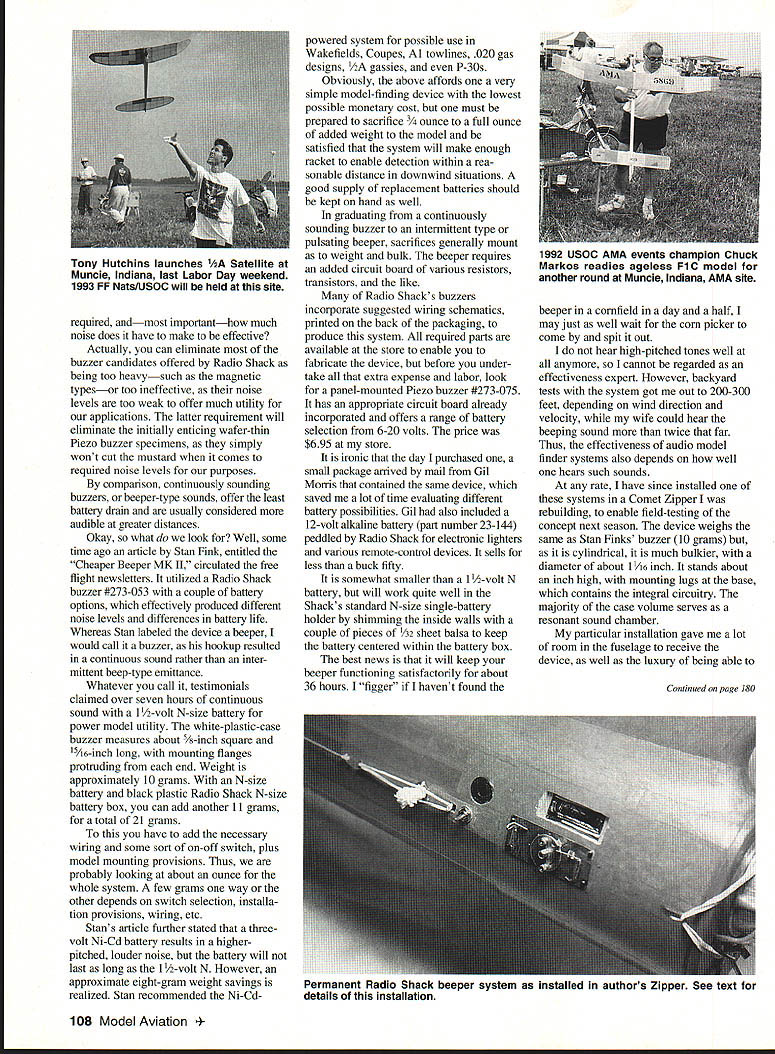
To start simply, let’s look at low-cost buzzers available from Radio Shack.
If electronics aren’t your specialty, a simple buzzer may be the limit of your comfort zone. Before buying, study devices for cost, weight, size, required accessories, and—most important—how loud the device must be to be effective.
- Many Radio Shack buzzers are too heavy (magnetic types) or too weak (small piezo wallet buzzers) for useful model-finder work.
- Continuously sounding buzzers (a steady tone) generally draw less battery and are often more audible at greater distances than intermittent beepers.
Stan Fink’s “Cheaper Beeper MK II” used Radio Shack buzzer #273-053 with different battery options, producing a continuous sound. Reported battery life was over seven hours with a 1½‑volt N-size cell. The white-plastic-case buzzer measures about 7/8" square by 15/16" long, with mounting flanges, and weighs approximately 10 grams. An N-size battery plus Radio Shack N-size holder adds about 11 grams, for a total near 21 grams (roughly an ounce) once wiring and a switch are included. Expect some variation depending on switch, wiring, and mounting.
Using a 3‑volt Ni‑Cd yields a higher-pitched, louder tone but shorter life and about an 8‑gram weight savings. Stan recommended the Ni‑Cd-powered configuration for Wakefields, Coupes, A/1 towlines, .020 gas designs, 1/2A gassers, and even P‑30s.
If you prefer intermittent beepers, be aware they usually require additional circuitry (small PC boards with resistors, transistors, etc.), adding weight and bulk. Before building your own, consider the panel-mounted piezo buzzer #273-075 from Radio Shack; it includes an appropriate circuit board and accepts 6–20 volts. Price was about $6.95.
A correspondent, Gil Morris, sent one of these along with a Radio Shack 12‑volt alkaline battery (part number 23-144). The 12‑volt cell is slightly smaller than an N battery and can be fitted in the N-size holder by shimming with thin balsa. It reportedly powers the beeper for about 36 hours—ample if you’re unlikely to recover a model after a day and a half in a field.
I have reduced sensitivity to high-pitched tones, so I can’t claim to be the final authority on audibility. Backyard tests with the piezo beeper reached me at 200–300 feet depending on wind; my wife heard it at more than twice that distance. Audibility depends on the listener as well as the device.
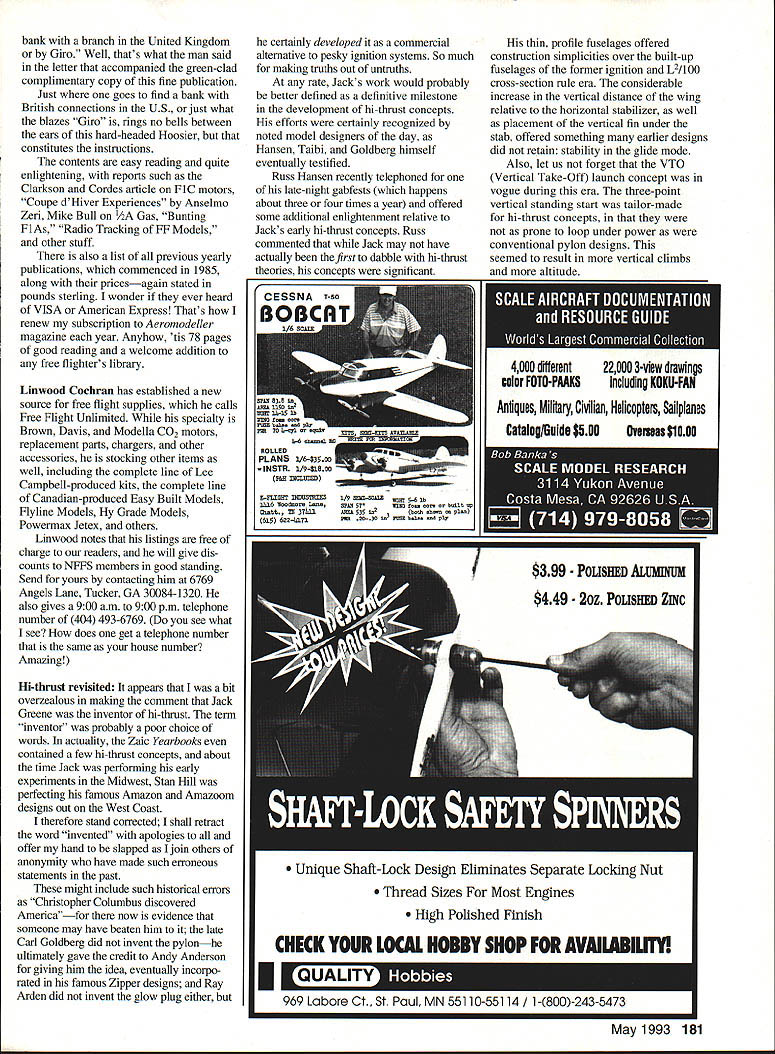
I installed one of these systems in a Comet Zipper I was rebuilding for next season’s field tests. The unit weighs about 10 grams and, being cylindrical, is bulkier (≈1 1/16" diameter, ≈1" high) with mounting lugs and an internal resonance chamber. I fitted an on‑off toggle and a DT‑fuse‑actuated microswitch to keep power off until the model D/Ted. The added weight was offset by removing weight elsewhere (lighter wheels, batteries, coil, etc.). For SAM‑legal models with a minimum weight of 26.3 ounces, the extra ounce had little adverse effect on performance.
Some object to DT‑actuated systems as they won’t help if the DT fails and the model flies away. That’s true, but the alternative—an expensive $125 electronic transmitter—won’t guarantee recovery either if the model goes far off course. At worst, you lose the model and a small investment in a buzzer rather than a larger sum.
That’s enough on audio model finders for now. I’ll review other systems in future columns. I welcome information on effective systems from commercial, cottage-industry, or individual sources for possible review in this series. Keep those cards and letters coming—thanks!
New publications and catalogs
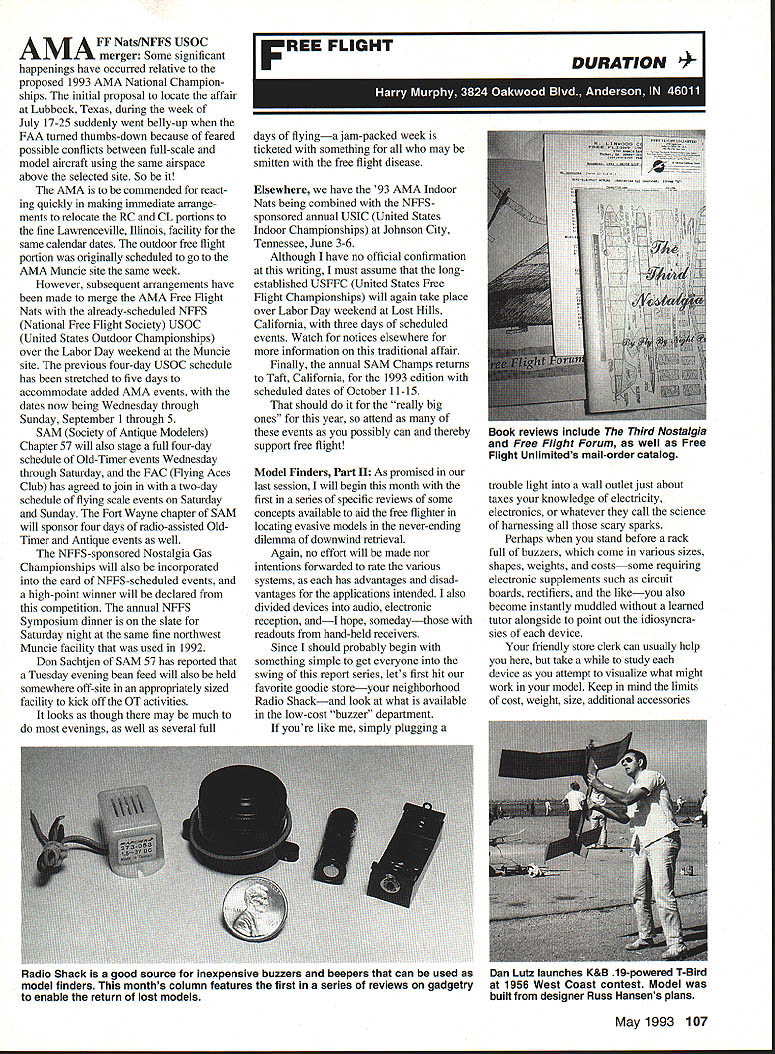
- Fly‑By‑Night Press (Terry Rimer) has issued The Third Nostalgia, a plan book of Nostalgia Gas designs with emphasis on 1/2A models. Included are reduced-size plans for many designs such as the '72a Kiwi, Frank Gardner’s Midwest Forstaller, Samuelson’s Half Wild Goose, A.J. Phillips’s Yo‑Ho, Mahieu’s 1/2A Zeek, the Zigenfuse Pogo, Russ Hansen’s T‑Bird, Ya Sobala Gee, Sal Taibi’s 1/2A Spacer, and others. Larger models included are Ed Howe’s The Stare (.29–.35 engines) and Denny Davis’s Ultra Hogan. Some older British designs (Y‑Bar, Creep, Eliminator) are also present. Pricing: The Third Nostalgia $10 plus $2 postage. Book One (Nostalgia) $8; Nostalgia Too $10. Order from Lee Campbell, Campbell’s Custom Kits, 401 Executive Center Dr., Suite H108, West Palm Beach, FL 33401. Tell them Duration sent you.
- The BMFA Free Flight Forum (British Model Flying Association) 1992 edition is available from Martin Dilly, 20 Links Rd., West Wickham, Kent, BR4 0QW, England, for £8.30. Payment should be by check payable to the BMFA Free Flight Team Travel Fund in pounds sterling drawn on a U.K. bank with a branch in the United Kingdom, or by Giro. The 78‑page issue includes items such as Clarkson and Cordes on F1C motors, Anselmo Zieri on Coupe d'Hiver experiences, Mike Bull on 1/2A Gas, Bunting F1As, radio tracking of free-flight models, and a list of past yearly publications (which began in 1985).
- Linwood Cochran has launched Free Flight Unlimited, a source for free flight supplies specializing in Brown, Davis, and Modella CO2 motors, replacement parts, chargers, and other accessories. He also stocks Lee Campbell kits, Canadian Easy Built Models, Flyline Models, Hy‑Grade Models, Powermaster Jetex, and more. Linwood’s listings are free to readers and he offers discounts to NFFS members. Contact: Free Flight Unlimited, 6769 Angels Lane, Tucker, GA 30084-1320. Phone (404) 493-6769 (9:00 a.m.–9:00 p.m.).
Hi‑thrust revisited
I overstated when I called Jack Greene the inventor of hi‑thrust—the word “inventor” was a poor choice. Zale Yearbooks contained hi‑thrust concepts earlier, and Stan Hill was developing his Amazon and Amazoom designs on the West Coast about the time Jack was experimenting in the Midwest. I retract “invented” and offer apologies.
Jack Greene’s work, however, was a definitive milestone. His thin, profile fuselages simplified construction compared to the built-up fuselages of earlier ignition-era designs. His increased vertical spacing of wing to horizontal stabilizer and the placement of the vertical fin under the stab improved glide stability. The VTO (vertical take-off) launch style favored hi‑thrust because these designs were less prone to looping under power than conventional pylon designs, yielding steeper climbs and more altitude.
Russ Hansen added that while Jack may not have been first, his concepts were influential and recognized by designers such as Hansen, Talbi, and Goldberg. Historical notes: Hal DeBolt claims a hi‑thrust Blitzkrieg concept as early as 1938; Stan Hill recalls a 1942 hi‑thrust setup with Ben Austin on a Leon Shulman Skyrocket and later the 1952 Amazon (kitted by Berkeley in 1953). Hi‑thrust designs remained popular through the ’60s and ’70s until VIT (variable incidence tail) devices reduced some advantages of fixed-geometry hi‑thrust designs.
Stan Hill recently observed that competition is really proving yourself to yourself; after the years of contest flying and making the U.S. FAI Power Team in 1953, he now flies for enjoyment—an approach many of us share.
Thanks to all who sent comments on this subject.
See ya downwind!
Transcribed from original scans by AI. Minor OCR errors may remain.

