
FREE FLIGHT DURATION
Jim Haught, 3069 Sovereign Dr., Cincinnati, OH 45251
Final column / New position
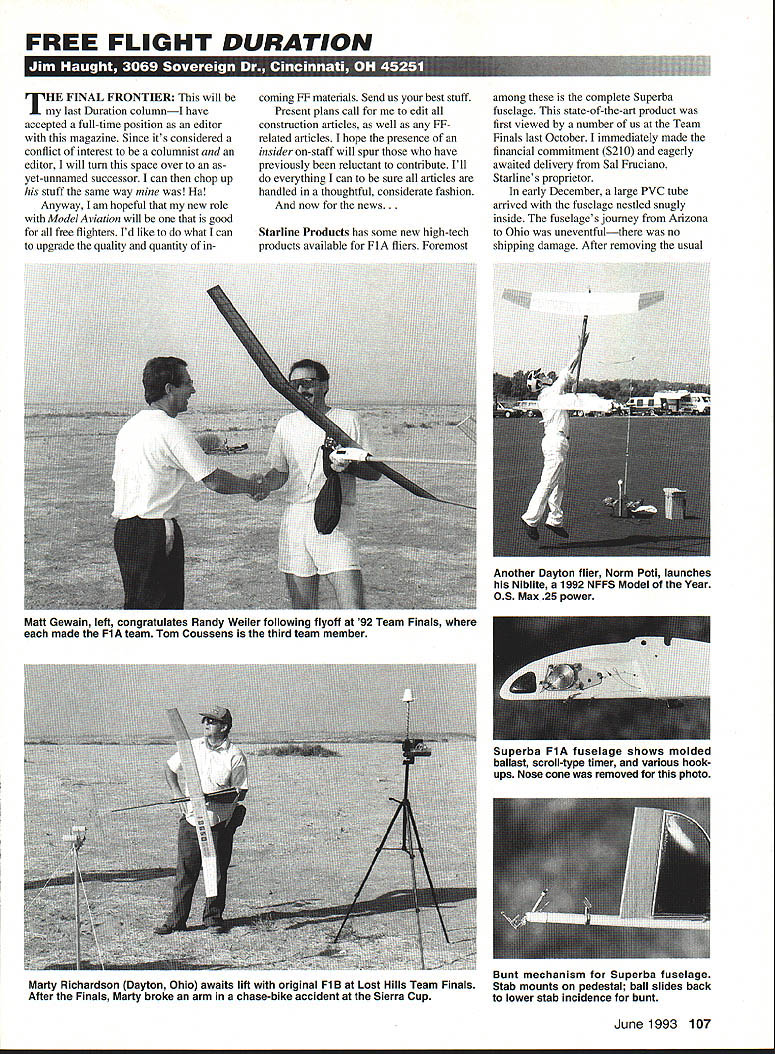
This will be my last Duration column — I have accepted a full-time position as an editor with this magazine. Since it's considered a conflict of interest to be a columnist and an editor, I will turn this space over to an as-yet-unnamed successor. I can then chop up his stuff the same way he may — Ha!
I am hopeful my new role with Model Aviation will be good for all free fliers. I'd like to upgrade the quality and quantity of incoming FF materials. Send us your best stuff. Present plans call for me to edit all construction articles and any FF-related articles. I hope the presence of an insider on staff will spur those who have been reluctant to contribute. I'll do everything I can to ensure articles are handled thoughtfully and considerately.
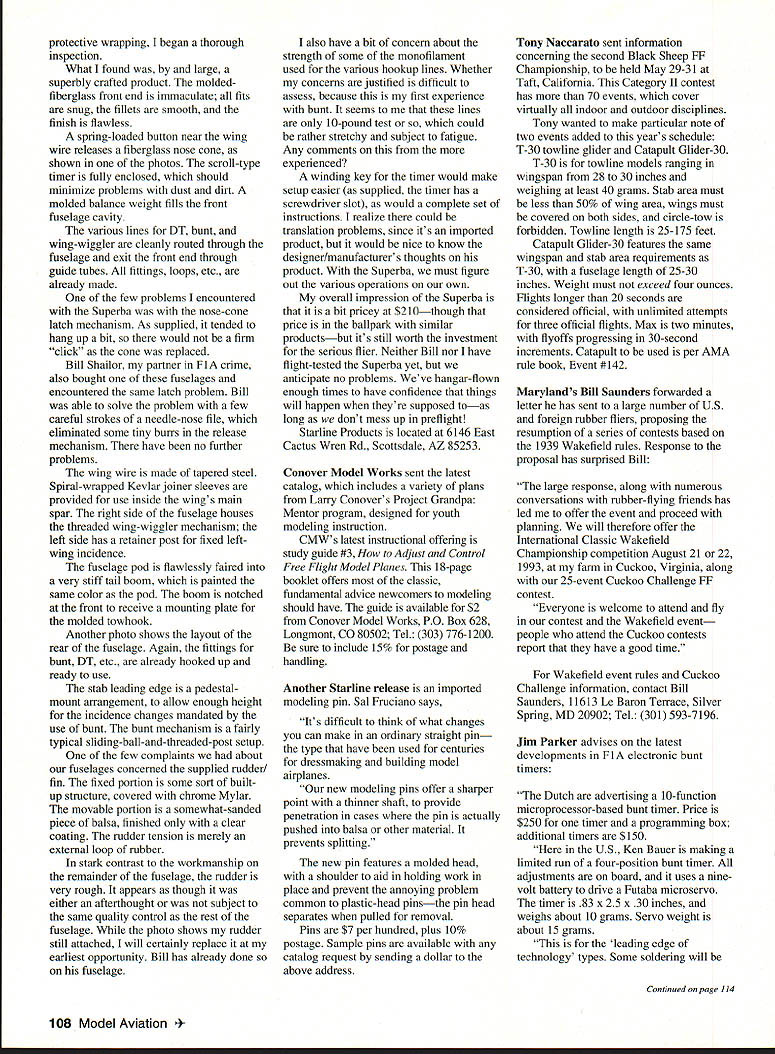
Starline Superba fuselage — inspection and features
Starline Products has some new high-tech products available for F1A fliers. Foremost among these is the complete Superba fuselage. I first viewed this state-of-the-art product at the Team Finals last October and immediately ordered one ($210) from Sal Fruciano, Starline's proprietor.
In early December, a large PVC tube arrived with the fuselage snugly inside. The journey from Arizona to Ohio was uneventful — there was no shipping damage. After removing the protective wrapping, I began a thorough inspection.
What I found was, by and large, a superbly crafted product:
- Molded-fiberglass front end: immaculate; fits are snug, fillets smooth, finish flawless.
- Spring-loaded button near the wing wire releases a fiberglass nose cone.
- Scroll-type timer fully enclosed to minimize dust and dirt problems.
- Molded balance weight fills the front fuselage cavity.
- Various lines (DT, bunt, wing-wiggler) are cleanly routed through guide tubes and fittings to the front; loops and fittings are already made.
- Wing wire: tapered steel.
- Spiral-wrapped Kevlar joiner sleeves provided for use inside the wing's main spar.
- Right side of fuselage: threaded wing-wiggler mechanism; left side: retainer post to fix left-wing incidence.
- Pod: flawlessly faired into a very stiff tail boom, painted same color as pod.
- Tail boom: notched at front to receive mounting plate molded to the tow hook.
- Stab leading-edge pedestal mount provides height for incidence changes needed when using the bunt.
- Bunt mechanism: typical sliding-ball-and-threaded-post setup.
Problems and concerns
A few issues were noted:
- Nose-cone latch: as supplied it tended to hang up and would not always give a firm click when replaced. Bill Shailor experienced the same issue; a few careful strokes with a needle-nose file removed tiny burrs in the release mechanism and solved the problem.
- Rudder/fin workmanship: in contrast to the rest of the fuselage, the rudder is rough. The fixed portion is a built-up structure covered with chrome Mylar; the movable portion is a somewhat-sanded piece of balsa with only a clear coating. Rudder tension is an external loop of rubber. It appears to have been an afterthought or not subject to the same quality control. I will replace mine; Bill already has.
- Monofilament strength: the hookup lines appear to be about 10-pound test and may be somewhat stretchy and subject to fatigue. It's hard to judge from my first experience with the bunt; comments from experienced fliers would be helpful.
- Timer setup: the supplied scroll timer uses a screwdriver slot; a winding-key timer would make setup easier.
- Documentation: a complete set of instructions would be appreciated. Translation issues are possible for this imported product, but it would be nice to know the designer/manufacturer's intentions and recommended procedures.
Price and verdict
The Superba is a bit pricey at $210—though comparable to similar products—but worth the investment for the serious flier. Bill and I have not yet flight-tested the Superba, but we anticipate no problems based on hangar testing and preflight procedures.
Starline Products contact: 6146 East Cactus Wren Rd., Scottsdale, AZ 85253.
Conover Model Works
Conover Model Works sent their latest catalog, which includes a variety of plans from Larry Conover's Project Grandpa: Mentor program, designed for youth modelers.
CMW's latest instructional offering is Study Guide #3, How to Adjust and Control Free Flight Model Planes. This 18-page booklet offers classic, fundamental advice for newcomers. The guide is available for $2 from: Conover Model Works, P.O. Box 622, Longmont, CO 80502; Tel.: (303) 776-1200. Be sure to include 15% for postage and handling.
Starline modeling pins
Starline also offers an imported modeling pin. Sal Fruciano describes the new pin as having a sharper point and thinner shaft for better penetration in balsa and other materials, preventing splitting. The pin features a molded head with a shoulder to help hold work in place and prevent head separation when pulled.
Pins are $7 per hundred, plus 10% postage. Sample pins are available with any catalog request by sending $1 with the request.
Black Sheep FF Championship (Taft, CA)
Tony Naccarato sent information on the second Black Sheep FF Championship, to be held May 29–31 at Taft, California. This Category II contest has more than 70 events, covering virtually all indoor and outdoor disciplines.
Two events added this year:
- T-30 towline glider:
- Wingspan: 28–30 inches
- Minimum weight: 44 grams
- Stab area must be less than 50% of wing area
- Wings must be covered on both sides
- Circle-tow forbidden
- Towline length: 25–175 feet
- Catapult Glider-30:
- Same wingspan and stab-area requirements as T-30
- Fuselage length: 25–30 inches
- Max weight: 4 ounces
- Flights longer than 20 seconds are official; unlimited attempts for three official flights
- Max flight: 2 minutes; flyoffs progress in 30-second increments
- Catapult use per AMA rule book, Event #142
International Classic Wakefield Championship / Cuckoo Challenge
Maryland's Bill Saunders has proposed resuming contests based on the 1939 Wakefield rules. Response has been large, so he will offer the International Classic Wakefield Championship on August 21 or 22, 1993, at his farm in Cuckoo, Virginia, along with the 25-event Cuckoo Challenge FF contest.
Everyone is welcome to attend and fly. For Wakefield rules and Cuckoo Challenge information, contact: Bill Saunders, 11613 La Barra Terrace, Silver Spring, MD 20902; Tel.: (301) 595-7196.
F1A electronic bunt timers and other electronics
Jim Parker reports the latest developments in F1A electronic bunt timers:
- Dutch timer: a 10-function microprocessor-based bunt timer is advertised. Price: $250 for one timer plus a programming box; additional timers $150.
- Ken Bauer (U.S.): making a limited run of a four-position bunt timer. Features:
- All adjustments on board
- Uses a nine-volt battery to drive a Futaba microservo
- Timer size: 0.83 x 2.5 x 0.30 inches; weight about 10 grams
- Servo weight: about 15 grams
- Some soldering required; mechanical setup left to the user
- Intended for top international competitors rather than casual fliers
Contact Ken Bauer for pricing and details: 2306 Turquoise Circle, Chino Hills, CA 91709.
Also ask Ken about his Airtek model retrieval system, designed specifically for free flight retrieval.
NFFS video
The National Free Flight Society announces release of a 42-minute video, The Joy of Flying Free (VHS). It covers sport and competition free flight, both indoor and outdoor, and is intended as an educational/promotional tool. The tape costs $25 plus $3 postage and handling. Order from: NFFS, 1655 Revere Dr., Brookfield, WI 53045.
F1J vs. F1C — the performance problem
The continuing problems created by the high performance of modern F1C models raise serious questions about the future of the event.
Points of concern:
- Muffler/tuned-pipe controversy:
- Without mufflers, noise is a problem.
- With tuned pipes, performance jumps, and engine runs become difficult to time, especially in mass launches.
- Real estate: very few flying fields worldwide can truly hold an extended flyoff within their boundaries. I suspect fewer than a dozen such places exist.
- Potential rules changes: ideas such as shortening engine runs or imposing intake-size limits have been discussed, but each has drawbacks.
F1C appears at a crossroads, at least in the U.S. Some top fliers say they would quit the event rather than endure the expense of new engines/models if tuned pipes are mandated. Many F1C fliers are considering F1J as an alternative or a likely future direction. Results from recent contests show more "name" F1C fliers placing high in F1J — perhaps a sign of things to come.
Closing
I've had a great time writing this column and hope my successor is treated as well as I have been. Thanks for your support, and I'll see you on the flying field.
Transcribed from original scans by AI. Minor OCR errors may remain.

