
Duration
Bob Meuser
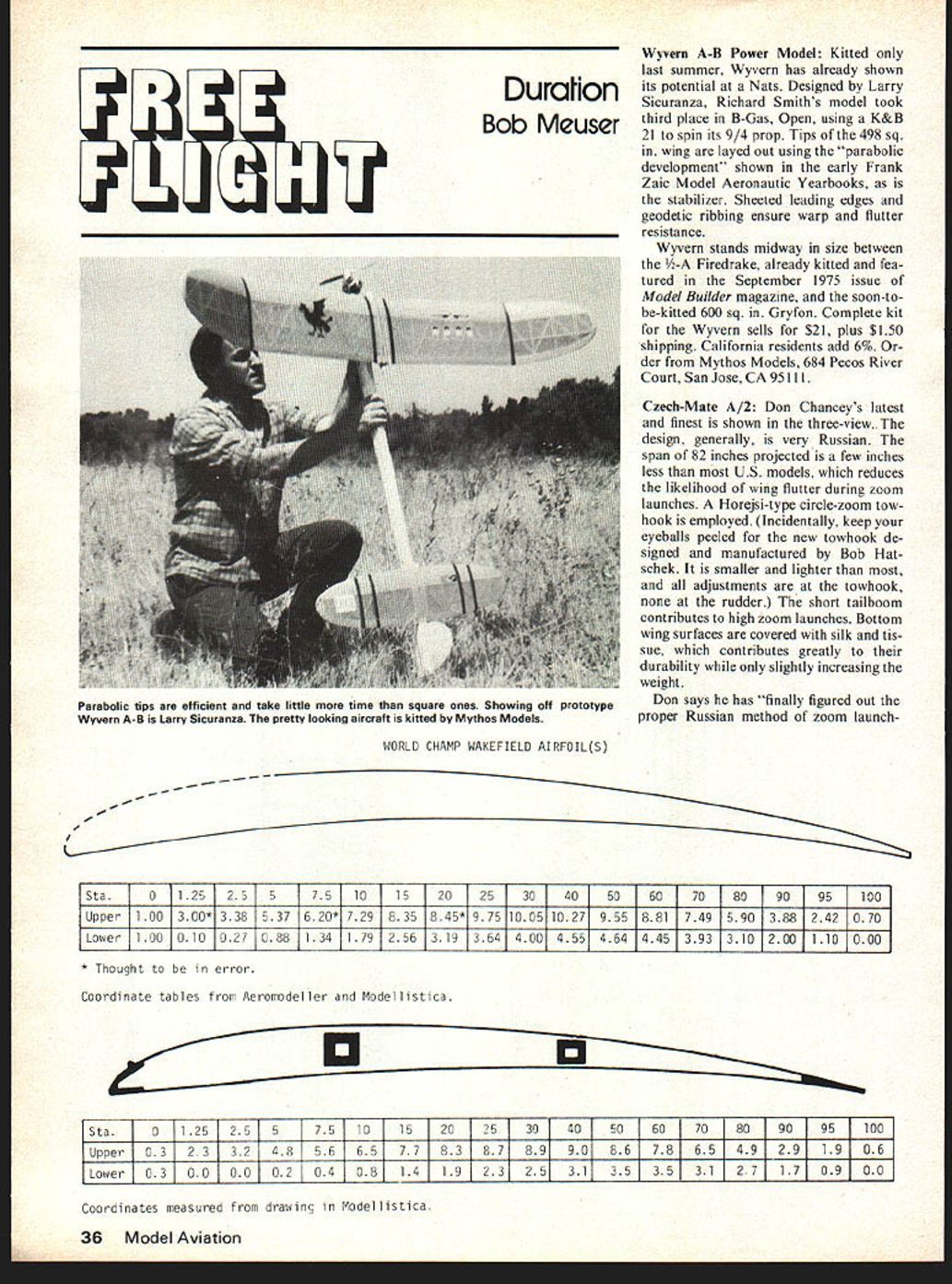
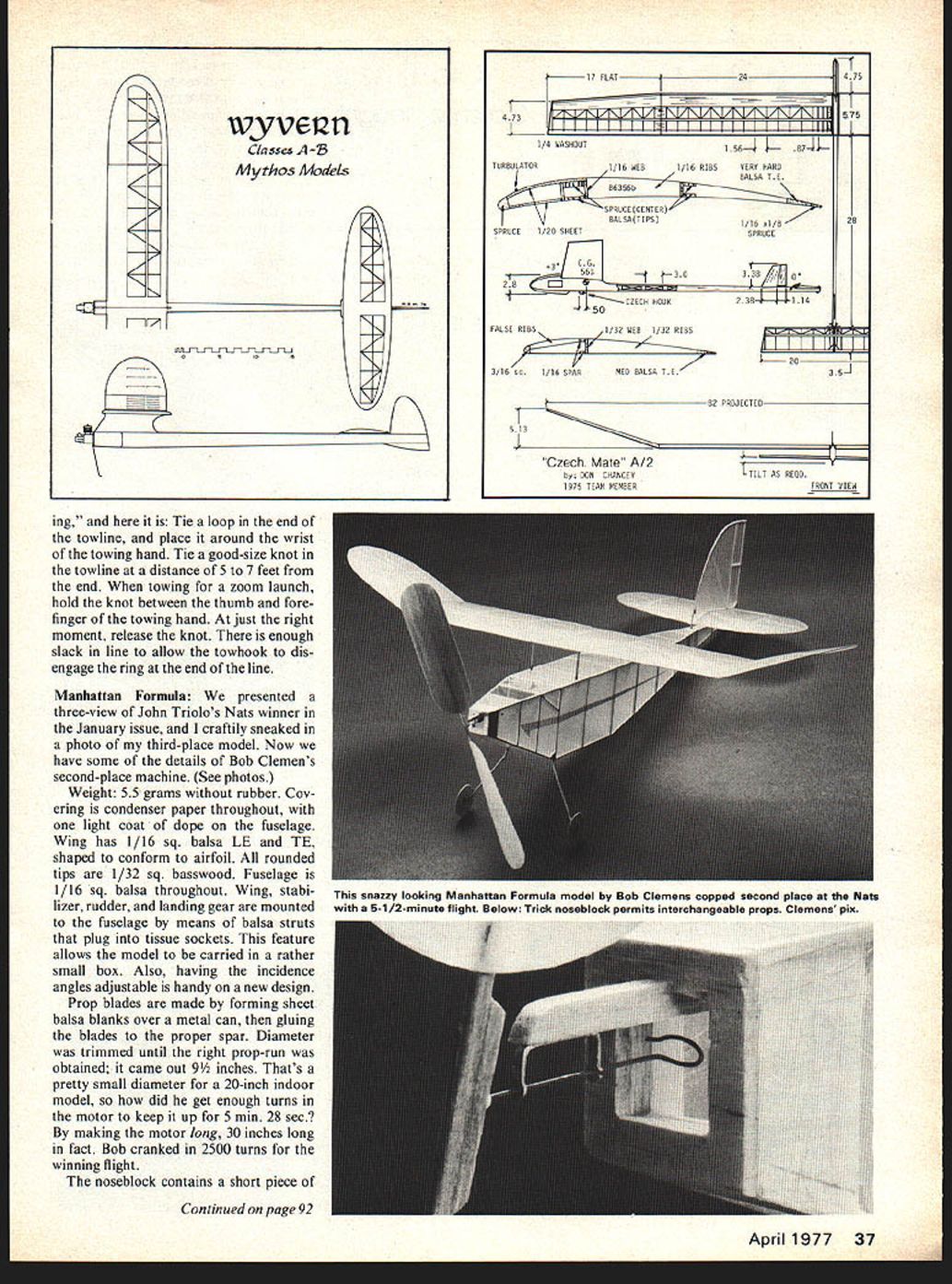
Wyvern A-B Power Model: Kitted only last summer, Wyvern has already shown its potential at a Nats. Designed by Larry Sicuranza, Richard Smith's model took third place in B-Gas, Open, using a K&B 21 to spin its 9/4 prop. Tips of the 498 sq. in. wing are layed out using the "parabolic development" shown in the early Frank Zaic Model Aeronautic Yearbooks, as is the stabilizer. Sheeted leading edges and geodetic ribbing ensure warp and flutter resistance.
Wyvern stands midway in size between the 1/2-A Firedrake, already kitted and featured in the September 1975 issue of Model Builder magazine, and the soon-to-be-kitted 600 sq. in. Gryfon. Complete kit for the Wyvern sells for $21, plus $1.50 shipping. California residents add 6%. Order from Mythos Models, 684 Pecos River Court, San Jose, CA 95111.
Czech-Mate A/2: Don Chancey's latest and finest is shown in the three-view. The design, generally, is very Russian. The span of 82 inches projected is a few inches less than most U.S. models, which reduces the likelihood of wing flutter during zoom launches. A Horejsi-type circle-zoom towhook is employed. (Incidentally, keep your eyeballs peeled for the new towhook designed and manufactured by Bob Hatschke. It is smaller and lighter than most, and all adjustments are at the towhook, none at the rudder.) The short tailboom contributes to high zoom launches. Bottom wing surfaces are covered with silk and tissue, which contributes greatly to their durability while only slightly increasing the weight.
Don says he has "finally figured out the proper Russian method of zoom launch.
WORLD CHAMP WAKEFIELD AIRFOIL(S)
Sta. 0 1.25 2.5 5 7.5 10 15 20 25 30 40 50 60 70 80 90 95 100 Upper 1.00 3.00 3.38 5.37 6.20 7.29 8.35 8.45 9.75 10.05 10.27 9.55 8.81 7.49 5.90 3.88 2.42 0.70 Lower 1.00 0.10 0.27 0.88 1.34 1.79 2.56 3.19 3.64 4.00 4.55 4.64 4.45 3.93 3.10 2.00 1.10 0.00
* Thought to be in error.
Coordinate tables from Aeromodeller and Modellistica.
Sta. 0 1.25 2.5 5 7.5 10 15 20 25 30 40 50 60 70 80 90 95 100 Upper 0.3 2.3 3.2 4.8 5.6 6.5 7.7 8.3 8.7 8.9 9.0 8.6 7.8 6.5 4.9 2.9 1.9 0.6 Lower 0.3 0.0 0.0 0.2 0.4 0.8 1.4 1.9 2.3 2.5 3.1 3.5 3.5 3.1 2.7 1.7 0.9 0.0
Coordinates measured from drawing in Modellistica. Tie a loop in the end of the towline, and place it around the wrist of the towing hand. Tie a good-size knot in the towline at a distance of 5 to 7 feet from the end. When towing for a zoom launch, hold the knot between the thumb and forefinger of the towing hand. At just the right moment, release the knot. There is enough slack in line to allow the towhook to disengage the ring at the end of the line.
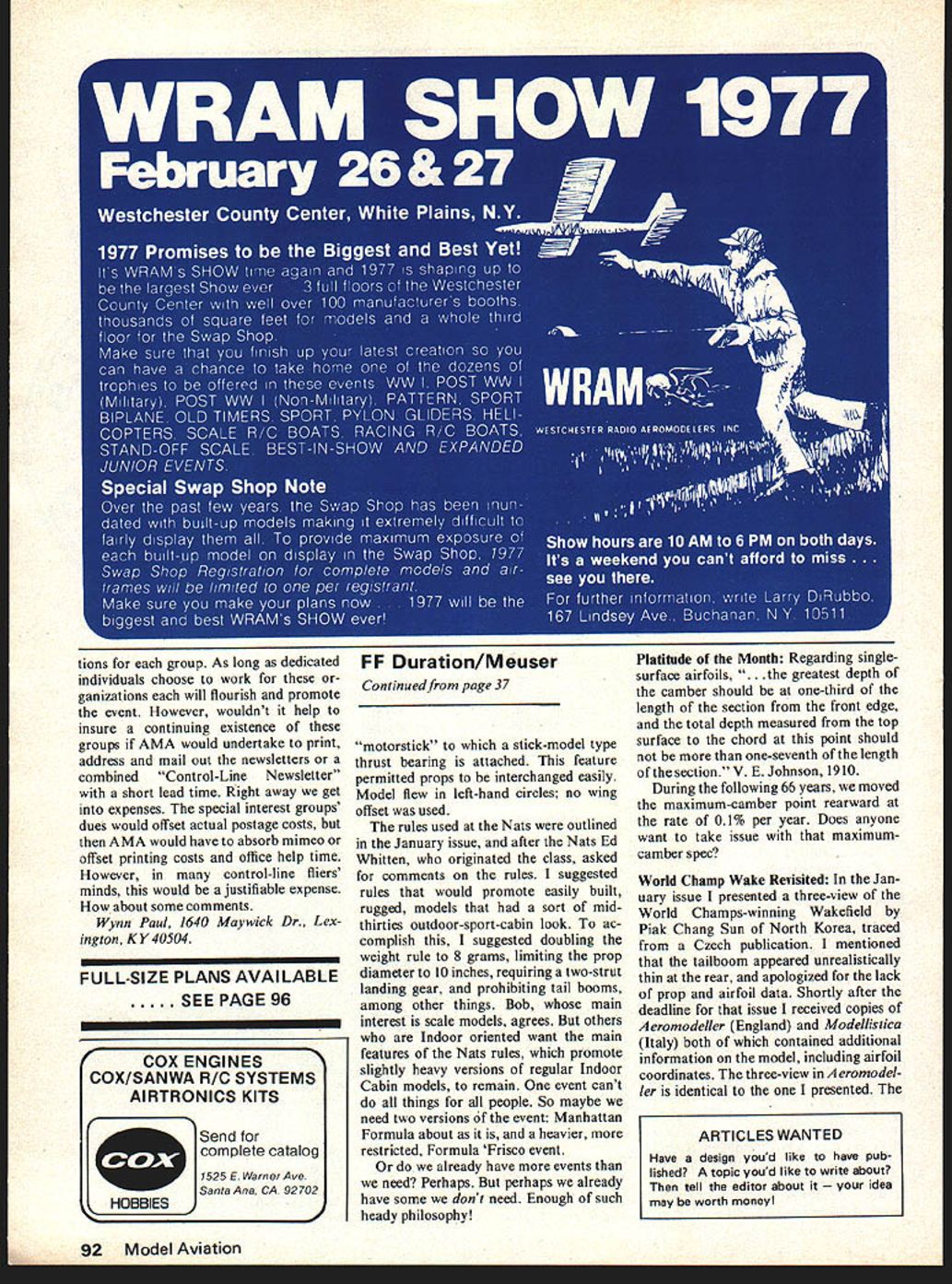
Manhattan Formula: We presented a three-view of John Triolo's Nats winner in the January issue, and I craftily sneaked in a photo of my third-place model. Now we have some of the details of Bob Clemens' second-place machine. (See photos.)
Weight: 5.5 grams without rubber. Covering is condenser paper throughout, with one light coat of dope on the fuselage. Wing has 1/16 sq. balsa LE and TE shaped to conform to airfoil. All rounded tips are 1/32 sq. basswood. Fuselage is 1/16 sq. balsa throughout. Wing, stabilizer, rudder, and landing gear are mounted to the fuselage by means of balsa struts that plug into tissue sockets. This feature allows the model to be carried in a rather small box. Also, having the incidence angles adjustable is handy on a new design.
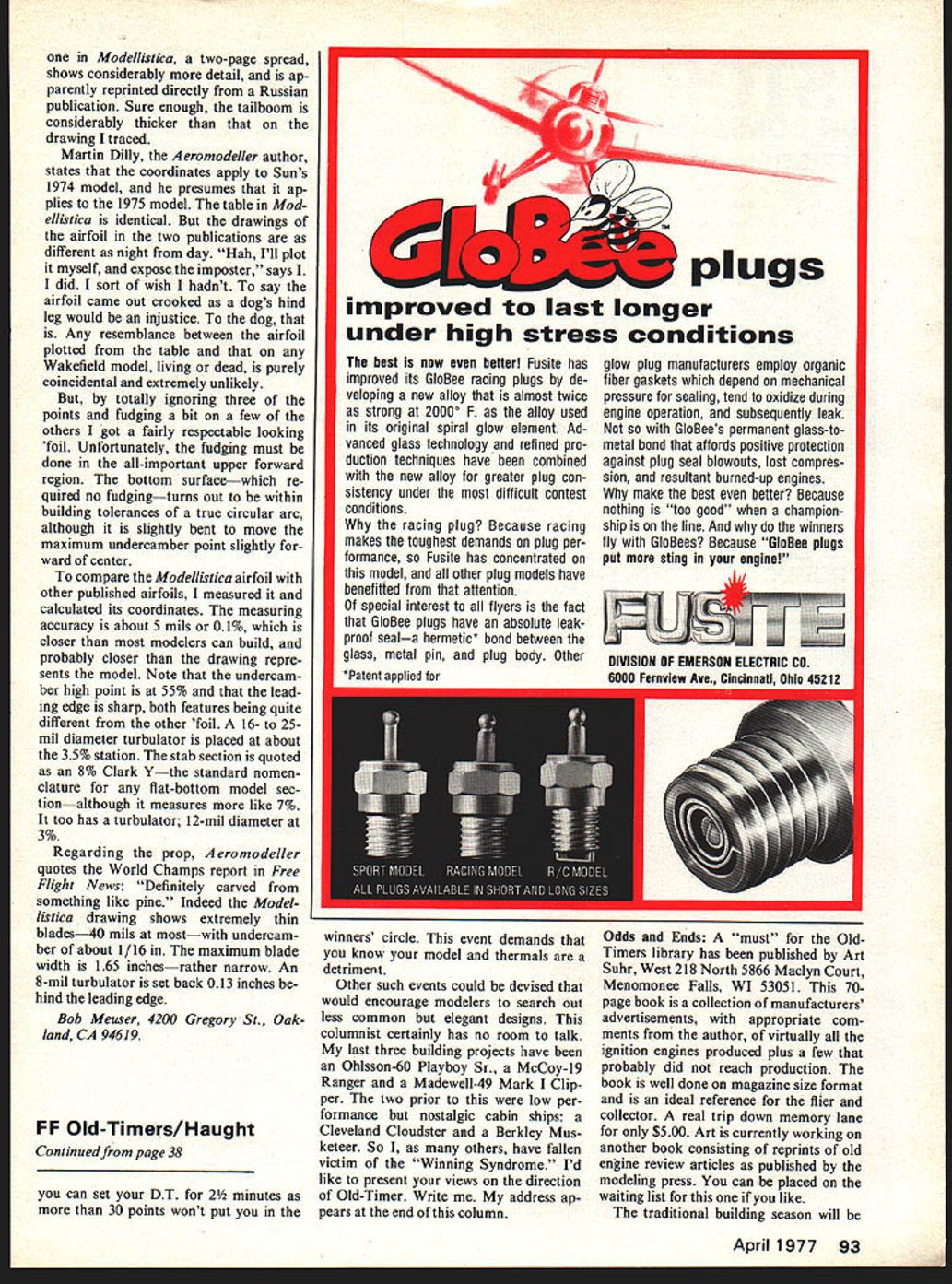
Prop blades are made by forming sheet balsa blanks over a metal can, then gluing the blades to the proper spar. Diameter was trimmed until the right prop-run was obtained; it came out 9½ inches. That's a pretty small diameter for a 20-inch model, so how did he get enough turns in the motor to keep it up for 5 min. 28 sec.? By making the motor long, 30 inches long in fact. Bob cranked in 2500 turns for the winning flight.
The noseblock contains a short piece of
FF Duration/Meuser
Continued from page 37
of "motorstick" to which a stick-model type thrust bearing is attached. This feature permitted props to be interchanged easily. Model flew in left-hand circles; no wing offset was used.
The rules used at the Nats were outlined in the January issue, and after the Nats Ed Whitten, who originated the class, asked for comments on the rules. I suggested rules that would promote easily built, rugged, models that had a sort of mid-thirties outdoor-sport-cabin look. To accomplish this, I suggested doubling the weight rule to 8 grams, limiting the prop diameter to 10 inches, requiring a two-strut landing gear, and prohibiting tail booms, among other things. Bob, whose main interest is scale models, agrees. But others who are Indoor oriented want the main features of the Nats rules, which promote slightly heavy versions of regular Indoor Cabin models, to remain. One event can't do all things for all people. So maybe we need two versions of the event: Manhattan Formula about as it is, and a heavier, more restricted, Formula 'Frisco' event.
Or do we already have more events than we need? Perhaps. But perhaps we already have some we don't need. Enough of such heady philosophy! one in Modellistica, a two-page spread, shows considerably more detail, and is apparently reprinted directly from a Russian publication. Sure enough, the tailboom is considerably thicker than that on the drawing I traced.
Martin Dilly, the Aeromodeller author, states that the coordinates apply to Sun's 1974 model, and he presumes that it applies to the 1975 model. The table in Modellistica is identical. But the drawings of the airfoil in the two publications are as different as night from day. "Hah, I'll plot it myself, and expose the imposter," says I. I did. I sort of wish I hadn't. To say the airfoil came out crooked as a dog's hind leg would be an injustice. To the dog, that is. Any resemblance between the airfoil plotted from the table and that on any Wakefield model, living or dead, is purely coincidental and extremely unlikely.
But, by totally ignoring three of the points and fudging a bit on a few of the others I got a fairly respectable looking 'foil. Unfortunately, the fudging must be done in the all-important upper forward region. The bottom surface—which required no fudging—turns out to be within building tolerances of a true circular arc, although it is slightly bent to move the maximum undercamber point slightly forward of center.
To compare the Modellistica airfoil with other published airfoils, I measured it and calculated its coordinates. The measuring accuracy is about .5 mils or 0.1%, which is closer than most modelers can build, and probably closer than the drawing represents the model. Note that the undercamber high point is at 55% and that the leading edge is sharp, both features being quite different from the other 'foil. A 16- to 25-mil diameter turbulator is placed at about the 3.5% station. The stab section is quoted as an 8% Clark Y—the standard nomenclature for any flat-bottom model section—although it measures more like 7%. It too has a turbulator; 12-mil diameter at 3%.
Regarding the prop, Aeromodeller quotes the World Champs report in Free Flight News: "Definitely carved from something like pine." Indeed the Modellistica drawing shows extremely thin blades—40 mils at most—with undercamber of about 1/16 in. The maximum blade width is 1.65 inches—rather narrow. An 8-mil turbulator is set back 0.13 inches behind the leading edge.
Bob Meuser, 4200 Gregory St., Oakland, CA 94619.
Transcribed from original scans by AI. Minor OCR errors may remain.

