
FREE FLIGHT DURATION
Harry Murphy, 3824 Oakwood Blvd., Anderson, IN 46011
THE INJUNS ARE COMING! THE INJUNS ARE COMING! Well, 1/2A "Injuns," that is. After a quiet 30 years' dominance by Cox 1/2A engines, the market has suddenly exploded with a number of offerings, most of which claim raised power levels over the ageless Cox mainstays.
The first serious challenger was the CS .049 from China, followed by the red-anodized Shurikens from BV Engines of Indianapolis. BV reorganized a year or so ago and now produces a second-generation amber-anodized product under the VE Enterprises label.
More recently, at least a couple of Russian-made 1/2A engines are seeking export markets. One is the Aero-sport-type engine, with prototypes originally distributed by CS. Another is a higher-performance power plant with some interesting, innovative attributes: the VA .049.
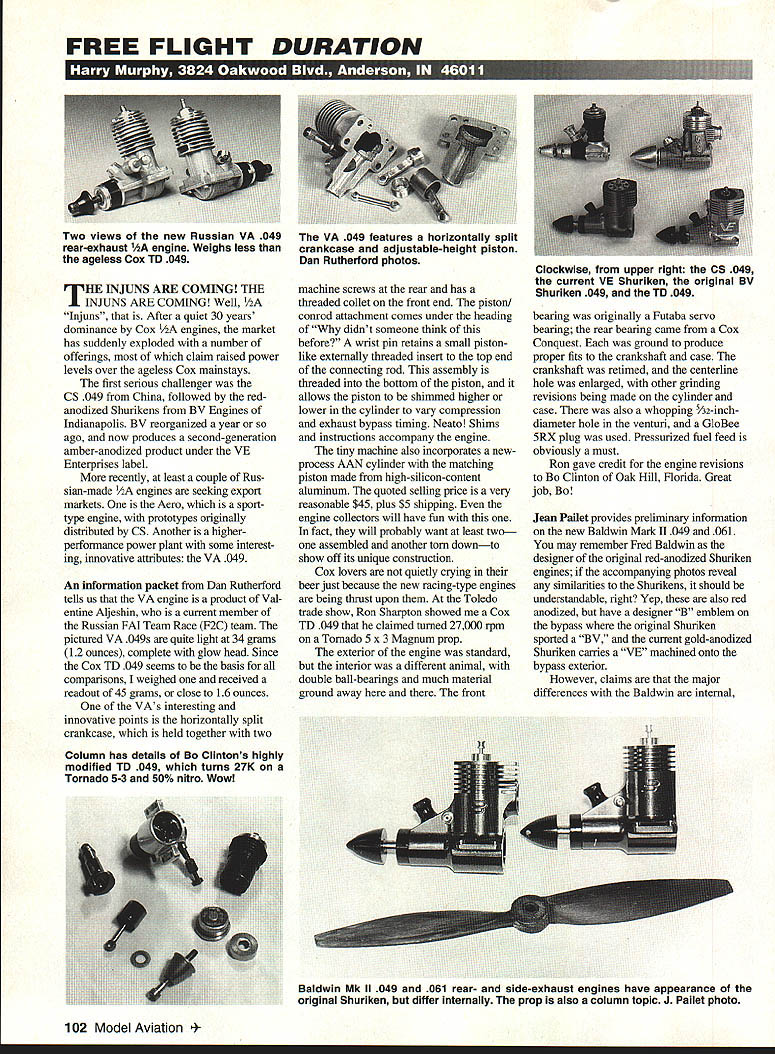
An information packet from Dan Rutherford tells us that the VA engine is a product of Valentine Aljeshin, who is a current member of the Russian FAI Team Race (F2C) team. The pictured VA .049s are quite light at 34 grams (1.2 ounces), complete with glow head. Since the Cox TD .049 seems to be the basis for all comparisons, I weighed one and received a readout of 45 grams, or close to 1.6 ounces.
One of the VA's interesting and innovative points is the horizontally split crankcase, which is held together with two machine screws at the rear and has a threaded collet on the front end. The piston/conrod attachment comes under the heading "Why didn't someone think of this before?" A wrist pin retains a small piston-like externally threaded insert on the top end of the connecting rod. This assembly is threaded into the bottom of the piston, and it allows the piston to be shimmed higher or lower in the cylinder to vary compression and exhaust bypass timing. Neat! Shims and instructions accompany the engine.
This tiny machine also incorporates a new-process AAN cylinder with the matching piston made from high-silicon-content aluminum. The quoted selling price is a very reasonable $45, plus $5 shipping. Even engine collectors will have fun with this one. In fact, they will probably want at least two—one assembled and another torn down to show off its unique construction.
Cox lovers are not quietly crying in their beer just because the new racing-type engines are being thrust upon them. At the Toledo trade show, Ron Sharpton showed me a Cox TD .049 that he claimed turned 27,000 rpm on a Tornado 5 x 3 Magnum prop.
The exterior of the engine was standard, but the interior was a different animal, with double ball bearings and much material ground away here and there to produce proper fits. The front bearing was originally a Futaba servo bearing; the rear bearing came from a Cox Conquest. Each was ground to produce proper fits to the crankshaft and case. The crankshaft was retimed, and the centerline hole was enlarged, with other grinding revisions being made on the cylinder and case. There was also a whopping 5/32-inch diameter hole in the venturi, and a GloBee 5RX plug was used. Pressurized fuel feed is obviously a must.
Ron gave credit for the engine revisions to Bo Clinton of Oak Hill, Florida. Great job, Bo!
Jean Paillet provides preliminary information on the new Baldwin Mark II .049 and .061. You may remember Fred Baldwin as the designer of the original red-anodized Shuriken engines; if the accompanying photos reveal any similarities to the Shurikens, it should be understandable. Yep, these are also red-anodized, but have a designer "B" emblem on the bypass where the original Shuriken sported a "BV", and the current gold-anodized Shuriken carries a "VE" machined onto the bypass exterior.
Claims are that the major differences with the Baldwin are internal, including incorporation of a ceramic-coated aluminum cylinder liner. One would think a lighter-weight engine would result, and it does. The Baldwin weighs 55 grams (1.94 ounces) compared with the standard Shuriken at 63 grams (2.2 ounces). Availability and price are available by writing.
Rumors: Dale Kim is again dabbling with a double-ball-bearing Cox derivative and apparently is serious about it; he has a Hoosier machine shop turning out new aluminum bar-stock crankcases to house bearings. Anyway, it's a healthy feeling to hear of new activity in the 1/2A engine field.
As you know now, an AMA rules-change proposal to add a 1/2A high-performance-engine class—to prevent millions of Cox TD .049s becoming obsolete—was soundly defeated on the initial ballot. The AMA Free Flight Contest Board originally submitted the proposal to test the waters, and the mailbag rapidly filled with concern that the traditional entry-level event of Cox-powered 1/2A would be destroyed by the megabuck invasion of new racing-type 1/2A engines. Understandably, the expert/progressive community did not come up for air until the proposal saw official print status; then I began getting equal amounts of prose from that faction.
Since the proposal has now been soundly defeated, I suggest that all further pro-class-division writings be redirected to your neighborhood Contest Board members, leaving me out of the controversy altogether. (See how it works? There is method to my madness—ha!) Anyhow, it seems all is not lost—there are renewed efforts to upgrade the basic Cox TD by others, such as those mentioned above. So be it!
I suggest that the aforementioned individuals be contacted directly for information on availability, price, performance data, etc., for each item, as I have related just about my total knowledge. Listed in no particular order, they are:
- CS and Aero engines: CS Engines, 444 Guang Zhong Rd., Shanghai, China.
- Shuriken engines: Van Arsdall Enterprises, Inc., 1205 Country Club Rd., Indianapolis, IN 46234.
- VA engines: Dan Rutherford, 4705 237th Place SE, Bothell, WA 98021.
- Clinton/Cox: Bo Clinton, 251 Bissitt Bay Rd., Oak Hill, FL 32759.
- Baldwin Mk. II: Baldwin Competition Engines, 1217 Country Club Rd., Indianapolis, IN 46234.
Tell 'em Duration pointed you in their direction!
New high-performance 1/2A props
Note the carbon-fiber prop shown in the photo of the Baldwin 1/2A engines. It is the result of an ongoing project by Jean Paillet:
"The prop shown is the outgrowth of the static thrust tests I've been running on various 1/2A–F1J props for a number of years, and which were described in the 1991 NFFS Symposium.
"As you may recall, my static thrust results showed the old-reliable Cox 6 x 3 gray plastic producing the highest static thrust of all readily available commercial props. Later tests on more recently available APCs and Potik/Keck props still show that the Cox 6 x 3 develops the greatest static thrust. The single-blade Rocca props from Italy recorded 16% greater static thrust than the Cox props, but they are very expensive and carry a significant weight penalty (19 grams vs. six grams for the Cox) due to the heavy counterweight required to balance the single blade.
"So, with the help and good counsel of Ron McBurnett, I set out to try to develop a two-bladed (lightweight) prop that would outpull the Cox and, hopefully, equal or better Mario Rocca's great single-blader."
The initial result is a carbon-fiber prop weighing in at five grams, producing 13% more static thrust than the Cox 6 x 3, and just a half-ounce less than the Rocca single-bladed prop. While the photo shows the carbon-fiber version, it is also available in a fiberglass model which yielded the same performance results on Jean's static thrust rig.
Prices on these new props are $7 for the carbon-fiber version and $6 for the fiberglass model. They are available from Acme Aero Composites, 2265 Greenwood Road, Rickreall, OR 97371.
One word of caution: these props are shipped as they come out of the mold, with flashing removed but requiring final finishing and balancing. Based on the static thrust measurements to date, the results are well worth the little bit of extra effort required to finish the props. They are 6-1/4 inches in diameter and 2-5/8 inches pitch. My TD showed a 500-rpm increase over the Cox 6 x 3.
Now, I know there are a lot of flyers who think the only way to go is with an engine screaming on an itty-bitty little toothpick of a prop, and to that all I can say is "to each his own." I can't measure how high your airplane or mine or anyone else's gets (and I've never met anyone who could accurately make that measurement), but I can (and have) measured static thrust, and those measurements confirm my long-standing belief that "bigger is better" in props as in planes!
Thanks, Jean, for sharing your test results and conclusions with us. Anyone wish equal time?
Model finders—Part IV
We still have a few low-cost audio model-finder systems to discuss before we step up to the more expensive electronic types.
I want to thank all who have sent notices, descriptions, photos, and even actual samples for review in this column. The contributions have been most helpful and appreciated; the reader interest has been intense. We take this pause to thank you all, and now we rattle on.
I recently received a surprise package from David Conradt of Concord, Massachusetts, which contained two "Crickets" beeper-type systems—one intended for free flight and the other for RC. They are similar to the Radio Shack do-it-yourself fabrication discussed in Part II, but with a distinct difference in operating procedure.
Both of David's systems have identical beeper and circuit board layouts, but the on-off slide switch and battery power sources are tailored for FF or RC use.
The FF version is lighter (about 32 grams total) and uses the Radio Shack N-size battery box and a 12-volt #23-144 electric-cigarette-lighter battery, but a simple slide switch replaces the toggle switch of our original Radio Shack system.
The black-plastic-hulled beeper unit is about 7/16" deep and 1-5/8" diameter, with two diametrically opposed mounting lugs. The separate circuit board measures 15/16" x 1-1/2", and the assembled electronics give the unit about a 7/16" depth. A slip-on 1/8" x 2" green vinyl circuit board drill shield completes the Cricket.
When I initially switched on the circuit, nothing happened. I thought the unit may have been damaged during shipment, or the battery was dead—when all else fails, one should read the instructions, right? Guess what? April Fool, Murphy—it's supposed to do that! David had built in an adjustable 5- to 25-minute battery-saver delay feature that provides a steady initial tone, then switches to an intermittent beeper a la the Radio Shack unit.
A swamp problem adjacent to his flying site prompted David's interest in a model-finder device. I suppose the delay feature permits a battery-saving pause to allow time to get the boat in the water to retrieve out-of-bounds models. Anyway, it's the first system we have looked at that incorporates a programmable delay.
The RC version is similar, but a standard nine-volt #23-533 Radio Shack battery shoots the scales up to 72 grams, or more than double the weight of the free-flight unit. The special on-off slide switch can replace the normal radio receiver switch, and by using the time-delay feature, you can essentially prevent the model-locator system from ever causing interference with the model's RC receiver in the model. Sounds like another good idea.
Although David was not too clear as to actual pricing of his Crickets, I got the impression they were about $20 for either the FF or RC unit. You can get specific details on pricing and availability from David Conradt, 44 Harrington Ave., Concord, MA 01742.
It was too late to photograph these units before this column's deadline, but I will follow with a suitable photo next time. I am sure that a picture will make the above explanation much easier to follow.
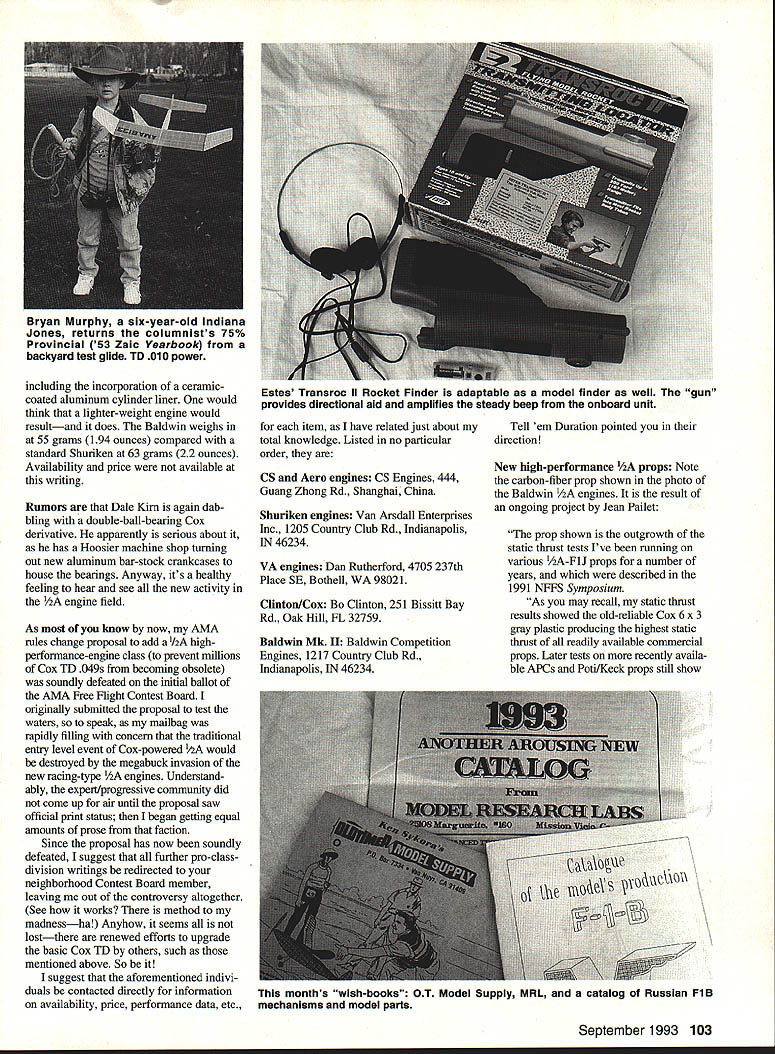
Our final audio system in this series is a second-generation commercial product from the Estes folks called the Transroc II.
The Transroc II consists of a small, high-pitched buzzer activated by a miniature slide switch. A 5/8" x 2-1/2" onboard capsule houses both components and the flight battery (6V Duracell PX28L), with a 16-gram total weight. The receiver unit is unique, as it incorporates an oversized, directional pickup containing a microphone and amplifier to which earphones are connected.
The pickup is basically a "gun," with its 1½-inch bore, pointed toward the downed model; the microphone picks up the audio signal and amplifies it to the earphones. Certainly an interesting concept, but not without some hiccups.
My backyard evaluation disclosed the gun would not only pick up and amplify the transmitter tone, but also bird calls, wind noise, street traffic, and my wife calling me for supper. Also, the "noise" level emitted by the miniature flight buzzer is considerably lower than the other audio systems we evaluated.
However, when I used the gun in conjunction with the Radio Shack transmitter I had installed in a Comet Zipper, the Estes gun/earphone receiver system doubled the effective hearing distance. The gun also seemed to offer more directional accuracy. The upshot was that the Estes gun/earphone receiver unit, or similar units that amplify audio signals, may prove to increase the range and directional effectiveness of any of these low-cost audio model-finder systems.
The Estes Transroc II normally retails for $29.95, but I picked up my evaluation unit at a Toys "R" Us for $5 less.
Catalog department
I wish to draw attention to three items:
- Ken Sykora's 1993 Oldtimer Model Supply catalog. The catalog is overflowing with plans and accessories for vintage scale and endurance models of all sizes. Get your copy by sending $2 to Oldtimer Model Supply, P.O. Box 7334, Van Nuys, CA 91409.
- Model Research Labs (MRL) 1993 list of materials—Kevlar, boron, Mylar, carbon-fiber products, specialized adhesives and the like. Send a large SASE (takes 52 cents in stamps) to Model Research Labs, 25108 Marguerite #160, Mission Viejo, CA 92692, for the basic eight-page listing, with other loose-leaf fillers. A must-have publication for the serious competition flier.
- A unique catalog of products produced in Russia for the FAI F1B (Wakefield) discipline. Most of the professionally engineered parts listed are for F.V. Alexandrovich's F1B model, which you can buy complete with deluxe hardware for $800. Individual parts are listed as well. The U.S. contact is Ron Felix, P.O. Box 74, Solebury, PA 18963; the catalog is $2.
This has turned out to be a rather lengthy column so I had better put a cork in it.
See ya downwind!
Transcribed from original scans by AI. Minor OCR errors may remain.

