
FREE FLIGHT DURATION
Louis Joyner, 4257 Old Leeds Road, Birmingham, AL 35213
The big event this month is, of course, the Free Flight World Championships at Lost Hills, California. Practice begins Monday, October 4, but many of the teams will likely arrive the weekend before to warm up at the 15th California Invitational.
Participating teams (provisional entries received):
- Argentina
- Australia
- Austria
- Belgium
- Brazil
- Bulgaria
- Canada
- Chile
- China
- Denmark
- Finland
- France
- Italy
- Japan
- Latvia
- Mexico
- New Zealand
- Poland
- Slovakia
- Spain
- Switzerland
- United Kingdom
- United States
- Venezuela
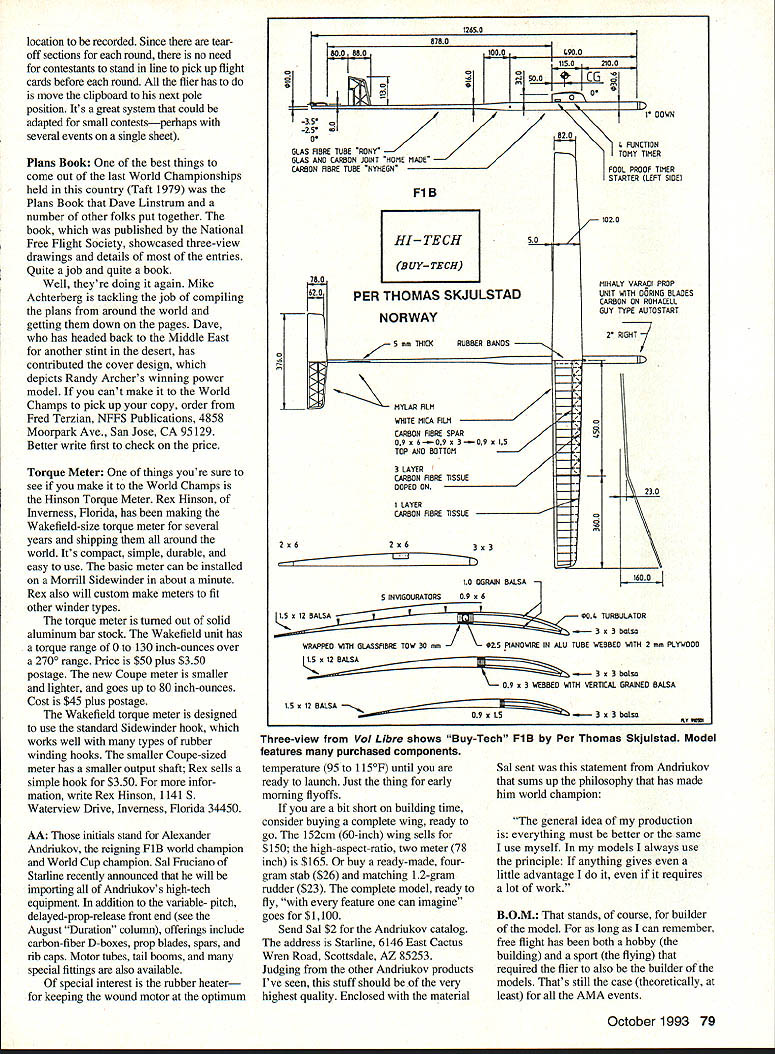
No word on Russia and Ukraine, but Ron Felix (who corresponds with some of the Russian modelers) says air fare could be a major factor, since they no longer enjoy state support. It would be a shame if the reigning world champions in F1A (Mikhail Kochkarov of Russia) and F1B (Alexander Andriukov of Ukraine) could not make it to Lost Hills. The F1C world champion, Randy Archer of Arizona, will be there to defend his title.
The United States team (selected last fall at Lost Hills):
- F1A (glider): Matt Gewain (former world champion), Tom Coussens, Randy Weiler
- F1B (Wakefield): George Xenakis, Chris Matsuno, Fred Pearce
- F1C (power): Ed Keck, Doug Galbreath, Roger Simpson
Contest schedule:
- Wednesday, October 6: F1A towline glider
- Thursday: F1C power
- Friday: F1B Wakefield
- First round each day: 7:55–8:55 a.m.
- Seven one-hour rounds will continue through the day.
- Flyoffs are scheduled each day beginning at 4:45 p.m.; Saturday is reserved for continuation of flyoffs.
- Banquet: Saturday night at the convention center in Bakersfield.
Headquarters hotel: Ramada Inn, 3535 Rosedale Highway, Bakersfield, California.
Event staff:
- Overall contest director: Bill Hartill
- F1A event director: Juan Livotto
- F1C director: Bob Waterman
- F1B director: Ed Turner
- Processing: Paul Crowley
- Timers director: Steve Geraghty
- Scoring: Bill Bogart
Scorecard system: The system to be used at the World Championships was tested at the last team selection finals and worked great. It uses a special 8½ x 11, preprinted, perforated, self-carboning form held in a clipboard. After each flight, the timer tears off the section for that round and takes it to a central processing area.
Plans Book
One of the best things to come out of the last World Championships held in this country (Taft, 1979) was the Plans Book. Dave Linstrum and others put together a book published by the National Free Flight Society showcasing three-view drawings and details of the entries. They’re doing it again. Mike Achterberg is compiling plans from around the world and laying out the pages. Dave Linstrum has contributed the cover design, which depicts Randy Archer’s winning power model.
If you can’t make the World Champs, pick up a copy. To order, write: Fred Terzian, NFFS Publications, 4858 Moorpark Ave., San Jose, CA 95129. Better write the first check.
Torque Meter
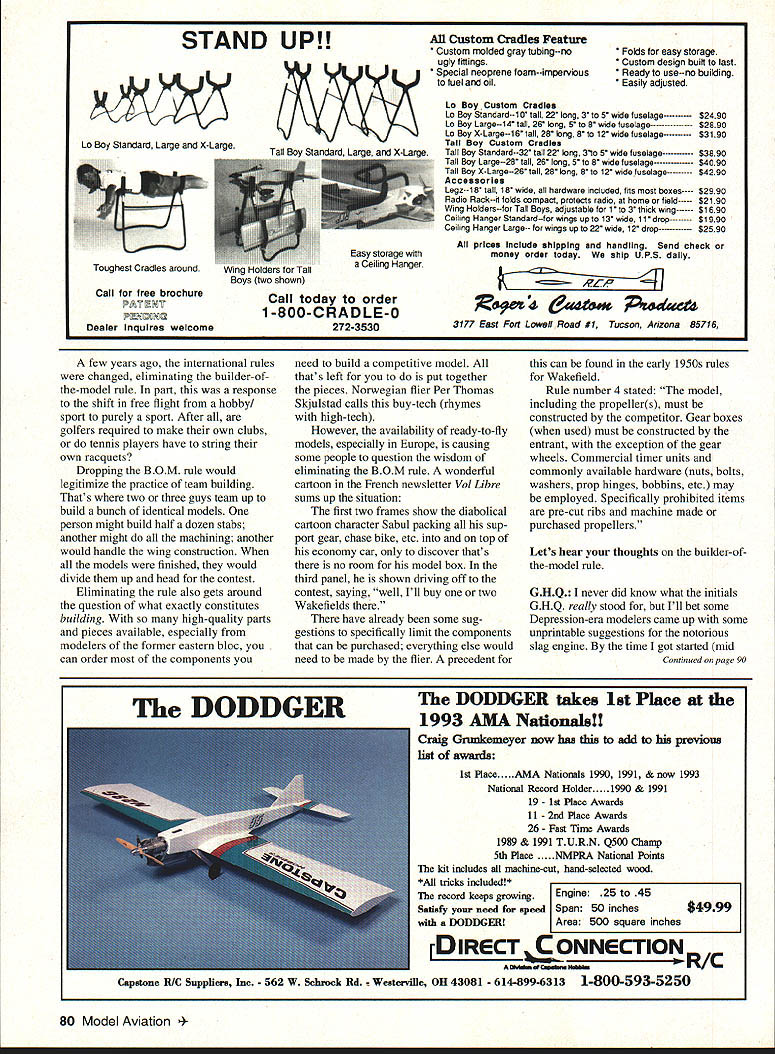
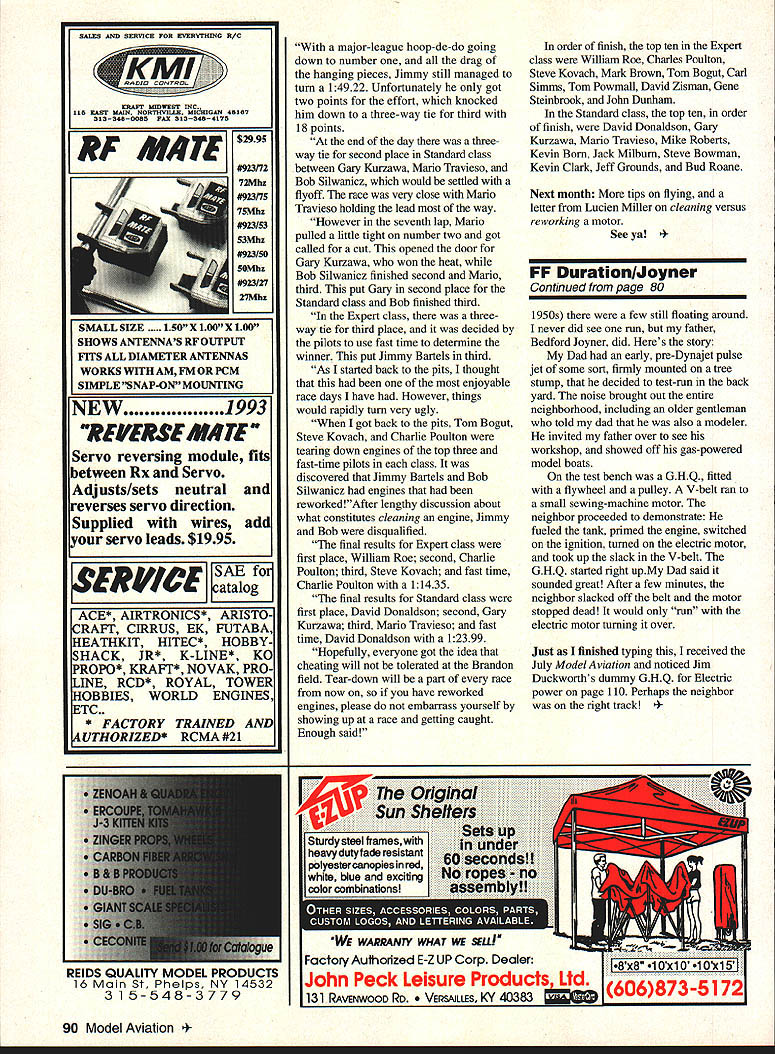
Things you’re sure to see at the World Champs. Rex Hinson of Inverness, Florida, has been making Wakefield-size torque meters for several years and shipping them around the world. It’s a compact, simple, durable, easy-to-use basic meter that can be installed on a Morrill Sidewinder in about a minute. Rex also will custom-make meters to fit other winder types.
- Construction: Machined out of solid aluminum bar stock.
- Wakefield unit: torque range 0–130 inch-ounces over a 2700 range. Price: $50 plus $3.50 postage.
- New Coupe meter: smaller and lighter, goes up to 80 inch-ounces. Cost: $45 plus postage.
- Wakefield meter uses the standard Sidewinder hook and works with most rubber winding hooks.
- Coupe-sized meter has a smaller output shaft; Rex sells a simple hook for $3.50.
For information, write: Rex Hinson, 11415 Waterview Drive, Inverness, Florida.
AA (Alexander Andriukov)
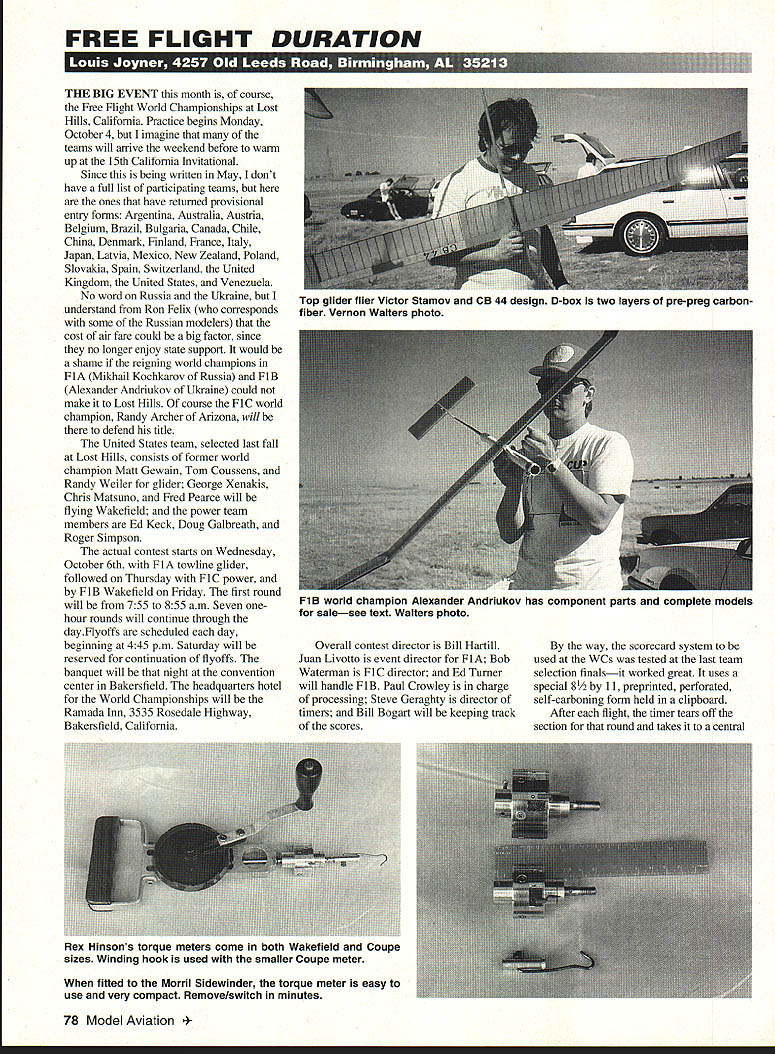
AA refers to Alexander Andriukov, the reigning F1B world champion and World Cup champion. Sal Feliciano of Starline recently announced he will be importing all of Andriukov’s hi-tech equipment. In addition to the variable-pitch delayed-prop-release front end, offerings include carbon-fiber D-boxes, prop blades, spars, and rib caps. Motor tubes, tail booms, and many special fittings are also available.
Of special interest is the rubber heater—for keeping the wound motor at the optimum temperature (95–115°F) until you’re ready to launch. Ideal for early morning flyoffs.
If short on building time, consider buying a complete wing ready to go:
- 152 cm (60-inch) wing: $150
- High-aspect-ratio 2-meter (78-inch) wing: $165
- Ready-made fuselage: price not listed
- Stabilizer: $26
- Matching 1.2-gram rudder: $23
- Complete ready-to-fly model with full features: $1,100
Send $2 for the Andriukov catalog to: Starline, 6146 E. Cactus Wren Road, Scottsdale, AZ 85253.
Andriukov’s philosophy, enclosed with the material Sal sent, sums up why he’s a world champion: "The general idea of my production is: everything must be better or the same as I use myself. In my models I always use the principle: If anything gives even a little advantage I do it, even if it requires a lot of work."
B.O.M.
B.O.M. stands for Builder Of the Model. For as long as I can remember, free flight has been both a hobby (the building) and a sport (the flying) that required the flier to also be the builder of the models. That’s still the case (theoretically, at least) for all AMA events.
A few years ago, the international rules were changed, eliminating the builder-of-the-model rule. This was partly a response to the shift in free flight from a hobby/sport to purely a sport. After all, are golfers required to make their own clubs, or do tennis players have to string their own rackets?
Dropping the B.O.M. rule legitimized team building, where two or three people team up to build a number of identical models (one person might build stabs, another handle machining, another the wings). Eliminating the rule also sidestepped the question of what exactly constitutes “building.” With many high-quality parts available—especially from modelers of the former eastern bloc—you can order most components and simply assemble them. Norwegian flier Per Thomas Skjulstad calls this “buy-tech” (rhymes with high-tech).
However, the availability of ready-to-fly models, especially in Europe, is causing some to question the wisdom of eliminating the B.O.M. rule. A cartoon in the French newsletter Vol Libre illustrates the situation: a character packs all his gear into a small car only to discover there’s no room for his model box, and drives off saying, “Well, I’ll buy one or two Wakefields there.”
There have been suggestions to specifically limit which components may be purchased, leaving the rest to be made by the flier. A precedent exists in the early 1950s Wakefield rules:
Rule number 4 stated: "The model, including the propeller(s), must be constructed by the competitor. Gear boxes (when used) must be constructed by the entrant, with the exception of the gear wheels. Commercial timer units and commonly available hardware (nuts, bolts, washers, prop hinges, bobbins, etc.) may be employed. Specifically prohibited items are pre-cut ribs and machine made or purchased propellers."
Let’s hear your thoughts on the builder-of-the-model rule.
G.H.Q.
G.H.Q.: I never did know what the initials G.H.Q. really stood for, but I’ll bet some Depression-era modelers came up with some unprintable suggestions for the notorious old engine. By the time I got started (mid-1950s) there were still some around. I never saw one run, but my father, Bedford Joyner, did. Here’s the story:
My dad had an early, pre-DynaJet pusher of some sort, firmly mounted on a tree stump, that he decided to test-run in the backyard. The noise brought out the entire neighborhood, including an older gentleman who told my dad he was also a modeler. He invited my father over to see his workshop and showed off his gas-powered model boats.
On the test bench was a G.H.Q., fitted with a flywheel and a pulley. A V-belt ran to a small sewing-machine motor. The neighbor demonstrated: he fueled the tank, primed the engine, switched on the ignition, turned on the electric motor, and took up the slack in the V-belt. The G.H.Q. started right up. My dad said it sounded great! After a few minutes, the neighbor slacked off the belt and the motor stopped dead—it would only “run” with the electric motor turning it over.
Just as I finished typing this, I received the July Model Aviation and noticed Jim Duckworth’s dummy G.H.Q. for electric power on page 110. Perhaps the neighbor was on the right track!
Transcribed from original scans by AI. Minor OCR errors may remain.

