
FREE FLIGHT DURATION
Harry Murphy, 3824 Oakwood Blvd., Anderson, IN 46011
Balloon Surgery
There is little more frustrating than having a pacifier or a balloon full of fuel let go in your lap while attempting to start an engine with a pressurized fuel system. Upon returning home from a flying session my wife took one look at my clothes, shook her head, and quipped about why I must periodically bathe in the stuff while ruining another shirt and pair of trousers.
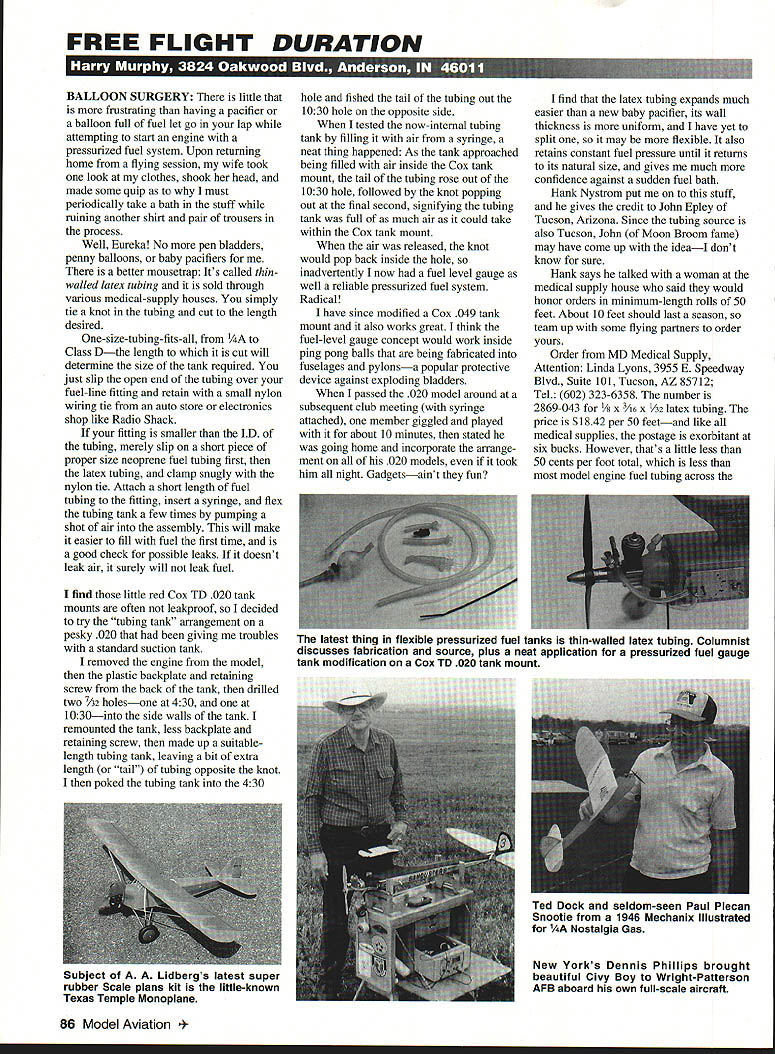
Eureka! No more pen bladders, penny balloons, or baby pacifiers. There is a better mousetrap: thin-walled latex tubing sold through medical-supply houses. You simply tie a knot in the tubing and cut it to the desired length.
One size of tubing fits all, from 1/4A to Class D—the length determines the tank capacity. Slip the open end of the tubing over your fuel-line fitting and retain it with a small nylon wiring tie from an auto store or electronics shop.
If your fitting is smaller than the I.D. of the tubing, slip on a short piece of proper-size neoprene fuel tubing first, then the latex tubing, and clamp snugly with the nylon tie. Attach a short length of fuel tubing to the fitting, insert a syringe, and flex the tubing tank a few times by pumping a shot of air into the assembly. This makes it easier to fill with fuel the first time and is a good leak check: if it doesn't leak air, it surely will not leak fuel.
I found the little red Cox TD .020 tank mounts often are not leakproof, so I tried the "tubing tank" arrangement on a pesky .020 that had given me trouble with a standard suction tank. I removed the engine, then the plastic backplate and retaining screw from the back of the tank, then drilled two 7/32" holes—one at 4:30 and one at 10:30—into the side walls of the tank. I remounted the tank (without backplate and retaining screw), then made up a suitably sized tubing tank, leaving a bit of extra length (a "tail") opposite the knot. I poked the tubing tank into the 4:30 hole and fished the tail out the 10:30 hole on the opposite side.
When I tested the now-internal tubing tank by filling it with air from a syringe, a neat thing happened: as the tank approached being filled with air inside the Cox tank mount, the tail rose out of the 10:30 hole, followed by the knot popping out at the final second—signifying the tubing tank was full of as much air as it could take within the Cox mount.
When the air was released, the knot popped back inside the hole, so I inadvertently had a fuel-level gauge as well as a reliable pressurized fuel system. Radical!
I have since modified a Cox .049 tank mount and it also works great. I think the fuel-level gauge concept would work inside ping-pong balls that are being fabricated into fuselages and pylons—a popular protective device against exploding bladders. I passed the .020 model around at a subsequent club meeting (with syringe attached); one member giggled and played with it for about 10 minutes, then stated he was going home to incorporate the arrangement on all of his .020 models, even if it took him all night. Gadgets—ain't they fun?
The latex tubing expands much easier than a new baby pacifier, its wall thickness is more uniform, and I have yet to split one; it may be more flexible. It also retains constant fuel pressure until it returns to its natural size, and gives me much more confidence against a sudden fuel bath.
Hank Nystrom put me onto this stuff and credits John Epley of Tucson, Arizona. Since the tubing source is also Tucson, John (of Moon Broom fame) may have originated the idea—I don't know for sure.
Hank says he talked with a woman at the medical supply house who said they will honor orders in minimum-length rolls of 50 feet. About 10 feet should last a season, so team up with flying partners to order yours.
Order from MD Medical Supply:
- MD Medical Supply, Attention: Linda Lyons, 3955 E. Speedway Blvd., Suite 101, Tucson, AZ 85712
- Tel.: (602) 323-6358
- Part number: 2869-043 for 1/8" x 3/16" x 1/32" latex tubing
- Price: $18.42 per 50 feet; postage about $6 (≈ $0.50/ft total)
Model Finders—Part V
First, check the photo of David Comeau's Cricket audio model finder system that we reviewed in our last session. David's free-flight version differs from the RC version only by a more complicated slide switch and a much heavier nine-volt battery.
This month we leap from simpler audio model finder systems into the more sophisticated realm of electronic model finders. An onboard miniature radio transmitter (Tx) in the model emits a signal inaudible to the human ear but picked up on a hand-held radio receiver (Rx).
Although the purpose remains the same—to find the wayward model—electronic or radio systems are usually more effective at greater ranges, generally emit stronger signals for longer periods before batteries are depleted, and, with proper Rx antenna and practice, can be satisfactorily directional. They are, however, considerably more expensive. Depending on complexity and manufacturer, cost can range from about $70 to well over $500.
There are tradeoffs: each system has its own Tx size, weight, adaptability between models, and sophistication of Rx and antennas. In general, you get about what you pay for.
To kick off our review we selected a very reliable, low-cost system that operates on the 27 MHz radio band (Citizen's Band): the Model Beacon, produced by 700 West. Although quite new to the marketplace, proprietor Moe Whittemore tells us sales have been brisk. One selling point is that it utilizes any commercial CB unit as its Rx—something many prospective buyers probably already own.
If you don't have a CB Rx, Radio Shack sells one for $19.95 that works well. As Moe says, cheaper Rxs produce more static; the more "racket" they make, the easier it is to interpret the radio beep transmitted by the Model Beacon Tx.
Product details:
- Onboard Tx weight: about 4 grams (with a wafer-thin CR1616 three-volt lithium battery)
- Dimensions: about 7/8" x 1 1/16" x 5/8"
- The flight unit mounts easily to a battery hatch; miniature connectors attach the battery and antenna leads.
- You can request any CB channel you want; the Model Beacon can be supplied with the appropriate crystal. Your Rx must incorporate the same channel crystal.
- Moe recommends a 30 AWG wire antenna stretching wingtip to wingtip inside the wing. If the wing is already covered, routing inside the model from stab to cabin and back to the tail (top and bottom runs) works satisfactorily.
For the receiver I purchased a Realistic TRC-90 CB Rx at Radio Shack for $19.95. Moe sells his Tx unit for $50, including battery, antenna wire, miniature connectors, mounting hardware, and shipping—so you can be in business for about $70 initial outlay (or $20 less if you already have a handheld CB unit).
For convenience I installed a mini toggle switch in both Dodgers to turn the lithium battery off and on. Simpler methods work too: a strip of index card can be shoved between the battery and its positive contact to serve as a weightless switch. Battery life is about 30 hours, cumulative.
Order from 700 West:
- M. J. Whittemore, Jr., 2348 South 700 West, New Palestine, IN 46163
- Tel.: (317) 861-4266
You can't get into electronic model locators for less money anywhere I know of.
New Stuff Department
We have a mixture this month, leading off with a new competition model kit from Campbell's Custom Kits. This is a stick-and-tissue P-30 designed by Thomas Greenhalgh, which won the 1990 U.S. Free Flight Champs and also holds the Open AMA record, set by Paul Herbst in 1990.
Called the Majesty (or the Charles Bronson Special—remember Mr. Majestyk?), the model has the standoff appearance of an Old-Timer-era rubber ship despite up-to-date performance.
The kit is typical Campbell quality: precut ribs and wingtips, rolled plans, hardware package, Japanese tissue, plastic competition prop, and great balsa. Ample 1/4" flat rubber is also included.
- Price: $21.98 through dealers who carry Campbell; add $4 to order direct.
- Campbell, Inc., 40 Executive Center Drive, H-108, West Palm Beach, FL 33401
Our 24-page model-supply catalog-of-the-month comes from Hobby Supply South of Acworth, GA. It's their first catalog; they have served Atlanta area modelers since 1986. They carry many adhesives and products from British and domestic manufacturers.
- Catalog: $2 (you receive the next issue automatically if you order)
- Hobby Supply South, 5060 Glade Rd., Acworth, GA 30101
- Tel.: (404) 974-0843
Terry Rimert has reprinted his initial Nostalgia plan book (volume one of a three-volume work). The second edition contains the same plans as the first but is much enlarged, with an index of plans and a complete set of the current 1991 NFFS Nostalgia Gas rules, including design and engine eligibility lists. Terry says the price has increased but specifics are available through Lee Campbell.
Terry's quest for the Tahiti Racer plans has been fruitful: a fellow from Phoenix recently yielded the plans to Bob Lash, chairman of the NFFS NosGas Review Board. Look up Terry at the Nats and thank him for his Nostalgia plan books—there is nothing like documented plans to keep a model activity alive and well.
Al Lidberg credits Dick Padgham of Ft. Worth, Texas, for getting him started on information about the Texas Temple Monoplane. The designer and builder, George Williams, began the aircraft in Temple, Texas, during the 1920s as WW I surplus supplies dwindled. The fuselage and engine were first based on the Jenny, but used a single parasol wing. Supposedly only three aircraft were built; George was killed during a test flight.
In 1990 Jerry Fennal of Temple revived the design by building a full-scale replica using a Warner Scarab for power. Al's 37½-inch replica is based on photos and factory drawings, with accuracy confirmed by Jerry Fennal.
AAL/Imp's deluxe plan kit of the TM contains:
- large three-view
- seven pages of photos
- instructions and history
- the construction plan and instrument panel
- color decals
Price: $8, plus $1.60 postage. Add $1.50 for Al's 16-page illustrated catalog of other scale projects.
- AAL/Imp, 614 E. Fordham Dr., Tempe, AZ 85283
- Tell 'em Duration sent you!
Stels 1/2A Engine
From St. Petersburg, Russia, comes an attractive 1/2A import: the Stels. The engine is distinctive—gold cylinder fins, bright front spinner washer, and unique twin round exhaust pipes extending about 60° to each side of the rear.
The engine comes without a glow head but accepts most aftermarket products (Cox .049 glow heads, GloBee button heads SRX/SR/SRP, and the Nelson glow plug with adapter head).
Performance and features:
- I have seen a Stels turn 29,200 rpm on a 6 x 2 APC prop cut down to 5.5" using 50% nitro. My engine logs 27K+ runs after just a few minutes.
- APC now makes a genuine 5.5 x 2 prop, so cutting tips is unnecessary.
- Weight: 43–44 grams (same as the Cox TD .049)
- Mounting lug holes match Cox, making interchangeability easy.
- The engine does not rev quite as high on the Nelson arrangement as with a GloBee 5RX button, but plug life is much longer.
- Twin exhausts give a muffled sound and cleaner, less oily models.
I purchased my Stels through Doug Galbreath for $72 at this writing; add $10 for the adapter head and $3 for a Nelson plug. Total about $85, plus $3 shipping.
- Doug Galbreath, 2810 McClellan, Davis, CA 95616
- Tel.: (916) 753-2519
- Check current pricing and availability before ordering.
International importer note: A few months back we mentioned the AD 06 being available direct from Italy at $165. That information proved erroneous—an importer notified me he has been the sole U.S. importer since Jan 1, 1993, and direct orders to Italy will no longer be accepted. Current prices at this writing are $208 for the .06 and $242 for the .15 FAI engine, plus $6 each for shipping and handling.
Because printed information will be several months old by the time it appears, send a SASE inquiry before placing an order. The current U.S. contact is:
- Bill Lynch, 11137 Creekhaven Court, Auburn, CA 95602
- Tel.: (916) 823-1037
Foreign manufacturers increasingly try to latch onto American markets; a cool head and patience are advisable when dealing with availability and pricing.
See ya downwind!
Transcribed from original scans by AI. Minor OCR errors may remain.

