
FREE FLIGHT DURATION
Harry Murphy, 3824 Oakwood Boulevard, Anderson, IN 46011
FREE FLIGHT AT MUNCIE
At the time of writing (third week of August), the Central Ohio Free Flight Club had just completed a super two-day free flight contest at the AMA Muncie site. The south field had been recently mowed, and the hay field north of Crossfield Road was being cut, baled, and sold to a local farmer. Peripheral fields that were planted in corn last year are now soybeans and vice versa. A long north–south, tree‑infested fence line east of the old hog barns (now renovated as storage sheds) is gone, aided by a couple of huge bulldozers.
With ten days left before the ’93 AMA NATS/USOC and a promise from AMA that the south side of the field will receive another cutting prior to the five‑day event, the site should be very well prepped for chase bikes. Anticipation for a great week of free flight is running high. Thanks to the folks at AMA HQ for preparing the fields so we can “do our thing” with the fewest problems. Muncie is improving with time, and rumors say no corn will be planted on the premises next season.
The Racer
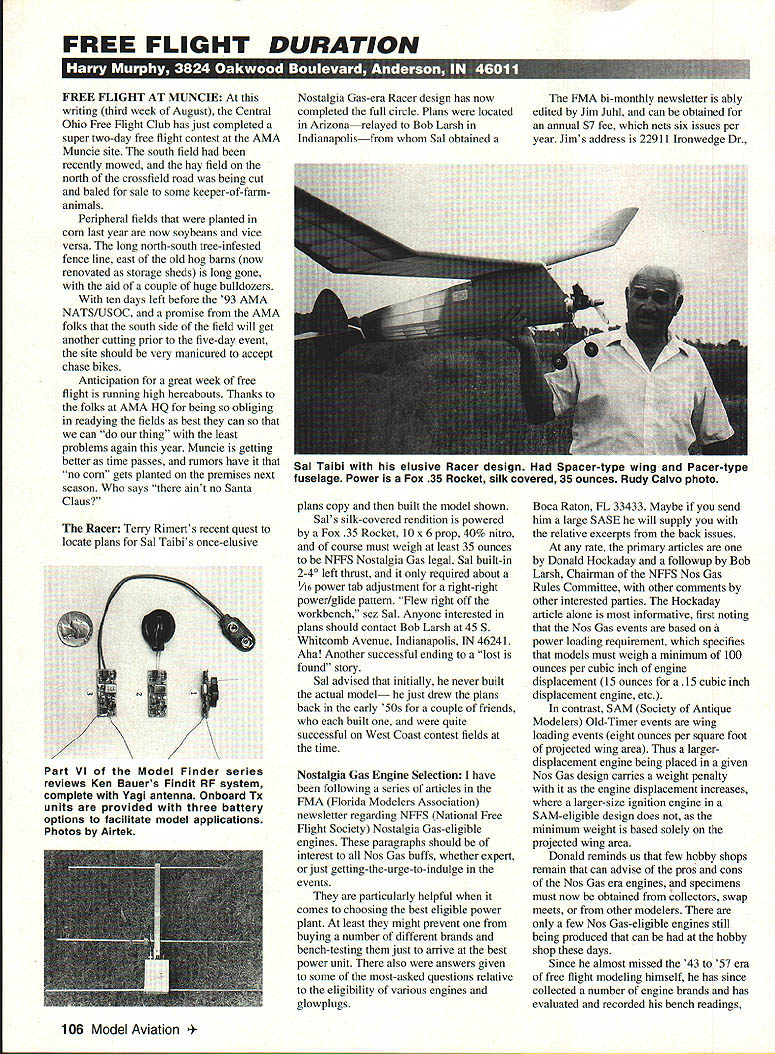
Terry Rimert’s recent request to locate plans for Sal Taibi’s once‑elusive Nostalgia Gas‑era Racer design has come full circle. Plans were located in Arizona, relayed to Bob Larsh in Indianapolis, and Sal obtained a copy and built the model shown.
Sal’s silk‑covered rendition is powered by a Fox .35 Rocket with a 10×6 prop, running on 40% nitro. To be NFFS Nostalgia Gas legal it must weigh at least 35 ounces. Sal built in 2–4° left thrust; it only required about a 1/16" power tab adjustment to achieve a right‑right power/glide pattern. “Flew right off the workbench,” says Sal. Anyone interested in plans should contact Bob Larsh at 45 South Whitcomb Avenue, Indianapolis, IN 46241.
Sal also advised that he initially never built the actual model—he drew the plans back in the early ’50s for a couple of friends, who built and flew them successfully on West Coast contest fields.
Model Finder — Airtek Findit RF System
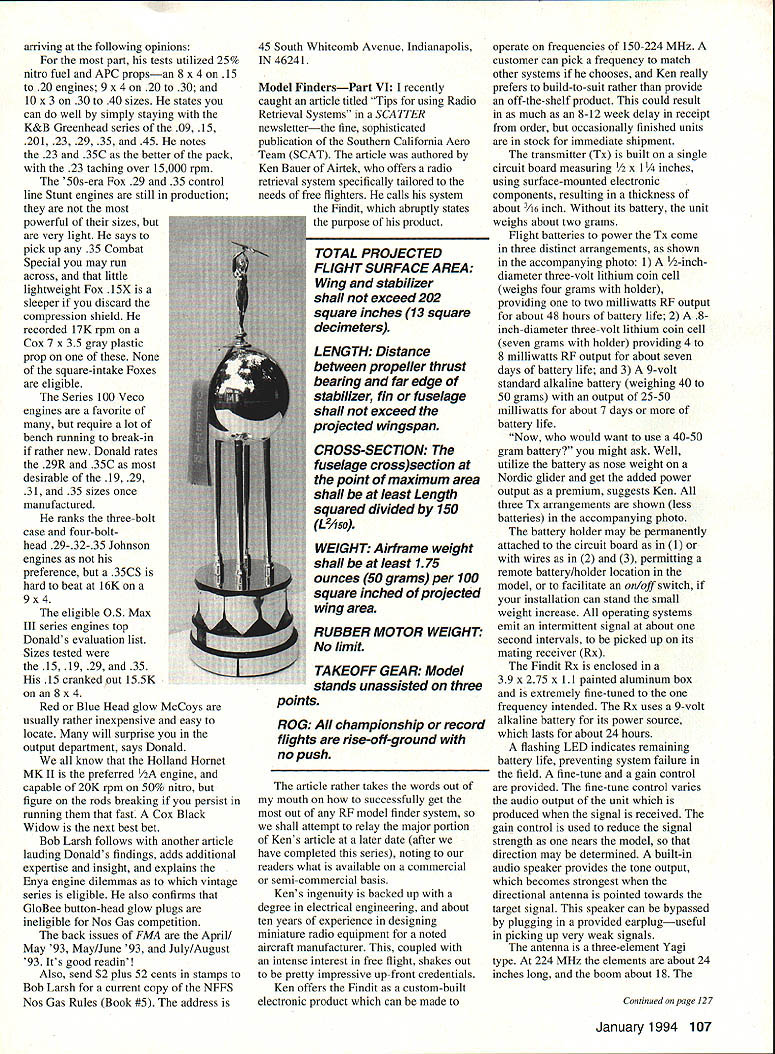
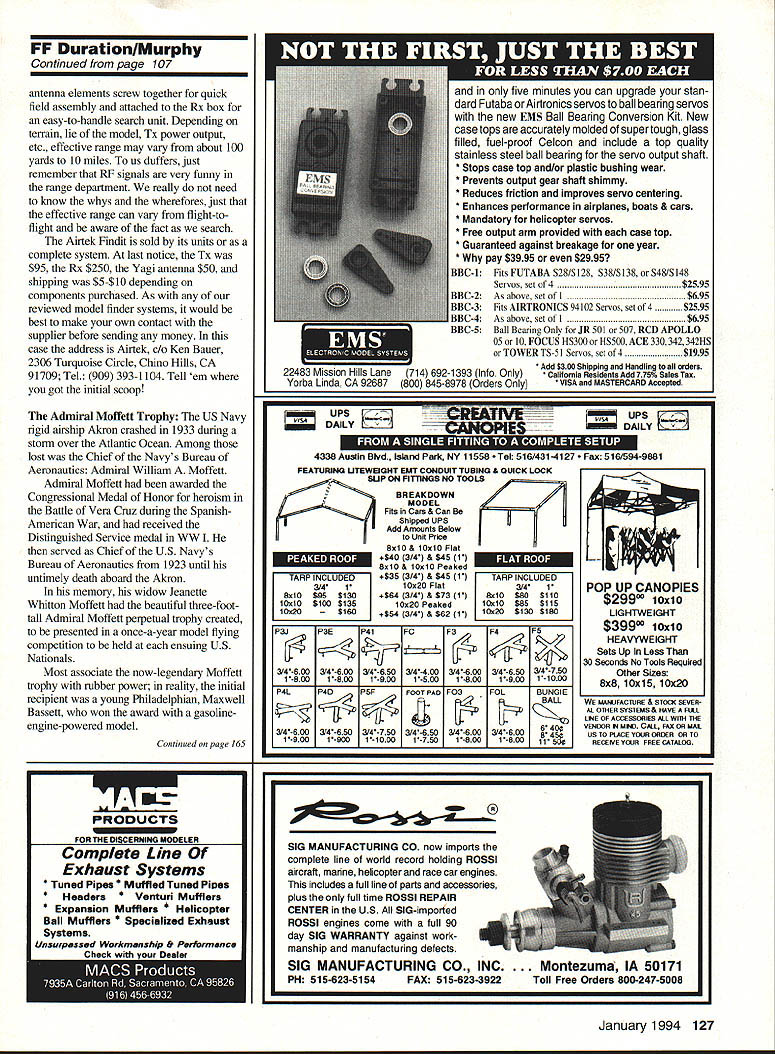
A few notes on the Airtek Findit radio‑finder system: antenna elements screw together for quick field assembly and attach to the receiver box to form an easy‑to‑handle search unit. Depending on terrain, line‑of‑sight to the model, transmitter power output, and other factors, effective range can vary greatly—from about 100 yards to as much as 10 miles. RF signals can be unpredictable; expect range to vary from flight to flight and plan searches accordingly.
The Airtek Findit is sold by components or as a complete system. At last notice: transmitter $95, receiver $250, Yagi antenna $50, and shipping $5–$10 depending on components purchased. As with any reviewed model finder, contact the supplier directly before sending money. Address: Airtek, c/o Ken Bauer, 2306 Turquoise Circle, Chino Hills, CA 91709; Tel.: (909) 393‑1104.
NOSTALGIA GAS — Engine Selection and Resources
I have been following a series of articles in the FMA (Florida Modelers Association) newsletter regarding NFFS (National Free Flight Society) Nostalgia Gas‑eligible engines. These writeups—particularly a primary article by Donald Hockaday and a followup by Bob Larsh (Chairman, NFFS Nostalgia Gas Rules Committee)—are useful for anyone interested in Nostalgia Gas events, whether experienced or just getting started. They help when choosing an eligible power plant and answer many eligibility questions about engines and glow plugs.
FMA’s bi‑monthly newsletter is edited by Jim Juhl and can be obtained for an annual $7 (six issues). Jim’s address: 22911 Ironwedge Dr., Boca Raton, FL 33433.
Key points and engine observations from Donald Hockaday’s testing (tests typically used 25% nitro fuel and APC props: 8×4 for .15–.20, 9×4 for .20–.30, and 10×3 for .30–.40):
- Nostalgia Gas events are based on a power‑loading requirement: models must weigh a minimum of 100 ounces per cubic inch of engine displacement (e.g., 15 ounces for a .15 ci engine).
- By contrast, SAM Old‑Timer events use wing loading (8 ounces per square foot of projected wing area). Thus increasing engine displacement in a Nostalgia Gas design carries a weight penalty that does not apply in SAM events.
- K&B Greenhead series (.09, .15, .20, .23, .29, .35, .45) performed well overall; the .23 and .35C stood out, with the .23 exceeding 15,000 rpm in tests.
- Fox .29 and .35 control‑line stunt engines (’50s era) are still in production; they are light if not the most powerful. Seek any Fox .35 Combat Special you find. The Fox .15X is a “sleeper” if you discard the compression shield—one recorded 17,000 rpm on a Cox 7×3.5 prop. Note: none of the square‑intake Foxes are eligible.
- Veco Series 100 engines are popular but may require extensive bench break‑in if new. The .29R and .35C versions are especially desirable.
- Johnson three‑bolt‑case and four‑bolt‑head .29–.35 engines were not the author’s preference, though a .35C can run about 16,000 rpm on a 9×4.
- O.S. Max III series (tested sizes .15, .19, .29, .35) topped Hockaday’s list; a .15 reached about 15,500 rpm on an 8×4.
- Red‑ or blue‑head glow McCoys are usually inexpensive and can be surprisingly capable.
- The Holland Hornet Mk II is the preferred 1/2A engine and can reach ~20,000 rpm on 50% nitro, though rod failures are possible at sustained high rpm. A Cox Black Widow is the next best 1/2A option.
Bob Larsh’s followup supports many of Hockaday’s findings, clarifies which Enya vintage series are eligible, and confirms that Globe button‑head glow plugs are ineligible for Nostalgia Gas competition.
To obtain a current copy of the NFFS Nostalgia Gas Rules (Book #5), send $2 plus 52¢ in postage to Bob Larsh, 45 South Whitcomb Avenue, Indianapolis, IN 46241.
Relevant FMA back issues: April/May ’93, May/June ’93, and July/August ’93.
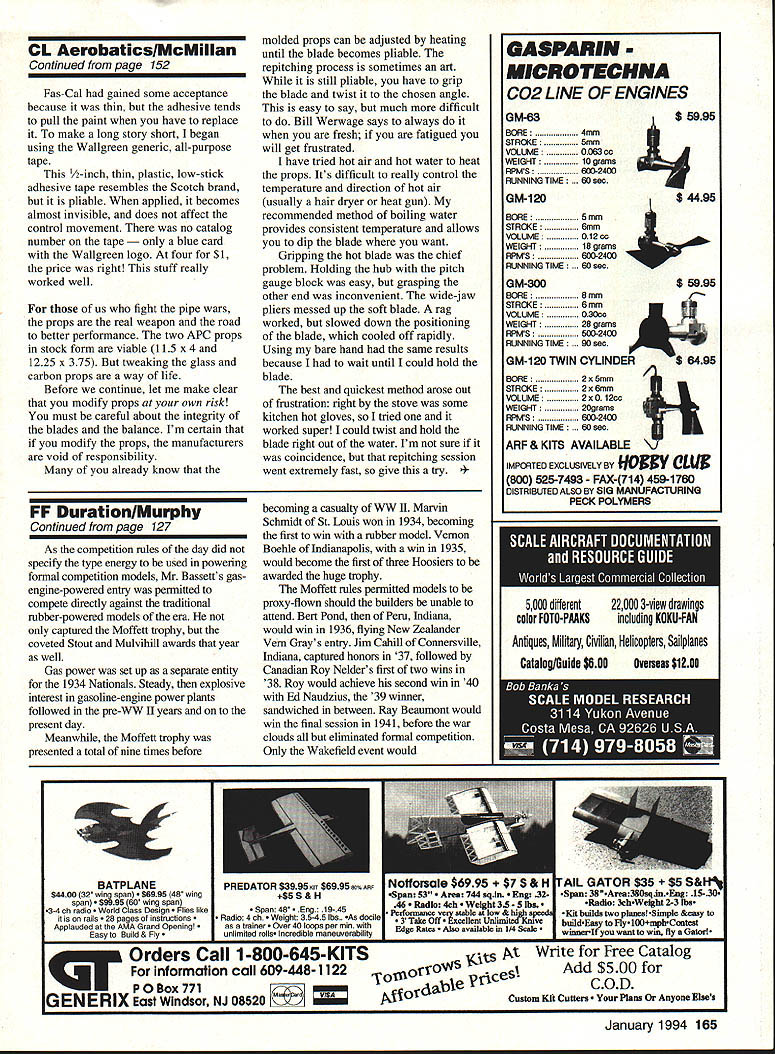
MOFFETT TROPHY HISTORY
Early competition rules did not always specify the type of energy allowed, so gasoline‑powered entries could compete against traditional rubber‑powered models. Mr. Bassett’s gasoline‑powered entry was permitted to compete and that year captured the Moffett Trophy plus the Stout and Mulvihill awards. Gas power was established as a separate entry at the 1934 Nationals, and interest in gasoline engines grew steadily through the pre‑WWII years and beyond.
The Moffett Trophy was presented nine times before becoming a casualty of WWII. Winners include:
- 1934: Marvin Schmidt (St. Louis) — first to win with a rubber model
- 1935: Vernon Boehle (Indianapolis) — first of three Hoosiers to win
- 1936: Bert Pond (Peru, Indiana) — flown by proxy (Vern Gray’s entry)
- 1937: Jim Cahill (Connersville, Indiana)
- 1938: Roy Nelder (Canada)
- 1939: Ed Naudzius
- 1940: Roy Nelder (second win)
- 1941: Ray Beaumont — last session before the war effectively ended formal competition (only the Wakefield event survived)
The Moffett rules permitted proxy flying if the builder could not attend, which led to a few notable proxy victories.
Transcribed from original scans by AI. Minor OCR errors may remain.

