
Free Flight: Duration
Louis Joyner, 4257 Old Leeds Road, Birmingham, AL 35213
Correspondence with Jørgen Korsgaard
For four or five years I've corresponded with Danish Wakefield flier Jørgen Korsgaard (he actually lives just across the border in Germany). Jørgen has also been known to dabble in towline gliders from time to time; his "Hot-Max" F1H design was named to the Top Ten list in the 1982 NFFS Symposium.
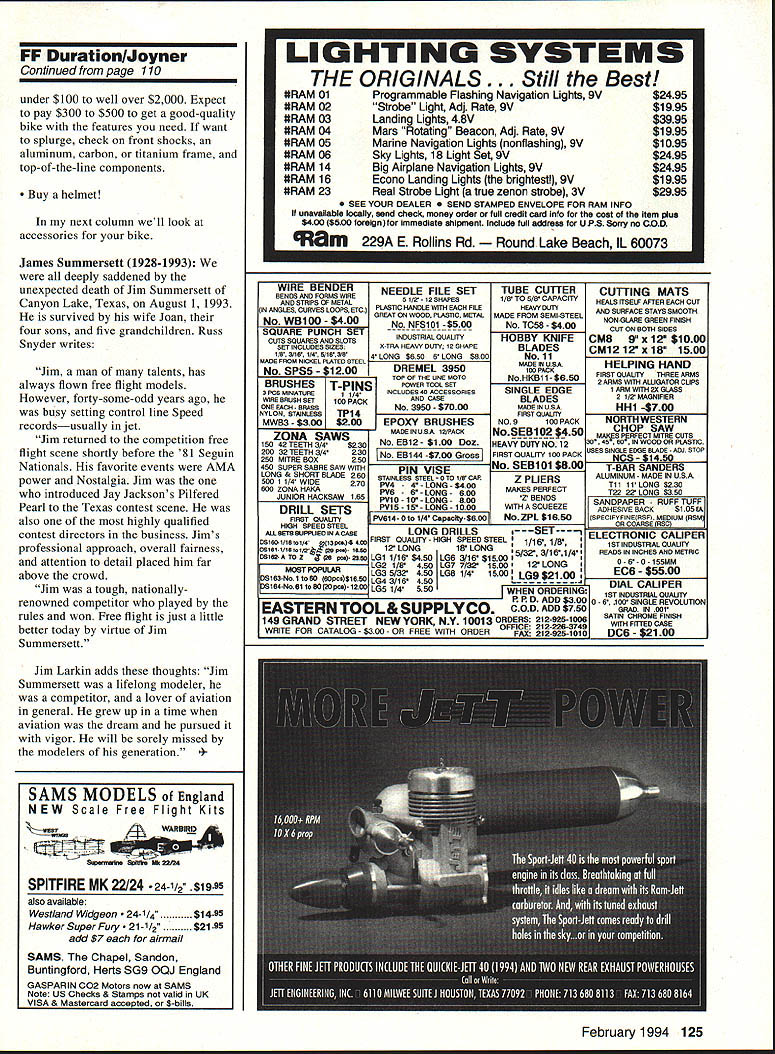
He recently sent plans for his AK-2 F1A model, designed for his teenage son Anders. At the Stonehenge Cup last Easter in England, Anders finished a credible 27th out of 48 flying the simple straight-tow model.
AK-2 and Anders at Stonehenge Cup (Jørgen's account)
"The weather was cold and windy. On glider day my son flew our new straight-hook model for the first time in tow launch, as we had not had time and the weather for trimming. He flew bravely in the hard wind and heavy rain. He is 13 years old and now an eager free fighter though he does not like building! As a matter of fact I built the model for him this winter using Joe Maxwell's solid balsa D-box cores, spruce, balsa ply main spar, and paper covering.
"I have taught him to tow at full speed — the wings can stand it — and then at top height just let the line go off his hands. The weight of the line and the lead-ballasted flag will pull the timer A/R pin out of the model. He can make some beautiful 'catapult' launches!
"We now plan to make a couple more models, one with the straight hook and one with circle tow, all wings built in the same manner with Maxwell's solid balsa D-box cores. Perhaps I can persuade him to take part in the building process."
On building, flying, and the BOM rule
"Speaking of building models...I have sent a long letter to André Schandel (editor of the French newsletter Vol Libre) concerning his attacks against those lazy people who don't like to build their own models. In my opinion we should be happy if people just like flying free flight models whether they have built them themselves or not.
"I think the 'Joy of Flying Free' will occur mainly in connection with flying, and therefore the building of the models is not important, especially not to the extent Schandel believes. My own son does not yet like building, but maybe some day he will.
"Another point is that the only thing that matters at contests are the seconds which can be measured per stopwatch no matter who has built the model or the way it looks! I think the BOM (Builder of the Model) rule discussion will lead to nowhere especially in these days where entertainment and leisure are mainly things you just buy in order to get instant satisfaction. Fast food!"
Enough about the politics of free flight. Take a close look at the three-view: there are some good ideas for a beginner's model. The solid balsa D-box is much easier to build than a conventional sheeted D-box and should handle the inevitable crashes better.
Joe Maxwell (parts supplier)
The Joe Maxwell Jørgen mentions is Joe Maxwell of Scotland. He produces finely machined balsa parts such as solid Wakefield wings, wing jigs, propellers, and custom-cut ribs. If you are interested, send a note and a couple of dollars for his catalog to: J. H. Maxwell, 14 Upper Craigs, Stirling FK8 2DG, Scotland.
Tan II rubber
Ed Dolby's FAI Model Supply has a new, improved version of tan rubber called Tan II. It looks about the same as the old stuff (perhaps a bit paler), but the stretch characteristics are different.
- Old tan rubber had a maximum stretch of about 7.2; the new Tan II goes out to about 9.2.
- That means the same number of strands of Tan II should take about 25% fewer turns. Field reports suggest shortening Wakefield motor length from about 17.5 inches down to about 15.5 inches.
- That change will likely mean using two four-strand bundles (i.e., increasing total strands slightly, for example from 26 to 28–30). The number of turns would then be about the same as for the old tan (somewhere around 400 turns), keeping the motor run near the optimum 35–40 seconds.
- Reported energy yields for Tan II are in the neighborhood of 3,800 to 4,000 foot-pounds per pound.
Check with Ed at FAI Model Supply, P.O. Box 3957, Torrance, CA 90510.
Tools (gift ideas)
Since winter is the building season and Christmas is approaching, here are a few favorite tools you might want to add to your list for Santa:
- Vernier caliper: A cheap plastic one (under $5) makes measuring much more accurate than a ruler. The inside/outside measurement feature is great for cutting parts to fit (for example, sheet balsa fillers between ribs). Take the inside reading, lock the blade, then use the outside jaws to mark the cut.
- Magnifying glasses: I bought a pair for about $20 and can't believe the difference — I can actually see what I'm building. They also make imperfections more visible. I use them like bifocals: position the glasses slightly above the center of the eyes; looking up uses the magnifier, looking down uses the naked eye to find tools and parts.
- Folding table: A plastic-laminate folding table (about $30 at office warehouse stores) makes a great work surface. Mine measures about 2' x 5' and is ideal for cutting tissue, covering models, or sorting balsa. Note: many folding tables are about 30" high, which is not ideal for stand-up detailed work.
- Leatherman (multi-tool): A stainless Leatherman-type tool includes pliers, several screwdrivers, knife blades, and more. The pliers are useful and some models include Phillips bits with anti-slip coating. Cost is around $40; Gerber makes similar tools sold at big-box stores.
Bicycles for retrieval
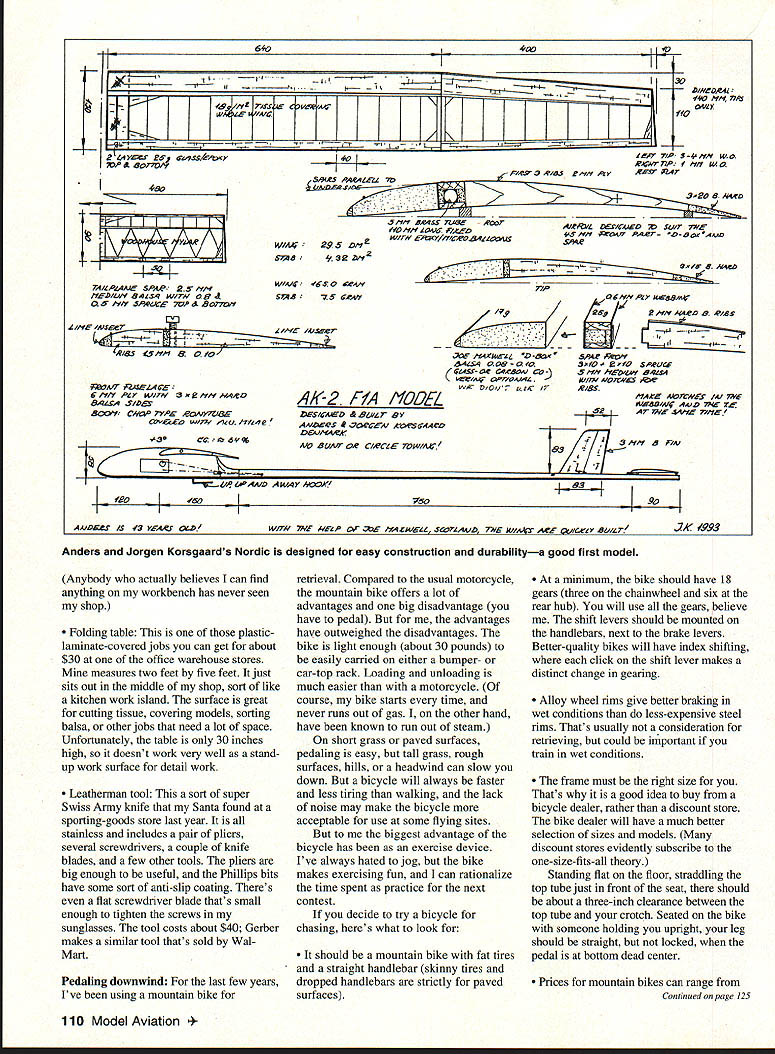
For several years I've used a mountain bike for retrieval. Compared to a motorcycle, a mountain bike offers many advantages and one big disadvantage — you have to pedal. For me, the advantages outweigh the effort.
- Advantages: light (about 30 lb), easily carried on a bumper or car-top rack, easier loading/unloading than a motorcycle, no gas or starting issues, quieter at flying sites, and useful exercise.
- Disadvantages: you must pedal; tall grass, rough terrain, hills, or headwinds can slow you down.
If you decide to try a bicycle for chasing, look for:
- A mountain bike with fat tires and a straight handlebar (skinny tires and dropped handlebars are for paved surfaces only).
- At minimum, 18 gears (three on the chainwheel and six at the rear hub). You will use all the gears. Shift levers should be mounted on the handlebars; better bikes have indexed shifting.
- Alloy wheel rims for better wet-condition braking compared with inexpensive steel rims.
- A frame that fits you — buy from a bicycle dealer rather than a discount store for better size selection.
- Fit checks: standing flat on the floor and straddling the top tube just in front of the seat, there should be about a three-inch clearance between the top tube and your crotch. Seated with someone holding you upright, your leg should be straight but not locked when the pedal is at bottom dead center.
Prices for mountain bikes vary widely depending on quality and components.
In memoriam: Jim Summersett
We were all deeply saddened by the unexpected death of Jim Summersett of Canyon Lake, Texas, on August 1, 1993. He is survived by his wife Joan, their sons, and grandchildren.
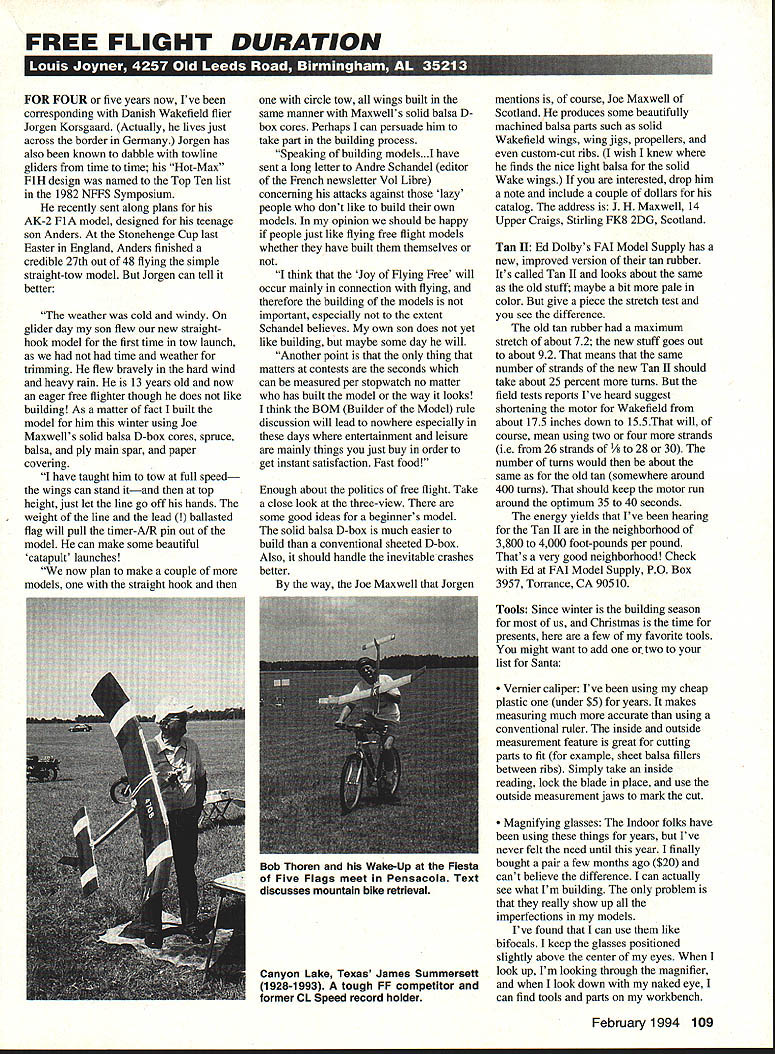
Russ Snyder wrote: "Jim, a man of many talents, has always flown free flight models. Forty-odd years ago he was busy setting control-line speed records — usually in jet. Jim returned to the competition free flight scene shortly before the '81 Seguin Nationals. His favorite events were AMA power and Nostalgia. Jim was the one who introduced Jay Jackson's Pelforth Pearl to the Texas contest scene. He was also one of the most highly qualified contest directors in the business. Jim's professional approach, overall fairness, and attention to detail placed him far above the crowd. Jim was a tough, nationally renowned competitor who played by the rules and won. Free flight is just a little better today by virtue of Jim Summersett."
Jim Larkin added: "Jim Summersett was a lifelong modeler; he was a competitor, and a lover of aviation in general. He grew up in a time when aviation was the dream and he pursued it with vigor. He will be sorely missed by the modelers of his generation."
Transcribed from original scans by AI. Minor OCR errors may remain.

