
FREE FLIGHT DURATION
Harry Murphy, 3824 Oakwood Boulevard, Anderson, IN 46011
Keith Hoover's Christmas greeting included the highlights of 1993 for powered models. Keith is the author of the recent NFFS book Power Models. This synopsis indicates that he is still keeping his ear to the ground:
"World Champs (at Lost Hills): The WC were the best ever — elevated to the status with a timely rescue by Bob Waterman. Frank Zaic merited the international honors bestowed on him at the event. Sierra Cup: Rocca did it again by winning F1J with AD engine power. Verbitsky, 'the teacher,' won F1C with a magnificent 102-inch-span model.
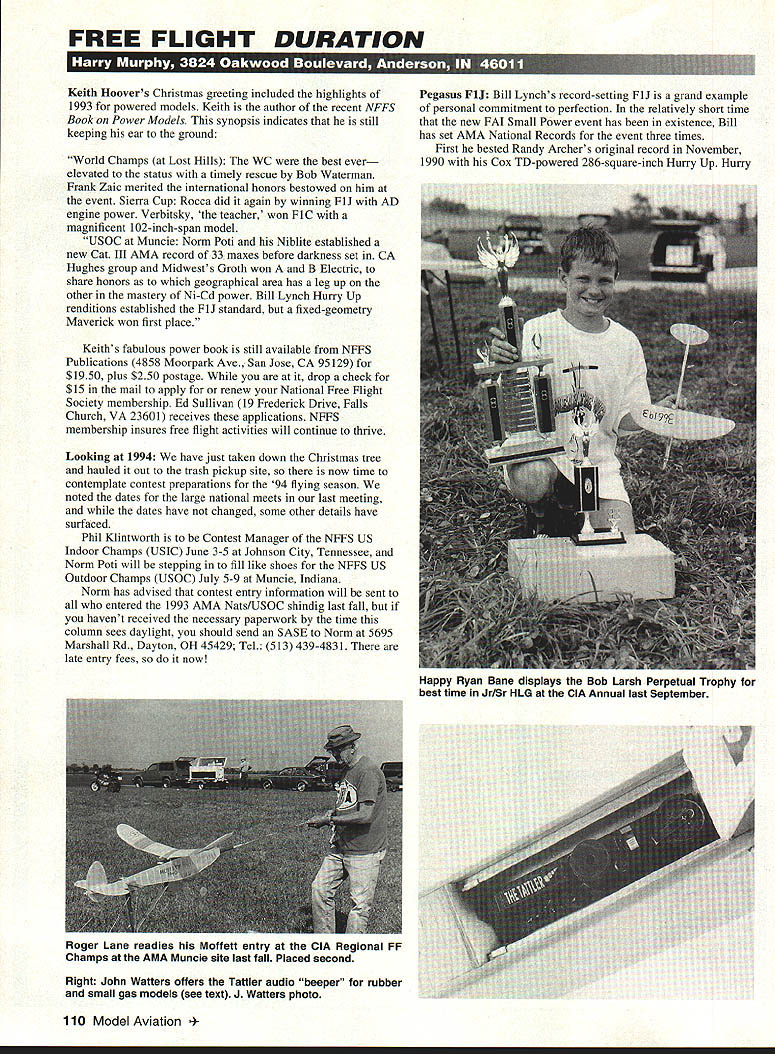
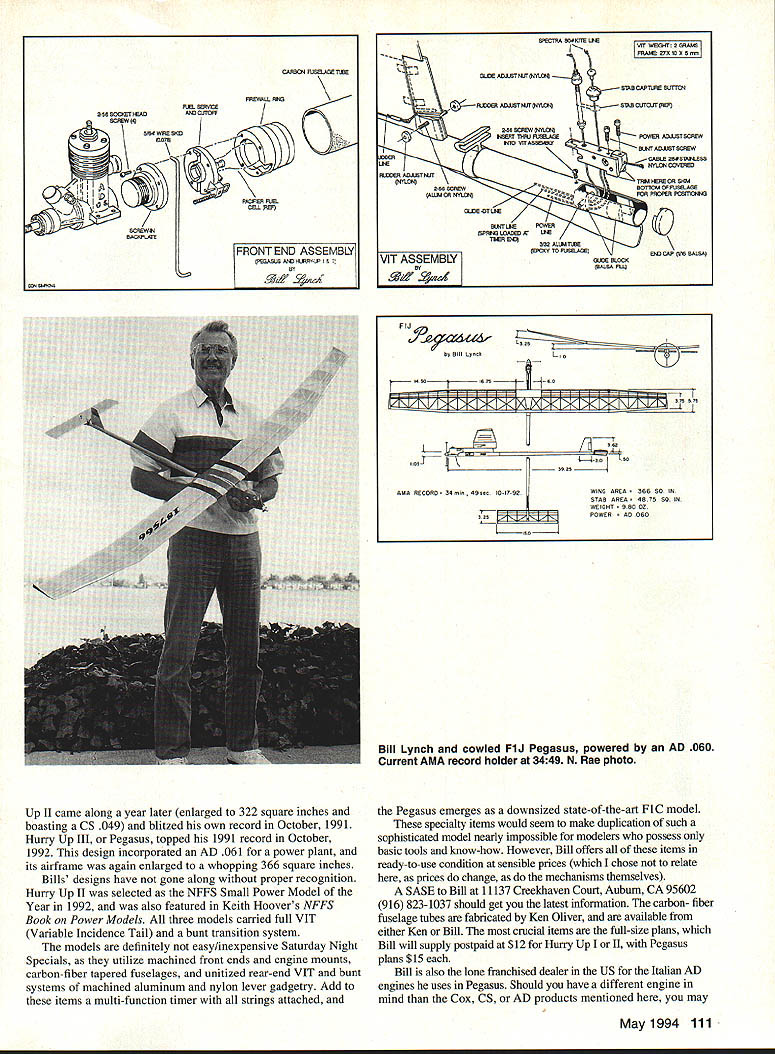
"USOC at Muncie: Norm Poti and his Niblite established a new Cat. III AMA record of 33 maxes before darkness set in. CA Hughes group and Midwest's Groth won A and B Electric, to share honors as to which geographical area has a leg up on the other in the mastery of Ni-Cd power. Bill Lynch Hurry Up renditions established the F1J standard, but a fixed-geometry Maverick won first place."
Keith's Power Models is still available from NFFS Publications for $19.50, plus $2.50 postage. While you are at it, drop a check for $15 to apply for or renew your National Free Flight Society membership. Ed Sullivan receives these applications. NFFS membership helps ensure free flight activities will continue to thrive.
- NFFS Publications: 4858 Moorpark Ave., San Jose, CA 95129
- Membership applications: Ed Sullivan, 19 Frederick Drive, Falls Church, VA 23601
Looking at 1994: We have just taken down the Christmas tree and hauled it out to the trash pickup site, so there is now time to contemplate contest preparations for the '94 flying season. The dates for the large national meets remain as previously noted, and some other details have surfaced.
Phil Klintworth is Contest Manager of the NFFS US Indoor Champs (USIC), June 3–5 at Johnson City, Tennessee. Norm Poti will step in as Contest Manager for the NFFS US Outdoor Champs (USOC), July 5–9 at Muncie, Indiana.
Norm has advised that contest entry information will be sent to all who entered the 1993 AMA Nats/USOC. If you haven't received the necessary paperwork by the time this column appears, send an SASE to Norm at 5695 Marshall Rd., Dayton, OH 45429; Tel.: (513) 439-4831. There are late entry fees, so do it now!
Pegasus F1J
Bill Lynch's record-setting F1J is a grand example of personal commitment to perfection. In the relatively short time that the new FAI Small Power event has been in existence, Bill has set AMA national records for the event three times.
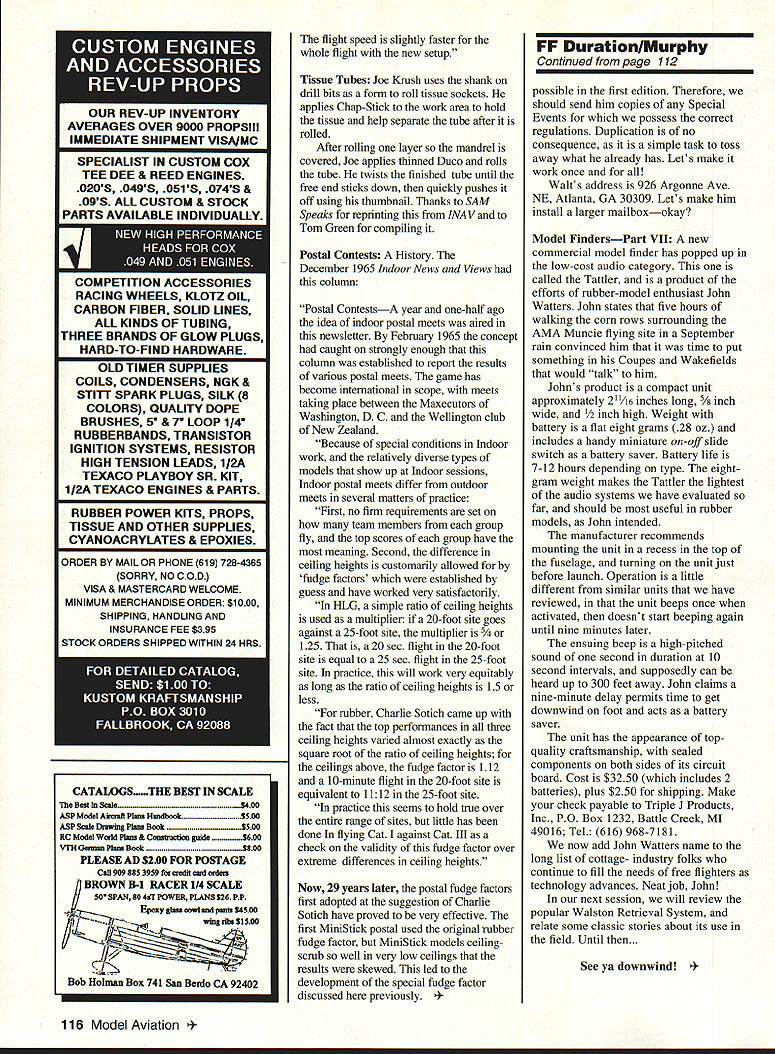
First he bested Randy Archer's original record in November 1990 with his Cox TD-powered 286-square-inch Hurry Up. Hurry Up II came along a year later, enlarged to 322 square inches and boasting a CS .049, and blitzed his own record in October 1991. Hurry Up III (Pegasus) topped the 1991 record in October 1992. The design incorporated an AD .061 power plant and its airframe was again enlarged to a whopping 366 square inches.
Bill's designs have received proper recognition. Hurry Up II was selected NFFS Small Power Model of the Year for 1992 and was featured in Keith Hoover's NFFS book Power Models. All three models carry full VIT (Variable Incidence Tail) and a bunt transition system.
These models are not inexpensive or trivial "Saturday Night Specials" — they utilize machined front ends and engine mounts, carbon-fiber tapered fuselages, and unitized rear-end VIT and bunt systems with machined aluminum and nylon lever gadgetry. Add multi-function timers and the usual strings attached, and the Pegasus emerges as a downsized, state-of-the-art F1J.
Although the specialty items could make duplication difficult for modelers who possess only basic tools, Bill offers crucial components and full-size plans ready-to-use at sensible prices.
For information or parts:
- Bill Lynch, 11137 Creekhaven Court, Auburn, CA 95602; Tel.: (916) 823-1037
- Plans (postpaid): Hurry Up I/II $12; Pegasus $15
- Carbon-fiber fuselage tubes are fabricated by Ken Oliver (available from Ken or Bill)
- Bill is the franchised U.S. dealer for Italian AD engines used on Pegasus; Cox and CS products may also be suitable
On the Move
Al Lidberg continues to offer fine plan kits. His next is a 1/2A Texaco Scale RC model of the 1931 Henderson Longster. New mailing address: 1008 East Baseline Road, Suite 1074, Tempe, AZ 85283. Send $2 for one of his catalogs.
Easy-Built Models (once Canadian-based) has moved:
- Easy-Built Models: P.O. Box 425, Lockport, NY 14095; Tel.: (716) 438-0505
Starlite International (Sal Fruciano) has released a fine new 16-page glossy catalog crammed with professional gadgets and photos. Send $2 to:
- Starlite International, 6146 East Cactus Wren Rd., Scottsdale, AZ 85253; Tel.: (602) 948-5798
Tell them "Duration" sent you.
I also caught a hint reprinted from a 1954 Air Trails Annual showing the lower half of a control-line fuselage with a balloon tank that uses a bicycle or football check valve to fill it from the rear through a tube to the outside. This allows filling the balloon tank without disassembling the model.
This is a great idea for a latex surgical-tubing tank on a free flight. Rather than disconnecting a tube at the needle valve to shoot fuel back into the fuel-tank tubing, insert a valve in the rear end of the tubing tank instead of tying the usual knot. You can fill the tank without disturbing the fuel system and reduce the chance of fuel spills.
Rule Soapbox
Rules are not the most enjoyable subject, but they are important: they project the standards that guide our hobby of friendly competition with model airplanes—an area that is constant in some ways and constantly changing in others.
Those changes sometimes breed controversy and occasionally calamity. Rulings forced upon us without the luxury of representation are often the most unpopular with competitors—"legislation without representation," as some put it.
As a competitor, I am bothered by the AMA rules change procedures. With all due respect to current Contest Board members, I question how they can truly evaluate how their constituents wish them to vote on each issue when there is no popular vote result available. Most Contest Board members have been seated for so long that it's unclear whether they arrived by appointment or by election. Under the present procedure, proper member representation seems nonexistent in the technical sense.
A timely straw vote on each proposal taken by a special-interest group (such as the National Free Flight Society) might serve the purpose without taxing the AMA workload. I would feel better about issues if I could visibly assess how my opinions compare with my fellow competitors'. Under the current system, I only have my District Contest Board member's opinion to influence.
While on the subject of rules, locating rules for some lesser-known Special Events continues to be a problem. Rules for these events are often difficult to find, since sources are sometimes unknown to contest officials and contestants. These events may vary from local to national in popularity and rules are more often passed by word of mouth than any official paper, resulting in interpretation errors. This gives contest directors fits when assembling a card of events.
There is positive movement to resolve the problem. Walt Rozelle has accepted the assignment to gather all known Special Events into a single publication for CDs and contestants. If rules were readily available in one publication, scheduling and participation might increase.
The plan is to produce an initial publication and update it yearly. Sales are to be at cost through the NFFS. Send copies of any Special Events regulations you possess to Walt so he can include them; duplication doesn't matter. Walt's address is:
- Walt Rozelle, 926 Argonne Ave. NE, Atlanta, GA 30309
Let's make this work once and for all.
Model Finders—Part VII
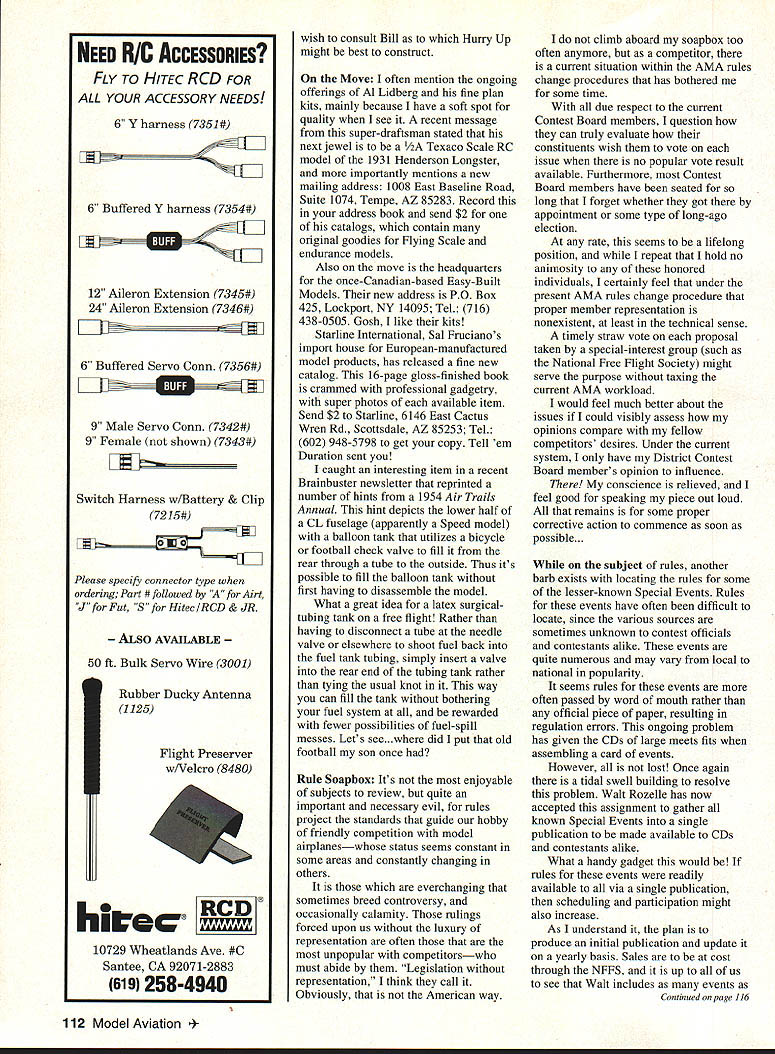
A new commercial model finder has appeared in the low-cost audio category: the Tatler, produced by rubber-model enthusiast John Watters. John says five hours of walking the corn rows surrounding the AMA Muncie flying site in a September rain convinced him it was time to put something in his Coupes and Wakefields that would "talk."
The Tatler is compact: approximately 2-1/2 inches long, 5/8 inch wide, and 1/2 inch high. Weight with battery is a flat eight grams (0.28 oz.). It includes a miniature on-off slide switch to save battery life. Battery life is 7–12 hours depending on type. The eight-gram weight makes the Tatler the lightest audio system we've evaluated so far, and it should be most useful in rubber models, as intended.
The manufacturer recommends mounting the unit in a recess in the top of the fuselage and turning it on just before launch. Operation differs from similar units: the Tatler beeps once when activated, then remains quiet for a delay period before beeping again. The ensuing beep is a high-pitched one-second sound at 10-second intervals and can reportedly be heard up to 300 feet away. John claims a nine-minute delay permits time to get downwind on foot and acts as a battery saver.
The unit appears to be of top-quality craftsmanship, with sealed components on both sides of the circuit board. Cost is $32.50 (includes 2 batteries), plus $2.50 shipping. Make checks payable to Triple J Products, Inc., P.O. Box 1232, Battle Creek, MI 49016; Tel.: (616) 965-7181.
We add John Watters' name to the long list of cottage-industry folks who fill the needs of free fliers as technology advances. Next time we will review the popular Walston Retrieval System and relate some classic stories about its use in the field.
See ya downwind!
Transcribed from original scans by AI. Minor OCR errors may remain.

