
Free Flight Duration
Bob Meuser
Free Flight's Top Ten: The National Free Flight Society announces the recipients of its ten Free Flight Model of the Year awards for 1975. In the pole position, receiving their second such NFFS award, are Bill and Bob Hunter, the greatest spectacle in free flight, with their Satellite 226. Check the new GLH series, which we predict will be due for another NFFS award along about 1977. Big Red Johnson gets the nod for his Tarter 800, highly successful in Southern Cal competition. The FAI Power award goes to a U.S. team member, not a World Champs winner, but a guy who stuck to a concept he knew was right: Bill Gieseking's flapped-wing concept, as exemplified by Siren-Dippity. In Wakefield we have John Gard, who received the award for his outstanding long-motor-run still-air machine.
Roger Jean Louis Garrigou, France, where the Coupe d'Hiver phenomenon began, received well-deserved recognition for his successful and popular Garricoupe, which won the 1973 Nats, among other things. How could the NFFS fail to recognize the longest officially recorded indoor flight ever? Erv Rodemsky got a second NFFS award; aptly named 600 sq. in. Monster has posted a flight of 45 min. 50 sec. Steve Geraghty developed a crummy-looking little mite of a hand-launch glider that anyone can build in a couple of hours and win contests with, named Drift.
If the NFFS doesn't have an award for "the guy who has come closest to winning the Mulvihill Trophy most often but never quite got it all together," so instead it gave George Perryman the award for the design of Little Daddy, which won the Mulvihill in the hands of another. Don Chancey collected his second NFFS award for his Canned Heat rocket-power model. The number ten award went to Hans Seelig for the Seelig Multi-Function Timer, which has dominated the field of cutting engine power and wiggling the tails of FAI-Power models worldwide for many years. Now could only get the price down!
Bob Stalick, head of the committee of 15 plus dozen consultants who made the selections, promises construction drawings of most of the models will be available through the NFFS Plans Service, as usual. In addition, stories and three-views will appear in the NFFS Sympo report. For a complete list of the plans, including Model of the Year awardees from previous years, write Larry Jordan, 5641 Diamond Heights Blvd., San Francisco, CA 94131.
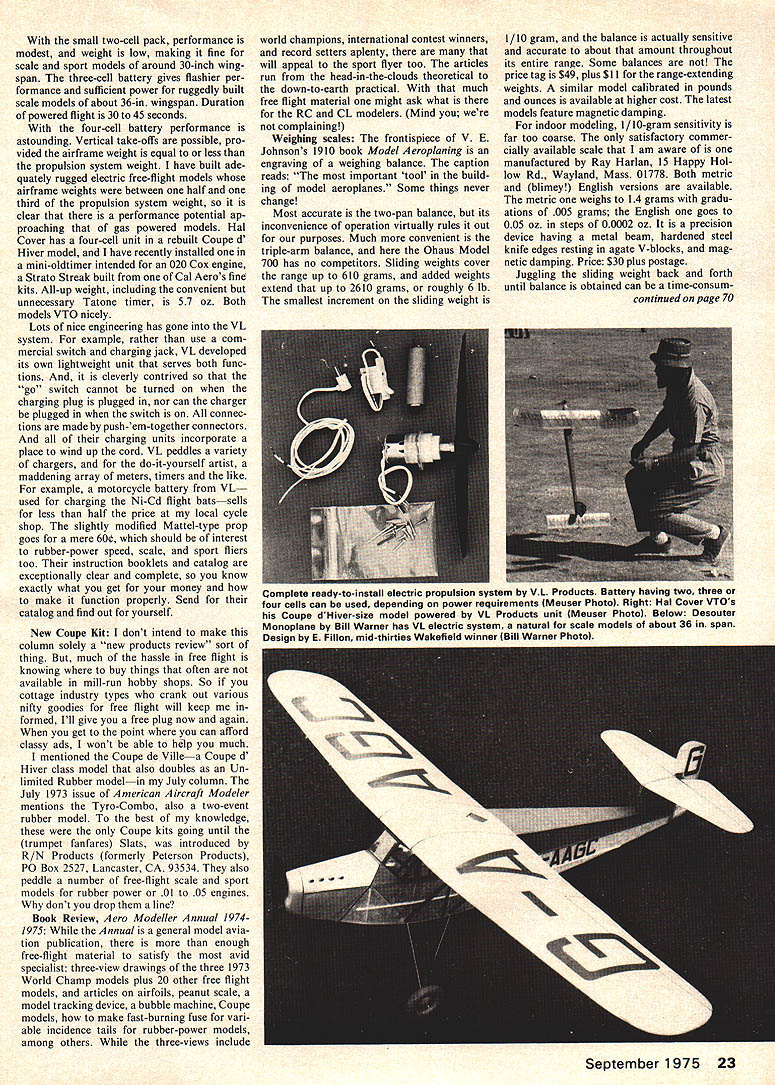
Cathexis Airfoil: In the August issue I mentioned the unusual airfoil used by Dave Parsons' Cathexis FAI-Power model. The airfoil was developed by Hank Cole back in the Fifties. Dave's version didn't come out quite as extreme as the original. Here is Hank's story:
"Several notable features of the airfoil are its extremely blunt leading edge which provides adequate turbulation, and the flat front portion of the lower surface, which works well with box-spar construction. Also note the droop-nose effect on the camber line near the leading edge. Some people prefer a sharper leading edge for Power to reduce drag during the climb, but in this Reynolds-number range, I doubt if you could measure the difference in drag between blunt and sharp leading edges.
"The airfoil was derived from a family of airfoils I conceived back in 1942 to 1944 for flying wings. (Air Trails 1944 Model Annual). Those blunt-nosed sections were obtained by transforming the Davis airfoil formulas (Air Trails, May 1942) into another dimension. (I think that means you push them through a hole in the space-time continuum, eh Hank?) The formulas are quite general; they simply give you a smooth curve with continuous derivatives. You have to know the general shape of the airfoil you want; then you manipulate the equations to produce such a shape. This particular one seems to work . . ."
"When I first contacted Dave about the airfoil I suggested that perhaps he would prefer that I sit on the information awhile before publishing it, so that he would have a chance to reap the benefits of it without fear of competition. His response was: 'No, publish it. Whatever success I have had is due to the willingness of other modelers to give me any information they had that might help me. It wouldn't be fair if I didn't do the same.' So, here it is. Advanced copies were sent to members of the U.S. FAI Power Team, incidentally."
Electric Propulsion: I don't intend plugging electric propulsion every month, but things keep happening that I think you might like to know about. The latest happening is the new system introduced recently by VL Products, 7023-D Canoga Ave., Canoga Park, CA 91303. The heart of the system is the Hytork 48 geared motor. The motor is the same size as the one used in the Mattel and Monogram units — maybe the same guts as the Mabuchi RE-26. The gear reducer gives a leg up on anything I have seen for model propulsion; a planetary gear set.
Planetary gearing has several advantages over conventional gearing. One is that the symmetric construction eliminates the side force on the front motor bearing, a large source of friction. The second advantage is compactness; the prop shaft is in line with the motor shaft, and the gearing adds little to the overall size of the motor. Gear ratios in the 4:8—about the same as the original Super Star units—and in the prop-gear reduction are available. Ni-Cd cells are used; three batteries consist of two- and four-cell packs of the same size as those used in the Mattel unit; the fourth battery consists of three AA-size (penlight) cells and is designed for multi-motor models. With that battery and a single motor, duration of powered flight could be around three minutes, which might be just the thing for schoolyard single-channel R/C models.
C(P)5408 by Hank Cole
(Note: figure and coordinates accompanying the airfoil are part of the original article.) With the small two-cell pack, performance is modest, and weight is low, making it fine for scale and sport models of around 30-inch wingspan. The three-cell battery gives flashier performance and sufficient power for ruggedly built scale models of about 36-in. span. Duration of powered flight is 30 to 45 seconds.
With the four-cell battery performance is outstanding. Vertical take-offs are possible, provided the airframe weight is equal to or less than the propulsion system weight. I have built adequately rugged electric free-flight models whose airframe weights were between one half and one third of the propulsion system weight, so it is clear that there is a performance potential approaching that of gas powered models. Hal Cover has a four-cell unit in a rebuilt Coupe d'Hiver model, and I have recently installed one in a mini-oldtimer intended for an 020 Cox engine, a Strato Streak built from one of Cal Aero's fine kits. All-up weight, including the convenient but unnecessary Tatone timer, is 5.7 oz. Both models VTO nicely.
Lots of nice engineering has gone into the VL system. For example, rather than use a commercial switch and charging jack, VL developed its own lightweight unit that serves both functions. And, it is cleverly contrived so that the "go" switch cannot be turned on when the charging plug is plugged in, nor can the charger be plugged in when the switch is on. All connections are made by push-'em-together connectors. And all of their charging units incorporate a place to wind up the cord. VL peddles a variety of chargers, and for the do-it-yourself artist, a maddening array of meters, timers and the like. For example, a motorcycle battery from VL—used for charging the Ni-Cd flight bats—sells for less than half the price of that at the local cycle shop. The slightly modified Mattel-type prop goes for a mere 60c, which should be of interest to rubber-power speed, scale, and sport fliers too. Their instruction booklets and catalog are exceptionally clear and complete, so you know exactly what you get for your money and how to make it function properly. Send for their catalog and find out for yourself.
New Coupe Kit: I don't intend to make this column solely a "new products review" sort of thing. But, much of the hassle in free flight is knowing where to buy things that often are not available in mill-run hobby shops. So if you cottage industry types who crank out various nifty goodies for free flight will keep me informed, I'll give you a free plug now and again. When you get to the point where you can afford classy ads, I won't be able to help you much.
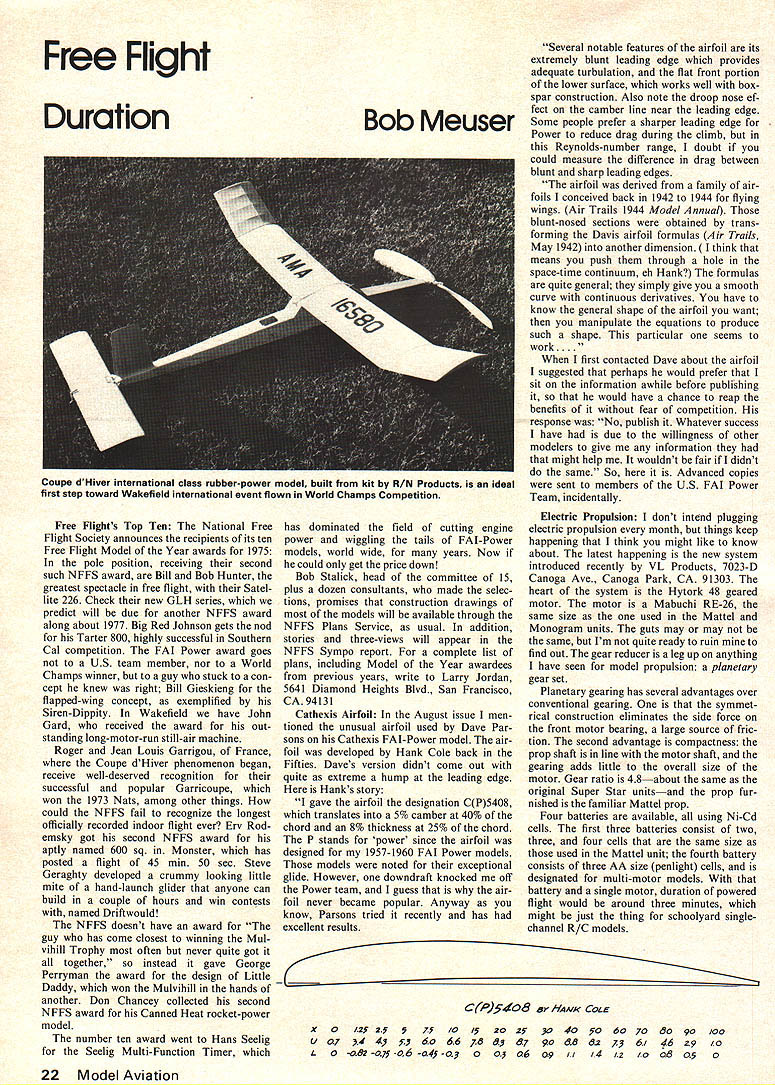
I mentioned the Coupe de Ville—a Coupe d'Hiver class model that also doubles as an Unlimited Rubber model—in my July column. The July 1973 issue of American Aircraft Modeler mentions the Tyro-Combo, also a two-event rubber model. To the best of my knowledge, these were the only Coupe kits going until the (trumpet fanfares) Slats, was introduced by R/N Products (formerly Peterson Products), PO Box 2527, Lancaster, CA 93534. They also peddle a number of free-flight scale and sport models for rubber power or .01 to .05 engines. Why don't you drop them a line?
Book Review, Aero Modeller Annual 1974–1975: While the Annual is a general model aviation publication, there is more than enough free-flight material to satisfy the most avid specialist: three-view drawings of the three 1973 World Champ models plus 20 other flight models, and articles on airfoils, peanut scale, a model tracking device, a bubble machine, Coupe models, how to make fast-burning fuse for variable incidence tails for rubber-power models, among others. While the three-views include world champions, international contest winners, and record setters aplenty, there are many that will appeal to the spot flyer to. The articles run from the head-in-the-clouds theoretical to the down-to-earth practical. With that much free flight material one might ask what is there for the RC and CL modelers. (Mind you; we're not complaining!)
Weighing scales: The frontispiece of V. E. Johnson's 1910 book Model Aeroplanes is an engraving of a weighing balance. The caption reads: "The most important 'tool' in the building of model aeroplanes." Some things never change!
Most accurate is the two-pan balance, but its inconvenience of operation virtually rules it out for our purposes. Much more convenient is the triple-arm balance, and here the Ohaus Model TA has no competitors. Sliding weights cover the range up to 610 grams, and added weights extend that up to 2610 grams, or roughly 6 lb. The smallest increment on the sliding weight is 1/10 gram, and the balance is actually sensitive and accurate to about that amount throughout its entire range. Some balances are not! The price tag is $49, plus $1 for the range-extending weights. A similar model calibrated in pounds and ounces is available at higher cost. The latest models feature magnetic damping.
For indoor modeling, 1/10-gram sensitivity is far too coarse. The only satisfactorily commercially available scale that I am aware of is one manufactured by Ray Harlan, 15 Happy Hollow Rd., Wayland, Mass. 01778. Both metric and (blimey!) English versions are available. The metric one weighs to 1.4 grams with graduations of .005 grams; the English one goes to .05 oz. in steps of .00002 oz. It is a precision device having a metal beam, hardened steel knife edges resting in agate V-blocks, and magnetic damping. Price: $30 plus postage. What to look for: A large total scale length; a 6-in. diameter dial is three times as good as a 2-in. straight scale. Sensitivity: how far does the indicator move for an ounce or a gram? Excessive sensitivity, however, can sometimes be a nuisance. Calibration accuracy: how accurately are the calibration marks placed? Difficult to check in the store. Freedom from friction: With a weight on the pan, push the weight down slightly, release it gradually, and note the reading. Then push the weight up slightly, release it gradually, and again note the reading. If the readings are noticeably different, don't buy it. Ruggedness, durability, convenience, size, and appearance may, or may not, be important to you. Above all in importance is suitability for weighing the kinds of model parts you use most frequently. (My address is: 4200 Gregory St., Oakland, Ca. 94619.)
Transcribed from original scans by AI. Minor OCR errors may remain.

