
Free Flight: Duration
Bob Meuser
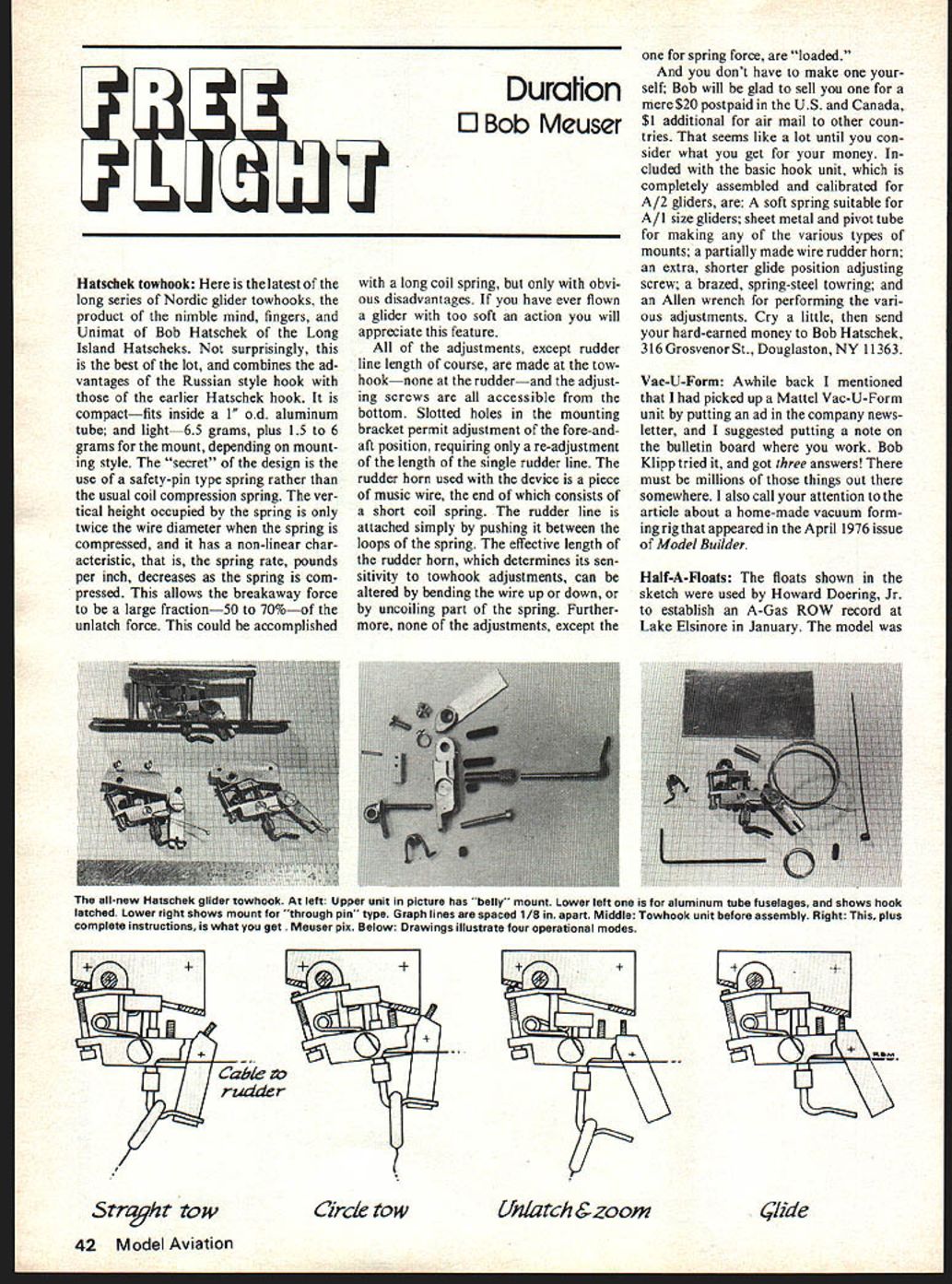
Hatschek towhook: Here is the latest of the long series of Nordic glider towhooks, the product of the nimble mind, fingers, and Unimat of Bob Hatschek of the Long Island Hatscheks. Not surprisingly, this is the best of the lot, and combines the advantages of the Russian style hook with those of the earlier Hatschek hook. It is compact—fits inside a 1" o.d. aluminum tube; and light—6.5 grams, plus 1.5 to 6 grams for the mount, depending on mounting style. The "secret" of the design is the use of a safety-pin type spring rather than the usual coil compression spring. The vertical height occupied by the spring is only twice the wire diameter when the spring is compressed, and it has a non-linear characteristic, that is, the spring rate, pounds per inch, decreases as the spring is compressed. This allows the breakaway force to be a large fraction—50 to 70%—of the unlatch force. This could be accomplished
with a long coil spring, but only with obvious disadvantages. If you have ever flown a glider with too soft an action you will appreciate this feature.
All of the adjustments, except rudder line length of course, are made at the towhook—none at the rudder—and the adjusting screws are all accessible from the bottom. Slotted holes in the mounting bracket permit adjustment of the fore-and-aft position, requiring only a re-adjustment of the length of the single rudder line. The rudder horn used with the device is a piece of music wire, the end of which consists of a short coil spring. The rudder line is attached simply by pushing it between the loops of the spring. The effective length of the rudder horn, which determines its sensitivity to towhook adjustments, can be altered by bending the wire up or down, or by uncoiling part of the spring. Furthermore, none of the adjustments, except the
one for spring force, are "loaded."
And you don't have to make one yourself; Bob will be glad to sell you one for a mere $20 postpaid in the U.S. and Canada, $1 additional for air mail to other countries. That seems like a lot until you consider what you get for your money. Included with the basic hook unit, which is completely assembled and calibrated for A/2 gliders, are: A soft spring suitable for A/1 size gliders; sheet metal and pivot tube for making any of the various types of mounts; a partially made wire rudder horn; an extra, shorter glide position adjusting screw; a brazed, spring-steel towring; and an Allen wrench for performing the various adjustments. Cry a little, then send your hard-earned money to Bob Hatschek, 316 Grosvenor St., Douglaston, NY 11363.
Vac-U-Form: Awhile back I mentioned that I had picked up a Mattel Vac-U-Form unit by putting an ad in the company newsletter, and I suggested putting a note on the bulletin board where you work. Bob Klipp tried it, and got three answers! There must be millions of those things out there somewhere. I also call your attention to the article about a home-made vacuum forming rig that appeared in the April 1976 issue of Model Builder.
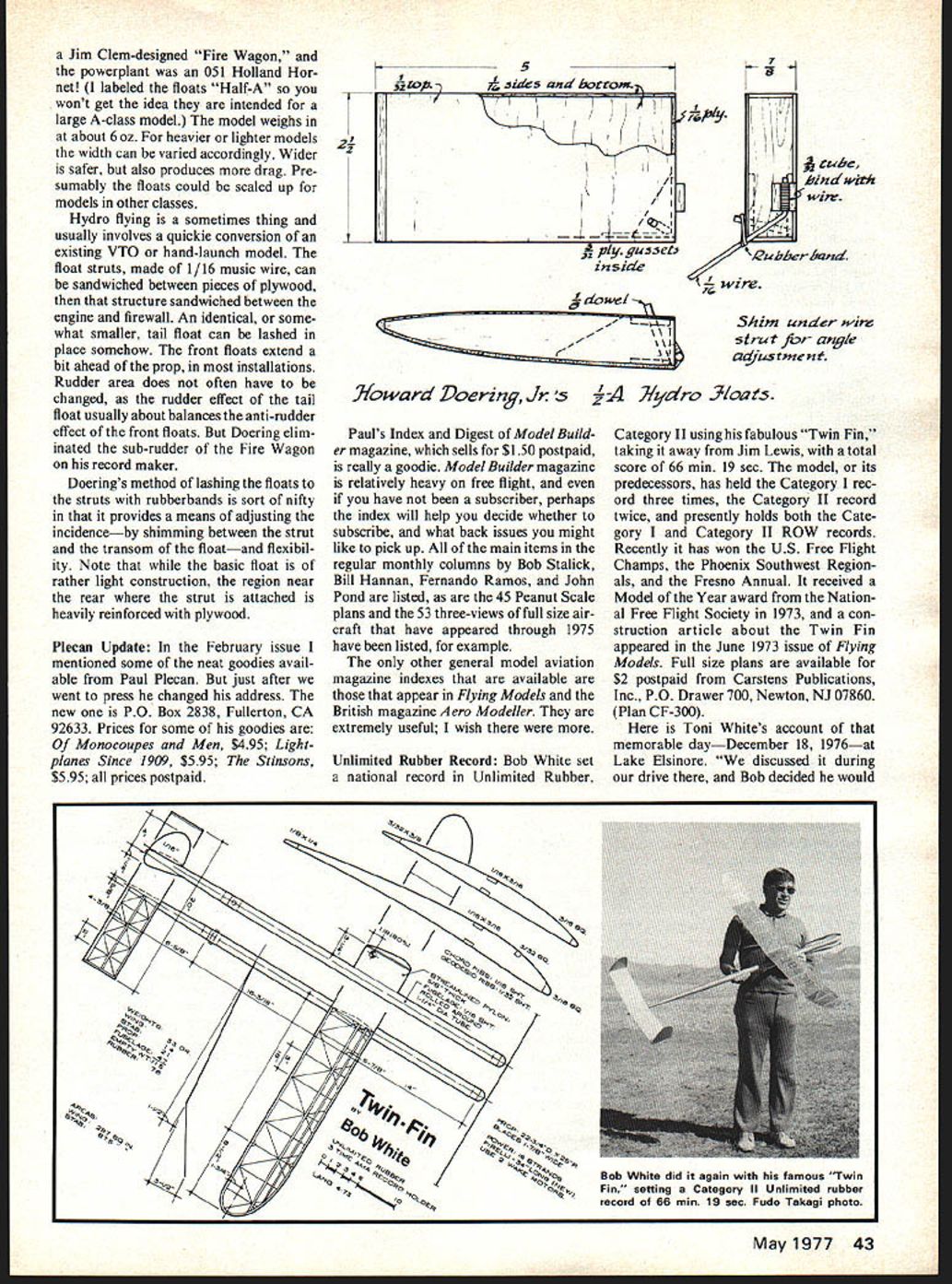
Half-A-Floats: The floats shown in the sketch were used by Howard Doering, Jr. to establish an A-Gas ROW record at Lake Elsinore in January. The model was a Jim Clem-designed "Fire Wagon," and the powerplant was an .051 Holland Hornet! (I labeled the floats "Half-A" so you won't get the idea they are intended for a large A-class model.) The model weighs in at about 6 oz. For heavier or lighter models the width can be varied accordingly. Wider is safer, but also produces more drag. Presumably the floats could be scaled up for models in other classes.
Hydro flying is a sometimes thing and usually involves a quickie conversion of an existing VTO or hand-launch model. The float struts, made of 1/16 music wire, can be sandwiched between pieces of plywood, then that structure sandwiched between the engine and firewall. An identical, or somewhat smaller, tail float can be lashed in place somehow. The front floats extend a bit ahead of the prop, in most installations. Rudder area does not often have to be changed, as the rudder effect of the tail float usually about balances the anti-rudder effect of the front floats. But Doering eliminated the sub-rudder of the Fire Wagon on his record maker.
Doering's method of lashing the floats to the struts with rubberbands is sort of nifty in that it provides a means of adjusting the incidence—by shimming between the strut and the transom of the float—and flexibility. Note that while the basic float is of rather light construction, the region near the rear where the strut is attached is heavily reinforced with plywood.
Plecan Update: In the February issue I mentioned some of the neat goodies available from Paul Plecan. But just after we went to press he changed his address. The new one is P.O. Box 2838, Fullerton, CA 92633. Prices for some of his goodies are: Of Monocoupes and Men, $4.95; Lightplanes Since 1909, $5.95; The Stinsons, $5.95; all prices postpaid.
Paul's Index and Digest of Model Builder magazine, which sells for $1.50 postpaid, is really a goodie. Model Builder magazine is relatively heavy on free flight, and even if you have not been a subscriber, perhaps the index will help you decide whether to subscribe, and what back issues you might like to pick up. All of the main items in the regular monthly columns by Bob Stallick, Bill Hannan, Fernando Ramos, and John Pond are listed, as are the 45 Peanut Scale plans and the 53 three-views of full size aircraft that have appeared through 1975 have been listed, for example.
The only other general model aviation magazine indexes that are available are those that appear in Flying Models and the British magazine Aero Modeller. They are extremely useful; I wish there were more.
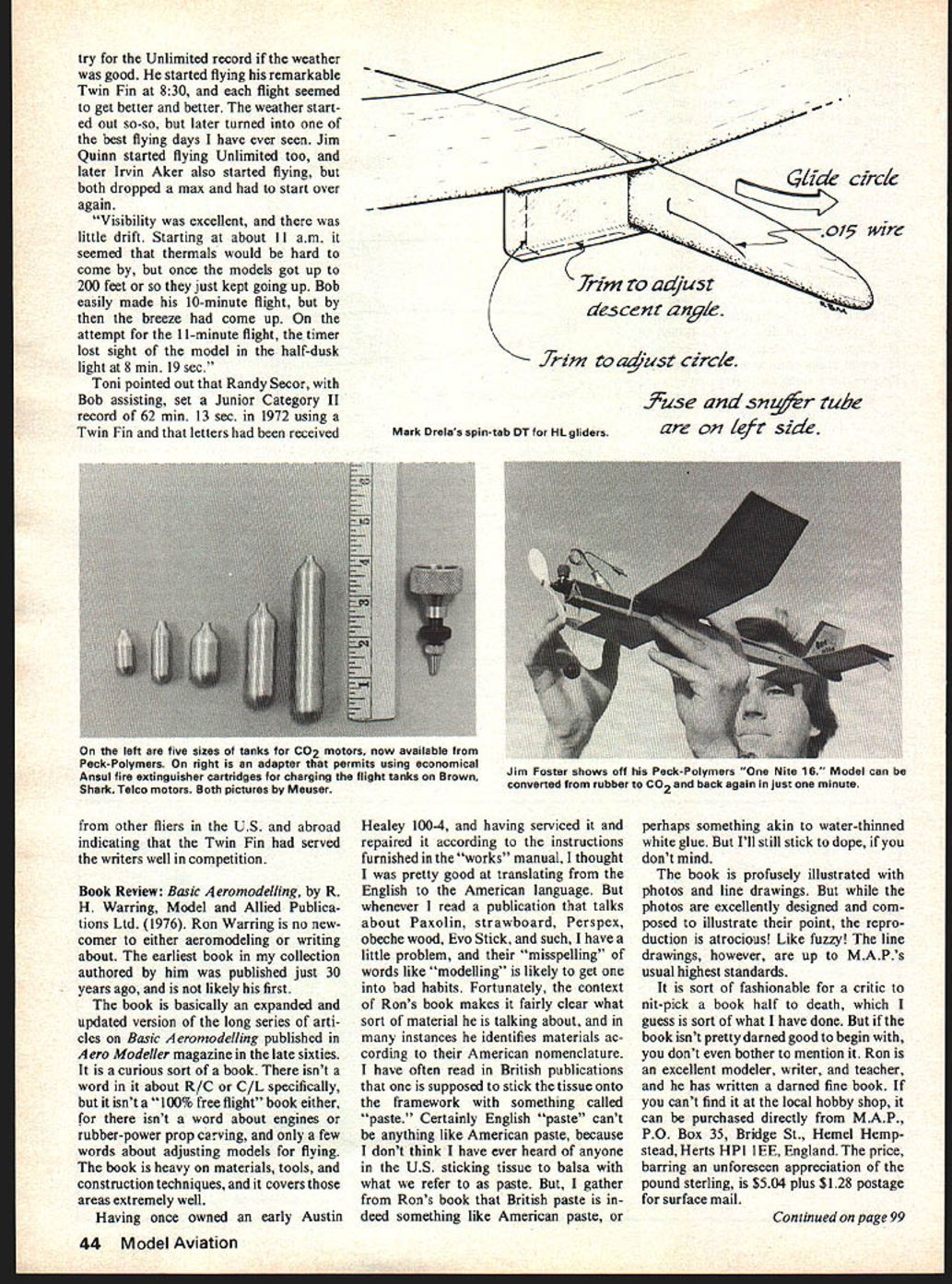
Unlimited Rubber Record: Bob White set a national record in Unlimited Rubber, Category II using his fabulous "Twin Fin," taking it away from Jim Lewis, with a total score of 66 min. 19 sec. The model, or its predecessors, has held the Category I record three times, the Category II record twice, and presently holds both the Category I and Category II ROW records. Recently it has won the U.S. Free Flight Champs, the Phoenix Southwest Regionals, and the Fresno Annual. It received a Model of the Year award from the National Free Flight Society in 1973, and a construction article about the Twin Fin appeared in the June 1973 issue of Flying Models. Full size plans are available for $2 postpaid from Carstens Publications, Inc., P.O. Drawer 700, Newton, NJ 07860. (Plan CF-300).
Here is Toni White's account of that memorable day—December 18, 1976—at Lake Elsinore. "We discussed it during our drive there, and Bob decided he would try for the Unlimited record if the weather was good. He started flying his remarkable Twin Fin at 8:30, and each flight seemed to get better and better. The weather started out so-so, but later turned into one of the best flying days I have ever seen. Jim Quinn started flying Unlimited too, and later Irvin Aker also started flying, but both dropped a max and had to start over again.
"Visibility was excellent, and there was little drift. Starting at about 11 a.m. it seemed that thermals would be hard to come by, but once the models got up to 200 feet or so they just kept going up. Bob easily made his 10-minute flight, but by then the breeze had come up. On the attempt for the 11-minute flight, the timer lost sight of the model in the half-dusk light at 8 min. 19 sec."
Toni pointed out that Randy Secor, with Bob assisting, set a Junior Category II record of 62 min. 13 sec. in 1972 using a Twin Fin and that letters had been received from other fliers in the U.S. and abroad indicating that the Twin Fin had served the writers well in competition.
Book Review: Basic Aeromodelling, by R. H. Warring, Model and Allied Publications Ltd. (1976). Ron Warring is no newcomer to either aeromodelling or writing about. The earliest book in my collection authored by him was published just 30 years ago, and is not likely his first.
The book is basically an expanded and updated version of the long series of articles on Basic Aeromodelling published in Aero Modeller magazine in the late sixties. It is a curious sort of a book. There isn't a word in it about R/C or C/L specifically, but it isn't a "100% free flight" book either, for there isn't a word about engines or rubber-power prop carving, and only a few words about adjusting models for flying. The book is heavy on materials, tools, and construction techniques, and it covers those areas extremely well.
Having once owned an early Austin Healey 100-4, and having serviced it and repaired it according to the instructions furnished in the "works" manual, I thought I was pretty good at translating from the English to the American language. But whenever I read a publication that talks about Paxolin, strawboard, Perspex, obeche wood, Evo Stick, and such, I have a little problem, and their "misspelling" of words like "modelling" is likely to get one into bad habits. Fortunately, the content of Ron's book makes it fairly clear what sort of material he is talking about, and in many instances he identifies materials according to their American nomenclature. I have often read in British publications that one is supposed to stick the tissue onto the framework with something called "paste." Certainly English "paste" can't be anything like American paste, because I don't think I have ever heard of anyone in the U.S. sticking tissue to balsa with what we refer to as paste. But, I gather from Ron's book that British paste is indeed something like American paste, or perhaps something akin to water-thinned white glue. But I'll still stick to dope, if you don't mind.
The book is profusely illustrated with photos and line drawings. But while the photos are excellently designed and composed to illustrate their point, the reproduction is atrocious! Like fuzzy? The line drawings, however, are up to M.A.P.'s usual highest standards.
It is sort of fashionable for a critic to nit-pick a book half to death, which I guess is sort of what I have done. But if the book isn't pretty darned good to begin with, you don't even bother to mention it. Ron is an excellent modeler, writer, and teacher, and he has written a darned fine book. If you can't find it at the local hobby shop, it can be purchased directly from M.A.P., P.O. Box 35, Bridge St., Hemel Hempstead, Herts HP1 1EE, England. The price, barring an unforeseen appreciation of the pound sterling, is $5.04 plus $1.28 postage for surface mail.
FF Duration/Meuser
Models By the Peck, By Heck: Peck-Polymers, long famous for its free flight scale and sport kits, plans, and hardware is now heavily into CO-2 power. Peck stocks the Brown single and twin, and the new Telco and Shark motors. His "One Nite '16" kit for a built-up 16"-span sport model now includes instructions for converting it to CO-2 power. But it can be converted back to rubber power in a minute or two.
Of great interest to CO-2 enthusiasts are the tanks offered by Peck in five sizes ranging from a teeny 1/4 cc to 20 cc capacity. And, too, Peck offers a goodie that adapts Ansul fire-extinguisher cartridges to any of the three brands of CO-2 motors, and provides flights at a fraction of the cost of using the small cartridges usually used. Send for Peck's complete catalog to PO Box 2498, La Mesa, CA 92041.
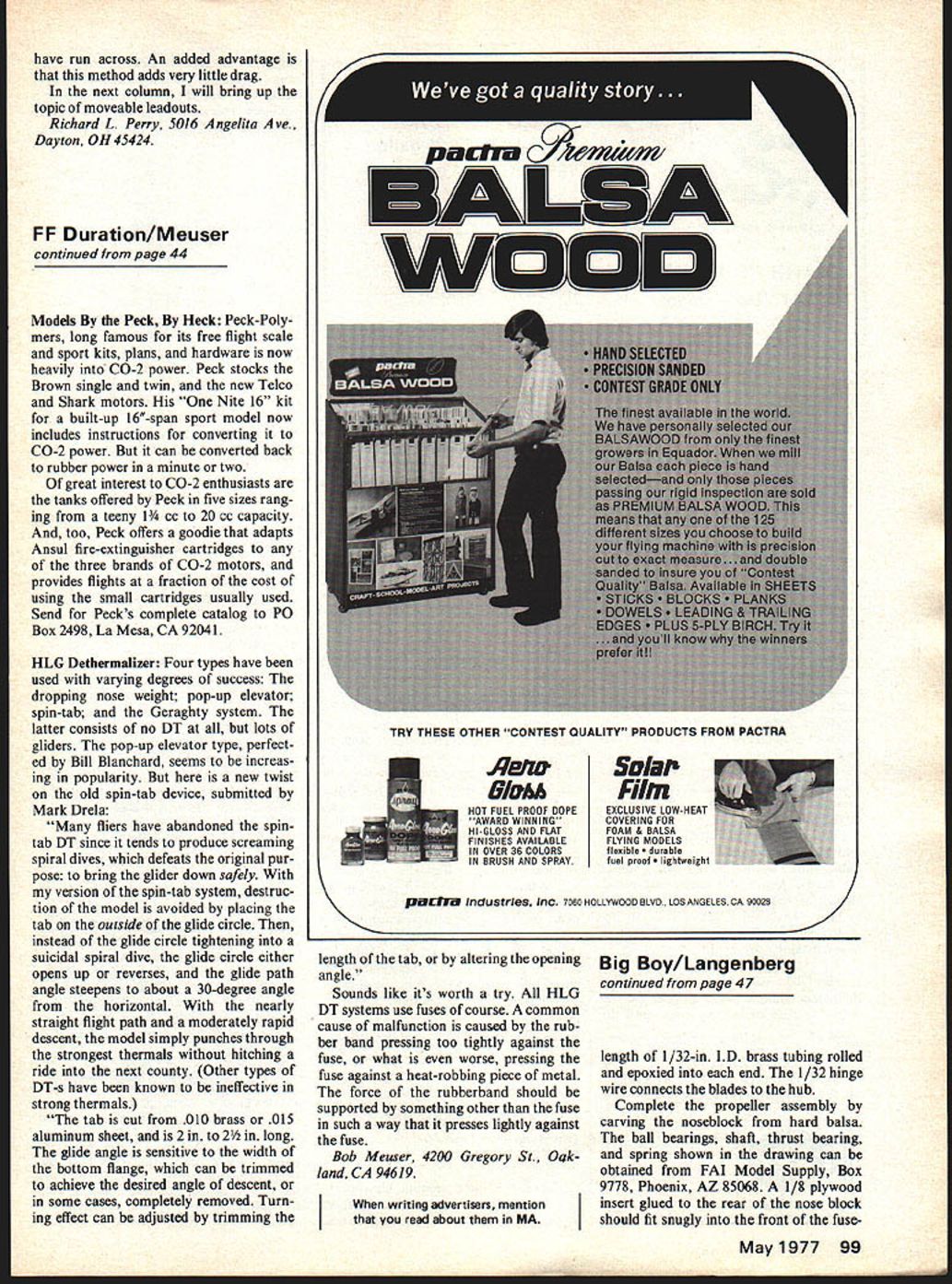
HLG Dethermalizer: Four types have been used with varying degrees of success: The dropping nose weight; pop-up elevator; spin-tab; and the Geraghty system. The latter consists of no DT at all, but lots of gliders. The pop-up elevator type, perfected by Bill Blanchard, seems to be increasing in popularity. But here is a new twist on the old spin-tab device, submitted by Mark Drela:
"Many fliers have abandoned the spin-tab DT since it tends to produce screaming spiral dives, which defeats the original purpose: to bring the glider down safely. With my version of the spin-tab system, destruction of the model is avoided by placing the tab on the outside of the glide circle. Then, instead of the glide circle tightening into a suicidal spiral dive, the glide circle either opens up or reverses, and the glide path angle steepens to about a 30-degree angle from the horizontal. With the nearly straight flight path and a moderately rapid descent, the model simply punches through the strongest thermals without hitching a ride into the next county. (Other types of DTs have been known to be ineffective in strong thermals.)"
The tab is cut from .010 brass or .015 aluminum sheet, and is 2 in. to 2 1/2 in. long. The glide angle is sensitive to the width of the bottom flange, which can be trimmed to achieve the desired angle of descent, or in some cases, completely removed. Turning effect can be adjusted by trimming the length of the tab, or by altering the opening angle.
Sounds like it's worth a try. All HLG DT systems use fuses of course. A common cause of malfunction is caused by the rubber band pressing too tightly against the fuse, or, what is even worse, pressing the fuse against a heat-robbing piece of metal. The force of the rubberband should be supported by something other than the fuse in such a way that it presses lightly against the fuse.
Bob Meuser, 4200 Gregory St., Oakland, CA 94619.
Transcribed from original scans by AI. Minor OCR errors may remain.

