
FREE FLIGHT DURATION
Louis Joyner, 4257 Old Leeds Road, Birmingham, AL 35213
Capstrips and D-box construction
On my last half-dozen Wakefield wings I have been using a composite D-box construction. Basically, this consists of a very stiff carbon-fiber spar, a D-box shell of either Kevlar or carbon, and precious little else. The trailing edge is a piece of .030 by 1/16-inch carbon. So the 1/16-inch-thick balsa ribs end up with a glue joint that's only about 1/32 by 1/16. That's not much.
To help hold the trailing edge on, I began using carbon-fiber capstrips on the top and bottom of each rib, running from the spar back to the trailing edge. Typically, the cap was .003-inch carbon, stripped to 1/16-inch width.
Surprisingly, the capstrips didn't seem to stiffen the wing in torsion, but they sure made the wing much more durable, and best of all, they hold their adjustments without warping.
At the World Championships I had the opportunity to examine several of the top Wakefields in detail. This provided additional information on how to best use the capstrips, especially at the center and dihedral break.
For example, reigning World Champion Alexander Andriukov uses a 10 mm wide cap at the center of the wing (and, surprisingly, no plywood root rib). At the dihedral break he uses a 5 mm wide balsa rib, with full-width carbon caps. This is then beveled HLG-fashion to accommodate the dihedral. Note that he routes out a section of the top cap at the root to mount the hook for the rubber band that holds the two wing halves in place.
New materials and sources
I also had a good visit at the WC with Gail Gewain (her husband Matt was off flying Nordic for the US team). She showed me their new .002-inch-thickness carbon for rib caps. Besides being lighter than the .003-inch carbon I had been using, this new stuff features a textured surface on one side for better adhesion.
A 3 x 36-inch piece of the ultrathin carbon goes for $8 plus shipping and handling from Composite Structures Technology, P.O. Box 642, Tehachapi, CA 93581-0642; Tel.: (800) 338-1278. They also have quite a few other new items for composite construction, including precut carbon trailing edges and carbon cloth.
Preparing and cutting capstrips
I've found the best way to use the thin carbon for rib caps is to cut a piece three inches wide that's at least a quarter of an inch longer than the longest piece you'll need. Sharp scissors work fine.
Next sand it lightly on both sides with fine sandpaper and wipe with a paper towel dipped in lacquer thinner. After the thinner has evaporated, strip into the desired width—say 1/16 inch. My method:
- Take a sharp single-edge razor blade and glue a hard balsa or plywood spacer to the side of the blade, about 5/16 inch back from the edge.
- Cut a piece of 1/16-inch plywood about the size of the razor blade, and glue this to the spacer, lining up with the blade.
- Use this assembly like a balsa stripper to slice the carbon strips to width. For a narrower or wider capstrip, make another stripper with a different-thickness spacer.
Attaching the caps
The best way to attach the caps is to use Pic-brand CyA for plastic models. I add all the bottom caps first, as soon as I take the wing off the building jig, and before I can manage to break the trailing edge off.
It's easiest to put a small drop of CyA at the rib/D-box juncture, then carefully position the cap, allowing it to overlap about 3/32 inch onto the D-box. Make sure that the cap lines up with the rib.
After the CyA sets, lift the carbon strip and run some CyA along the top rib, way back to the trailing edge. Then quickly push the capstrip down, working from the front to the rear. Some plastic wrap will keep your finger from becoming one with the wing. After the CyA sets, simply break the caps off at the rear of the carbon trailing edge. For a balsa trailing edge, you'll be better off cutting the carbon with a sharp razor.
After all the bottom caps are in place, carefully check to make sure that the panel is flat, or has the desired washin or washout. Once the top caps are in place, the wing will stay just the way you build it. If necessary, cut through the ribs just behind the spar (being careful not to cut the bottom caps) and adjust the panel for the desired wash. Then add the top caps in the same manner.
The weight gain for a Wakefield wing is only about 4 grams, but the increased durability and consistency is well worth it. For me, another advantage is the elimination of the need for diagonal ribs. But using only straight ribs works only if you use a very rigid D-box.
Lightweight wings and diagonal ribs
For lightweight models, you can combine carbon-fiber capstrips with diagonal ribs to make a wing that is both light and strong. British flier Phil Ball gives an excellent account of this type of construction in his article "Composite Construction Methods for Open Rubber" in the 1993 Free Flight Experts' Forum.
His method yields a 31-gram weight (covered) for a 400-square-inch wing. Ball begins by positioning the lower capstrips on the undercambered wing jig, then adding the leading edge, trailing edge, and spar. Next come the ribs, followed by the top caps. Note that he constructs the spar as a single unit, from tip to tip.
By the way, the Free Flight Experts' Forum series is an excellent counterpart to our own NFFS Symposia. The 1993 edition features an article on F1C engine tuning, an article on rubber motors that includes several circuit diagrams for rubber heaters, and a timely article on F1A flying by reigning world champion Mike Fantham.
The easiest way to get a copy is to contact Fred Terzian, NFFS Publications, 4858 Moorpark Ave., San Jose, CA 95129. Fred usually has some of the British publications available, so you don't have to go to the trouble of an international money order. Best to drop Fred a line first to see exactly what he has in stock.
You might also ask about the 1993 NFFS Digest. To join, send $15 to NFFS, 19 Frederic Drive, Newport News, VA 23601. Ed Sullivan is the man in charge of memberships. For age 18 and under, the cost is only $7.50 a year. Join today!
Recommended books and publications
Another British publication deserving of mention is The Book That Flies. Bob Bass and Martin Dilly have put together a very effective package that should be just the thing to give a young person the nudge into a lifelong addiction to free flight. The book comes with two Delta Dart kits.
The cover features a rather dramatic shot of a 1940s vintage Bob Copeland Wakefield. The book proceeds to cover the history of free flight, which in its early years was very much the history of aviation. The list of early model fliers reads like a Who's Who of British aviation, including Sir Richard Fairey, Sir Thomas Sopwith, Sir Frederick Handley Page, Sir Geoffrey de Havilland, and Sir Sidney Camm, designer of the Hawker Hurricane.
The book also points out that it was Camm who gave Bob Copeland his first job in aviation, designing the rear-view mirror for the Hurricane. Copeland's last job in aviation was the Harrier jump-jet, which does bear a marked resemblance to his earlier Wakefield designs.
But the book doesn't dwell on the past. Each of the international classes is covered in detail, with action photographs from the 1991 World Championships as well as closeups of typical models. The book does an excellent job of promoting free flight as an international sport.
The book also includes detailed step-by-step instructions for building and flying the Delta Dart kits. This is the best beginner's book I've seen on free flight, and one of the best books I've seen on any subject. Martin Dilly and Bob Bass are to be commended for putting this package together. Their publisher, Ebury Press, also deserves thanks for their willingness to spend the money up front to do a really first-class job.
I don't know if the book will be distributed in this country, but it would be worth the trouble to track down. The publisher's address is: Ebury Press Ltd, Random House, 20 Vauxhall Bridge Road, London, SW1V 2AS, UK.
Flappers and innovative Wakefields
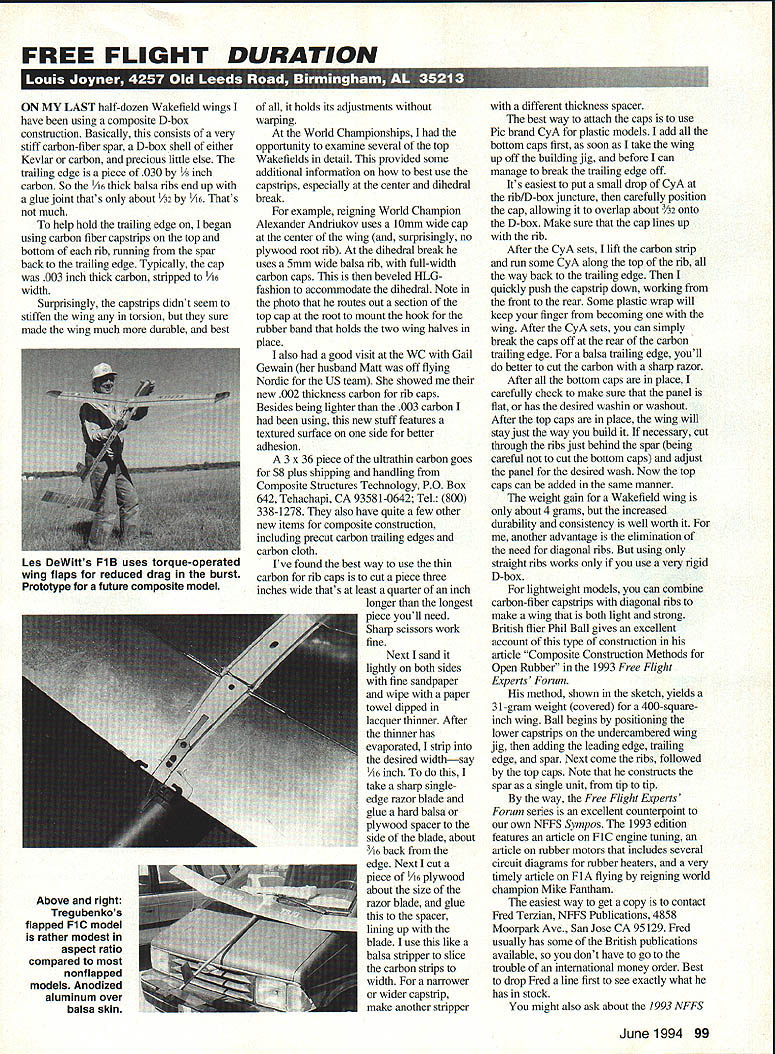
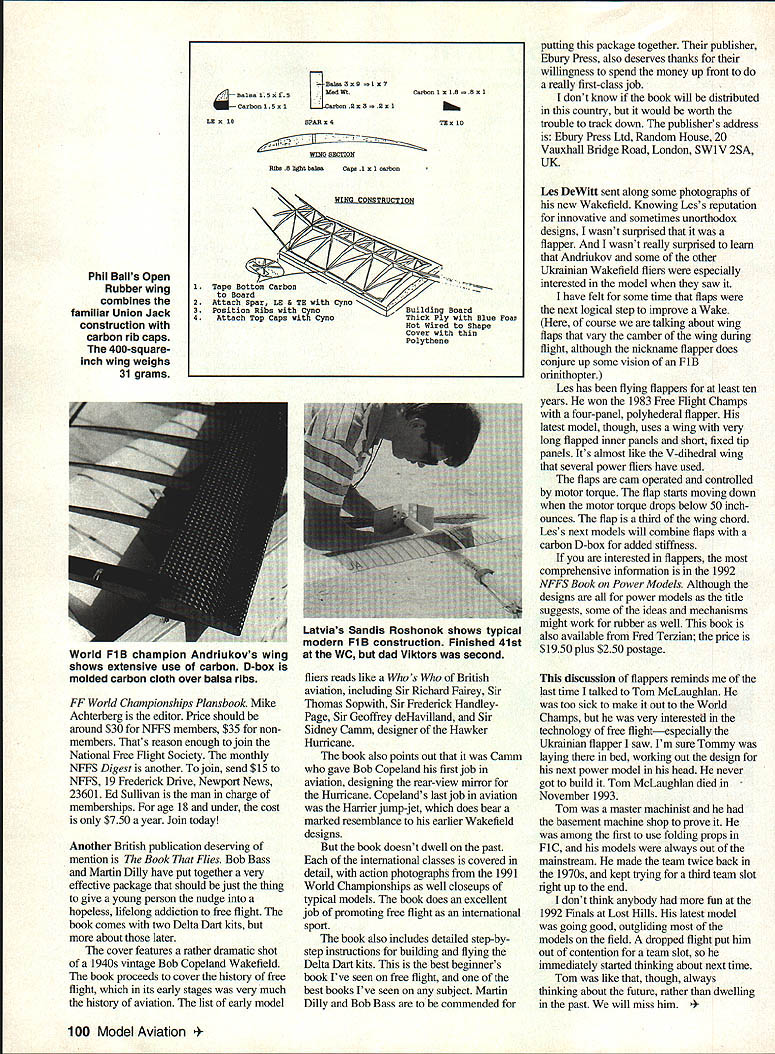
Les DeWitt sent along some photographs of his new Wakefield. Knowing Les's reputation for innovative and sometimes unorthodox designs, I wasn't surprised that it was a flapper. And I wasn't really surprised to learn that Andriukov and some of the other Ukrainian Wakefield fliers were especially interested in the model when they saw it.
I have felt for some time that flaps were the next logical step to improve a Wake. Here, of course, we are talking about wing flaps that vary the camber of the wing during flight, although the nickname "flapper" does conjure up some vision of an F1B ornithopter.
Les has been flying flappers for at least ten years. He won the 1983 Free Flight Champs with a four-panel, polyhedral flapper. His latest model, though, uses a wing with very long flapped inner panels and short, fixed tip panels. It's almost like the V-dihedral wing that several power fliers have used.
The flaps are cam-operated and controlled by motor torque. The flap starts moving down when the motor torque drops below 50 inch-ounces. The flap is a third of the wing chord. Les's next models will combine flaps with a carbon D-box for added stiffness.
If you are interested in flappers, the most comprehensive information is in the 1992 NFFS Book on Power Models. Although the designs are all for power models as the title suggests, some of the ideas and mechanisms might work for rubber as well. This book is also available from Fred Terzian; the price is $19.50 plus $2.50 postage.
In memoriam — Tom McLaughlin
This discussion of flappers reminds me of the last time I talked to Tom McLaughlin. He was too sick to make it out to the World Champs, but he was very interested in the technology of free flight—especially the Ukrainian flapper I saw. I'm sure Tommy was laying there in bed, working out the design for his next power model in his head. He never got to build it. Tom McLaughlin died in November 1993.
Tom was a master machinist and he had the basement machine shop to prove it. He was among the first to use folding props in F1C, and his models were always out of the mainstream. He made the team twice back in the 1970s, and kept trying for a third team slot right up to the end.
I don't think anybody had more fun at the 1992 Finals at Lost Hills. His latest model was going good, outgliding most of the models on the field. A dropped flight put him out of contention for a team slot, so he immediately started thinking about next time.
Tom was like that, though, always thinking about the future, rather than dwelling in the past. We will miss him.
Transcribed from original scans by AI. Minor OCR errors may remain.

