
FREE FLIGHT DURATION - 2001/03
Louis Joyner, 183 Civitas St., Mt. Pleasant SC 29464
Team Selection Finals
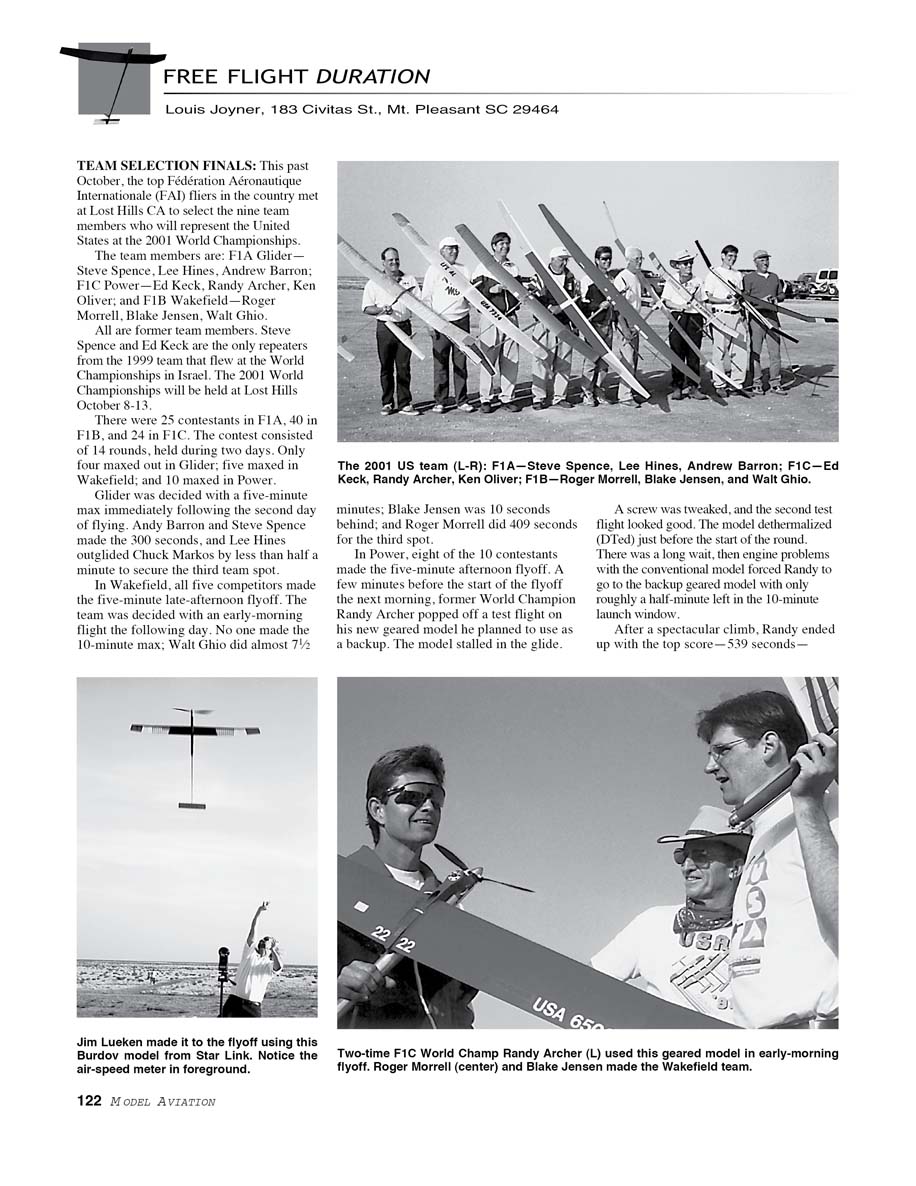
This past October, the top Fédération Aéronautique Internationale (FAI) fliers in the country met at Lost Hills, CA to select the nine team members who will represent the United States at the 2001 World Championships.
The team members are:
- F1A Towline Glider — Steve Spence, Lee Hines, Andrew Barron
- F1C Power — Ed Keck, Randy Archer, Ken Oliver
- F1B Wakefield — Roger Morrell, Blake Jensen, Walt Ghio
All are former team members. Steve Spence and Ed Keck are the only repeaters from the 1999 team that flew at the World Championships in Israel. The 2001 World Championships will be held at Lost Hills October 8–13.
There were 25 contestants in F1A, 40 in F1B, and 24 in F1C. The contest consisted of 14 rounds, held during two days. Only four maxed out in Glider; five maxed in Wakefield; and 10 maxed in Power.
Glider was decided with a five-minute max immediately following the second day of flying. Andy Barron and Steve Spence made the 300 seconds, and Lee Hines outglided Chuck Markos by less than half a minute to secure the third team spot.
In Wakefield, all five competitors made the five-minute late-afternoon flyoff. The team was decided with an early-morning flight the following day. No one made the 10-minute max; Walt Ghio flew almost 7½ minutes; Blake Jensen was 10 seconds behind; and Roger Morrell did 409 seconds for the third spot.
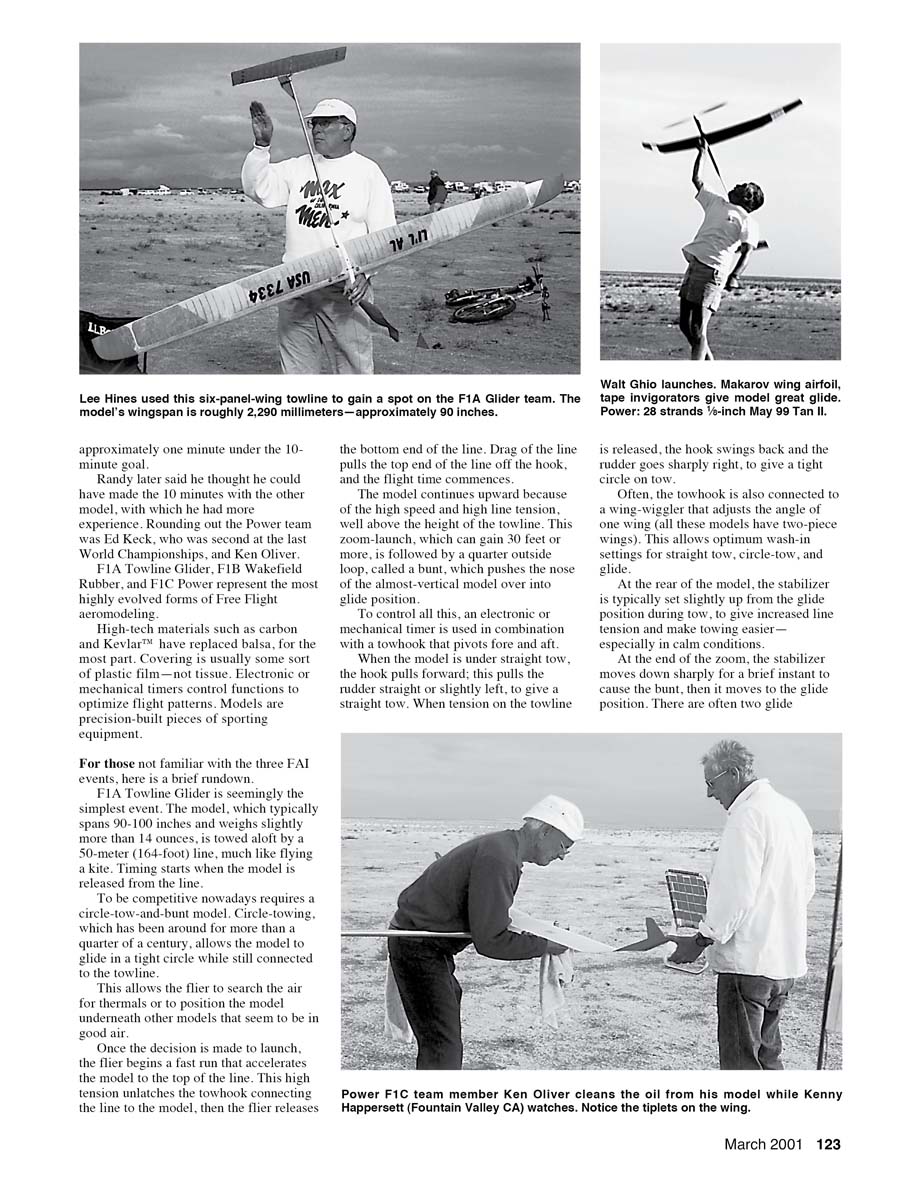
In Power, eight of the 10 contestants made the five-minute afternoon flyoff. A few minutes before the start of the flyoff the next morning, former World Champion Randy Archer popped off a test flight on his new geared model he planned to use as a backup. The model stalled in the glide. A screw was tweaked, and the second test flight looked good. The model dethermalized (DTed) just before the start of the round. There was a long wait, then engine problems with the conventional model forced Randy to go to the backup geared model with only roughly a half-minute left in the 10-minute launch window. After a spectacular climb, Randy ended up with the top score—539 seconds—approximately one minute under the 10-minute goal. Randy later said he thought he could have made the 10 minutes with the other model, with which he had more experience. Rounding out the Power team was Ed Keck, who was second at the last World Championships, and Ken Oliver.
FAI Events Overview
F1A Towline Glider, F1B Wakefield Rubber, and F1C Power represent the most highly evolved forms of Free Flight aeromodeling. High-tech materials such as carbon and Kevlar have replaced balsa for the most part. Covering is usually some sort of plastic film rather than tissue. Electronic or mechanical timers control functions to optimize flight patterns. Models are precision-built pieces of sporting equipment.
For those not familiar with the three FAI events, here is a brief rundown.
F1A Towline Glider
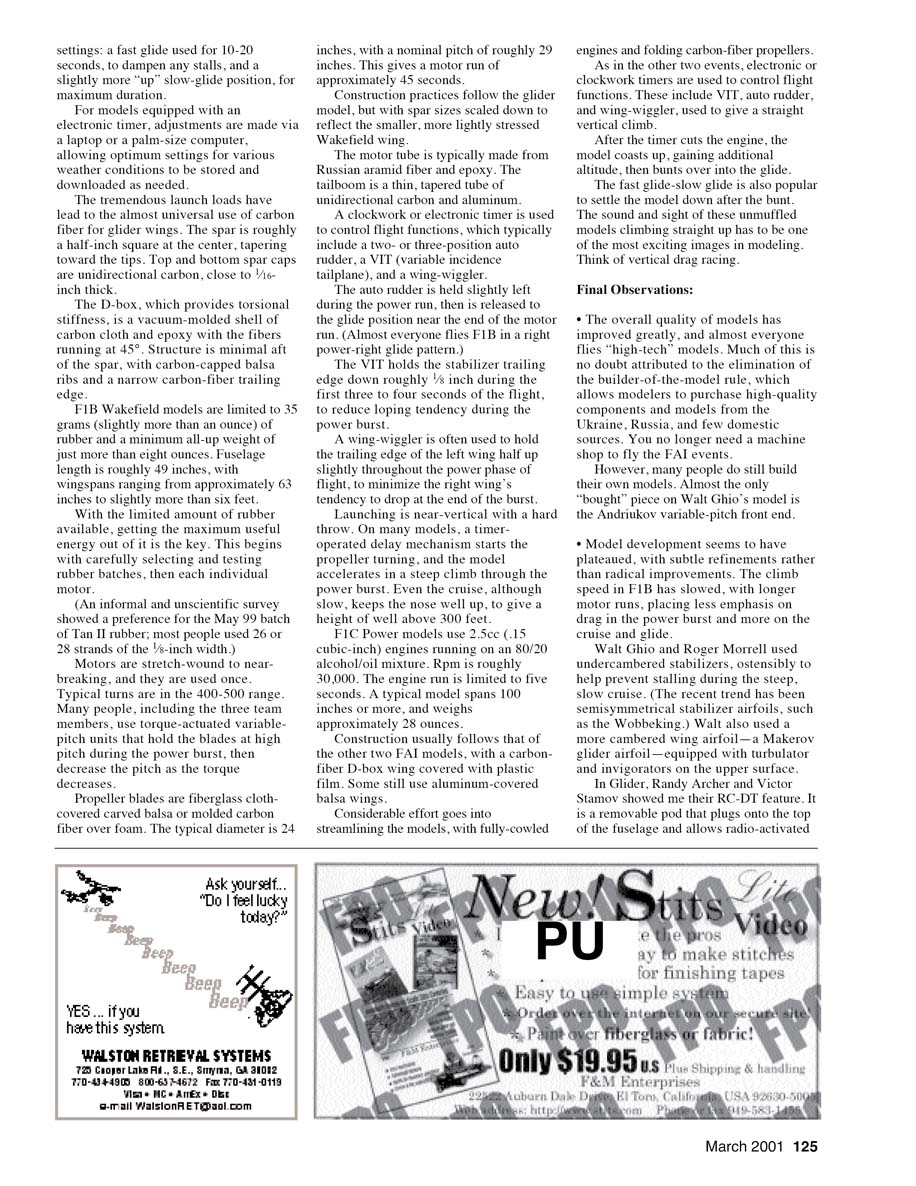
F1A Towline Glider is seemingly the simplest event. The model, which typically spans 90–100 inches and weighs slightly more than 14 ounces, is towed aloft by a 50-meter (164-foot) line, much like flying a kite. Timing starts when the model is released from the line.
To be competitive nowadays requires a circle-tow-and-bunt model. Circle-towing, which has been around for more than a quarter of a century, allows the model to glide in a tight circle while still connected to the towline. This allows the flier to search the air for thermals or to position the model underneath other models that seem to be in good air. Once the decision is made to launch, the flier begins a fast run that accelerates the model to the top of the line. This high tension unlatches the towhook connecting the line to the model, then the flier releases the bottom end of the line. Drag of the line pulls the top end of the line off the hook, and the flight time commences.
The model continues upward because of the high speed and high line tension, well above the height of the towline. This zoom-launch, which can gain 30 feet or more, is followed by a quarter outside loop, called a bunt, which pushes the nose of the almost-vertical model over into glide position.
To control all this, an electronic or mechanical timer is used in combination with a towhook that pivots fore and aft. When the model is under straight tow, the hook pulls forward; this pulls the rudder straight or slightly left to give a straight tow. When tension on the towhook is released, the hook swings back and the rudder goes sharply right, to give a tight circle on tow.
Often, the towhook is also connected to a wing-wiggler that adjusts the angle of one wing (all these models have two-piece wings). This allows optimum wash-in settings for straight tow, circle-tow, and glide.
At the rear of the model, the stabilizer is typically set slightly up from the glide position during tow to give increased line tension and make towing easier—especially in calm conditions. At the end of the zoom, the stabilizer moves down sharply for a brief instant to cause the bunt, then it moves to the glide position. There are often two glide settings: a fast glide used for 10–20 seconds to dampen any stalls, and a slightly more "up" slow-glide position for maximum duration.
For models equipped with an electronic timer, adjustments are made via a laptop or a palm-size computer, allowing optimum settings for various weather conditions to be stored and downloaded as needed.
The tremendous launch loads have led to the almost universal use of carbon fiber for glider wings. The spar is roughly a half-inch square at the center, tapering toward the tips. Top and bottom spar caps are unidirectional carbon, close to 1/16-inch thick. The D-box, which provides torsional stiffness, is a vacuum-molded shell of carbon cloth and epoxy with the fibers running at 45°. Structure is minimal aft of the spar, with carbon-capped balsa ribs and a narrow carbon-fiber trailing edge.
F1B Wakefield Rubber
F1B Wakefield models are limited to 35 grams (slightly more than an ounce) of rubber and a minimum all-up weight of just more than eight ounces. Fuselage length is roughly 49 inches, with wingspans ranging from approximately 63 inches to slightly more than six feet.
With the limited amount of rubber available, getting the maximum useful energy out of it is the key. This begins with carefully selecting and testing rubber batches, then each individual motor. (An informal and unscientific survey showed a preference for the May 99 batch of Tan II rubber; most people used 26 or 28 strands of the 1/8-inch width.)
Motors are stretch-wound to near-breaking, and they are used once. Typical turns are in the 400–500 range. Many people, including the three team members, use torque-actuated variable-pitch units that hold the blades at high pitch during the power burst, then decrease the pitch as the torque decreases.
Propeller blades are fiberglass cloth-covered carved balsa or molded carbon fiber over foam. The typical diameter is 24 inches, with a nominal pitch of roughly 29 inches. This gives a motor run of approximately 45 seconds.
Construction practices follow the glider model, but with spar sizes scaled down to reflect the smaller, more lightly stressed Wakefield wing. The motor tube is typically made from Russian aramid fiber and epoxy. The tailboom is a thin, tapered tube of unidirectional carbon and aluminum.
A clockwork or electronic timer is used to control flight functions, which typically include a two- or three-position auto rudder, a VIT (variable incidence tailplane), and a wing-wiggler. The auto rudder is held slightly left during the power run, then is released to the glide position near the end of the motor run (almost everyone flies F1B in a right power–right glide pattern). The VIT holds the stabilizer trailing edge down roughly 1/8 inch during the first three to four seconds of the flight to reduce loping tendency during the power burst.
A wing-wiggler is often used to hold the trailing edge of the left wing half up slightly throughout the power phase of flight, to minimize the right wing's tendency to drop at the end of the burst.
Launching is near-vertical with a hard throw. On many models, a timer-operated delay mechanism starts the propeller turning, and the model accelerates in a steep climb through the power burst. Even the cruise, although slow, keeps the nose well up to give a height of well above 300 feet.
F1C Power
F1C Power models use 2.5cc (.15 cubic-inch) engines running on an 80/20 alcohol/oil mixture. RPM is roughly 30,000. The engine run is limited to five seconds. A typical model spans 100 inches or more and weighs approximately 28 ounces.
Construction usually follows that of the other two FAI models, with a carbon-fiber D-box wing covered with plastic film. Some still use aluminum-covered balsa wings. Considerable effort goes into streamlining the models, with fully cowled engines and folding carbon-fiber propellers.
As in the other two events, electronic or clockwork timers are used to control flight functions. These include VIT, auto rudder, and wing-wiggler, used to give a straight vertical climb. After the timer cuts the engine, the model coasts up, gaining additional altitude, then bunts over into the glide. The fast-glide/slow-glide technique is also popular to settle the model down after the bunt. The sound and sight of these unmuffled models climbing straight up is one of the most exciting images in modeling—think vertical drag racing.
RC-DT: Some competitors (notably in F1C) use an RC-activated DT feature. This is a removable pod that plugs onto the top of the fuselage and allows radio-activated DT during test flights. RC-DT is only allowed for contest flights in F1C Power for motor stop or DT; it is removed for official flights in the other events. RC-DT should be a great asset for those who test-fly on small fields.
Perhaps the biggest recent innovation at this Finals was the Verbitsky "Reductor." Former World Champion Evgeny Verbitsky introduced the geared model several years ago. It features a planetary gear system of his design that allows the engine to swing a much larger, more efficient propeller (roughly 12 inches vs. seven inches). Evgeny recently made a small batch (probably half a dozen) for sale. The climb is very good, and the sound is incredible.
Final Observations
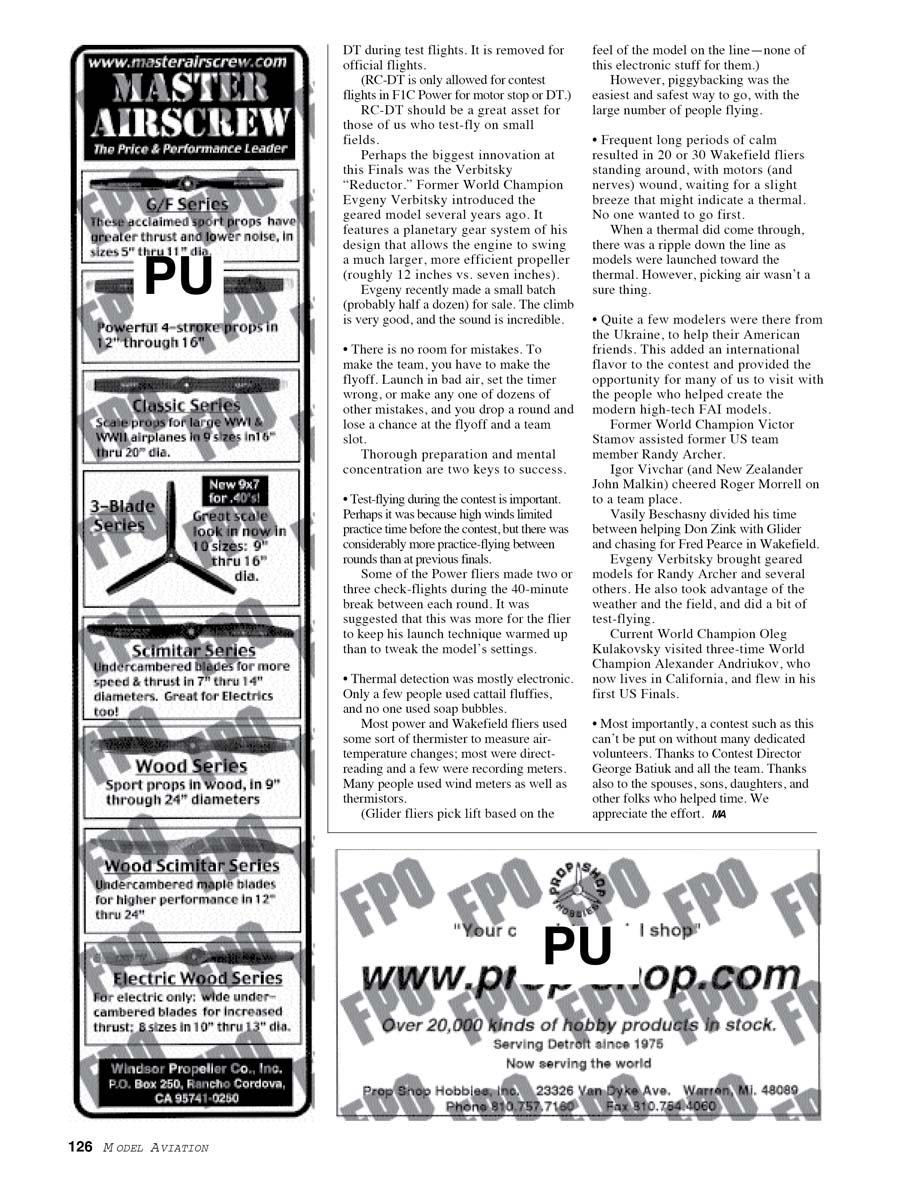
- The overall quality of models has improved greatly, and almost everyone flies high-tech models. Much of this is no doubt attributed to the elimination of the builder-of-the-model rule, which allows modelers to purchase high-quality components and models from the Ukraine, Russia, and a few domestic sources. You no longer need a machine shop to fly the FAI events. However, many people still build their own models. Almost the only "bought" piece on Walt Ghio's model is the Andriukov variable-pitch front end.
- Model development seems to have plateaued, with subtle refinements rather than radical improvements. The climb speed in F1B has slowed, with lower motor runs, placing less emphasis on drag in the power burst and more on cruise and glide. Walt Ghio and Roger Morrell used undercambered stabilizers, ostensibly to help prevent stalling during the steep, slow cruise. (The recent trend has been semisymmetric stabilizer airfoils, such as the Wobbleking.) Walt also used a more cambered wing airfoil—a Makevor glider airfoil—equipped with turbulator and invigorators on the upper surface.
- In Glider, Randy Archer and Victor Stanov showed me their RC-DT feature: a removable pod that plugs onto the top of the fuselage and allows radio-activated DT during test flights. It is removed for official flights. (RC-DT is only allowed for contest flights in F1C Power for motor stop or DT.) RC-DT should be a great asset for those who test-fly on small fields.
- There is no room for mistakes. To make the team, you have to make the flyoff. Launch in bad air, set the timer wrong, or make any one of dozens of other mistakes, and you drop a round and lose a chance at the flyoff and a team slot. Thorough preparation and mental concentration are two keys to success.
- Test-flying during the contest is important. Perhaps it was because high winds limited practice time before the contest, but there was considerably more practice-flying between rounds than at previous finals. Some of the Power fliers made two or three check-flights during the 40-minute break between each round. It was suggested that this was more for the flier to keep his launch technique warmed up than to tweak the model's settings.
- Thermal detection was mostly electronic. Only a few people used cattail fluffies, and no one used soap bubbles. Most power and Wakefield fliers used some sort of thermistor to measure air-temperature changes; most were direct-reading and a few were recording meters. Many people used wind meters as well as thermistors. (Glider fliers pick lift based on the feel of the model on the line—none of this electronic stuff for them.) However, piggybacking was the easiest and safest way to go, given the large number of people flying.
- Frequent long periods of calm resulted in 20 or 30 Wakefield fliers standing around, with motors (and nerves) wound, waiting for a slight breeze that might indicate a thermal. No one wanted to go first. When a thermal did come through, there was a ripple down the line as models were launched toward the thermal. However, picking air wasn't a sure thing.
- Quite a few modelers were there from the Ukraine to help their American friends. This added an international flavor to the contest and provided the opportunity for many of us to visit with the people who helped create the modern high-tech FAI models. Former World Champion Victor Stanov assisted former US team member Randy Archer. Igor Vivchar (and New Zealander John Malkin) cheered Roger Morrell on to a team place. Vasily Beschasny divided his time between helping Don Zink with Glider and chasing Fred Pearce in Wakefield. Evgeny Verbitsky brought geared models for Randy Archer and several others. He also took advantage of the weather and the field and did a bit of test-flying. Current World Champion Oleg Kulakovsky visited three-time World Champion Alexander Andriukov, who now lives in California, and flew in his first US Finals.
Most importantly, a contest such as this can't be put on without many dedicated volunteers. Thanks to Contest Director George Battiuk and all the team. Thanks also to the spouses, sons, daughters, and other folks who helped time. We appreciate the effort.
MA
Transcribed from original scans by AI. Minor OCR errors may remain.

