
FREE FLIGHT DURATION
Louis Joyner, 6 Saturday Rd., Mt. Pleasant, SC 29464
What is Free Flight?
What is Free Flight? Simply stated, a Free Flight model aircraft is one in which there is no physical connection between the aeromodel and the competitor during flight. There are no control lines; there is no radio control. The model flies by careful design, construction, and adjustments that allow it to balance the forces of flight.
Free Flight is the oldest form of model aviation — in fact, the oldest form of fixed-wing aviation. A century before the Wright brothers, Sir George Cayley experimented with kite-based gliders and published his results in On Aerial Navigation. In 1871, Frenchman Alphonse Penaud’s Planophore flew 40 meters (approximately 131 feet) and stayed aloft 11 seconds. Penaud’s 18-inch-wingspan model used a pusher propeller powered by a rubber motor; it was the first sustained, stable flight by an aircraft.
Hundreds of models of the Planophore and Penaud’s rubber-powered helicopter were sold in Paris. Bishop Wright brought one of these helicopter models back to his sons Wilbur and Orville, sparking their interest in aviation.
Modern Free Flight
Free Flight is very much alive today. Internationally, sportsmen from more than 30 countries compete in the Free Flight World Championships (most recently held at Lost Hills, California, in October 2001). The Free Flight Nationals regularly draws more than 200 contestants from across the United States. The National Free Flight Society’s (NFFS) membership exceeds 1,600 members.
Free Flight models range from simple stick-and-tissue models to complex, high-tech craft constructed from carbon fiber, Kevlar, and aluminum. Costs can run from a few dollars to more than $2,000.
Competition and Duration
Although some people fly Free Flight models strictly for the fun of watching the aircraft climb against the sky and glide slowly downward, competition is the essence of Free Flight for most participants.
Almost all Free Flight events are scored based on duration: the time the model stays aloft. To limit the distance a model flies, there is a maximum duration for a single flight. These times vary by event and can be changed to fit the size of the field or weather conditions. A typical maximum for smaller-field contests is two minutes. Any time surpassing the set maximum does not count.
A device called a dethermalizer is used to bring the model down after it has reached the maximum. The most popular type allows the horizontal stabilizer to pop up to roughly 40°, causing the model to go into a deep stall and descend parachute-like to the ground. Binoculars are used to follow the flight from the ground.
Since models can drift considerable distances, especially in windy weather or when there are strong thermals, bicycles and motorbikes are often used for retrieval. Many modelers also use small, low-power tracking transmitters in the models to aid in finding them; this has all but eliminated the loss of Free Flight models.
Community and Sportsmanship
Free Flight is not a cutthroat, win-at-all-costs type of competition. Experienced competitors are often generous with help for new modelers. Tools, advice, and spare parts are given freely; tips and techniques are shared willingly. Having a friend, or someone you just met, spend hours in a cornfield helping you find a model is common and part of the Free Flight experience.
Events and Classes
Free Flight includes a wide variety of events, allowing modelers to find categories that suit their abilities, interests, budgets, and temperaments.
- Small rubber-powered models, such as the popular P-30 class, are easy and inexpensive to build yet offer surprisingly good performance.
- Power models offer the exciting sound of an engine turning at more than 30,000 rpm.
- Simple hand-launched or catapult gliders, carefully built from solid balsa, provide hours of enjoyment at a nearby soccer field and the thrill of a contest-winning thermal flight.
- Old-Timer and Nostalgia events allow modelers to build and fly designs dating back to earlier days of model aviation.
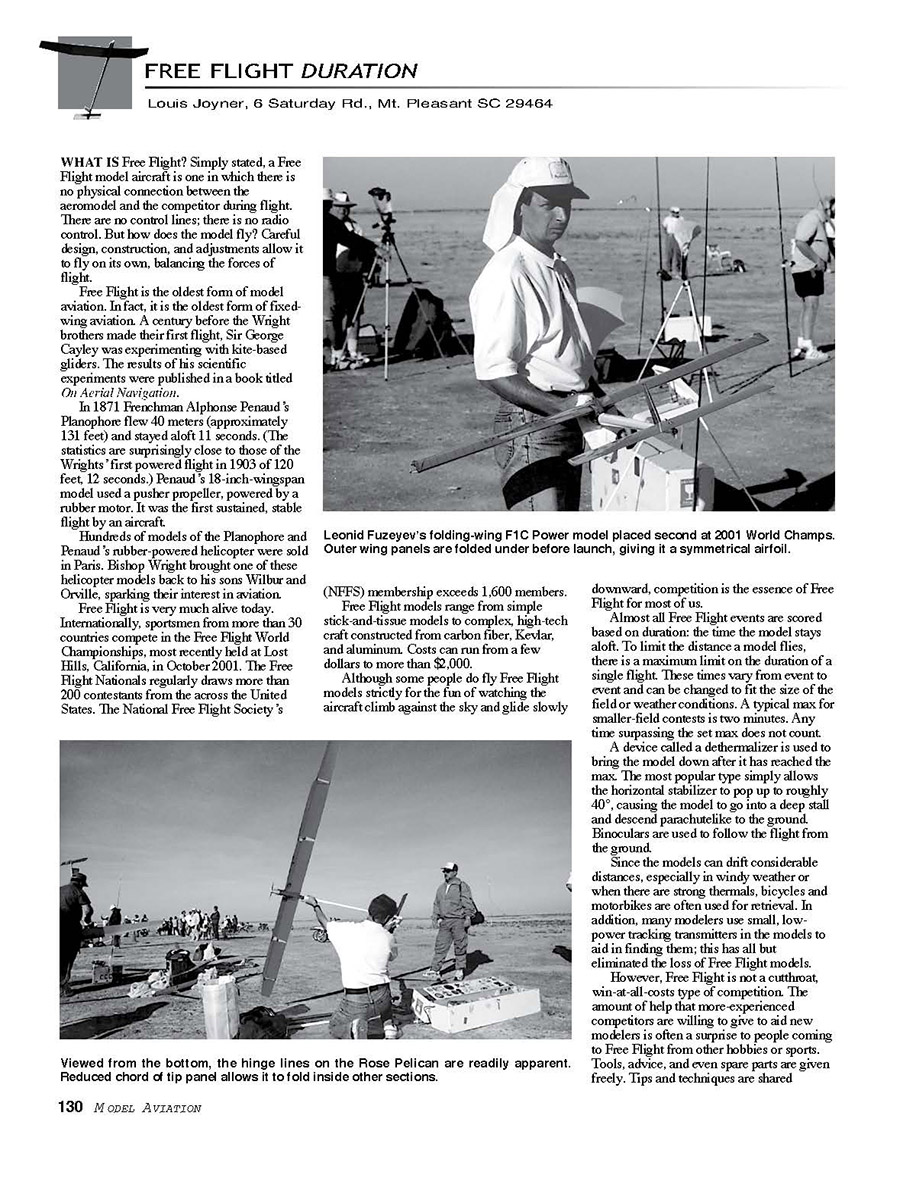
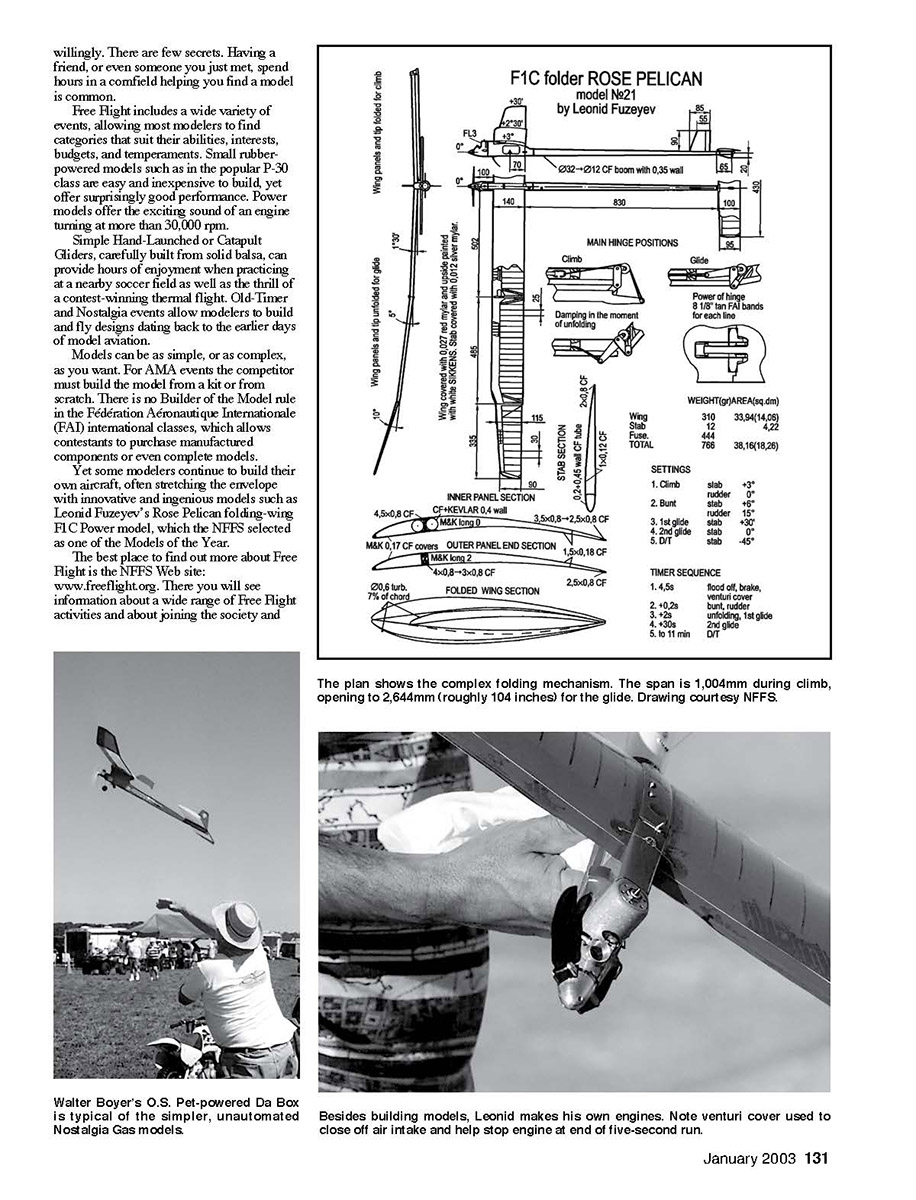
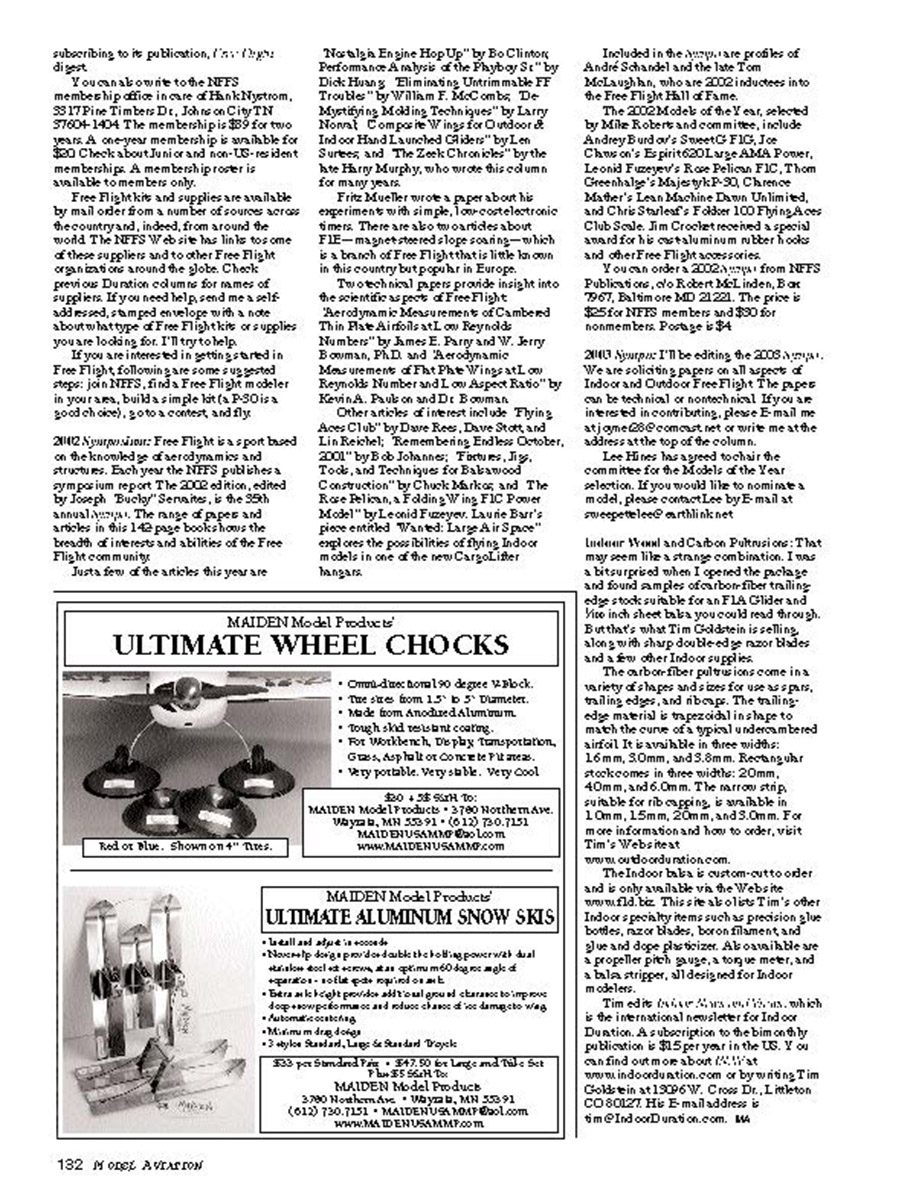
For AMA events the competitor must build the model from a kit or from scratch. The Fédération Aéronautique Internationale (FAI) international classes do not have a "Builder of the Model" rule and allow contestants to purchase manufactured components or even complete models. Many modelers, however, continue to build their own aircraft and sometimes push the envelope with innovative designs, such as Leonid Fuzeyev’s Rose Pelican folding-wing F1C power model (selected by the NFFS as one of the Models of the Year).
How to Get Started
If you are interested in getting started in Free Flight, consider these suggested steps:
- Join the National Free Flight Society (NFFS).
- Find a Free Flight modeler or club in your area.
- Build a simple kit (it’s possible to find inexpensive starter kits).
- Attend a contest or club meeting.
- Ask questions — experienced Free Flighters are usually happy to help newcomers.
If you need help finding kits or supplies, send a self-addressed, stamped envelope with a note about what type of Free Flight kits or supplies you are looking for; assistance may be available.
NFFS and Resources
The best place to find out more about Free Flight is the NFFS website: www.freeflight.org. There you will see information about a wide range of Free Flight activities and about joining the society and subscribing to its publication, Free Flight Digest.
You can write to the NFFS membership office:
- Hank Nuyten, 3317 Pine Trees Dr., Johnstown, NY 12004-1404.
Membership fees:
- $28 for two years.
- $20 for one year.
- Check about junior and non‑U.S. resident memberships.
A membership roster is available to members only.
Free Flight kits and supplies are available by mail order from a number of sources in the U.S. and around the world. The NFFS website has links to some suppliers and other Free Flight organizations. Check every issue’s Destination column for names of suppliers.
2002 Symposium: Free Flight
Free Flight is a sport based on aerodynamics and structures. Each year the NFFS publishes a symposium report. The 2002 edition, edited by Joseph “Bucky” Severin, is the 35th annual issue. The 142-page book presents a wide range of papers and articles illustrating the breadth of interest and abilities in the Free Flight community.
Selected articles and papers in the 2002 symposium include:
- “Nostalgia Engine Hop‑Up” by Bo Clinton
- “Performance Analysis of the Playboy Sr.” by Dick Hearn
- “Eliminating Untrimable FF Trouble” by William F. MacComb
- “De‑Mystifying Molding Techniques” by Larry Novak
- “Composite Wings for Outdoor & Indoor Hand‑Launched Gliders” by Len Surtees
- “The Zeek Chronicles” by Harry Murphy
- Fritz Mueller’s paper on experiments with simple, low‑cost electronic timers
- Two articles about F1E (magnet-assisted rope soaring) by leading European and American authorities
- “Aerodynamic Measurement of Camber in Thin Airfoils at Low Reynolds Numbers” by James E. Parry and W. Jerry Bowman, Ph.D.
- “Aerodynamic Measurements of Flat Plate Wings at Low Reynolds Number and Low Aspect Ratio” by Kevin A. Paulson and D. Bowman
- “Flying Aces Club” by Dave Rea, Dave Stott, and Lin Reichel
- “Remembering Bendix October, 2001” by Bob Johansen
- “For Better Trim, Try Tools, and Techniques for Balancing and Construction” by Chuck Marks
- “The Rose Pelican, a Folding Wing F1C Power Model” by Leonid Fuzeyev
- “Wanted: Large Air Space” by Laurie Baird (exploring indoor flying in one of the new Cargo Lifter hangars)
The symposium also includes profiles of Andre Schandell and the late Tom McLaughlin, who were 2002 inductees into the Free Flight Hall of Fame.
2002 Models and Awards
The 2002 Models of the Year (selected by the Models of the Year committee and featured in the symposium) include:
- Andrey Burdov’s Sweet G Fig
- Joe Choffo’s Biplane 620
- Lance AMA Power
- Leonid Fuzeyev’s Rose Pelican F1C
- Thom Greenhalgh’s Majesty K‑30
- Clarence Maehler’s Leam Machine Dawn Unlimited
- Chris Staver’s Felder 100 Flying Lawn Club Scale
Jim Crockett received a special award for his aluminum rubber hook and other Free Flight accessories.
Ordering the Symposium
Order from NFFS Publications:
- c/o Robert McLinden, Box 7967, Baltimore, MD 21226.
- Price: $25 for NFFS members, $30 for nonmembers.
- Postage: $4.
Closing
Free Flight is very much a people sport. The generosity of experienced competitors — sharing tools, advice, spare parts, tips, and time spent helping to find models — is a defining feature of the community and a great way for newcomers to become involved.
Transcribed from original scans by AI. Minor OCR errors may remain.

