
FREE FLIGHT DURATION
Louis Joyner 6 Saturday Rd., Mt. Pleasant SC 29464
FAI Team Selection Finals
The Fédération Aéronautique Internationale (FAI) Team Selection Finals, held this past September in Palm Bay, Florida, produced one of the most experienced and geographically diverse teams in recent memory. Only two fliers (Bob Piserchio and Brian VanNest) are from California. Other states represented include:
- New Mexico
- Texas
- Oregon
- Michigan
- New York
- Ohio
- Arizona
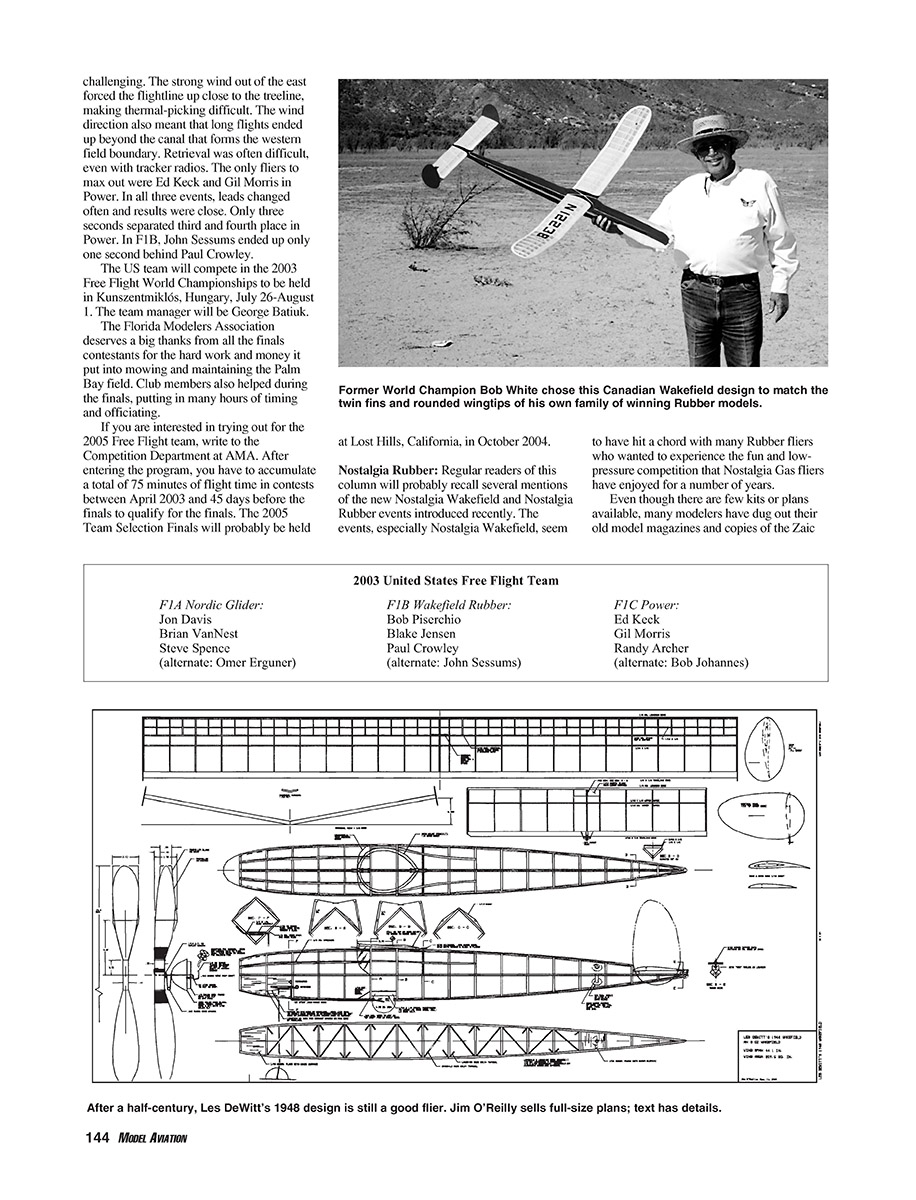
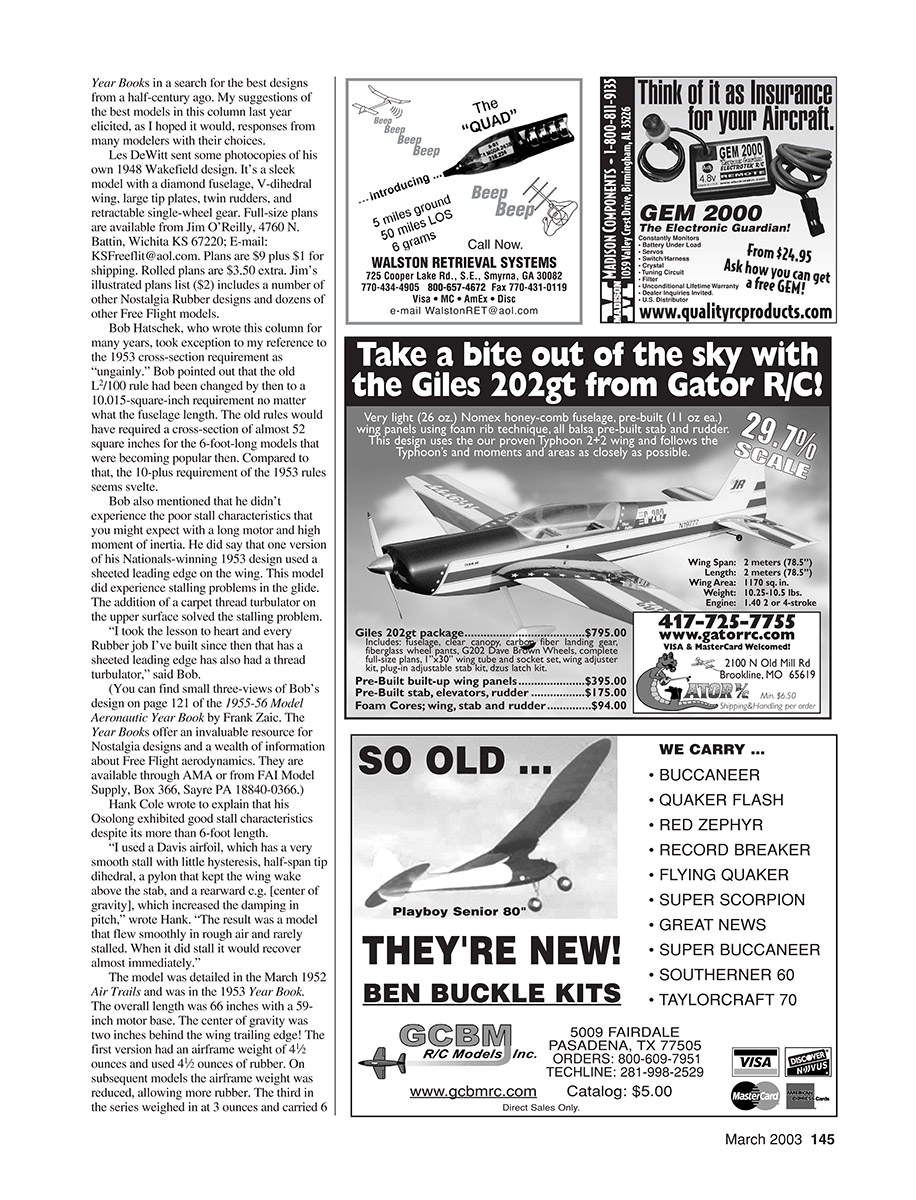
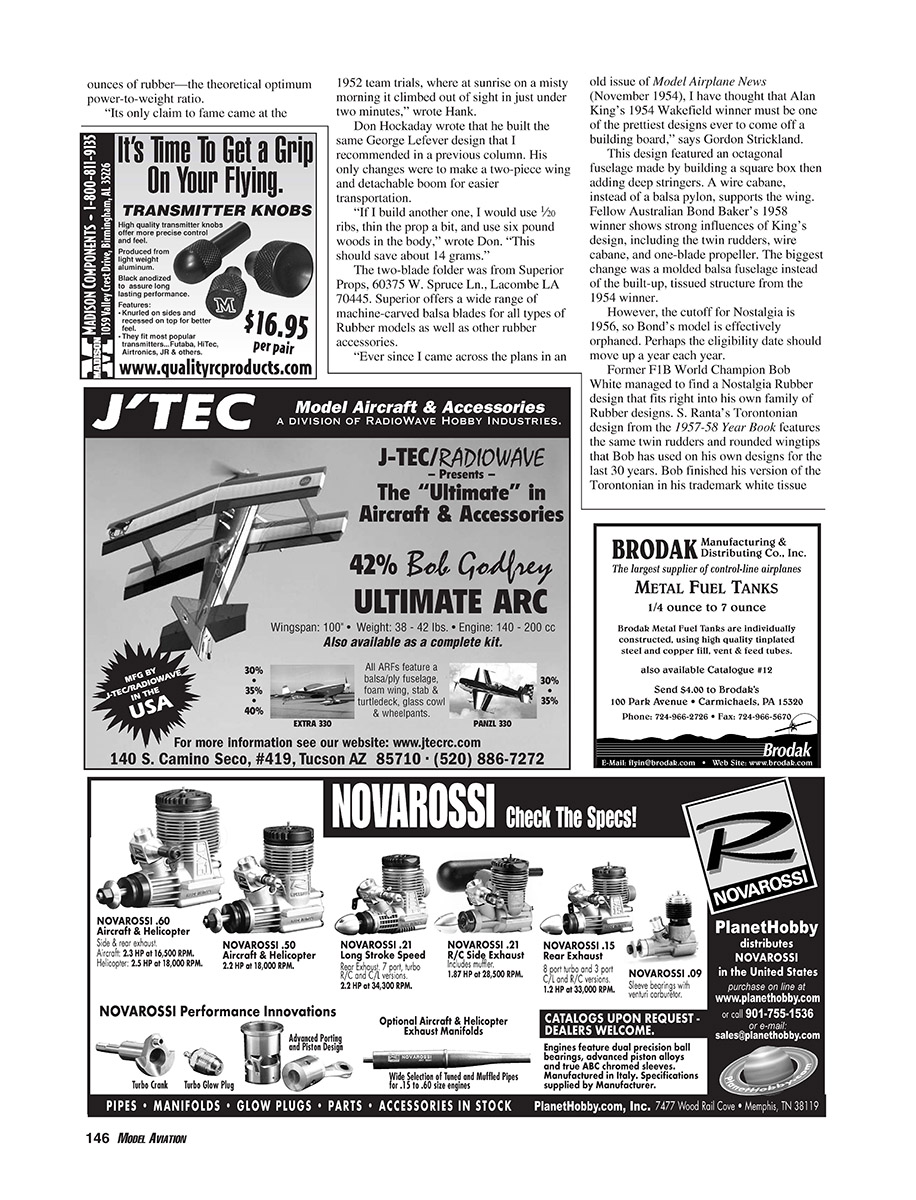
The team includes one multiple World Champion, Randy Archer, and several fliers who have medaled at previous World Championships, including Blake Jensen, Ed Keck, and Gil Morris.
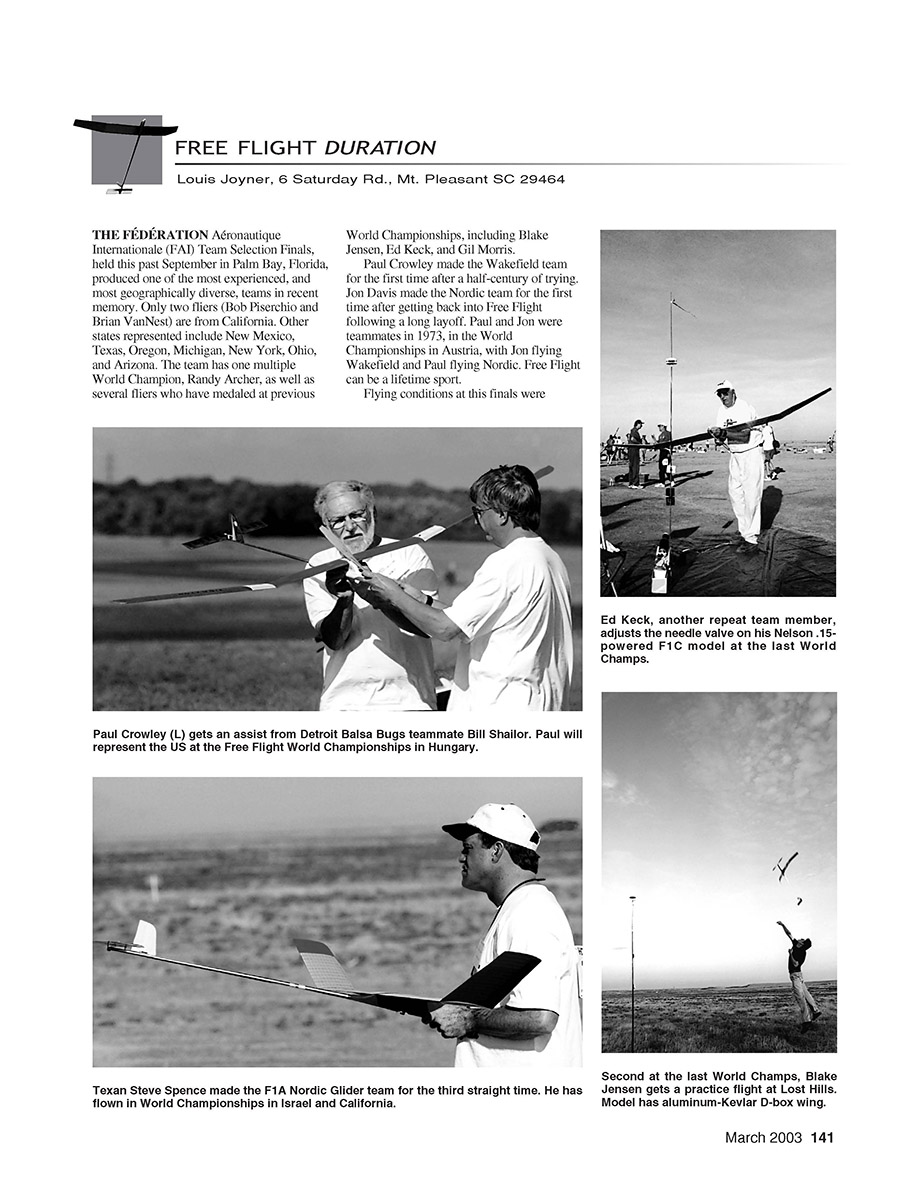
Paul Crowley made the Wakefield team for the first time after a half-century of trying. Jon Davis made the Nordic team for the first time after getting back into Free Flight following a long layoff. Paul and Jon were teammates in 1973 at the World Championships in Austria, with Jon flying Wakefield and Paul flying Nordic. Free Flight can be a lifetime sport.
Flying conditions at this finals were challenging. Strong east winds forced the flightline up close to the treeline, making thermal picking difficult. The wind direction also meant that long flights often ended up beyond the canal that forms the western field boundary. Retrieval was often difficult, even with tracker radios. The only fliers to max out were Ed Keck and Gil Morris in Power. In all three events, leads changed often and results were close—only three seconds separated third and fourth place in Power. In F1B, John Sessums ended up only one second behind Paul Crowley.
The U.S. team will compete in the 2003 Free Flight World Championships in Kunszentmiklós, Hungary, July 26–August 1. The team manager will be George Batiuk.
The Florida Modelers Association deserves a big thanks from all the finals contestants for the hard work and money it put into mowing and maintaining the Palm Bay field. Club members also put in many hours of timing and officiating.
If you are interested in trying out for the 2005 Free Flight team, write to the Competition Department at AMA. After entering the program, you must accumulate a total of 75 minutes of flight time in contests between April 2003 and 45 days before the finals to qualify for the finals. The 2005 Team Selection Finals will probably be held at Lost Hills, California, in October 2004.
Nostalgia Rubber
Regular readers of this column will recall several mentions of the new Nostalgia Wakefield and Nostalgia Rubber events introduced recently. The events—especially Nostalgia Wakefield—have struck a chord with many Rubber fliers who wanted to experience the fun and low-pressure competition that Nostalgia Gas fliers have enjoyed for years.
Even though there are few kits or plans available, many modelers have dug out old magazines and copies of the Zaic Year Books in search of the best designs from a half-century ago. My suggestions of the best models in this column last year elicited responses from many modelers with their choices.
Les DeWitt sent photocopies of his own 1948 Wakefield design. It's a sleek model with a diamond fuselage, V-dihedral wing, large tip plates, twin rudders, and retractable single-wheel gear. Full-size plans are available from Jim O'Reilly, 4760 N. Battin, Wichita KS 67220; E-mail: KSFreeflit@aol.com. Plans are $9 plus $1 for shipping. Rolled plans are $3.50 extra. Jim's illustrated plans list (S2) includes a number of other Nostalgia Rubber designs and dozens of other Free Flight models.
Bob Hatschek, who wrote this column for many years, took exception to my reference to the 1953 cross-section requirement as "ungainly." Bob pointed out that the old L-2/100 rule had been changed by then to a 10.015-square-inch requirement no matter what the fuselage length. The old rules would have required a cross-section of almost 52 square inches for the 6-foot-long models that were becoming popular then. Compared to that, the 10-plus requirement of the 1953 rules seems svelte.
Bob also mentioned that he didn't experience the poor stall characteristics one might expect with a long motor and high moment of inertia. He did say that one version of his Nationals-winning 1953 design used a sheeted leading edge on the wing, and this model did experience stalling problems in the glide. The addition of a carpet-tread turbulator on the upper surface solved the stalling problem.
"I took the lesson to heart and every Rubber job I've built since then that has a sheeted leading edge has also had a thread turbulator," Bob wrote.
Small three-views of Bob's design can be found on page 121 of the 1955–56 Model Aeronautic Year Book by Frank Zaic. The Year Books offer an invaluable resource for Nostalgia designs and a wealth of information about Free Flight aerodynamics. They are available through AMA or from FAI Model Supply, Box 366, Sayre PA 18840-0366.
Hank Cole wrote to explain that his Osolong exhibited good stall characteristics despite its more-than-6-foot length.
"I used a Davis airfoil, which has a very smooth stall with little hysteresis, half-span tip dihedral, a pylon that kept the wing above the stab, and a rearward C.G. (center of gravity), which increased the damping in pitch," Hank wrote. "The result was a model that flew smoothly in rough air and rarely stalled. When it did stall it would recover almost immediately."
The model was detailed in the March 1952 Air Trails and was in the 1953 Year Book. The overall length was 66 inches with a 59-inch motor base. The center of gravity was two inches behind the wing trailing edge. The first version had an airframe weight of 4.5 ounces and used 4.5 ounces of rubber. On subsequent models the airframe weight was reduced, allowing more rubber. The third in the series weighed in at 3 ounces and carried 6 ounces and flew fine on a half-ounce motor. It performed well in the 1952 team trials, where at sunrise on a misty morning it climbed out of sight in just under two minutes.
Don Hockaday wrote that he built the same George Lefever design I recommended in a previous column. His only changes were to make a two-piece wing and detachable boom for easier transportation.
"If I build another one, I would use 1/32 ribs, thin the prop a bit, and use six-pound woods in the body," Don wrote. "This should save about 14 grams."
The two-blade folder he used was from Superior Props, 60375 W. Spruce Ln., Lacombe, LA 70445. Superior offers a wide range of machine-carved balsa blades for all types of Rubber models as well as other rubber accessories.
Gordon Strickland wrote, "Ever since I came across the plans in an old issue of Model Airplane News (November 1954), I have thought that Alan King's 1954 Wakefield winner must be one of the prettiest designs ever to come off a building board." King's design featured an octagonal fuselage made by building a square box then adding deep stringers. A wire cabane, instead of a balsa pylon, supports the wing. Fellow Australian Bond Baker's 1958 winner shows strong influences of King's design, including twin rudders, wire cabane, and a one-blade propeller. The biggest change was a molded balsa fuselage instead of the built-up, tissue structure from the 1954 winner. However, the cutoff for Nostalgia is 1956, so Bond's model is effectively orphaned; perhaps the eligibility cutoff should move up a year each year.
Former F1B World Champion Bob White managed to find a Nostalgia Rubber design that fits right into his own family of Rubber designs. S. Ranta's Torontonian design from the 1957–58 Year Book features the same twin rudders and rounded wingtips that Bob has used on his own designs for the last 30 years. Bob finished his version of the Torontonian in his trademark white tissue.
Last summer Bob sent a photo of the just-completed model. This past October he sent another photo and a copy of his scorecard from the San Valeers Nostalgia Annual contest. The times tell it all: three 120s, 180, 240, 300, and 305 seconds—a seven-flight total of more than 23 minutes. Bob notes that the model is flown at full Wakefield weight of just more than 8 ounces. (Current Nostalgia Wakefield rules place no limits on model or rubber weight.) Full-size plans are available from Jim O'Reilly.
Collectible Kits
Free Flight kits come and go. In the 1950s it seemed as if there was a new .049 and 1/2A gas kit every month. As new designs flew off the dealers' shelves, the old kits languished, collecting dust. Eventually the kits that didn't sell were discontinued. Often the manufacturers themselves either went out of business or switched focus from Free Flight to other hobby items.
More recently, most Free Flight kits have been produced by small, one-person operations in small batches. If reorders didn't come in, there might not be a second batch. Modelers picked up on the realities of the kit business and learned to buy now because it might not be available later.
If you didn't prudently stock up on kits you wanted to build, swap meets, garage sales, and eBay offer a few possibilities. For a wider range of choices you need to find a kit dealer such as Robert Stricker. His price list is 10 pages long, single-spaced, with two columns per page—well more than 1,500 items.
Not surprisingly, many of the kits listed are Rubber Scale. Along with the usual mass-market Comet, Cleveland, Guillow's, and Sterling offerings, there are some from boutique manufacturers such as Golden Age and Diehl's. The list even includes a Spad XIII and an S.E.5a by California Models.
If you remember the pre-plastic era, you may recall Strombecker solid models—basically a few pieces of hardwood, a small piece of sandpaper, powdered glue, and a sheet of decals. With a lot of work they could look good from a distance. When plastic kits arrived, the solid models died out. Evidently a few people still prefer the hard way: prices for old Strombecker solid model kits now range from about $40 to $75 (originally well under $1).
A close reading of Robert Stricker's November 2002 list turns up a number of Free Flight Duration kits, including:
- Berkeley Amazon .400 — $75
- Aircraft Baby Bombshell — $50
- Comet Sparky — $30
- Comet Zipper A — $75
- Jetco Thermic Trooper — $5
- Jetco Thermic 50-X — $5
- Midwest Dyna-Moc (wartime kit with hardwood parts) — $60
- Scientific Flying Glory Hand-Launched Glider (1945) — $40
The list also includes engine parts for K&B, OK Cub, Testors, and McCoy, as well as parts and accessories from Darwin, Perfect, and Veco.
If you'd like to relive the past, write for a price list: Robert Stricker, 924 Jaipur Ave., Naperville, IL 60540. A dollar or a stamp or two to help offset mailing costs would be appreciated. If you are in a hurry, call (630) 961-0327.
Transcribed from original scans by AI. Minor OCR errors may remain.

