
FREE FLIGHT DURATION
Louis Joyner, 6 Saturday Rd., Mt. Pleasant SC 29464
Perhaps the most frequently asked question I hear from radio-control modelers and the general public is, "How do you control a model without a radio?" The answer is both simple and complex.
The short answer is that the model is designed to be inherently stable so that it can fly without the constant corrective control adjustments required with most full-scale aircraft or radio-controlled models. The long answer requires an explanation of dihedral, the relationship of vertical fin area to the amount of dihedral, the location of the center of gravity relative to the center of pressure, decalage, and so on. Those are design factors that most free flighters have learned through the years, often the hard way. If you start with a good kit or magazine plans and follow the instructions for balancing the model properly, there shouldn’t be any major problems. At the very least, you’ll have a model that should fly.
Things get interesting when you start trying to improve the model’s flight characteristics beyond the basic flying-without-crashing level. This is where speed becomes an important factor. For instance, a rubber model at low power will cruise under power at a speed that is close to its glide speed. Things are fairly safe, and a model adjusted for a safe glide will usually have a safe cruise pattern. Wind the motor all the way, and things get interesting. For the first few seconds of the flight the model is traveling faster than glide speed. This means the wing is generating more lift, causing the model to try to loop. With careful design and adjustment you can turn that extra lift into a productive climb rather than a loop. The trick is to do it without affecting the cruise and glide.
Luckily, most of the adjustments we can make to a model are speed sensitive. Downthrust and side thrust, center-of-gravity location, and stabilizer tilt are more effective at low speeds, while rudder, elevator, and wing warps (washin and washout) are more effective at high speeds. This allows us to balance a high-speed adjustment with a low-speed adjustment, creating self-correcting flight.
The combination of right thrust and left rudder is perhaps the easiest to understand. At high speeds a slight amount of right rudder will become effective and straighten out a right-climbing pattern, preventing a right spiral dive. The straighter pattern tends to cause the model’s nose to go up and the model to climb. If the nose gets too far up, the model will slow down. Then the right thrust becomes more effective and the model starts to yaw right rather than stall. All of this requires a careful balance in the amount of thrust offset relative to the amount of rudder deflection and in the overall amounts; that is, a lot of both or a little of both. Excessive thrust and rudder offsets can work, but they usually cause reduced performance. The trick is finding how little of each you need and, perhaps more important, settings that control the high-speed climb without adversely affecting the glide.
There is another way. By using a timer to activate an AR (auto rudder), VIT (variable incidence tailplane), or other controls, we can isolate the different segments of the flight and adjust each independently. Most of the high-performance free flight events, rubber and power, use auto surfaces. Although there is the added complication of a timer, movable surfaces, and lines to hook up, adjusting the model is often easier than with a non-automated, locked-up model.
However, there has been a backlash against the complexity of the automated models. A non-automated AMA Power event—Classic Gas—has recently been added to the schedule. This event places no restrictions on model design, construction, or the engine used, but it forbids the use of auto surfaces. One advantage of Classic Gas compared to the similar but more restrictive Nostalgia Gas is that it allows innovation in model design and construction; Nostalgia Gas limits the designs to those published before 1956.
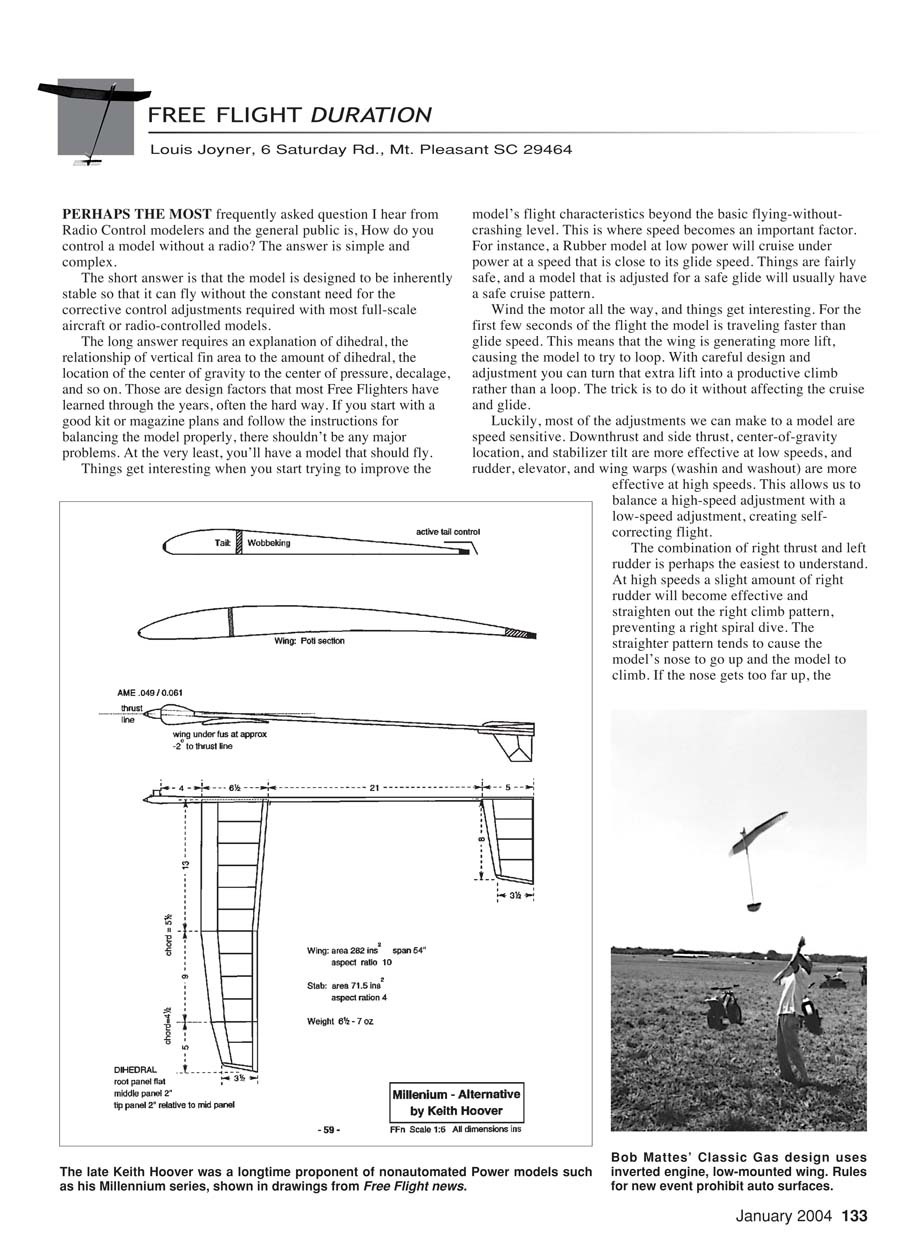
The late Keith Hoover was a longtime proponent of non-automated power models. His designs ranged from high-thrustline models in the 1950s to his last Millennium series. These models dispense with the traditional pylon or high-thrust arrangements and use a wing set close to the thrustline and a fuselage that angles downward toward the rear to locate the stabilizer slightly below the wing.
Keith also used what he called an "active tail control," a simple aluminum tab attached to the top of the stabilizer. At glide speed the tab had little effect. At high speeds the tab became effective and caused a nose-down force to counteract the increased lift of the wing and prevent looping. The tab extended only three inches on either side of the stabilizer centerline.
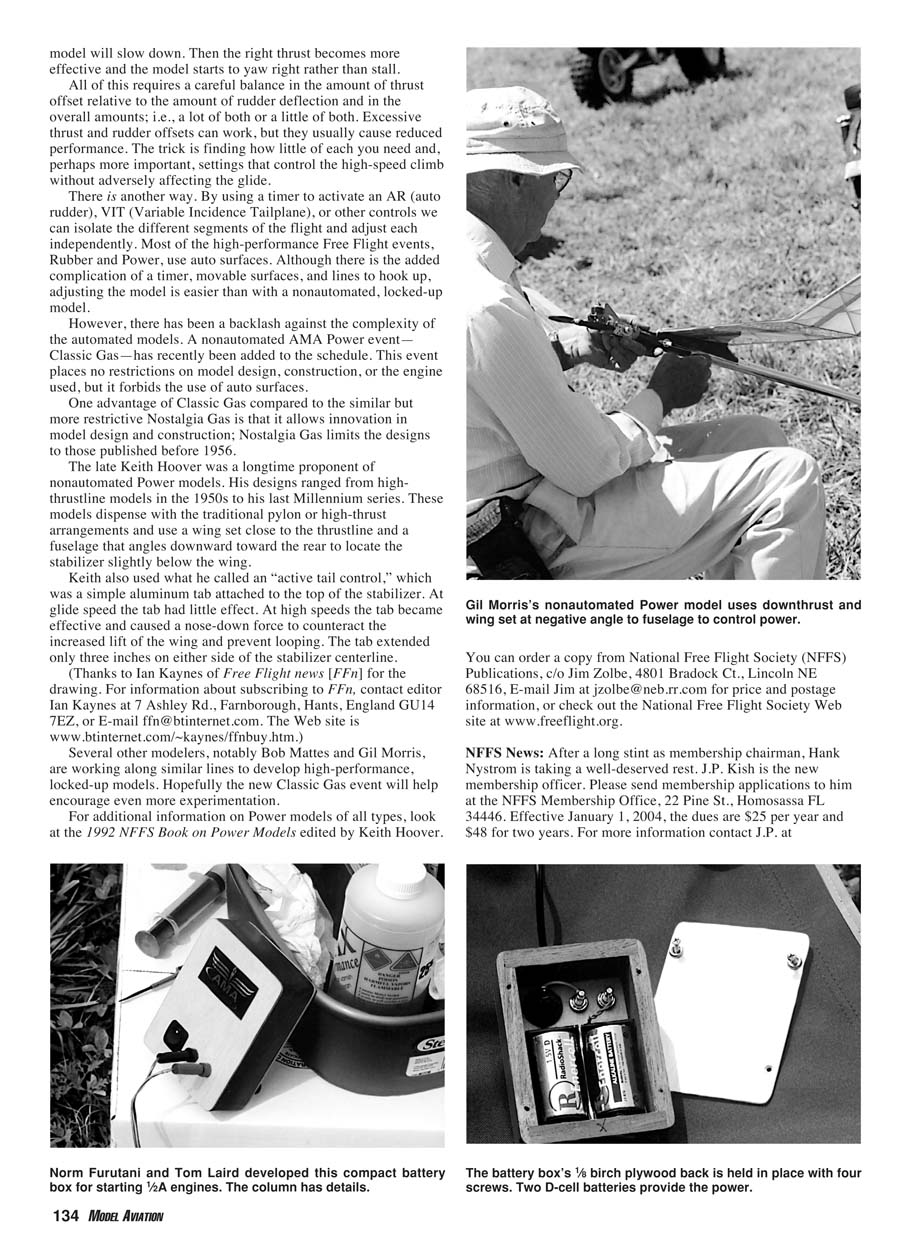
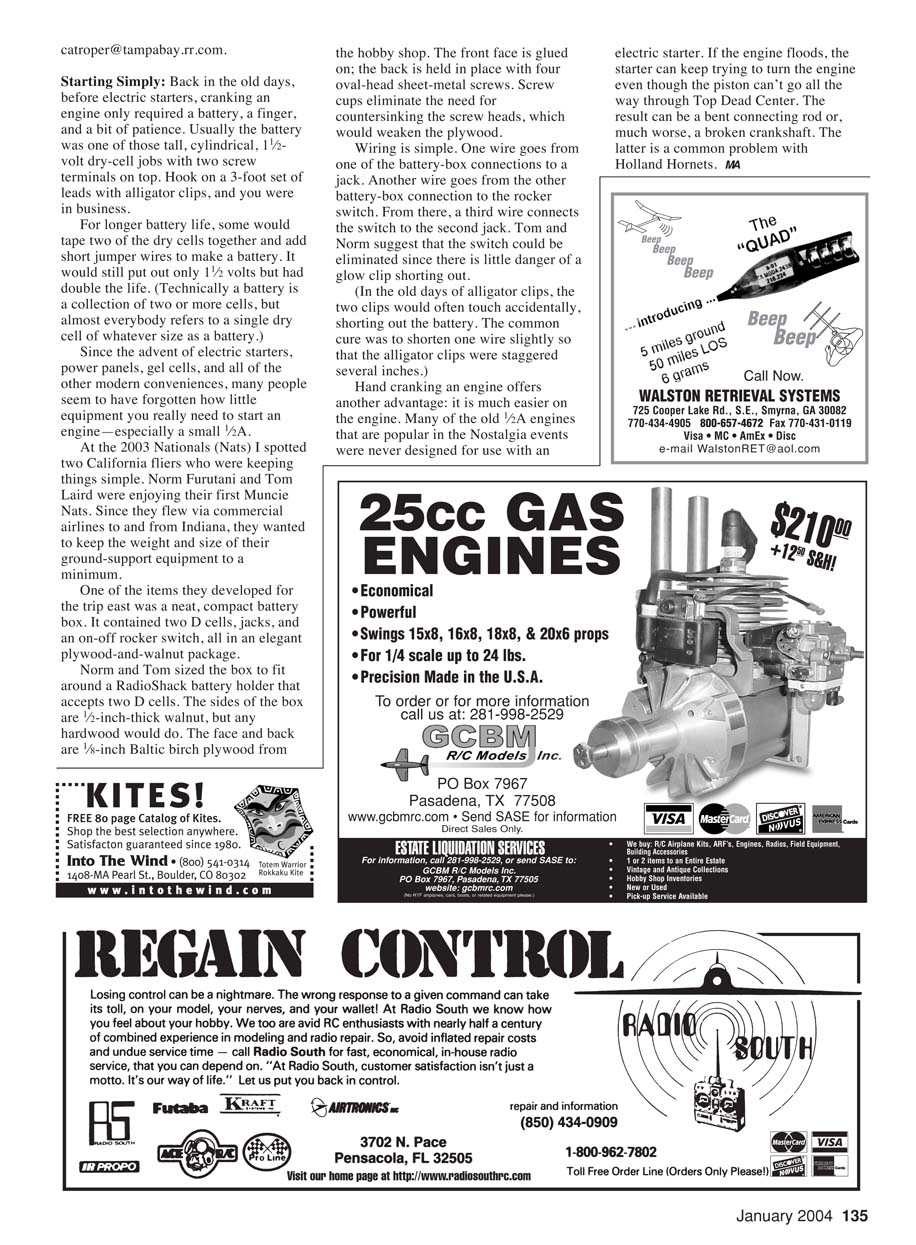
Several other modelers, notably Bob Mattes and Gil Morris, are working along similar lines to develop high-performance, locked-up models. Hopefully the new Classic Gas event will help encourage even more experimentation.
For additional information on power models of all types, see the 1992 NFFS Book on Power Models edited by Keith Hoover. You can order a copy from National Free Flight Society (NFFS) Publications, c/o Jim Zolbe, 4801 Bradock Ct., Lincoln NE 68516. E-mail Jim at jzolbe@neb.rr.com for price and postage information, or check out the National Free Flight Society web site at www.freeflight.org.
(Thanks to Ian Kaynes of Free Flight News (FFn) for the drawing. For information about subscribing to FFn, contact editor Ian Kaynes at 7 Ashley Rd., Farnborough, Hants, England GU14 7EZ, or e-mail ffn@btinternet.com. The web site is www.btinternet.com/~kaynes/ffn/ffn.htm.)
NFFS News
After a long stint as membership chairman, Hank Nystrom is taking a well-deserved rest. J.P. Kish is the new membership officer. Please send membership applications to him at the NFFS Membership Office, 22 Pine St., Homosassa FL 34446. Effective January 1, 2004, dues are $25 per year and $48 for two years.
For more information contact J.P. Kish at the NFFS Membership Office.
Transcribed from original scans by AI. Minor OCR errors may remain.

