

FREE FLIGHT DURATION
Louis Joyner, 6 Saturday Rd., Mt. Pleasant SC 29464
JUNIOR WORLD CHAMPIONSHIPS
August 8–14, the 11 members of the US team competed in the 2004 Junior Free Flight World Championships in Moncontour, France. I've had the opportunity to watch many of the team members in action at the Nats and have developed a respect for their teamwork and ability to persevere despite bad weather and other problems. These were qualities they needed in France.
For some of our Junior team, the bad weather hit before the contest. Thunderstorms in London caused flight delays and thousands of pieces of misplaced luggage, including two of the team members' model boxes. Philip Scheiman and Brian Bauer had to make do with borrowed aircraft.
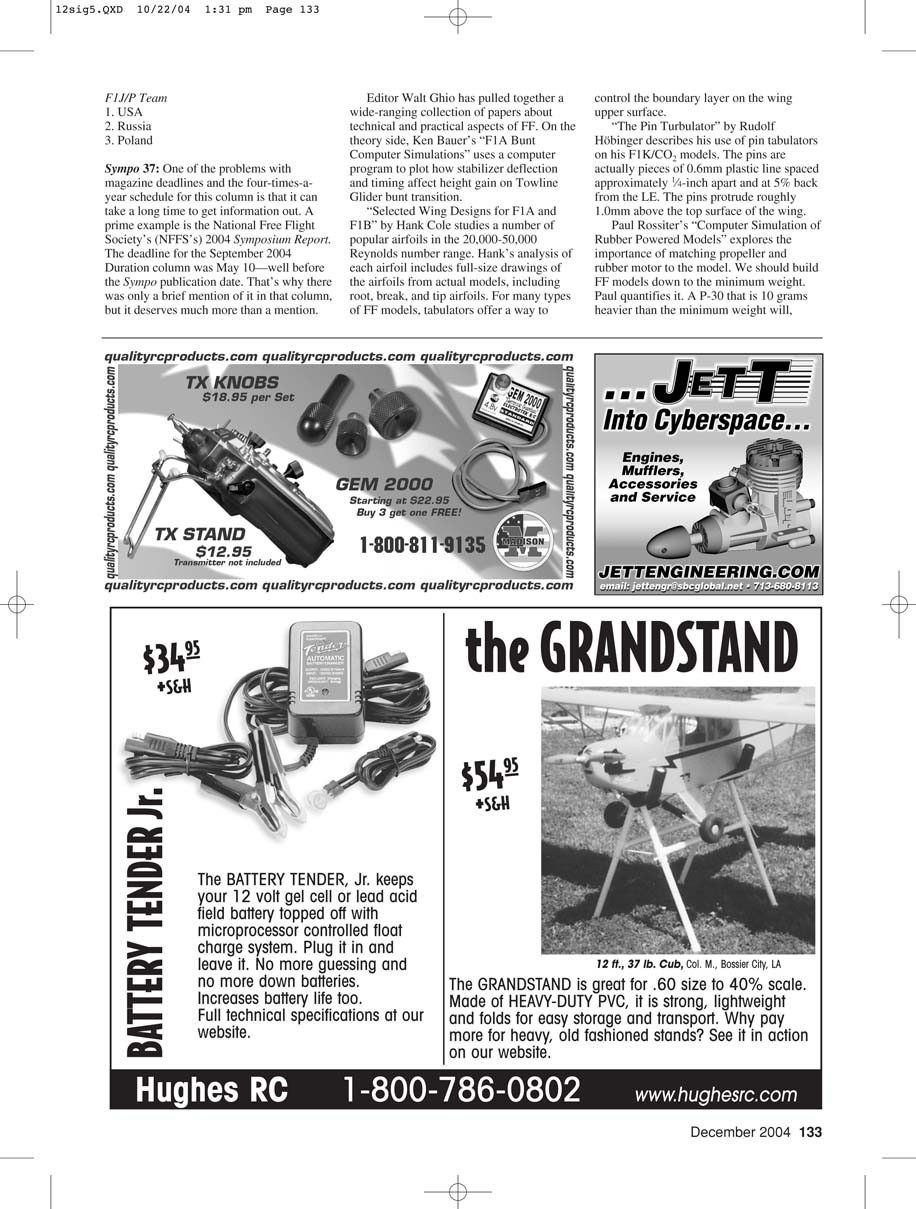
Others had problems during the contest. Sarah Radziunas, who is noted for her aggressive winding style, broke two motors in the fourth round and then launched, only to have the DPR (delayed propeller release) fail to activate. A hurried second attempt resulted in the stabilizer staying down in the power-burst setting and the model diving in.
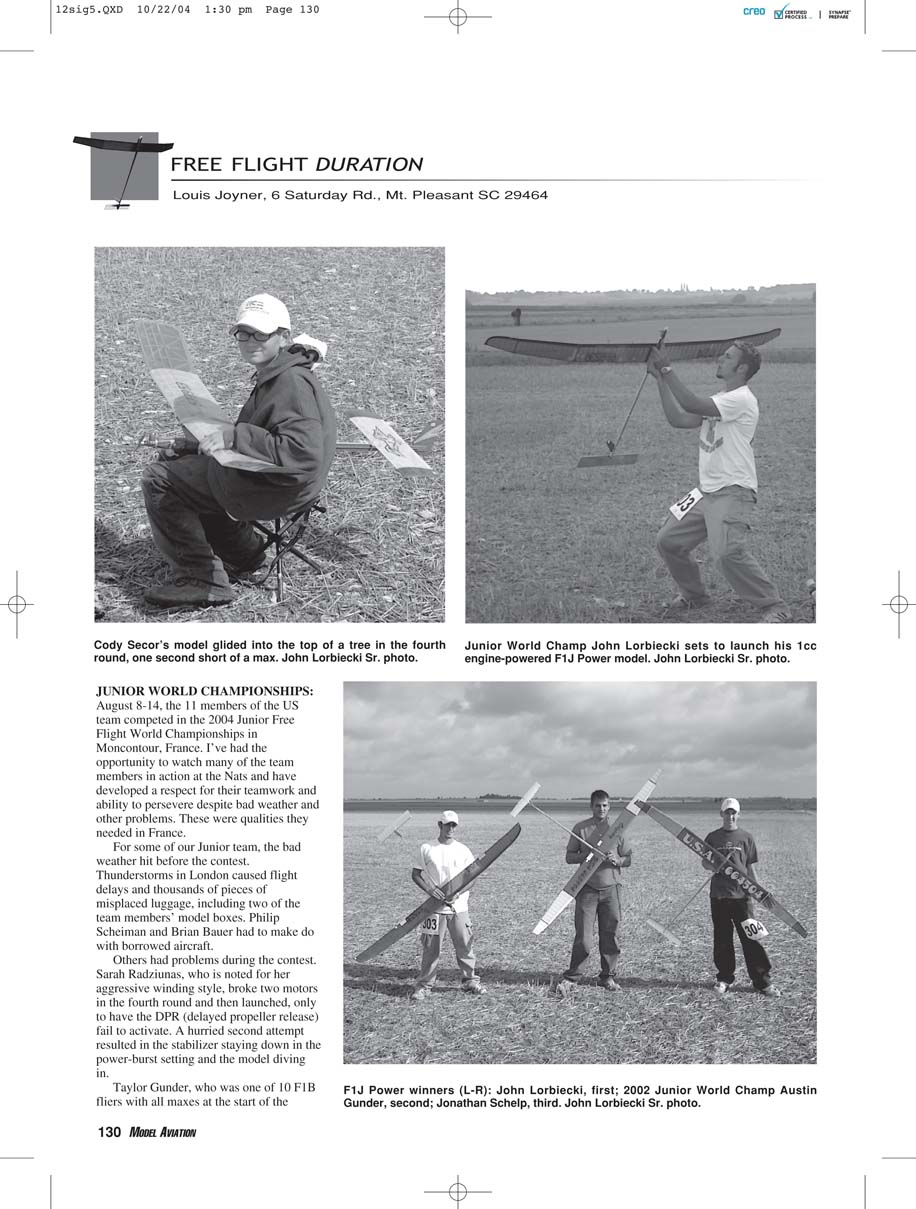
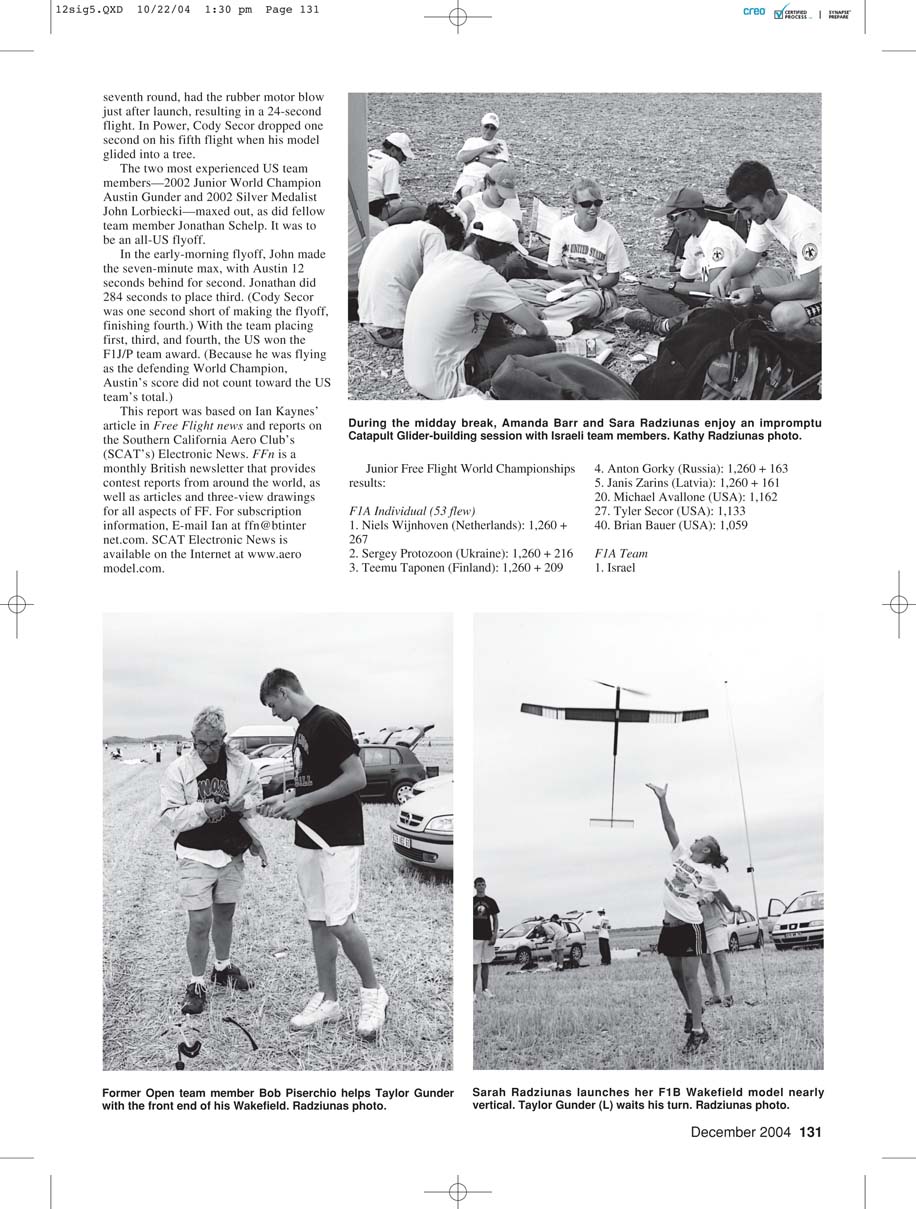
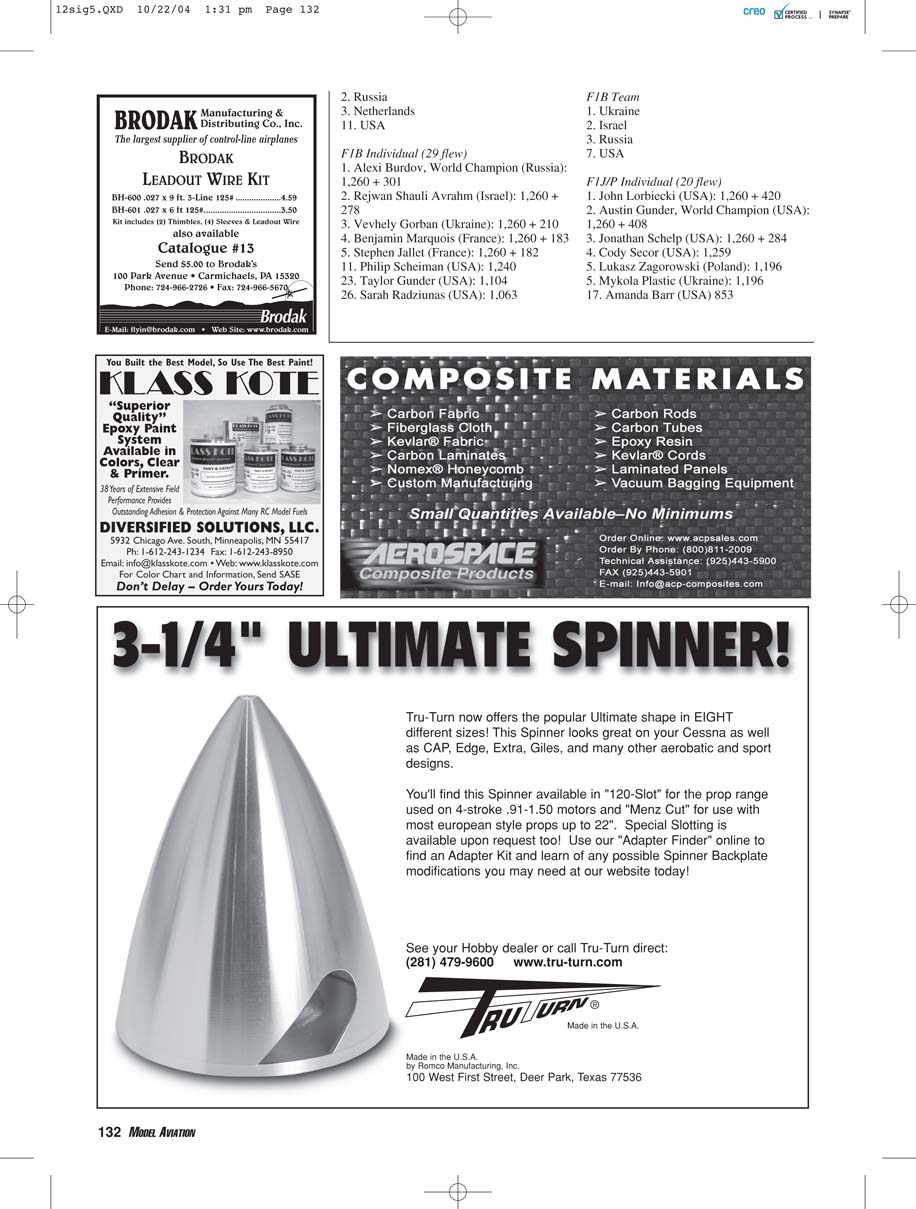
Taylor Gunder, who was one of 10 F1B fliers with all maxes at the start of the seventh round, had the rubber motor blow just after launch, resulting in a 24-second flight. In Power, Cody Secor dropped one second on his fifth flight when his model glided into a tree. The two most experienced US team members—2002 Junior World Champion Austin Gunder and 2002 Silver Medalist John Lorbiecki—maxed out, as did fellow team member Jonathan Schelp. It was to be an all-US flyoff. In the early-morning flyoff, John made the seven-minute max, with Austin 12 seconds behind for second. Jonathan did 284 seconds to place third. (Cody Secor was one second short of making the flyoff, finishing fourth.) With the team placing first, third, and fourth, the US won the F1J/P team award. (Because he was flying as the defending World Champion, Austin's score did not count toward the US team's total.)
This report was based on Ian Kaynes' article in Free Flight News and reports in the Southern California Aero Club's (SCAT's) Electronic News. FFn is a monthly British newsletter that provides contest reports from around the world, as well as articles and three-view drawings for all aspects of free flight. For subscription information, e-mail Ian at ffn@btinternet.com. SCAT Electronic News is available on the Internet at www.aeromodel.com.
Junior Free Flight World Championships results:
F1A Individual (53 flew)
- Niels Wijnhoven (Netherlands): 1,260 + 267
- Sergey Protozoon (Ukraine): 1,260 + 216
- Teemu Taponen (Finland): 1,260 + 209
- Anton Gorky (Russia): 1,260 + 163
- Janis Zarins (Latvia): 1,260 + 161
- Michael Avallone (USA): 1,162
- Tyler Secor (USA): 1,133
- Brian Bauer (USA): 1,059
F1A Team
- Israel
- Russia
- Netherlands
- USA
F1B Individual (29 flew)
- Alexi Burdov, World Champion (Russia): 1,260 + 301
- Rejwan Shauli Avrahm (Israel): 1,260 + 278
- Vevhely Gorban (Ukraine): 1,260 + 210
- Benjamin Marquois (France): 1,260 + 183
- Stephen Jallet (France): 1,260 + 182
- Philip Scheiman (USA): 1,240
- Taylor Gunder (USA): 1,104
- Sarah Radziunas (USA): 1,063
F1B Team
- Ukraine
- Israel
- Russia
- USA
F1J/P Individual (20 flew)
- John Lorbiecki (USA): 1,260 + 420
- Austin Gunder, World Champion (USA): 1,260 + 408
- Jonathan Schelp (USA): 1,260 + 284
- Cody Secor (USA): 1,259
- Lukasz Zagorowski (Poland): 1,196
- Mykola Plastic (Ukraine): 1,196
- Amanda Barr (USA): 853
F1J/P Team
- USA
- Russia
- Poland
SYMPO 37
One of the problems with magazine deadlines and the quarterly schedule for this column is that it can take a long time to get information out. A prime example is the National Free Flight Society’s (NFFS’s) 2004 Symposium Report. The deadline for the September 2004 Duration column was May 10—well before the Sympo publicity date. That’s why there was only a brief mention of it in that column, but it deserves much more than a mention.
Editor Walt Ghio has pulled together a wide-ranging collection of papers about technical and practical aspects of free flight. Notable contributions include:
- "The F1B Bunt Computer Simulations" — Ken Bauer uses a computer program to plot how stabilizer deflection and timing affect height gain on towline glider bunt transition.
- "Selected Wing Designs for F1A and F1B" — Hank Cole studies a number of popular airfoils in the 20,000–50,000 Reynolds number range, including full-size drawings of root, break, and tip airfoils.
- "The Pin Turbulator" — Rudolf Höbinger describes using pin turbulators on F1K/CO2 models: pieces of 0.6 mm plastic line spaced about 1/4 inch apart at roughly 5% back from the leading edge, protruding about 1.0 mm above the wing surface.
- "Computer Simulation of Rubber Powered Models" — Paul Rossiter explores the importance of matching propeller and rubber motor to the model and quantifies the benefit of building models down to minimum weight (e.g., a P-30 10 g heavier can lose about 20 seconds).
- "Eliminating the Pusher Climb Trouble" — William McCombs suggests using a retractable forward fin to counterbalance the increased effective vertical tail area on a pusher model under power.
- "Tips on Tips" — Hermann Andersen examines wingtip design options and tradeoffs.
- "Profili v2.0, A Review" — Peter King and Sergio Montes review the Profili airfoil software for drawing ribs and analyzing airflow at various Reynolds numbers.
On the practical side:
- "Composite Moulding at Elevated Temperatures" — Allard van Wallene provides a step-by-step account of molding a carbon-fiber/epoxy component using a two-piece mold and a silicone core to provide pressure.
- "Put Your Electric in the Clouds" — Charles Groth details the controller he uses on Nats-winning electric models, a gear setup with a shaft extension for cleaner propeller fold while keeping motor weight near the CG, and discusses lithium polymer batteries as an alternative to Ni-Cd.
- "Growing Your Club" — David Mills offers advice for attracting and retaining free flight club members.
- "Rubber Testing" — Ron Pollard discusses methods for testing rubber.
- "Building F1E Magnet-Steered Gliders" — Daniel Petcu provides construction guidance to help grow US interest in slope soaring.
Other papers include Mike Segrave's "Variations on a Theme by Richmond" (adapting low-aspect indoor planforms to a Coupe), Don DeLoach's "Beginning Free Flight Power: A Journey" (engines, models, trimming, contest tips), Aimee Raymond's "Learning to Fly With a Flight Log" (a methodical approach to trimming and flying Coupe and Wakefield), Michael Woodhouse's "The End of History Part II?! Or The Never Ending Story" (a philosophical look at the future of free flight), and Charles Dorsett's "The More I Fly, The Luckier I Get" (analysis of how eight former World Champions prepared and won). The Symposium also includes the annual Models of the Year selection.
FREE FLIGHT DURATION - 2004/12
A committee chaired by Aram Schlosberg chose eight airplanes for the 2004 honors:
- V-Squared (AMA Power model) by the late Ed Keck
- Big Red (electric) by Charles Groth
- STS-88 (F1B) by Stephan Stefanchuk
- B Coup by Bill Davis
- 35 cm F1D design by Bill Bailey
- MARPO (F1E) by Marian Popescu
- S-27 Magic (F1A) by Stefan Rumpp
- F1H by Victor Stamov
Ken Bauer received a special award for his F1A electronic timer.
The Symposium also includes biographies of the five 2004 inductees into the Free Flight Hall of Fame: Hank Nystrom, Bob Randolph, Bob Stalick, Jim Walston, and the late Ed Keck.
Copies of the 2004 Sympo are available from NFFS Publications Services, c/o Bob Stalick, Box 1775, Albany OR 97321. The cost is $25 for NFFS members and $30 for nonmembers. Postage is an additional $4. Please make checks payable to NFFS. For more information, contact Bob Stalick via e-mail at freeflier@aol.com.
The 2005 Symposium is already in the works. If you are interested in contributing a paper, please contact Michael J. Woodhouse, editor, at 12 Marston Ln., Eaton, Norwich, Norfolk, NR4 6LZ, United Kingdom, or e-mail mike@freeflightsupplies.co.uk.
Starlink
For most of the last decade, Allen Brush and his wife Tina have provided high-quality rubber kits and accessories under the Starlink and FliteTech labels. Their offerings included the popular Burdov Coupe and Wakefield models, the Bob White Twin Fin series, and several P-30 designs. Through the years, Al worked closely with Andrey Burdov, who produces the kits in Russia.
Now it's time for a well-earned rest. The new owner is Larry Bagalini. New contact information:
- Starlink-FliteTech Models
- 15423 Barona Mesa Way, Ramona CA 92065
- Tel.: (760) 788-1858
- Fax: (760) 789-6524
- E-mail: starlink_flitetech@yahoo.com
- Web site: www.starlink-flitetech.com
MA
Transcribed from original scans by AI. Minor OCR errors may remain.

