
FREE FLIGHT: DURATION
Twigs
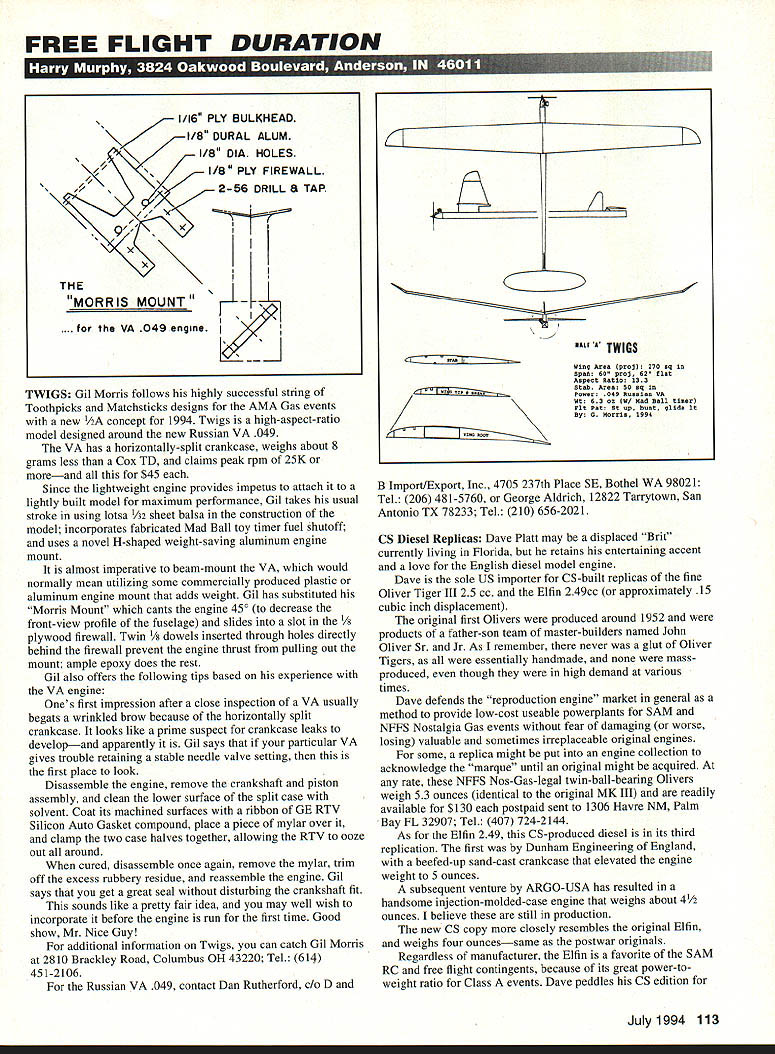
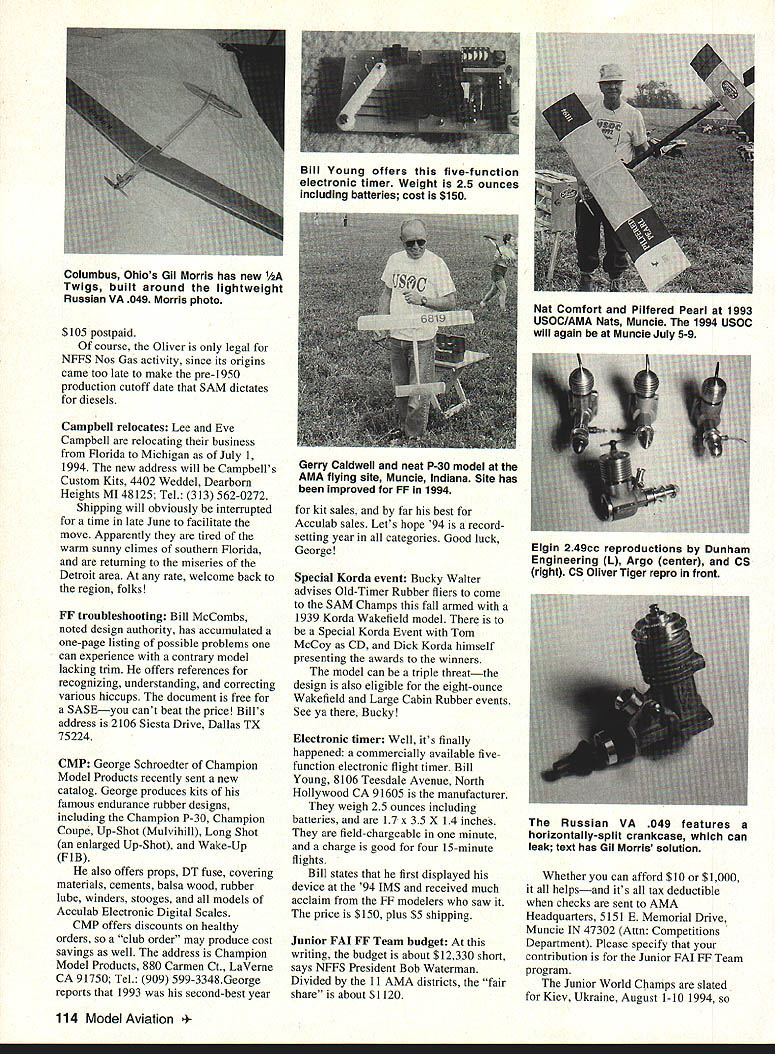
Gil Morris follows his highly successful string of Toothpicks and Matchsticks designs for the AMA Gas events with a new 1/2A concept for 1994. Twigs is a high-aspect-ratio model designed around the new Russian VA .049.
The VA has a horizontally-split crankcase, weighs about 8 grams less than a Cox TD, and claims peak rpm of 25K or more—and all this for $45 each.
Since the lightweight engine provides impetus to attach it to a lightly built model for maximum performance, Gil uses lots of 1/32" sheet balsa in the construction of the model; incorporates a fabricated Mad Ball toy timer fuel shutoff; and uses a novel H-shaped, weight-saving aluminum engine mount.
It is almost imperative to beam-mount the VA, which would normally mean using a commercially produced plastic or aluminum engine mount that adds weight. Gil has substituted the "Morris Mount," which cants the engine 45° (to decrease the front-view profile of the fuselage) and slides into a slot in the 1/8" plywood firewall. Twin 1/8" dowels inserted through holes directly behind the firewall prevent the engine thrust from pulling out the mount; ample epoxy does the rest.
VA engine tips
Gil also offers the following tips based on his experience with the VA engine:
- One's first impression after a close inspection of a VA usually begats a wrinkled brow because the horizontally split crankcase looks like a prime suspect for crankcase leaks to develop—and apparently it is. Gil says that if your particular VA gives trouble retaining a stable needle-valve setting, then this is the first place to look.
- Disassemble the engine, remove the crankshaft and piston assembly, and clean the lower surface of the split case with solvent. Coat its machined surfaces with a ribbon of GE RTV Silicone Auto Gasket compound, place a piece of mylar over it and clamp the two case halves together, allowing the RTV to ooze out all around.
When cured, disassemble once again, remove the mylar, trim off the excess rubbery residue, and reassemble the engine. Gil says that you get a great seal without disturbing the crankshaft fit. Sounds like a pretty fair idea, and you may well wish to incorporate it before the engine is run for the first time.
Contacts and price
- For additional information on Twigs, contact Gil Morris: 2810 Brackley Road, Columbus, OH 43220; Tel: (614) 451-2106.
- For the Russian VA .049, contact Dan Rutherford, c/o D and B Import/Export, Inc., 4705 237th Place SE, Bothell, WA 98021; Tel: (206) 481-5760, or George Aldrich, 12822 Tarrytown, San Antonio, TX 78233; Tel: (210) 656-2021.
Price note: $105 postpaid.
Oliver and NFFS rules
Of course, the Oliver is only legal for NFFS Nostalgia Gas activity, since its origins came too late to make the pre-1950 production cutoff date that SAM dictates for diesels.
Campbell relocates
Lee and Eve Campbell are relocating their business from Florida to Michigan as of July 1, 1994. The new address will be Campbell's Custom Kits, 4402 Weddel, Dearborn Heights, MI 48125; Tel.: (313) 562-0272. Shipping will obviously be interrupted for a time in late June to facilitate the move. Apparently they are tired of the warm sunny climes of southern Florida and are returning to the miseries of the Detroit area. At any rate, welcome back to the region!
FF troubleshooting
Bill McCombs, noted design authority, has accumulated a one-page listing of possible problems one can experience with a contrary model lacking trim. He offers references for recognizing, understanding, and correcting various hiccups. The document is free for a SASE. Bill's address is 2106 Siesta Drive, Dallas, TX 75224.
CMP (Champion Model Products)
George Schroedter of Champion Model Products recently sent a new catalog. George produces kits of his famous endurance rubber designs, including:
- Champion P-30
- Champion Coupe
- Up-Shot (Mulvihill)
- Long Shot (an enlarged Up-Shot)
- Wake-Up (F1B)
He also offers props, DT fuses, covering materials, cements, balsa wood, rubber, line-winders, stooges, and all models of Acculab Electronic Digital Scales.
CMP offers discounts on healthy orders, so a "club order" may produce cost savings. Address: Champion Model Products, 880 Carmen Ct., La Verne, CA 91750. Tel.: (909) 599-3348. George reports that 1993 was his second-best year for kit sales, and by far his best for Acculab sales. Let's hope '94 is a record-setting year in all categories.
Special Korda event
Bucky Walter advises Old-Timer Rubber fliers to come to the SAM Champs this fall armed with a 1939 Korda Wakefield model. There is to be a Special Korda Event with Tom McCoy as CD, and Dick Korda himself presenting the awards to the winners.
The model can be a triple-threat—the design is also eligible for the eight-ounce Wakefield and Large Cabin Rubber events.
Electronic timer
A commercially available five-function electronic flight timer has appeared. Manufacturer: Bill Young, 8106 Tesselade Avenue, North Hollywood, CA 91605. The timers weigh 2.5 ounces including batteries and measure 1.7" x 3.5" x 1.4". They are field-chargeable in one minute, and a charge is good for four 15-minute flights.
Bill first displayed his device at the '94 IMS and received much acclaim from FF modelers. Price: $150, plus $5 shipping.
Junior FAI FF Team budget
At this writing, the budget is about $12,330 short, says NFFS President Bob Waterman. Divided by the 11 AMA districts, the "fair share" is about $1,120.
Whether you can afford $10 or $1,000, it all helps—and it's all tax deductible when checks are sent to: AMA Headquarters, 5151 E. Memorial Drive, Muncie, IN 47302 (Attn: Competitions Department). Please specify your contribution is for the Junior FAI FF Team program.
The Junior World Champs are slated for Kiev, Ukraine, August 1–10, 1994, so time is of the essence.
W HOBBY (Lithuanian source)
W HOBBY is a Lithuanian source for classic F1A gadgetry such as circle-towhooks, mechanical-timer wing wiggers, butt systems, front-end pods, carbon tailbooms, F1B props and fuselages, ready-built wings, and complete models.
Their 12-page catalog is free by sending your address to Vidas Nikolaejevas, Vilnius 237-24, 5400 Siauliai, Lithuania. The catalog is descriptive, with clear photos and English explanations.
Tom Joerger sent the information and says the F1A bunt fuselages he received were well made. According to my International Postal Rate Book, a 1/2-ounce letter of inquiry is a 50-cent item.
AMCA (Aviation Magazine Collectors Association)
We mentioned KAPA a while back, a newly organized model-kit-collectors group. Jim Alaback sent a card saying their first year of existence brought about 400 subscribers into the fold.
There is already an organization called AMCA (Aviation Magazine Collectors Association), c/o Charles Gokey, Jr., 2307 Burrer Dr., Louisville, KY 40216. Membership is $10/year for a bimonthly newsletter with free classified advertising. It covers full-scale as well as model aviation publications.
Tornadoes by the dozen
Grish Plastics, makers of Tornado props, may be one of the oldest established propeller manufacturers in the U.S. They are offering a "bulk ordering plan" to clubs and individuals at a 10% discount direct from the factory.
Their current production white nylon Tempest and glass-reinforced polyester black Magnum props are favorites of many. Send an SASE and inquiry to Grish Plastics, P.O. Box 248, St. John, IN 46373; Tel.: (800) 322-4062 to receive a product listing and pricing sheet. Tell them where you heard about it.
Check valves for latex tubing fuel tanks
Check valves for latex tubing fuel tanks were discussed in our last session. Replacing the knot in the bottom end of a homemade fuel bladder with a check valve from a football bladder or bicycle tube used to be a common practice, but modern designs have changed and those parts are no longer usable.
An all-plastic specimen produced by Fourmost Products called an Auto Plug/One Way Valve works but tends to seep a little. Joe Klause of Kustom Kraftsmanship has been selling a fuel-line check valve for some years: order #515 In-Line Check Valve at $3.50 each. Address: P.O. Box 3010, Fallbrook, CA 92028; Tel.: (619) 728-4365.
Nos Gas engines revisited
You may remember our January column where Donald Hockaday evaluated Nostalgia-Gas engines using APC plastic props and fuel containing 25% nitro. That report prompted a reply from Jerry Price, who questioned safety and engine-preservation aspects.
Key points from Jerry Price:
- Factory recommendations for free flight did not use the small props Hockaday recommended. For Veco .29, .31, and .35 series, propeller recommendations would align with K&B recommendations (typically 10x6) rather than the small 10x3 props used in the tests.
- Many early engines will break crankshafts if used with synthetic (nylon/plastic/fiberglass) props. Hi Johnson reportedly would not honor guarantees if nylon props were used.
- Most of these engines recommend not less than 25% castor oil in fuel. Castor oil provides a strong lubricating film for plain-bearing engines that synthetics often cannot match.
- Modelers should limit nitro to 15% and preferably 5% for these engines.
I agree that much of what Jerry states is valid. Many early glow engines lacked dynamic balance, especially at high rpm, and would vibrate excessively—sometimes to the extent of throwing blades from plastic props or causing internal crankshaft failure.
On the other hand, current engine runs are generally at lower rpm than the rules of the era permitted, and modern plastic/fiberglass props are better engineered, which may mitigate some concerns.
As for fuels, castor-oil-based fuels are highly recommended for plain-bearing engines. A recent example: two Stels 1/2A engines returned to Doug Galbraith had plain-bearing front inserts replacing the original front ball bearing, accompanied by a notice from Doug specifically recommending castor-based fuels.
Last summer I ran bench tests on several vintage OK Cub .049s to evaluate their potential for powering a 1/2A Zeek for the Early 1/2A Nostalgia Gas event. I discovered some early glow engines do not respond well to high nitro. One Cub ran faster but stuttered on 40% nitro; it ran about 1,000 rpm better at 25% nitro and another 800 rpm better when reduced to 15% nitro.
Modelers should treat these mature engines gently to extend their life.
We are out of space for this month, so the promised Model Finders Part VII will have to wait until next time.
See ya downwind!
Transcribed from original scans by AI. Minor OCR errors may remain.

