
FREE FLIGHT DURATION
Harry Murphy, 3824 Oakwood Boulevard, Anderson, IN 46011
I have been having "heated" arguments with the weatherman in an attempt to get him to cough up some nice warm sunny days so I can finally get to the AMA Muncie flying site this spring for some test flying. Today is such a day: warm and sunny and a cloudless sky—super!
Then I note in the morning paper that we get an eclipse of the sun at noon, and you "mustn't" look at the sun until about 3 p.m. or you'll be struck blind on the spot (or something like that). How can you fly free flight and not take an occasional peek at the sun? Drat! Murphy's Law strikes again! So I'll crank out the column instead—sitting in the shade, of course.
Toledo
Those annual winter/springtime RC trade shows are mostly past at this writing. I take in the Toledo show each year, and although it is RC oriented, there are always some neat items of interest to free fliers.
Three Russian-made 1/2A engines were being offered this year: the VA, the Stels and its AME sport counterpart. Stels was also peddling their .06 for F/J.
I picked up a number of packages of small screws from a fastener display at the Nelson Aircraft Company booth. They offer fine little #0 screws to retain fuel cutoff timers to gas models. Once dropped onto my cluttered workbench, the screws seem to disappear forever, so I can always use an additional supply.
California Carbon had carbon fiber for strengthening spars. The .007 strips are impregnated with a special heat-sensitive adhesive that allows the strip to be ironed to the spar. Drops of gap-filling cyanoacrylate (CyA) glue are rubbed into it with a piece of waxed paper, which provides the permanent bond. Neato!
I later used some to make a fabricated reinforced "sandwich" spar with great results. Dick Covalt subsequently showed up at a club meeting with the stuff just ironed on the top of a ready-built wing for added torsional strength. Good stuff!
On the upstairs balcony of the massive waterfront Seagate Center, the Swap Shop was endless. The tables, with their piles of new and used wares, stretched around the huge convention center room and across the street on one of those above-the-street skywalks and into another building across the street!
The Swap Shop was like another show in itself. If you have yet to attend one of these trade shows, do so next time one is in your area. You will like it—and be surprised at all the free fliers you might bump into.
At the Movies: Alan Abriss has a new professional video
Alan Abriss has a new professional video documentary of the 1992 AMA Nats held at Chicopee, Massachusetts. The film is two hours long, was condensed from seven hours of original footage, and has been two years in the making. It contains footage of RC, CL, and indoor and outdoor free flight.
Originally produced for a local TV show, the video is formatted to acquaint non-modelers with the various areas of the hobby. The tape has brought accolades from all who have seen it. The cost is $25 plus $4 shipping from Alan Abriss, 94-20 66th Avenue, Forest Hills, NY 11374. Allow 6–8 weeks for delivery. Get one to show at club meetings, to local civic groups or schools, or for your own entertainment.
Model Finders, Part VIII
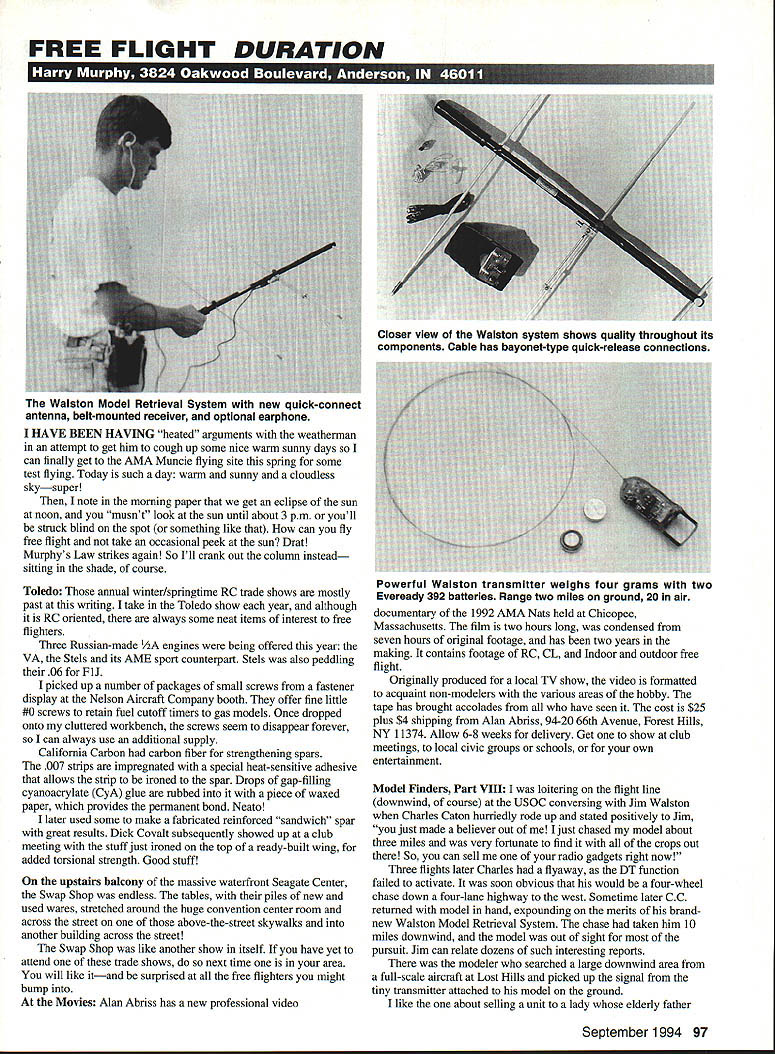
I was loitering on the flight line (downwind, of course) at the USOC conversing with Jim Walston when Charles Caton hurriedly rode up and stated positively to Jim, "You just made a believer out of me!" Charles had just chased his model about three miles and was very fortunate to find it with all the crops out there. He wanted one of Jim's radio gadgets right away.
Three flights later Charles had a flyaway, as the DT function failed to activate. It was soon obvious that this would be a four-wheel chase down a four-lane highway west. Sometime later Charles returned with the model in hand, expounding on the merits of his brand-new Walston Model Retrieval System. The chase had taken him 10 miles downwind, and the model was out of sight for most of the pursuit. Jim can relate dozens of such interesting reports.
There was the modeler who searched a large downwind area from a full-scale aircraft at Lost Hills and picked up the signal from the tiny transmitter attached to his model on the ground.
I like the one about selling a unit to a lady whose elderly father kept running away from a rest home, so they simply sewed the transmitter into the lining of his clothes, and the next time he ventured out, the staff had little difficulty in locating the wandering gentleman.
At Lawrenceville a few years ago, I noticed a large gas model drifting deep into the ocean of head-high corn behind me as I stepped out into the open after retrieving my own model from the sea of green. As I rounded a bend in the perimeter trail, another flier was approaching, holding a familiar Walston antenna in front of him like a divining rod.
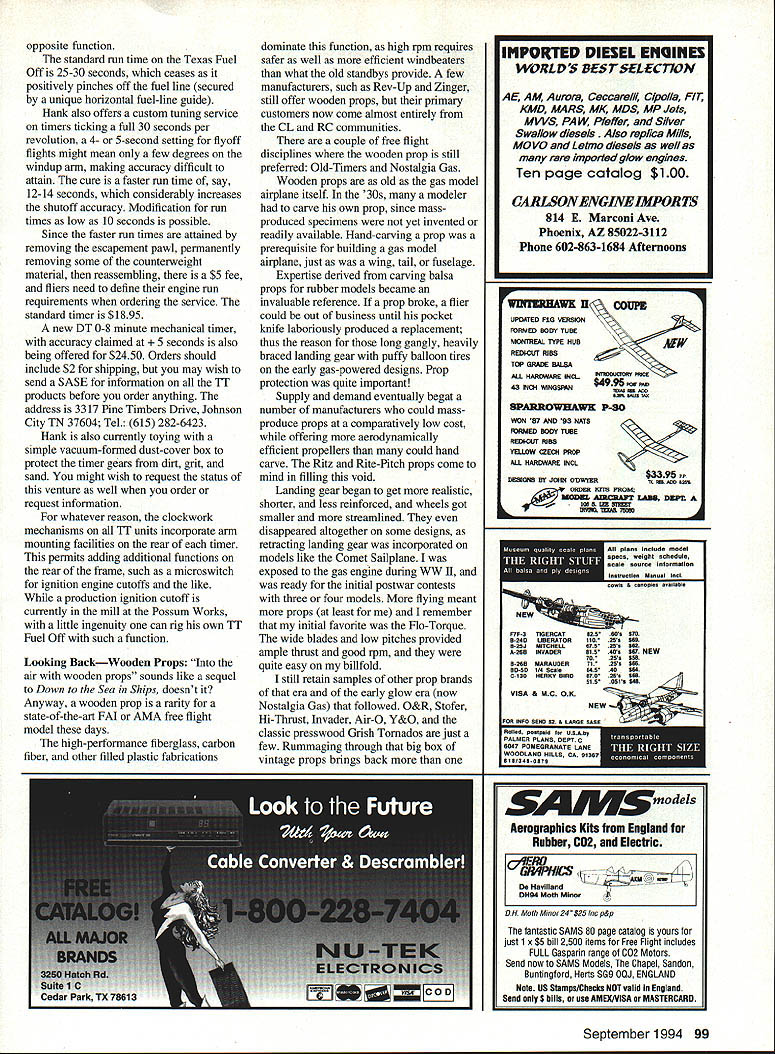
Thinking I might help him some, I queried, "Are you looking for a large gas job?" As he trudged by he answered, "No, a Gollywock!" Obviously, model size and weight is hardly influenced by the diminutive onboard transmitter, which tips the scales at four grams. However, as I have yet to see one on a hand-launched glider, I must assume it has its limitations somewhere.
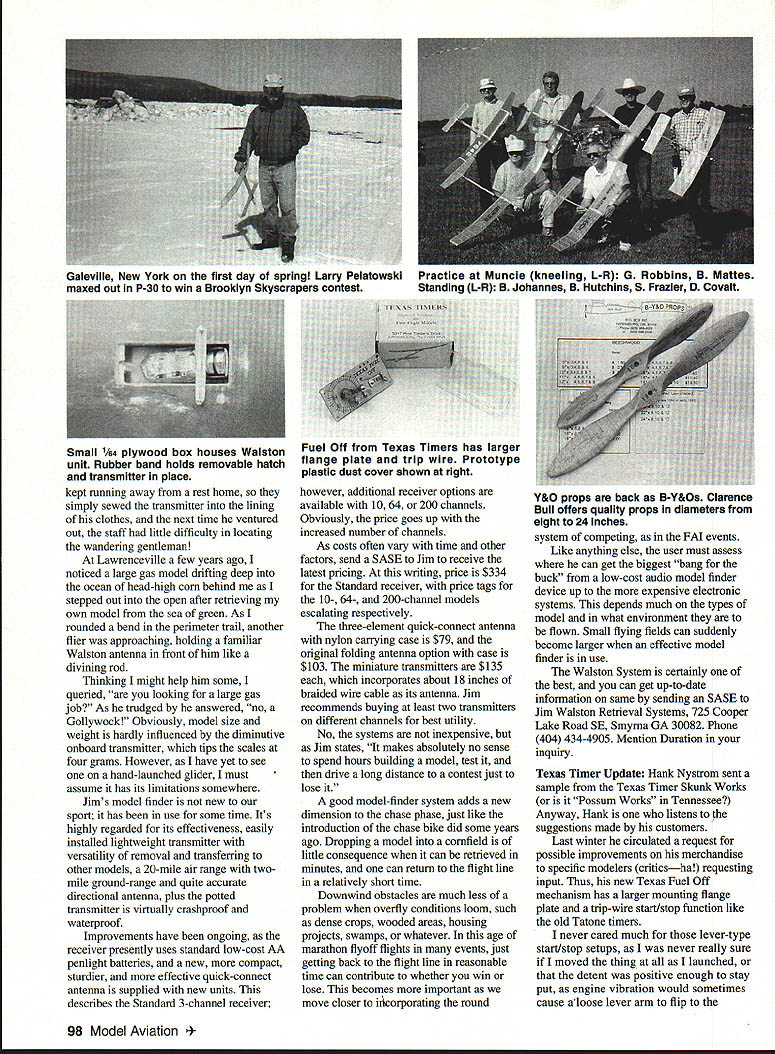
Jim's model finder is not new to our sport; it has been in use for some time. It's highly regarded for its effectiveness, easily installed lightweight transmitter with versatility of removal and transferring to other models, a 20-mile air range with two-mile ground range and quite accurate directional antenna, plus the potted transmitter is virtually crashproof and waterproof.
Improvements have been ongoing. The receiver presently uses standard low-cost AA penlight batteries, and a new, more compact, sturdier, and more effective quick-connect antenna is supplied with new units. This describes the Standard 3-channel receiver; however, additional receiver options are available with 10, 64, or 200 channels. Obviously, the price goes up with the increased number of channels.
Features and options:
- Standard 3-channel receiver
- Optional 10-, 64-, or 200-channel receivers
- Three-element quick-connect antenna (nylon carrying case optional)
- Original folding antenna option (with case)
- Miniature transmitters, each with about 18 inches of braided wire antenna
Pricing (at time of writing; send SASE for current pricing):
- Standard receiver: $334
- Three-element quick-connect antenna with nylon carrying case: $79
- Original folding antenna option with case: $103
- Miniature transmitters: $135 each
Jim recommends buying at least two transmitters on different channels for best utility.
No, the systems are not inexpensive, but as Jim states, "It makes absolutely no sense to spend hours building a model, test it, and then drive a long distance to a contest just to lose it."
A good model-finder system adds a new dimension to the chase phase, just like the introduction of the chase bike did some years ago. Dropping a model into a cornfield is a little consequence when it can be retrieved in minutes, and one can return to the flight line in a relatively short time.
Downwind obstacles are much less of a problem when effective finder systems are used—dense crops, wooded areas, housing projects, swamps, or whatever. In this age of marathon flyoff flights in many events, just getting back to the flight line in reasonable time can contribute to whether you win or lose. This becomes more important as we move closer to incorporating the round system of competing, as in the FAI events.
Like anything else, the user must assess where he can get the biggest "bang for the buck" from a low-cost audio model finder device up to the more expensive electronic systems. This depends on the types of model and the environment in which they are flown. Small flying fields can suddenly become larger when an effective model finder is in use.
The Walston System is certainly one of the best. For up-to-date information send an SASE to: Jim Walston Retrieval Systems 725 Cooper Lake Road SE Smyrna, GA 30082 Tel.: (404) 434-4905 Mention Duration in your inquiry.
Texas Timer Update
Hank Nystrom sent a sample from the Texas Timer Skunk Works (or is it "Possum Works" in Tennessee?). Hank is one who listens to the suggestions made by his customers.
Last winter he circulated a request for possible improvements on his merchandise to specific modelers (critics—ha!), requesting input. Thus, his new Texas Fuel Off mechanism has a larger mounting flange plate and a trip‑wire/start/stop function like the old Tatone timers.
I never cared much for those lever-type start/stop setups, as I was never really sure if I moved the thing at all as I launched, or that the detent was positive enough to stay put, as engine vibration would sometimes cause a loose lever arm to flip to the off position.
The standard run time on the Texas Fuel Off is 25–30 seconds, which ceases as it positively pinches off the fuel line (secured by a unique horizontal fuel-line guide).
Hank also offers a custom tuning service. For timers ticking a full 30 seconds per revolution, a 4- or 5-second setting for flyoff flights might mean only a few degrees on the windup arm, making accuracy difficult to attain. The cure is a faster run time, of, say, 12–14 seconds, which considerably increases the shutoff accuracy. Modification for run times as low as 10 seconds is possible.
Since the faster run times are attained by removing the escapement pawl and permanently removing some of the counterweight material, then reassembling, there is a $5 fee. Fliers need to define their engine run requirements when ordering the service. The standard timer is $18.95.
A new DT 0–8 minute mechanical timer, with claimed accuracy of +/- 5 seconds, is also being offered for $24.50. Orders should include $2 for shipping, but you may wish to send a SASE for information on all the T&T products before you order anything. The address is: 3317 Pine Timbers Drive Johnson City, TN 37604 Tel.: (615) 282-6423
Hank is also currently toying with a simple vacuum-formed dust-cover box to protect the timer gears from dirt, grit, and sand. You might wish to request the status of this venture as well when you order or request information.
Looking Back—Wooden Props
"Into the air with wooden props" sounds like a sequel to Down to the Sea in Ships, doesn't it? Anyway, a wooden prop is a rarity for a state-of-the-art FAI or AMA free flight model these days.
High-performance fiberglass, carbon fiber, and other filled plastic fabrications dominate this function, as high rpm requires safer as well as more efficient windbeaters than the old standbys provide. A few manufacturers, such as Rev-Up and Zinger, still offer wooden props, but their primary customers now come almost entirely from the CL and RC communities.
There are a couple of free flight disciplines where the wooden prop is still preferred: Old-Timers and Nostalgia Gas. Wooden props are as old as the gas model airplane itself. In the '30s, many a modeler had to carve his own prop, since mass-produced specimens were not yet invented or readily available. Hand-carving a prop was a prerequisite to building a gas model airplane, just as was a wing, tail, or fuselage.
Expertise derived from carving balsa props for rubber models became an invaluable reference. If a prop broke, a flier could be out of business until his pocket knife laboriously produced a replacement; thus the reason for those long gangly, heavily braced landing gear with puffy balloon tires on the early gas-powered designs. Prop protection was quite important!
Supply and demand eventually begat a number of manufacturers who could mass-produce props at a comparatively low cost, while offering more aerodynamically efficient propellers than many could hand carve. The Ritz and Rite-Pitch props come to mind in filling this void.
Landing gear began to get more realistic, shorter, and less reinforced, and wheels got smaller and more streamlined. They even disappeared altogether on some designs, as retracting landing gear was incorporated on models like the Comet Sailplane. I was exposed to the gas engine during WWII, and was ready for the initial postwar contests with three or four models. More flying meant more props (at least for me) and I remember that my initial favorite was the Flo-Torque. The wide blades and low pitches provided ample thrust and good rpm, and they were quite easy on my billfold.
I still retain samples of other prop brands of that era and of the early glow era (now Nostalgia Gas) that followed. O&R, Stofer, Hi-Thrust, Invader, Air-O, V&O, and the classic presswood Grish Tornados are just a few. Rummaging through that big box of vintage props brings back more than one fond memory of yesteryear.
Although my current interests run the whole gamut of free flight gas, and plastic props cover the floor of the model box, I admit that with all the new inroads into more efficient props and prop design offered by the modern molded plastic and/or composite developments, I still cannot bring myself to bolt anything but a wooden prop onto an ignition or diesel engine.
For some years the Top Flite product line met my requirements, and I was very sad when they eventually folded their tent with their fine original birch (and later, maple) wooden prop design.
Following up on subsequent closeout sales, I probably have a lifetime supply, but have since been somewhat concerned about those squirrels, other than I, who haven't hoarded enough nuts for the ensuing winter. But as often is the case, a new star pops over the horizon.
In the late '40s one of the better props of the waning ignition era was a J.C. Yates and Henry Orwick development: the Y&O. J.C. became AMA Open CL Stunt Champion using Henry's engine and the Y&O prop in 1947. J.C.'s model, the Madman, was ultimately kitted by the pair.
The initial Y&O prop was obviously designed for stunt flying, but free flighters soon picked up the new prop and quickly demanded more sizes and pitches for their purposes.
The west-coast-produced Y&O was an exceptional prop, but it was not readily available in my corner of the Midwest. We used substitutes, but cherished the few Y&Os we managed to accumulate. In subsequent years, the Y&O tooling spread through a number of hands until the well-worn tools began to produce a product lacking the original Y&O quality, and they finally went into storage once again.
A year or so ago Clarence Bull phoned to inform me that he had recently purchased the dusty old equipment and planned to upgrade it and to produce the prop as an after-retirement project. Since after-retirement projects seldom materialize, I put little stock in this, and I nearly forgot about Clarence's phone call.
Man, did Clarence show me up! Here he is, as promised, with his great new product labeled B-Y&O, available in sizes from 8 to 24 inches. Superb quality and "biggie" sizes are the forte of the B-Y&Os.
The redesigned hub area is made purposely wider than the original, adding strength and durability, with the original wide blades and familiar Y&O shape being preserved in the new beechwood renditions.
If your hobby supplier does not currently carry the B-Y&O brand, you can send an SASE to: Clarence Bull B-Y&O Propellers P.O. Box 492 Harrisburg, OR 97446 Tel.: (503) 995-6509 He will gladly send you the latest information on sizes and pricing.
See ya downwind!
Transcribed from original scans by AI. Minor OCR errors may remain.

