
FREE FLIGHT DURATION
Harry Murphy, 3824 Oakwood Boulevard, Anderson, IN 46011
Editor's Note:
At his request, this will be Murf's final column. The MA staff wishes to publicly thank him for his years of effort, and we wish him well as he gets some much-deserved rest.
USOC NOTES:
The final bell has just tolled to mark the end of the July 5–9 United States Outdoor Championships (USOC). The affair was a great success, as was a first-time event: Early 1/2A Nostalgia Gas. Not since Hand-Held Catapult Glider popped onto the field has a new event made such an initial splash in a national competition. Would you believe 43 entrants?
The event uses the same rules as 1/2A Nostalgia Gas, with the following exceptions:
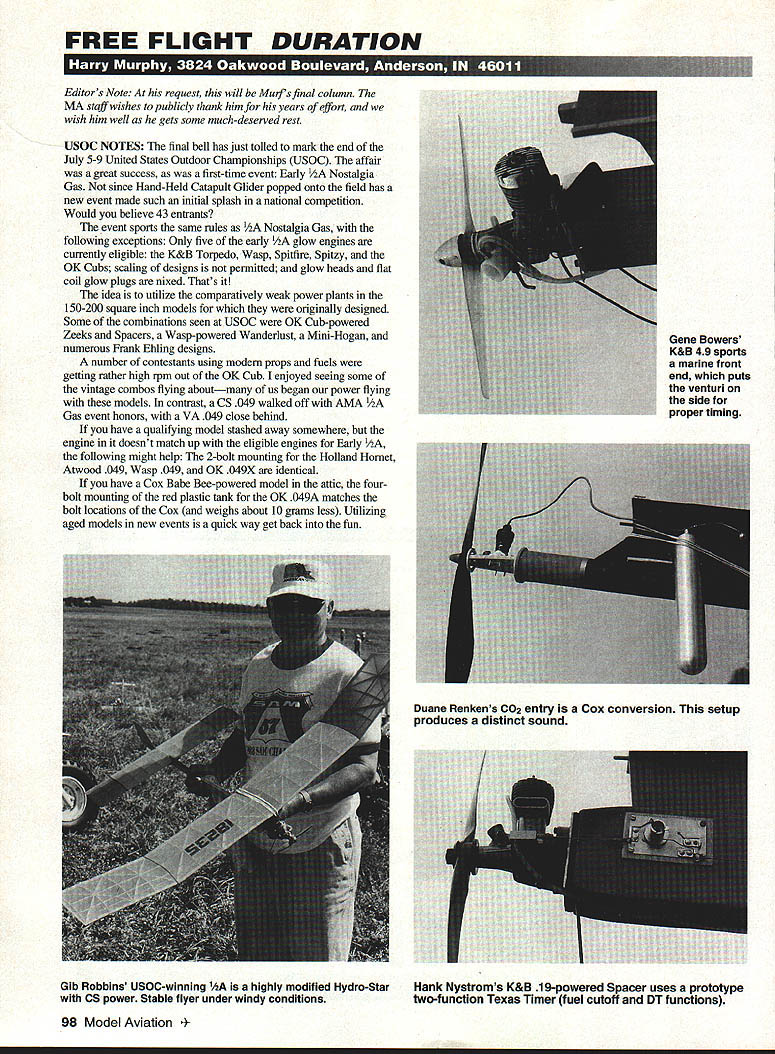
- Only five early 1/2A glow engines are currently eligible: K&B Torpedo, Wasp, Spitfire, Spitzy, and the OK Cubs.
- Scaling of designs is not permitted.
- Glow heads and flat-coil glow plugs are nixed.
The idea is to utilize the comparatively weak power plants in the 150–200 square inch models for which they were originally designed. Some of the combinations seen at USOC were OK Cub–powered Zeeks and Spacers, a Wasp-powered Wanderlust, a Mini-Hogan, and numerous Frank Ehling designs.
A number of contestants using modern props and fuels were getting rather high rpm out of the OK Cub. I enjoyed seeing some of the vintage combos flying about—many of us began our power flying with these models. In contrast, a CS .049 walked off with AMA 1/2A Gas event honors, with a VA .049 close behind.
If you have a qualifying model stashed away somewhere, but the engine in it doesn't match up with the eligible engines for Early 1/2A, the following might help: the 2-bolt mounting for the Holland Hornet, Atwood .049, Wasp .049, and OK .049X are identical.
If you have a Cox Babe Bee–powered model in the attic, the four-bolt mounting of the red plastic tank for the OK .049A matches the bolt locations of the Cox (and weighs about 10 grams less). Utilizing aged models in new events is a quick way to get back into the fun.
Special events rules curator Walt Rozelle put the finishing touches on the NFFS "Rules for Special Events 1994" in time for the first 100 booklets to be available at USOC. The 16-page offering sold like hotcakes for $2.
The book contains rules for the most popular events being flown around the country that are not included in the AMA Competition Regulations, including:
- Pee Wee 30
- Moffett
- .010 Gas
- 1/2A Free Flight Antique
- Jimmie Allen
- Korda Open Rubber
- Jetex
- Embryo Endurance
- A myriad of Indoor events
Copies may be obtained postpaid from Walt Rozelle, Fred Terzian, Campbell's Custom Kits, and other sources:
- Walt Rozelle — 926 Argonne Avenue NE, Atlanta, GA 30309
- Fred Terzian (keeper of NFFS Publications) — 4858 Moorpark Ave., San Jose, CA 95129
- Lee Campbell — 4402 Weddel, Dearborn Heights, MI 48125 (ask for new Catalog #15 when ordering the rulebook)
Feedback is important to maintain an updated status, so Walt is accepting comments, corrections, additions, etc. for the 1995 edition. Man, what an aid to contestant and contest director alike!
New repro diesel
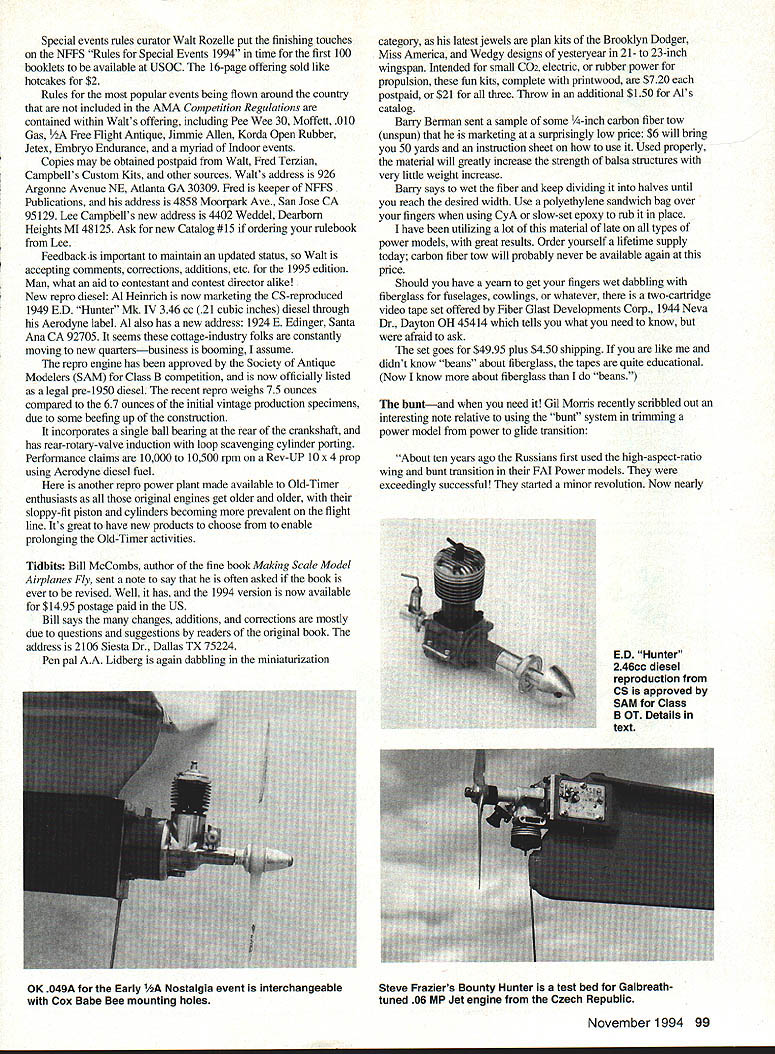
Al Heinrich is now marketing the CS-reproduced 1949 E.D. "Hunter" Mk IV, 3.46 cc (2.1 cubic inches) diesel through his Aerodyne label. Al also has a new address: 1924 E. Edinger, Santa Ana, CA 92705. It seems these cottage-industry folks are constantly moving to new quarters—business is booming, I assume.
The repro engine has been approved by the Society of Antique Modelers (SAM) for Class B competition and is now officially listed as a legal pre-1950 diesel. The recent repro weighs 7.5 ounces compared to the 6.7 ounces of the initial vintage production specimens, due to some beefing up of the construction.
It incorporates a single ball bearing at the rear of the crankshaft and has rear-rotary-valve induction with loop-scavenging cylinder porting. Performance claims are 10,000 to 10,500 rpm on a Rev-UP 10 x 4 prop using Aerodyne diesel fuel.
Here is another repro power plant made available to Old-Timer enthusiasts as all those original engines get older and older, with their sloppy-fit pistons and cylinders becoming more prevalent on the flight line. It's great to have new products to choose from to enable prolonging Old-Timer activities.
Tidbits
Bill McCombs, author of the fine book Making Scale Model Airplanes Fly, sent a note to say that he is often asked if the book is ever to be revised. Well, it has been revised, and the 1994 version is now available for $14.95 postage paid in the U.S. Bill's address is 2106 Siesta Dr., Dallas, TX 75224.
Pen pal A.A. Lidberg is again dabbling in the miniaturization category. His latest offerings are plan kits of the Brooklyn Dodger, Miss America, and Wegdy designs of yesteryear in 21- to 23-inch wingspans. Intended for small CO2, electric, or rubber power, these fun kits, complete with printwood, are $7.20 each postpaid or $21 for all three. Add $1.50 for Al's catalog.
Barry Berman sent a sample of some 1/4-inch carbon fiber tow (unspun) that he is marketing at a surprisingly low price: $6 will bring you 50 yards and an instruction sheet on how to use it. Used properly, the material will greatly increase the strength of balsa structures with little weight increase. Barry says to wet the fiber and keep dividing it into halves until you reach the desired width. Use a polyethylene sandwich bag over your fingers when using CyA or slow-set epoxy to rub it in place.
I have been utilizing a lot of this material of late on all types of power models, with great results. Order yourself a lifetime supply today; carbon fiber tow will probably never be available again at this price.
If you have a yen to get your fingers wet dabbling with fiberglass for fuselages, cowlings, or whatever, there is a two-cartridge videotape set offered by Fiber Glast Developments Corp., 1944 Neva Dr., Dayton, OH 45414 which tells you what you need to know. The set goes for $49.95 plus $4.50 shipping. If you are like me and didn't know "beans" about fiberglass, the tapes are quite educational. (Now I know more about fiberglass than I do "beans.")
The bunt—and when you need it!
Gil Morris recently scribbled an interesting note relative to using the "bunt" system in trimming a power model from power to glide transition:
"About ten years ago the Russians first used the high-aspect-ratio wing and bunt transition in their FAI power models. They were exceedingly successful! They started a minor revolution. Now all FAI power models follow this lead, and it's beginning to spill over into AMA designs. But all is not vanilla unless you understand and prepare for the consequences.
"The bunt was a necessary tool to successfully transition a model with high-aspect-ratio wing from power to glide. High-aspect-ratio wings are nearly impossible to roll out onto consistently—they go into hammered stalls. The bunt solved the problem by rotating the wing about its axis. The familiar corkscrew rollout requires rotating the wing about the fuselage axis, which long wings resist. Short wings roll about the fuselage axis okay.
"Now if you bunt, there is no need to corkscrew—just go straight up and bunt. Right? Herein lies the trap.
"Going straight up, the wing is at zero lift, and at zero lift most common airfoils produce a forward pitching moment, which tries to wash out the wing. The faster the model moves, the more likely the wing is to twist and force the model 'over the top'—into the doomed spike.
"But if you were to corkscrew, the wing would be at a positive angle of attack and lifting, thereby greatly reducing the pitching moment and likely overcoming the 'over the top' problem. If you plan to fly fast straight up, you must have a very rigid wing. If the condition is borderline, you might get by with added downthrust and increased decalage to break the zero lift and the forward pitching moment.
"Furthermore, if you are going to fly very fast under power, you will need a stabilizer with little top-side camber. Otherwise you will experience 'over the top'—the same symptom as the weak wing. As the speed of the stab increases, the separation of the air over the top of a high-camber airfoil lessens, and the stab becomes more efficient, lifting the tail end and forcing the model 'over the top.' The high-cambered airfoil is speed sensitive. Lower the stab top camber and use semisymmetrical or even symmetrical stab airfoil to achieve necessary structural strength.
"But if you have one of these overpowered bunters with weak wing and stab, have heart—it might be just the thing for three- and four-second flyoffs. Just forget about seven-second engine runs."
Well, fellas, this session is to be my last under the Duration banner. After eleven years in this chair, it is time for me to arise and let someone else take my seat to carry on. I thank you one and all for all the past interest and support.
Most of all, I shall miss the postman, who has filled the corridors with many lifelong free flight friendships—some of whom I shall probably never meet face to face, but I consider as friends nonetheless. Before I start blubbering and the paper gets wet, we will just say it for the final time:
See ya downwind... and thanks!
Transcribed from original scans by AI. Minor OCR errors may remain.

