
Free Flight: Duration
Bob Meuser
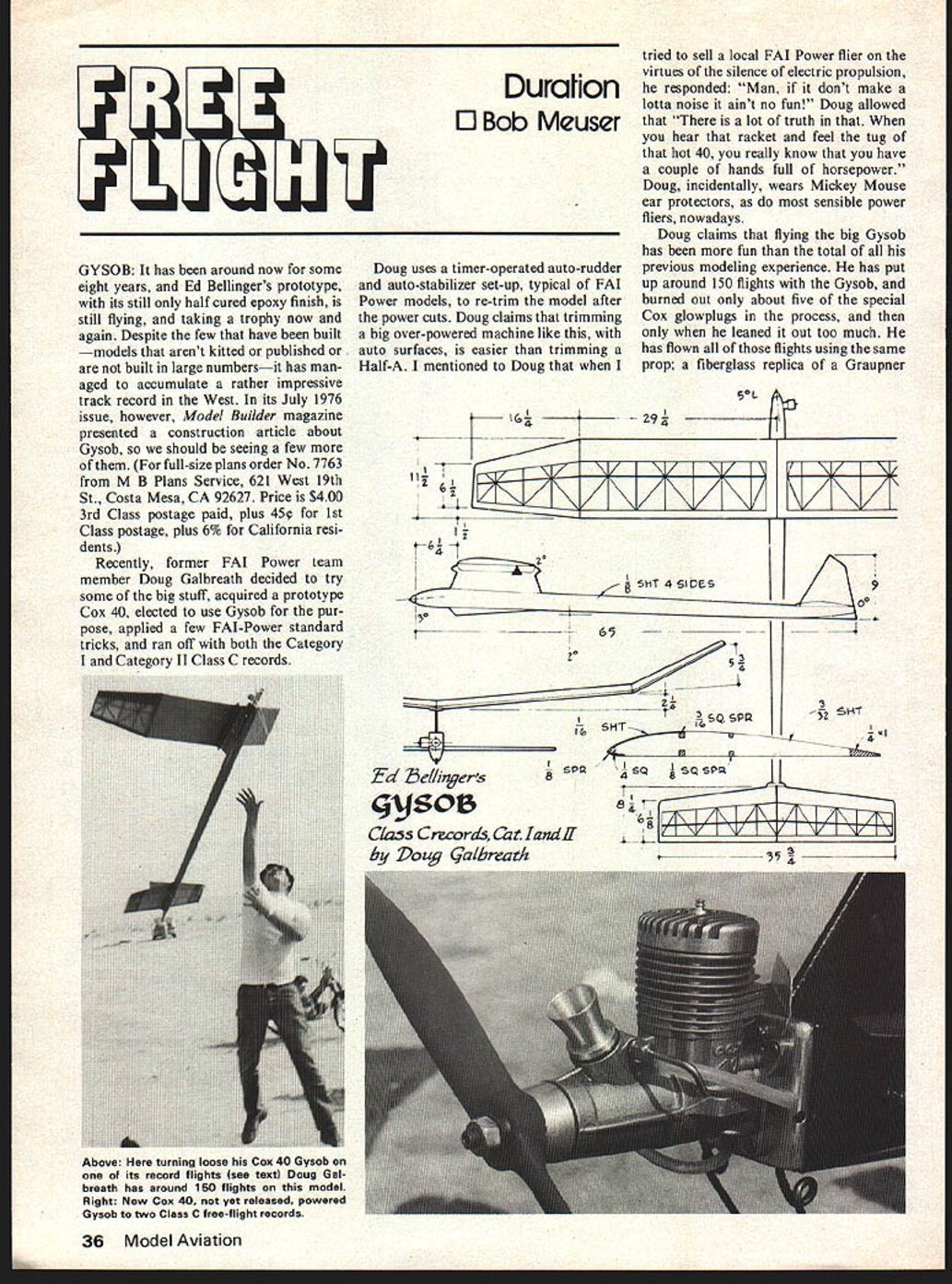
GYSOB: It has been around now for some eight years, and Ed Bellinger’s prototype, with its still only half cured epoxy finish, is still flying, and taking a trophy now and again. Despite the few that have been built — models that aren’t kitted or published or are not built in large numbers — it has managed to accumulate a rather impressive track record in the West. In its July 1976 issue, however, Model Builder magazine presented a construction article about Gysob, so we should be seeing a few more of them. (For full-size plans order No. 7763 from M B Plans Service, 621 West 19th St., Costa Mesa, CA 92627. Price is $4.00, 3rd Class postage paid, plus 45¢ for 1st Class postage, plus 6% for California residents.)
Recently, former FAI Power team member Doug Galbreath decided to try some of the big stuff, acquired a prototype Cox 40, elected to use Gysob for the purpose, applied a few FAI-Power standard tricks, and ran off with both the Category I and Category II Class C records.
Doug uses a timer-operated auto-rudder and auto-stabilizer set-up, typical of FAI Power models, to re-trim the model after the power cuts. Doug claims that trimming a big over-powered machine like this, with auto surfaces, is easier than trimming a Half-A. I mentioned to Doug that when I tried to sell a local FAI Power flier on the virtues of the silence of electric propulsion, he responded: "Man, if it don’t make a lotta noise it ain’t no fun!" Doug allowed that "There is a lot of truth in that. When you hear that racket and feel the tug of that hot 40, you really know that you have a couple of hands full of horsepower." Doug, incidentally, wears Mickey Mouse ear protectors, as do most sensible power fliers, nowadays.
Doug claims that flying the big Gysob has been more fun than the total of all his previous modeling experience. He has put up around 150 flights with the Gysob, and burned out only about five of the special Cox glowplugs in the process, and then only when he leaned it out too much. He has flown all of those flights using the same prop; a fiberglass replica of a Graupner 50L. 10-4 molded by Roger Simpson. The Cox burns 50%-nitro fuel with so much other junk in it there is scarcely any space left for any alcohol at all. Still, repeated teardowns of the engine have indicated that it is still essentially as new.
Don't line up in front of your local hobby emporium to buy a Cox 40 quite yet. Cox, at this writing, has not yet scheduled a release date.
Boeing Meet: On July 9 and 10, modelers who are at least midlin' amused at the prospect of getting a healthy portion of their job-training expenses paid for by the Establishment will converge on the Boeing Aerospace Center at Kent, Wash., for the eighth running of the annual event sponsored by the Boeing Management Assoc. Prizes for the top places run from around $1000 to $250 towards the winners' education expenses. Anyone 18 or under is eligible. But bring Big Bruder or Ol' Man along too; there are "Open" classes too for those already over the hill. The contest has been traditionally Free-Flight biased, but there are events for Control-Line and Rocket also, and a catch-all called "Special."
P/30 Event at Nats: It is now "official" that an unofficial P/30 outdoor rubber-power event will be held at the 1977 Nats. According to John Oldenkamp, one of the originators of the event to be sponsored by the San Diego Orbiteers, trophies will be awarded through fifth place, and in addition there will be a Junior High Time Award and a Ladies Cup.
At about the time you read this, the event will be included on the bill-of-fare for the U.S. Free Flight Champs. And later this year, Model Airplane News magazine will celebrate the tenth anniversary of Dave Linstrum's editorship of its VTO column by means of a Postal International P/30 Proxy Meet. Entries may be submitted at the Nats, or mailed to Peck-Polymers.
Rules are as follows: No dimension may exceed 30 inches. Model must be propelled by an unaltered 9-1/2-in. commercial plastic prop. (We presume that smaller props would be allowed.) Rubber weight must not exceed 10 g. The max is 3 minutes.
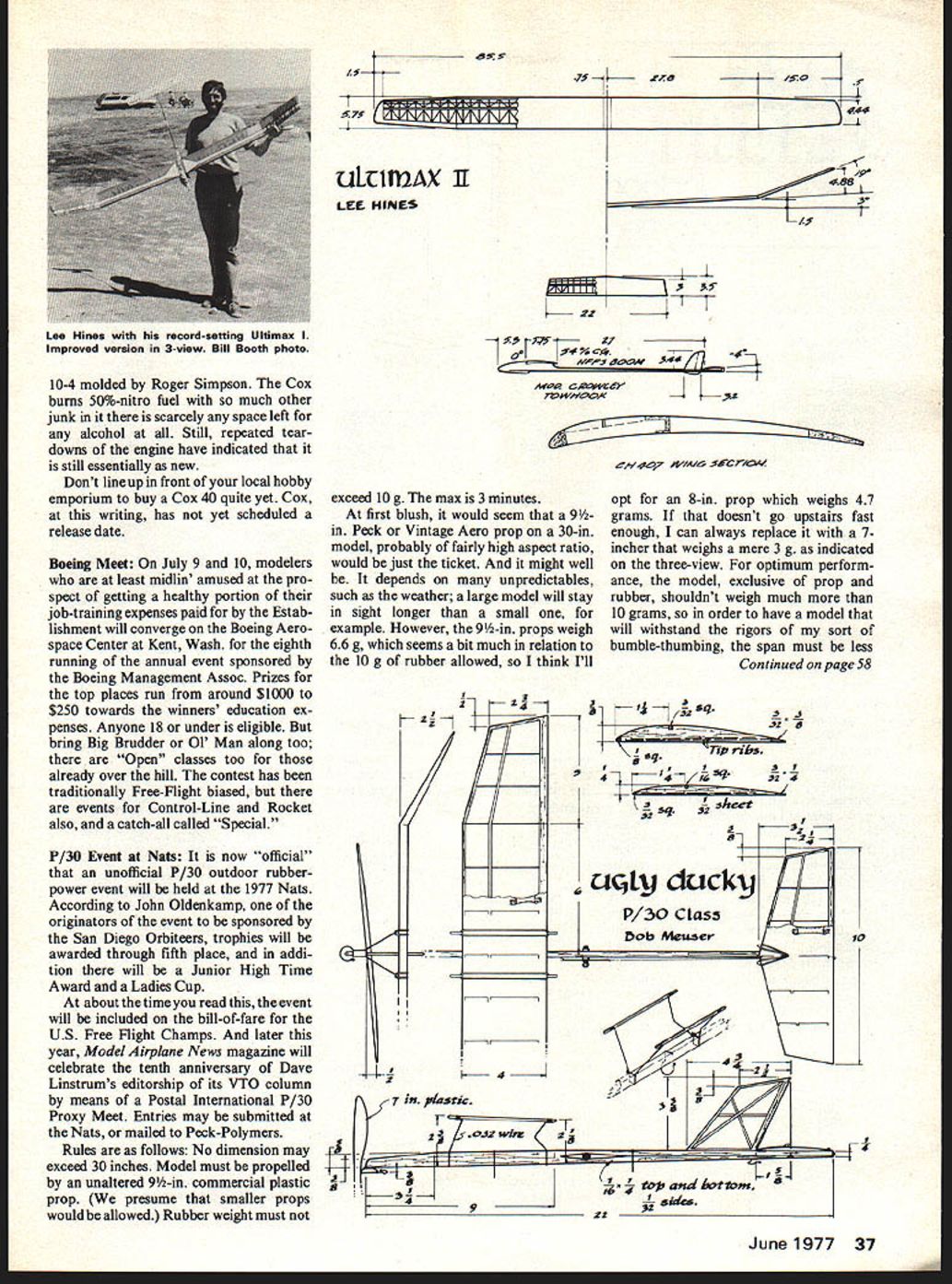
At first blush, it would seem that a 9-1/2-in. Peck or Vintage Aero prop on a 30-in. model, probably of fairly high aspect ratio, would be just the ticket. And it might well be. It depends on many unpredictables, such as the weather; a large model will stay in sight longer than a small one, for example. However, the 9-1/2-in. props weigh 6.6 g, which seems a bit much in relation to the 10 g of rubber allowed, so I think I'll opt for an 8-in. prop which weighs 4.7 grams. If that doesn't go upstairs fast enough, I can always replace it with a 7-incher that weighs a mere 3 g, as indicated on the three-view. For optimum performance, the model, exclusive of prop and rubber, shouldn't weigh much more than 10 grams, so in order to have a model that will withstand the rigors of my sort of bumble-thumbing, the span must be less
Free Flight: Duration
than the allowed 30 inches. 21 inches seems about right. But your guess is probably as good as mine. The construction should be reasonably simple, the layout should be fairly conventional, and the design should be as ugly as poor taste and inconsistency of line and form permit. A design, based on these rock-solid principles, is presented in the three view. Right-thrust is used to get right turn under power.
There are many kits on the market that satisfy the rules, and which might be competitive: Peck's One-Night 28; Sig's Mini-MaXer, Tiger, Cub, and Thermal Dart, to name but a few.
New NFFS Officers: The National Free Flight Society has acquired three new officers. After serving as editor of Free Flight, the NFFS Digest, for longer than any two previous editors, I am turning over the cutting, pasting, and wise-cracking to Keith Varneau, 4147 Wilson Ave., Castro Valley, CA 94546. Keith, age 32, has an elementary school teaching credential, is currently going to college and driving a bus. He took fourth at the 1967 Nats, behind Hines, Miller, and Cailliau, in high-ceiling Indoor Hand-Launch Glider. He'll be needing material in the way of club newsletters, photos, individual contributions, and probably can use some help with the drafting jobs.
Bill Booth, Jr. takes over as Membership Chairman from Doug Galbreath. Doug will continue doing the printing and mailing. However, Bill, recently married, hasn't settled down to a permanent address at this writing, so meanwhile you had better continue to address your membership problems to Doug. Keeping the dues payments and address changes all sorted out is a difficult, time consuming, and often thankless job. He is the guy to talk to if you wish to join the society, or to complain to when your Digest got lost in the mail, you forgot to pay your dues, or you forgot to tell him you moved.
Arlene Hannah, who goes around with Bruce Hannah, Jr., replaces Barbara Parsons as manager of N.F.F.S. Supplies, a good source for all of the nifty free-flight specialty hardware items that aren't normally stocked at your local hobby emporium. Send a stamped, self-addressed envelope for a price list to N.F.F.S. Supplies, 9525 Achates Circle, Sacramento, CA 95826.
Rumor has it that the Executive Director Hardy Brodersen and the manager of N.F.F.S. Plans and Publications, Larry Jordan are seeking replacements. Any suggestions?
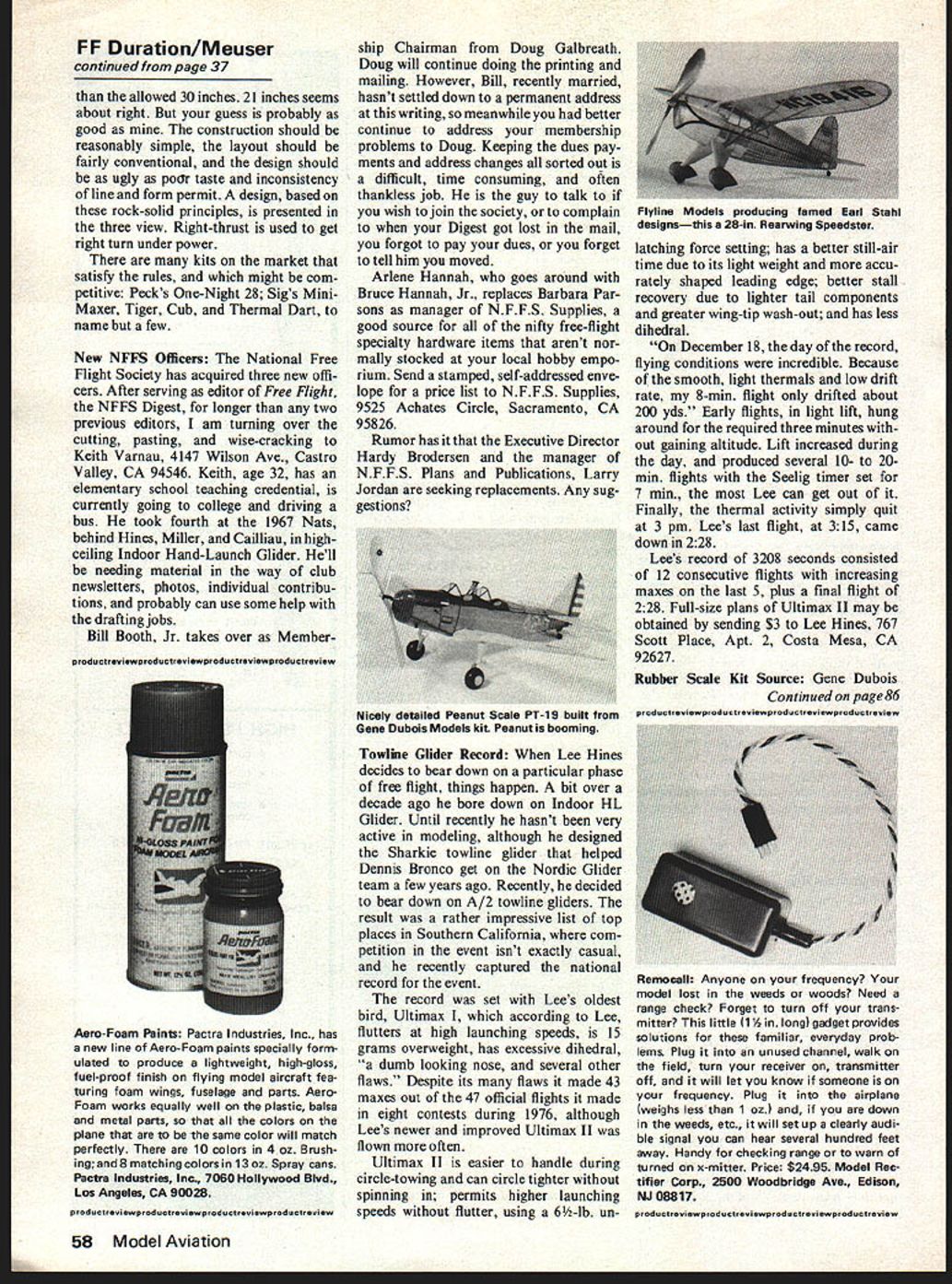
Towline Glider Record: When Lee Hines decides to bear down on a particular phase of free flight, things happen. A bit over a decade ago he bore down on Indoor HL Glider. Until recently he hasn't been very active in modeling, although he designed the Sharkie towline glider that helped Dennis Bronco get on the Nordic Glider team a few years ago. Recently, he decided to bear down on A/2 towline gliders. The result was a rather impressive list of top places in Southern California, where competition in the event isn't exactly casual, and he recently captured the national record for the event.
The record was set with Lee's oldest bird, Ultimax I, which according to Lee, flutters at high launching speeds, is 15 grams overweight, has excessive dihedral, a dumb looking nose, and several other flaws. Despite its many flaws it made 43 maxes out of the 47 official flights it made in eight contests during 1976, although Lee's newer and improved Ultimax II was flown more often.
Ultimax II is easier to handle during circle-towing and can circle tighter without spinning in; permits higher launching speeds without flutter, using a 6-1/2-lb. unlatching force setting; has a better still-air time due to its light weight and more accurately shaped leading edge; better stall recovery due to lighter tail components and greater wing-tip wash-out; and has less dihedral.
On December 18, the day of the record, flying conditions were incredible. Because of the smooth, light thermals and low drift rate, my 8-min. flight only drifted about 200 yds. Early flights, in light lift, hung around for the required three minutes without gaining altitude. Lift increased during the day, and produced several 10- to 20-min. flights with the Seelig timer set for 7 min., the most Lee can get out of it. Finally, the thermal activity simply quit at 3 pm. Lee's last flight, at 3:15, came down in 2:28.
Lee's record of 3208 seconds consisted of 12 consecutive flights with increasing maxes on the last 5, plus a final flight of 2:28. Full-size plans of Ultimax II may be obtained by sending $3 to Lee Hines, 767 Scott Place, Apt. 2, Costa Mesa, CA 92627. Models, so far a one-man basement operation, carries a nice line of models. Top of the line is a 28½‑in. Gere Sport, FF or single‑channel RC; rubber, electric, or gas power. Mainstay of the line, however, is his line of Peanut Scale models, which so far includes a Gere Sport, P‑47D, P‑19 Army Air Force trainer, and a Grumman Hellcat. Other models, and hardware items such as a balsa stripper, are in the works.
The Gere Sport kit I examined seemed to be of good quality. Printed sheetwood was C‑grain of the correct hardness, and the stripwood was uniform and nicely cut. Hardware includes plastic prop and thrust button; vac‑formed scale wheel halves, four of 'em; plastic windshield material, and wire parts. Tissue is top quality. Nose opening is a bit small for my liking, but could be easily enlarged. Plans appear adequate and accurate. Price of all the Peanuts is $3.75 plus 75¢ handling, and 5% tax for Massachusetts residents.
If your hobby shop doesn't stock them, order direct from G. D. Models, P.O. Box C, Acushnet, MA 02743. Send a stamped, self‑addressed envelope for a price list.
Bob Meuser, 4200 Gregory St., Oakland, CA 94619.
Transcribed from original scans by AI. Minor OCR errors may remain.

