
FREE FLIGHT DURATION
A few columns back I asked if anyone had real-world experiences with turbulators. Jim O'Reilly sent a letter tracing his experiences. His story and some related notes follow.
Turbulators — Jim O'Reilly's experience
Jim recounts a wind-tunnel article by Hans Gremmer (Vol Libre, 1986) that tested actual model-construction airfoils. Included were the Hofsas Espada (clean and with a couple of turbulator styles) and the Benedek B7406f, which had no on-purpose turbulation other than a leading-edge discontinuity. The two clear winners were the Espada with a 2-D turbulator and the B7406f.
Jim had been building Gard-style tapered, sheeted-balsa D-box wings on a jig with aggressive turbulators at about 7% and 20% chord (he remembers using only the 7%). After seeing Gremmer's article he designed a stick-and-tissue wing based on the B7406f—easy to build and it flew great.
Later he built an ex-USSR style graphite/Kevlar D-box on a new jig (again using the B7406f section). The first wing glided poorly—“like a horseshoe.” He had a braided fishline turbulator at about 10% chord; it still glided badly. Fred Pearce suggested the turbulator was too far back and recommended 5% chord. Jim moved the fishline forward to about 5% and the wing’s performance improved dramatically. He was surprised that moving a fishline forward by only about 0.2 inch could make such a difference.
From Jim’s experience he concludes:
- Turbulator spars need to be very far forward and create a significant discontinuity to be effective.
- Many older, thick, highly cambered wings glided well without added turbulators, implying something inherent (such as a leading-edge discontinuity) was doing the job.
- The leading-edge discontinuity—often a slight ridge caused by the tissue sagging just behind the leading edge—can act as the effective turbulator when in the right spot.
I had similar experiences with the thin, highly cambered Espada section. My model originally used a solid balsa wing (quick to build but heavy and prone to flutter). I experimented:
- Conventional thread turbulator — glide not as good as expected.
- V-shaped sawtooth turbulator notches — glide improved.
- Narrow tape invigorators on the top surface starting at about 25% chord — further improvement; the model then glided very well and handled turbulence better.
Lesson: experiment if your model “glides like a horseshoe.” Proper turbulation and placement can make a big difference.
Plans and contacts (Jim O'Reilly)
Jim now runs a plans business. His 15-plan line includes:
- Lanzo Puss Moth
- City Boy 84
- Leslie Bartlett's Scimitar (1/2 A Nostalgia)
- Les DeWitt's Whirlaway C (Nostalgia)
- Winterhawk III (for Coupe d'Hiver)
- Jim's own Tubular Bustard (P-30)
Plans are drawn on CAD and are clean and accurate. Most plans sell for $7 plus $1 postage.
Contact: Jim O'Reilly, 4760 N. Battin, Wichita, KS 67220. Ask him about other free flight products.
Wakefield Symposium
For the last few years John Lenderman and others in the Pacific Northwest have been hosting a Wakefield Symposium to bring West Coast modelers together to share thoughts and techniques for F1B. The most recent meeting (January 14) included presentations by 1995 Wakefield team member Dan Tracy and discussions by Blake and Gene Jensen, Ralph Cooney, Rick Ewing, and Norm Beattie (Canada).
Topics covered:
- Model development and construction
- Trimming and tactics
- Air picking
- Rubber quality and winding techniques
- Use of DPR (delayed prop release)
- Scratch-built models versus purchased models
The proceedings were professionally recorded; three 90-minute tapes are available from Bob Wood. Cost is $14 postpaid.
Contact: Bob Wood, 1480 Conyers Creek Road, Clatskanie, OR 97016.
More from Starline (Sal Fruciano)
Sal Fruciano is importing Ukrainian and Russian free flight supplies under Starline International. Highlights:
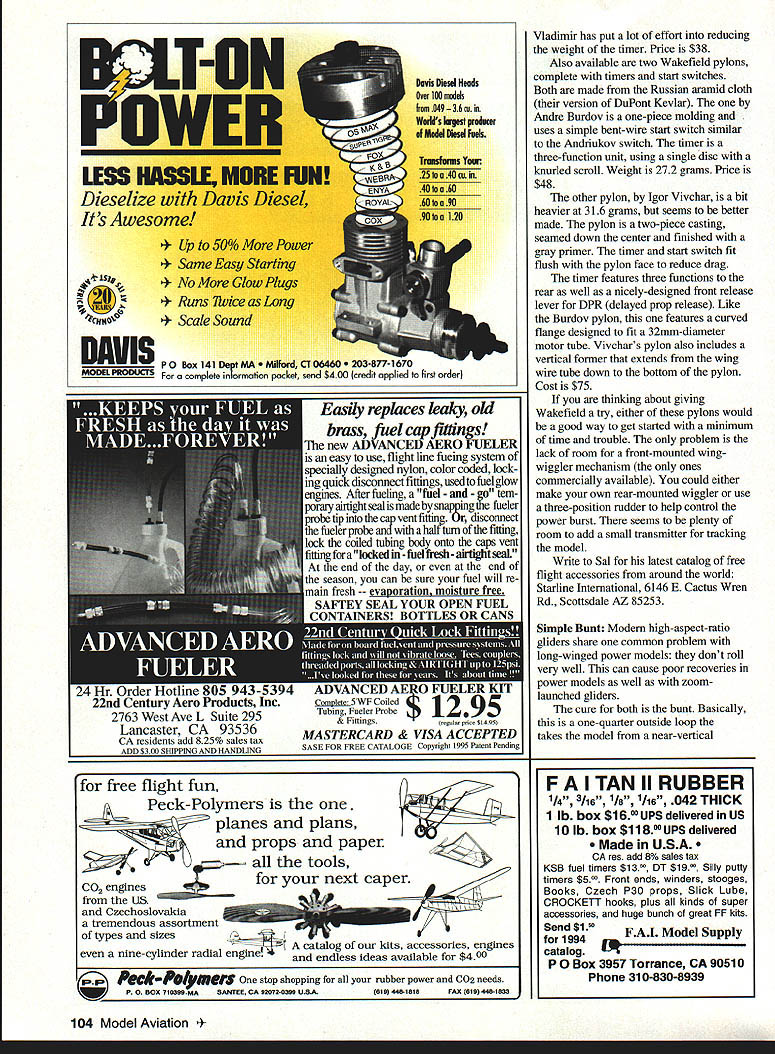
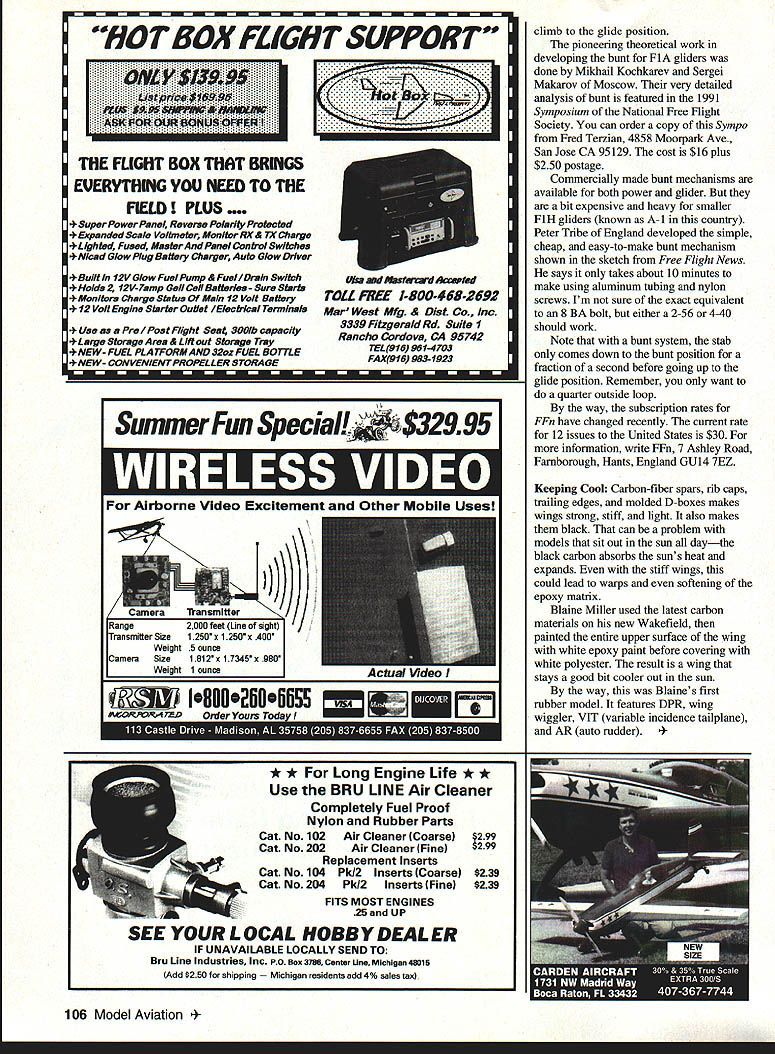
- Vladimir Fedorov timer
- Very light (about 12 grams)
- Two discs plus a knurled scroll for DT
- All three trip arms spring-loaded for quick, positive release
- Scroll knurled for easy winding (no winding ears to catch trip arms)
- Price: $38
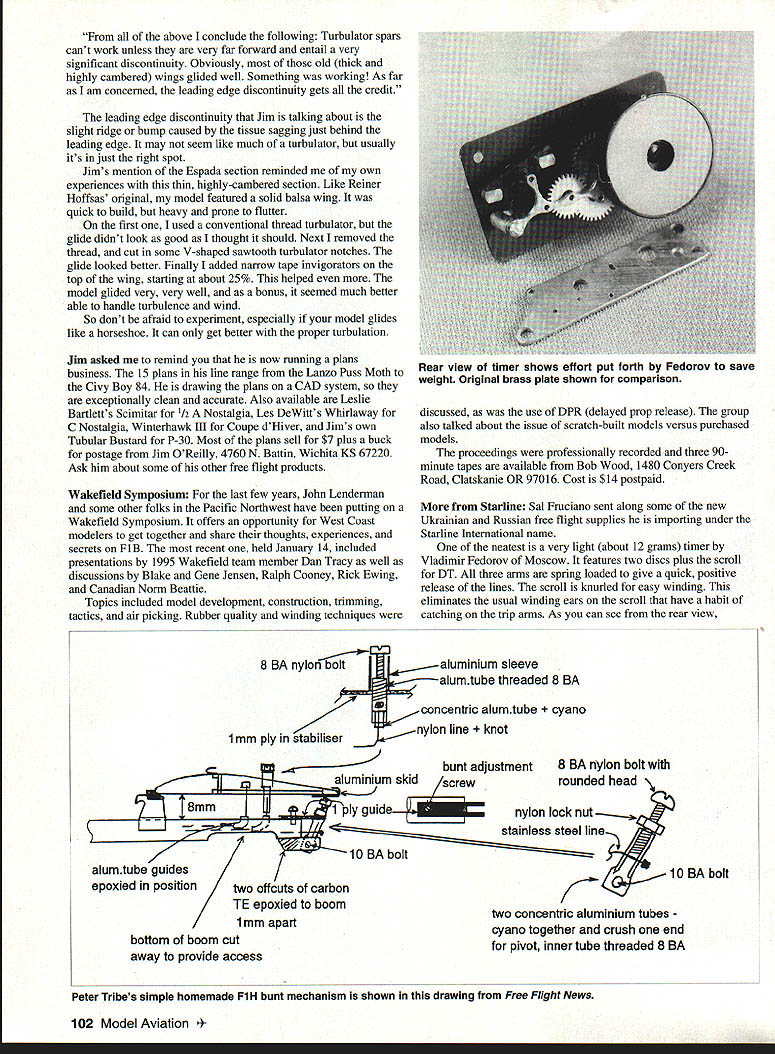
- Wakefield pylons (complete with timers and start switches), made from Russian aramid cloth (their Kevlar):
- Andre Burdov pylon
- One-piece molding
- Simple bent-wire start switch (similar to Andriukov)
- Single-disc timer with knurled scroll
- Weight: 27.2 grams
- Price: $48
- Igor Vivchar pylon
- Two-piece casting, seamed down the center, finished with gray primer
- Timer and start switch fit flush with the pylon face to reduce drag
- Three-function timer to the rear plus a well-designed front release lever for DPR
- Curved flange to fit a 32 mm-diameter motor tube
- Includes a vertical former from the wing wire tube to the bottom of the pylon
- Weight: 31.6 grams
- Price: $75
If you’re starting with Wakefield, either pylon is a good way to begin with minimal time and trouble. Note: limited room for a front-mounted wing-wiggler mechanism; options are to build a rear-mounted wiggler or use a three-position rudder for power-burst control. There’s probably room to add a small transmitter for tracking.
Contact: Starline International, 6146 E. Cactus Wren Rd., Scottsdale, AZ 85253.
Bunt mechanisms and FFN
Pioneering theoretical work on bunt development for F1A gliders was done by Mikhail Kochkarev and Sergei Makarov (Moscow). Their detailed analysis of bunt appears in the 1991 Symposium of the National Free Flight Society. A copy can be ordered from Fred Terzian.
- Symposium copy: Fred Terzian, 4858 Moorpark Ave., San Jose, CA 95129. Cost: $16 plus $2.50 postage.
Commercially made bunt mechanisms are available for power and glider models, but they can be heavy and expensive for small F1H (A-1) gliders. Peter Tribe (England) developed a simple, cheap bunt mechanism that can be made from aluminum tubing and nylon screws; he reports it takes about 10 minutes to make. An equivalent to an 8 BA bolt would be a 2-56 or 4-40 in common U.S. hardware sizes.
Note: with a bunt system the stab only comes down to the bunt position for a fraction of a second before returning to the glide position—you want only a quarter outside loop.
FFN subscription: current rate for 12 issues to the United States is $30. For more information: FFN, 7 Ashley Road, Farnborough, Hants, England GU14 7EZ.
Keeping cool — carbon construction
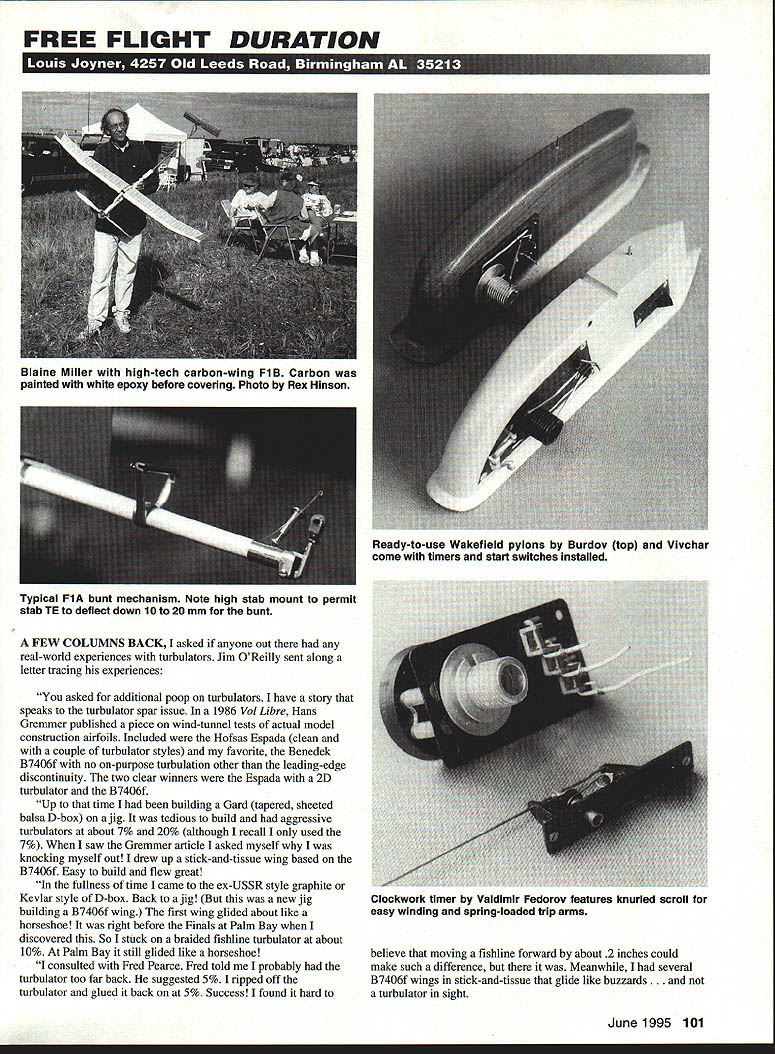
Carbon-fiber spars, rib caps, trailing edges, and molded D-boxes make wings strong, stiff, and light—but they also make them black. Black surfaces absorb more sun and can heat and expand, potentially causing warps or softening epoxy in prolonged sun.
Blaine Miller painted the entire upper surface of his carbon wing with white epoxy paint before covering it with white polyester. The wing stayed much cooler in the sun. Blaine's Wakefield was his first rubber model and includes DPR, a wing wiggler, VIT (variable-incidence tailplane), and AR (auto-rudder).
Transcribed from original scans by AI. Minor OCR errors may remain.

