


FREE FLIGHT DURATION
Louis Joyner, 4257 Old Leeds Road, Birmingham, AL 35213
Some years back I was involved in a rather unusual fly-off. We were flying at the old Huntsville, Alabama, airport. Closed to full-sized aircraft, it was used for model flying — and just about everything else. By the time you factored in the golf course, the garbage dump, and other encroachments, there wasn't a lot of room. In other words, it was a typical free-flight site.
Two of us had made the three two-minute maxes in Unlimited Rubber. With the existing drift, upping the max to three minutes, or even two-and-a-half, would have meant some lost models. So the contest director suggested that we both launch at the same time, and whoever was highest at two minutes would be the winner. There was enough drift so it was easy to tell who was highest. (It wasn't me.)
I had about forgotten about this until I came across an article by Ron Pollard in the British newsletter Free Flight News. The Tynemouth club proposed an experimental contest designed to minimize long flights, long retrievals, landowner complaints, and other problems that go with long maxes on short fields. Here's their proposal:
- The CD shall fix a max with due consideration to the wind speed, drift and visibility, to terminate flights close to the flying-site boundary.
- Timekeepers shall observe the entire flight (if possible) and record the following times:
a. from the start to when the model is seen to DT, b. from the start to flight termination.
- The winner shall be the entrant who has completed the max plus the highest DT time.
Notes: a. If the max is not reached, the total flight time will be recorded in the normal way. b. If the model is not seen to DT and lands or flies out of sight (OOS), only the max will be recorded.
The following observations come to mind:
- Large, light open-rubber and open-power models are likely to descend more slowly on DT, but don't tend to climb very high.
- Smaller, higher-powered models will climb higher but sink faster on DT.
- In dead-air conditions, open gliders often need DT and flights will be normal.
- However, in similar conditions, open-rubber and open-power models will want to take advantage of the height gained and DT soon after the max has been reached to obtain the best score.
- It will still be an advantage to put the model into lift.
- Timekeepers will have to be more accurate with their timekeeping duties; however, this should be offset by reduced concentration time.
It sounds like an interesting idea that's worth a try, especially for local contests where the flying site is limited. Note that these rules don't change the model specifications whatsoever. To my way of thinking, this makes a lot more sense than the progressive maxes in Category III, especially for a high-performance event like Mulvihill.
What's F1J
For the last couple of years I've been chatting over the phone with Walt Rozelle about his F1J project. We discussed wing construction and the use of composite materials. I even made up a set of Kevlar "taco" shells to his specs (real wide, black tissue).
Apparently I wasn't the only one he was talking to. Harry Grogan crunched the numbers aerodynamically. Bill Lynch supplied plans for his Hurry Up, Pegasus, and Sidewinder F1J designs, as well as the VIT mechanism and Rocca folding prop. Ken Oliver supplied the carbon-fiber motor tube and tailboom. Doug Galbreath furnished the Seelig Mini-4 timer and reworked the CS .06 engine. Rohacell foam and carbon fiber came from Matt and Gail Gewain at CST.
Walt also did some reading. Construction ideas for the wing came from Jim Parker's NFFS Digest series on F1A technology. Other ideas were from Keith Hoover's 1992 Power Book.
What Walt did was do it right. He got help from as many different people as he could, digested it all, and built the model. Sure, it takes some effort at the front end (not to mention the long-distance phone bills), but the end results are much better than trying to reinvent the wheel all by yourself.
The Hatschek Strangler
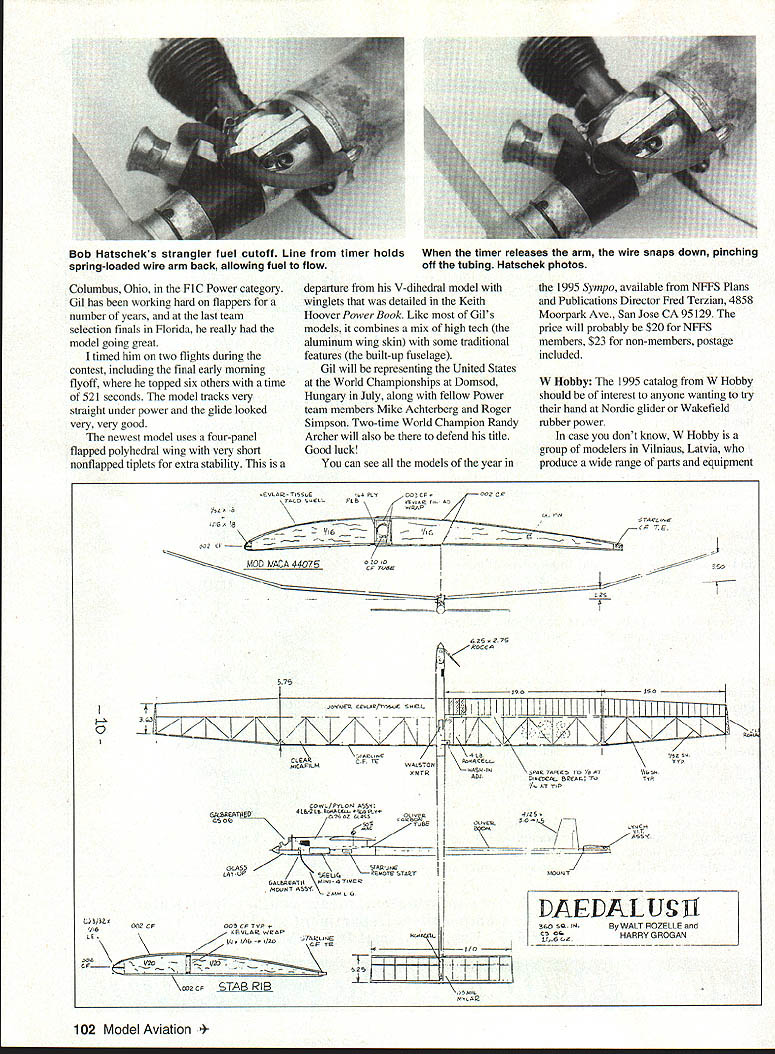
Noted modeler, writer, and bender of music wire Bob Hatschek sent along two photos of his strangler. It's a simple fuel-shutoff device for a Cox TD or other beam-mounted engines. This allows a remote timer position and shortens the length of fuel tubing needed.
Construction and operation:
- The mounting plate is cut from 1/16-inch aluminum and mounts on the top engine lugs, extending forward about 1/4 inch.
- A D-shaped hole is cut in the plate just big enough for the fuel tubing, with the straight side to the front.
- A spring-loaded lever is formed from .025 music wire. An extension wire has a loop end to anchor to the engine mounting lug; a coil bend gives spring action downward.
- Another triangular loop fits around the fuel tubing; a final loop provides an attachment point for the line back to the timer.
- When the line is pulled back, fuel can flow freely through the tubing. When the timer releases the line, the wire springs down and pinches off the tubing.
- The D-shaped hole and the triangular loop assure that the tube is squeezed between two straight edges for a positive shutoff.
Models of the Year
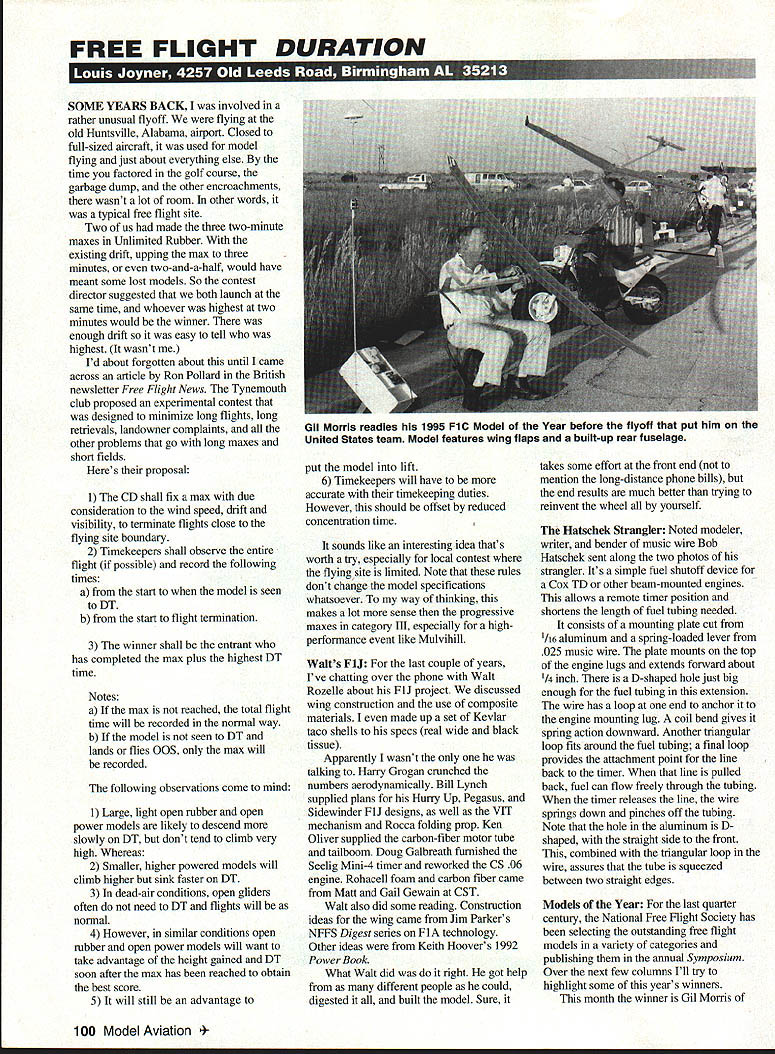
For the last quarter century, the National Free Flight Society has been selecting outstanding free-flight models in a variety of categories and publishing them in the annual Symposium. Over the next few columns I'll highlight some of this year's winners. This month the winner is Gil Morris of Columbus, Ohio, in the F1C Power category.
Gil has been working hard on flappers for a number of years, and at the last team selection finals in Florida he really had the model going great. I timed him on two flights during the contest, including the final early-morning flyoff, where he topped six others with a time of 521 seconds. The model tracks very straight under power and the glide looked very, very good.
The newest model uses a four-panel flapped polyhedral wing with very short nonflapped tiplets for extra stability. This departs from his previous V-dihedral model with winglets that was detailed in the Keith Hoover Power Book. Like most of Gil's models, it combines a mix of high tech (the aluminum wing skin) with some traditional features (the built-up fuselage).
Gil will be representing the United States at the World Championships at Domsod, Hungary in July, along with fellow Power team members Mike Achterberg and Roger Simpson. Two-time World Champion Randy Archer will also be there to defend his title. Good luck!
You can see all the Models of the Year in the 1995 Symposium, available from NFFS Plans and Publications Director Fred Terzian, 4858 Moorpark Ave., San Jose, CA 95129. The price will probably be $20 for NFFS members, $23 for non-members, postage included.
W Hobby
The 1995 catalog from W Hobby should be of interest to anyone wanting to try their hand at Nordic glider or Wakefield rubber power. W Hobby is a group of modelers in Vilnius, Latvia, who produce a wide range of parts and equipment.
Transcribed from original scans by AI. Minor OCR errors may remain.

