
FREE FLIGHT DURATION
Louis Joyner, 4257 Old Leeds Road, Birmingham AL 35213
Another Model of the Year
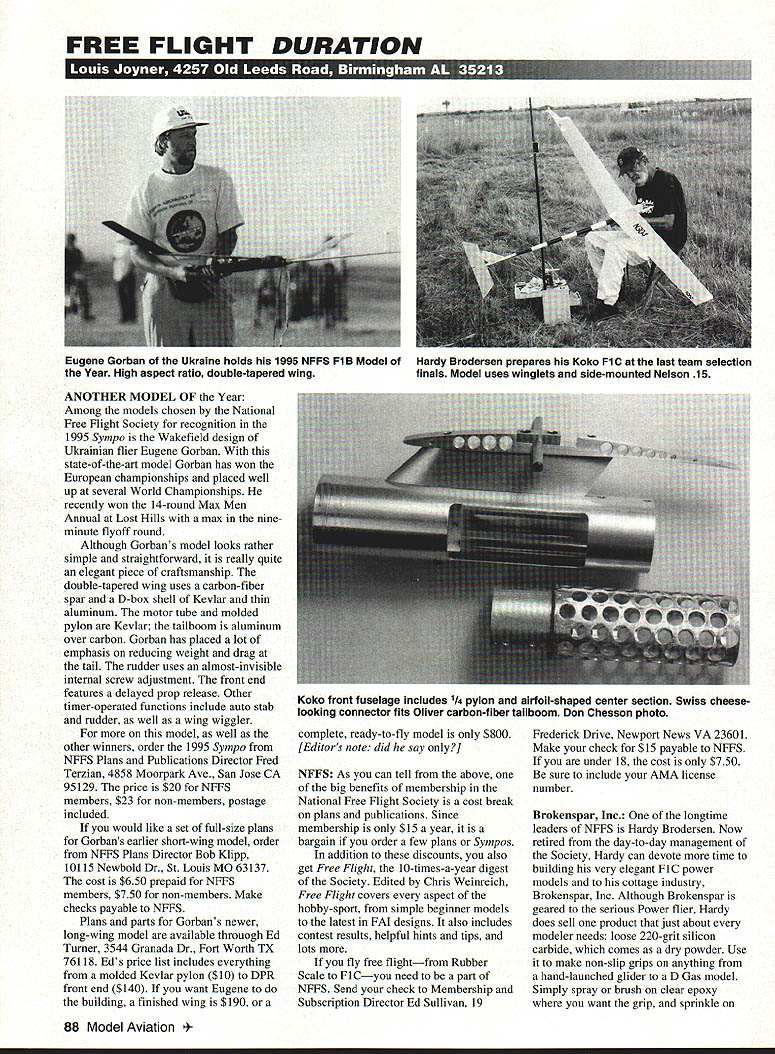
Among the models chosen by the National Free Flight Society for recognition in the 1995 Sympo is the Wakefield design of Ukrainian flier Eugene Gorban. With this state-of-the-art model Gorban has won the European championships and placed well at several World Championships. He recently won the 14-round Max Men Annual at Lost Hills with a max in the nine-minute flyoff round.
Although Gorban's model looks simple and straightforward, it is an elegant piece of craftsmanship. The double-tapered wing uses a carbon-fiber spar and a D-box shell of Kevlar and thin aluminum. The motor tube and molded pylon are Kevlar; the tailboom is aluminum over carbon. Gorban has placed a lot of emphasis on reducing weight and drag at the tail. The rudder uses an almost-invisible internal screw adjustment. The front end features a delayed prop release. Other timer-operated functions include auto stab and rudder, as well as a wing wiggler.
For more on this model, as well as the other winners, order the 1995 Sympo from:
- Fred Terzian, NFFS Plans and Publications Director, 4858 Moorpark Ave., San Jose CA 95129.
- Price: $20 for NFFS members, $23 for non-members (postage included).
If you would like full-size plans for Gorban's earlier short-wing model, order from:
- Bob Klipp, NFFS Plans Director, 10115 Newbold Dr., St. Louis MO 63137.
- Cost: $6.50 prepaid for NFFS members, $7.50 for non-members. Make checks payable to NFFS.
Plans and parts for Gorban's newer long-wing model are available through:
- Ed Turner, 3544 Granada Dr., Fort Worth TX 76118.
- Ed's price list includes everything from a molded Kevlar pylon ($10) to DPR front end ($140).
- If you want Eugene to do the building: finished wing $190, complete ready-to-fly model $800. [Editor's note: did he say only?]
NFFS
One of the big benefits of membership in the National Free Flight Society is a cost break on plans and publications. Since membership is only $15 a year, it is a bargain if you order a few plans or Sympos. In addition to these discounts, you also get Free Flight, the 10-times-a-year digest of the Society. Edited by Chris Weinreich, Free Flight covers every aspect of the hobby-sport, from simple beginner models to the latest in FAI designs. It also includes contest results, helpful hints and tips, and lots more.
If you fly free flight — from Rubber Scale to F1C — you need to be a part of NFFS. Send your check to:
- Ed Sullivan, Membership and Subscription Director, 19 Frederick Drive, Newport News VA 23601.
- Make your check for $15 payable to NFFS. If you are under 18, the cost is $7.50.
- Be sure to include your AMA license number.
Brokenspar, Inc.
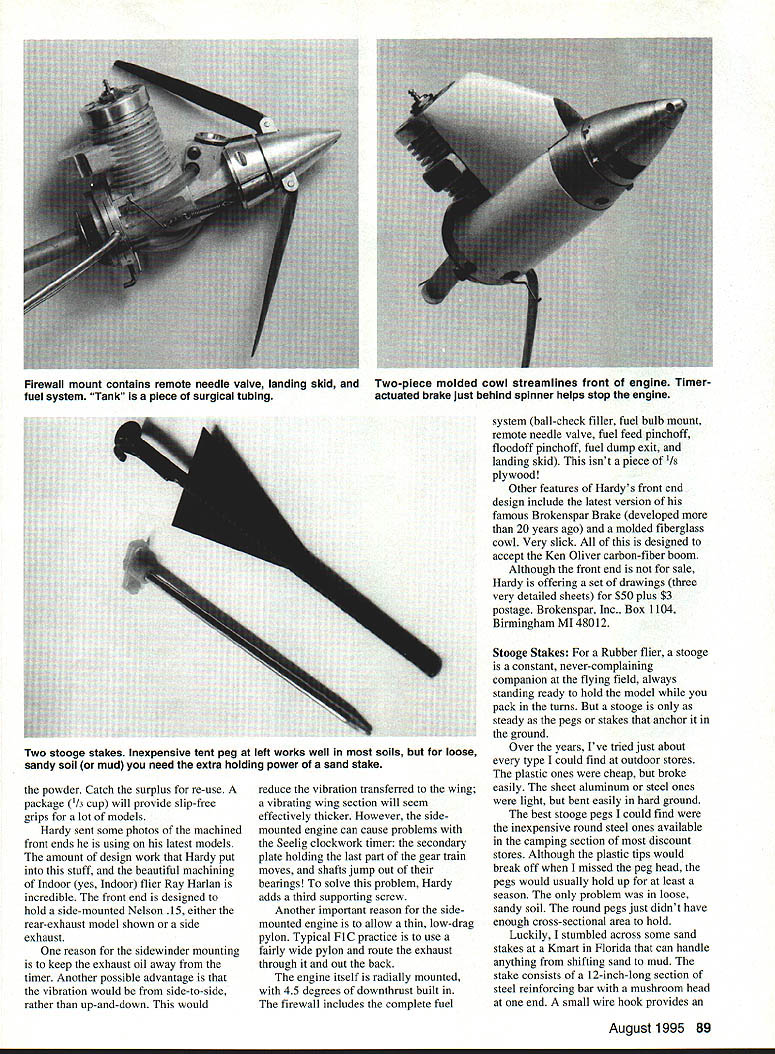
One of the longtime leaders of NFFS is Hardy Brodersen. Now retired from the day-to-day management of the Society, Hardy devotes more time to building elegant F1C power models and to his cottage industry, Brokenspar, Inc.
Although Brokenspar is geared to the serious power flier, Hardy sells one product that nearly every modeler needs: loose 220-grit silicon carbide, sold as dry powder. Use it to make non-slip grips on anything from a hand-launched glider to a D-Gas model:
- Spray or brush clear epoxy where you want the grip.
- Sprinkle on the silicon carbide powder.
- A 1/3-cup surplus re-use package will provide slip-free grips for many models.
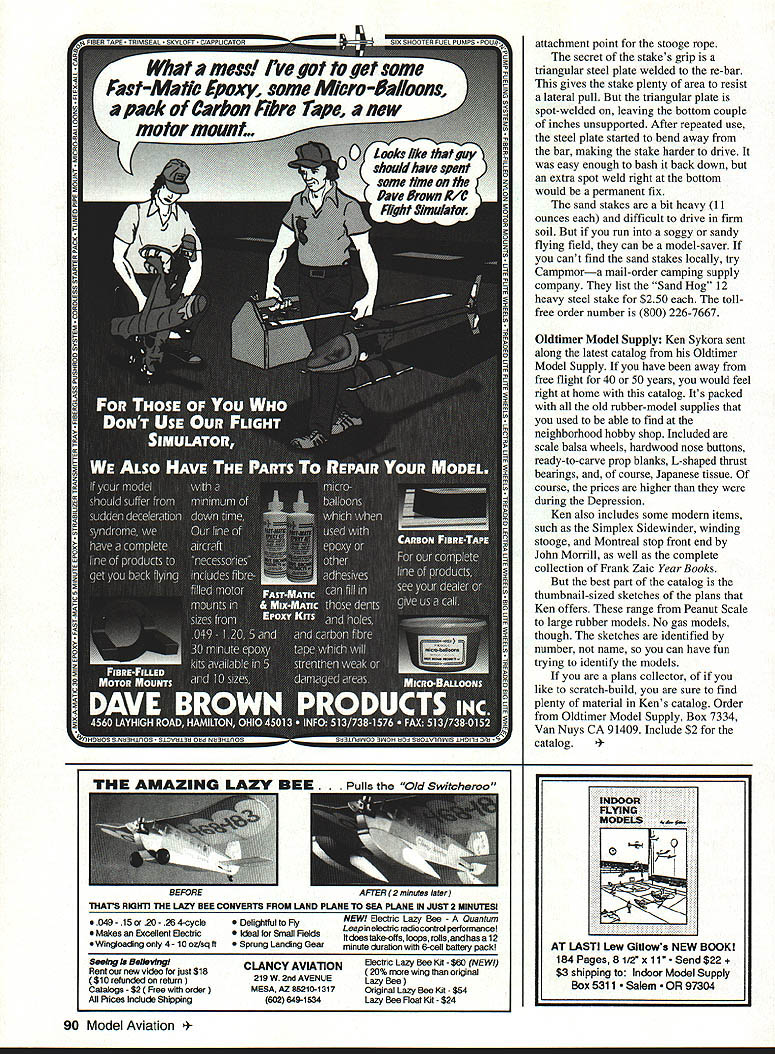
Hardy sent photos of machined front ends using the latest models; the amount of design work shows in the beautiful machining.
#### Indoor front end Indoor flier Ray Harlan's front end is designed to hold a side-mounted Nelson .15. Either rear-exhaust or side-exhaust can be used; the sidewinder mounting keeps exhaust oil away from the timer. Another possible advantage is that vibration is side-to-side rather than up-and-down, reducing vibration transferred to the wing; a vibrating wing section will seem effectively thicker. However, side-mounted engines can cause problems.
On a Seelig clockwork timer, the secondary plate holding the last part of the gear train can move and the shafts may jump out of their bearings. To solve the problem, Hardy adds a third supporting screw.
Another important reason for a side-mounted engine is that it allows a thin, low-drag pylon. Typical F1C practice is to use a fairly wide pylon and route the exhaust out the back. The engine itself is radially mounted with 45 degrees downthrust. The built firewall includes a complete fuel system with ball-check filler and fuel bulb mount for remote operation.
This isn't a piece of 1/8 plywood!
Other features of Hardy's front end design include the latest version of his famous Brokenspar Brake (developed more than 20 years ago) and a molded fiberglass cowl. Very slick. All of this is designed to accept the Ken Oliver carbon-fiber boom.
Although the front end is not for sale, Hardy offers a set of drawings (three very detailed sheets) for $50 plus $3 postage.
- Brokenspar, Inc., Box 1104, Birmingham MI 48012.
Stooge Stakes
For a Rubber flier, a stooge is a constant, never-complaining companion at the flying field, always standing ready to hold the model while you pack in the turns. But a stooge is only as steady as the pegs or stakes that anchor it in the ground.
Over the years, I've tried just about every type I could find at outdoor stores. The plastic ones were cheap but broke easily. The sheet aluminum or steel ones were light but bent in hard ground. The best stooge pegs I could find were inexpensive round steel ones available in the camping section of most discount stores. Although the plastic tips would break off when I missed the peg head, the pegs usually held up for at least a season. The only problem was loose, sandy soil — the round pegs didn't have enough cross-sectional area to hold.
I stumbled across some sand stakes at a Kmart in Florida that can handle anything from shifting sand to mud. The stake consists of a 12-inch-long section of steel reinforcing bar with a mushroom head at one end. A small wire hook provides an attachment point for the stooge rope.
The secret of the stake's grip is a triangular steel plate welded to the rebar. This gives the stake plenty of area to resist a lateral pull. But the triangular plate is spot-welded on, leaving the bottom couple of inches unsupported. After repeated use, the steel plate started to bend away from the bar, making the stake harder to drive. It was easy enough to bash it back down, but an extra spot weld right at the bottom would be a permanent fix.
The sand stakes are a bit heavy (11 ounces each) and difficult to drive in firm soil. But if you run into a soggy or sandy flying field, they can be a model-saver. If you can't find the sand stakes locally, try Campmor — a mail-order camping supply company. They list the "Sand Hog" 12" heavy steel stake for $2.50 each.
- Toll-free order number: (800) 226-7667.
Oldtimer Model Supply
Ken Sykora sent the latest catalog from Oldtimer Model Supply. If you have been away from free flight for 40 or 50 years, you would feel right at home with this catalog. It's packed with all the old rubber-model supplies that used to be available at the neighborhood hobby shop: scale balsa wheels, hardwood nose buttons, ready-to-carve prop blanks, L-shaped thrust bearings, and Japanese tissue. Of course, prices are higher than they were during the Depression.
Ken also includes some modern items, such as the Simplex Sidewinder, winding stooge, and Montreal stop front end by John Morrill, as well as the complete collection of Frank Zaic Year Books.
The best part of the catalog is the thumbnail-sized sketches of the plans Ken offers. These range from Peanut Scale to large rubber models. No gas models, though. The sketches are identified by number, not name, so you can have fun trying to identify the models.
If you are a plans collector or like to scratch-build, you are sure to find plenty of material in Ken's catalog. Order from:
- Oldtimer Model Supply, Box 7334, Van Nuys CA 91409.
- Include $2 for the catalog.
Transcribed from original scans by AI. Minor OCR errors may remain.

