

FREE FLIGHT DURATION
Louis Joyner 4257 Old Leeds Road, Birmingham AL 35213
How long?
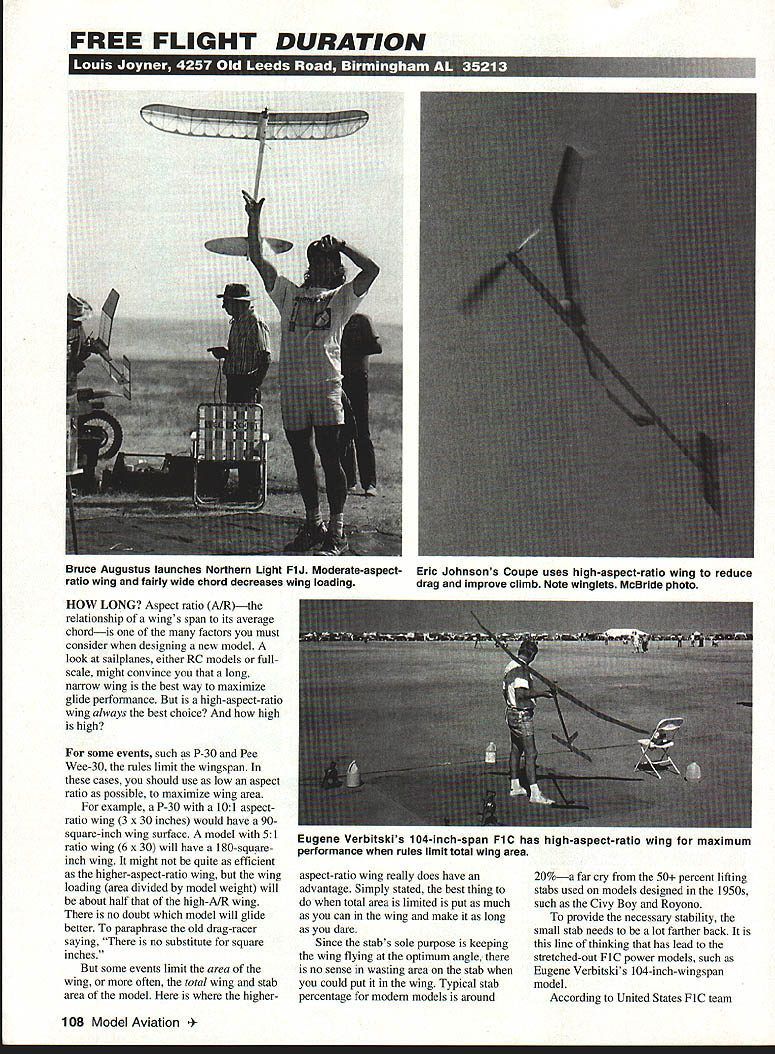
Aspect ratio (A/R)—the relationship of a wing's span to its average chord—is one of the many factors you must consider when designing a new model. A glance at sailplanes, either RC models or full-scale, might convince you that a long, narrow wing is the best way to maximize glide performance. But is a high-aspect-ratio wing always the best choice? And how high is "high"?
- For events such as P-30 and Pee Wee-30 the rules limit wingspan. In those cases you should use as low an aspect ratio as possible to maximize wing area.
- Example: A P-30 with a 10:1 aspect-ratio wing (3" × 30") has a 90 in² wing surface. A model with a 5:1 ratio wing (6" × 30") has a 180 in² wing. The lower-A/R wing may be less efficient per unit area, but its wing loading (weight divided by area) will be about half that of the high-A/R wing—and it will almost certainly glide better. As the old drag-racer saying goes, "There is no substitute for square inches."
When total area is limited
Some events limit wing area, or more often the total wing-plus-stab area. When total area is limited, put as much area as you can into the wing and make the wing as long as practical.
- Typical modern stabilizer area is around 20% of the lifting area—far from the 50%+ lifting stabs used on many 1950s designs (e.g., Civy Boy, Royono).
- A smaller stab can provide the necessary stability only if it is placed farther back; this has encouraged longer fuselages and stretched-out designs (for example, some F1C power models).
Practical and aerodynamic limits
According to U.S. F1C team member Roger Simpson, every increase in span has resulted in increased performance. What limits span and aspect ratio?
- Practical limit: what you can fit in your model box. Many top fliers have model boxes modified to accommodate longer wings.
- Aerodynamic limit: when wing area is fixed, increasing A/R reduces chord and therefore reduces Reynolds number (which relates chord to airspeed). As chord decreases, Reynolds number falls; generally a minimum chord of about 3 inches still yields an acceptable Reynolds number.
- Structural limit: longer wings become thinner in both absolute and relative terms. For conventional balsa-and-tissue construction the practical A/R limit is probably around 12:1. Newer composite methods—aluminum-over-balsa skins, carbon-fiber D-boxes—allow much stronger, longer wings.
Open events: design trade-offs
Some events (open power, open Coupe) impose no limits on wing area or span. Choices include:
- Build a fairly low-A/R wing to pack in lots of area (low wing loading), or
- Go to a higher-A/R wing (higher wing loading) to reduce induced drag and improve climb.
A real example: Eric Johnson's new Coupe uses the higher-A/R approach. It has a 54-1/2" span wing and 192 in² area, giving a 3-1/2" average chord and an aspect ratio reportedly around 15.6:1—very high for a Coupe.
- Eric might have improved glide by increasing chord (reducing wing loading), but that would have increased profile drag and hurt climb.
- In free flight you often choose compromises. A lightly loaded model may outglide a high-loading design, but it may be harder to get high at launch. Eric chose the best possible climb for several reasons:
- Thermals are generally larger higher up.
- A fast-climbing model is less affected by wind and ground turbulence.
- It's more fun to climb above the other models.
Eric Johnson's Dream Catcher — specs
- Span: 54-1/2"
- Area: 192 in² (average chord ~3-1/2")
- Wing construction: balsa D-box with carbon-fiber top and bottom spars
- Trailing edge: carbon fiber
- Airfoil: modified Andrukov, ~6% thickness
- Wing triplets: built-up, 1-1/4" × 1/8"
- Motor tube: 1" diameter, rolled balsa with Tyvek inside and tissue outside
- Boom: rolled balsa with tissue outside
- Overall length: 36-1/4"
- Power: 12 strands of 5" Tan TL driving a pair of Champion Coupe blades
- Covering: wing tissue-covered; tail covered with Mylar
- Trim: flies right-left without auto surfaces; a follow-up model will add auto stab and rudder
- All-up weight: 82 grams (including 10 g motor and locating transmitter)
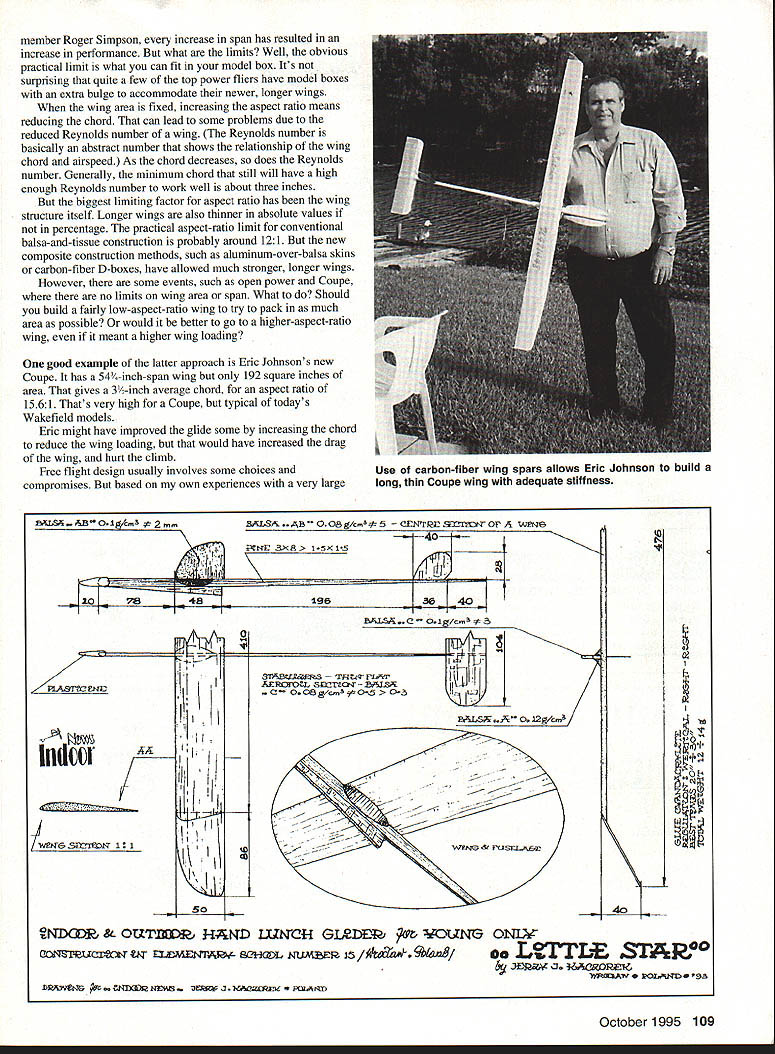
Little Star
From the pages of Vol Libre: a high-aspect-ratio hand-launched glider intended for younger modelers, designed by Jerzy Kaczorek. Notable features:
- Eliminates the troublesome center dihedral joint, effectively making a flat wing with small basic tapers.
- All dimensions are in millimeters, making it easy to scale up.
To subscribe to Vol Libre, contact Peter Brooks, 313 Lynchburg Dr., Newport News, VA 23606. The newsletter is published six times a year in French, with English subtitles.
Transcribed from original scans by AI. Minor OCR errors may remain.

