
FREE FLIGHT: DURATION
Louis Joyner 4257 Old Leeds Road, Birmingham AL 35213
Towline and reel
Back in the old days (before carbon fiber and circle tow) towlines — like the gliders themselves — used to be simple. I remember local experts showing up at contests with red silk‑covered Jasco Nordic 72s and a new 10‑cent ball of kite string. The string often stayed behind. Modern technology and rules have changed that. Circle towhooks now need a 15–20 pound pull to unlatch, so cotton kite string would break long before the hook released. Rules also require that the line be wound up immediately after each flight.
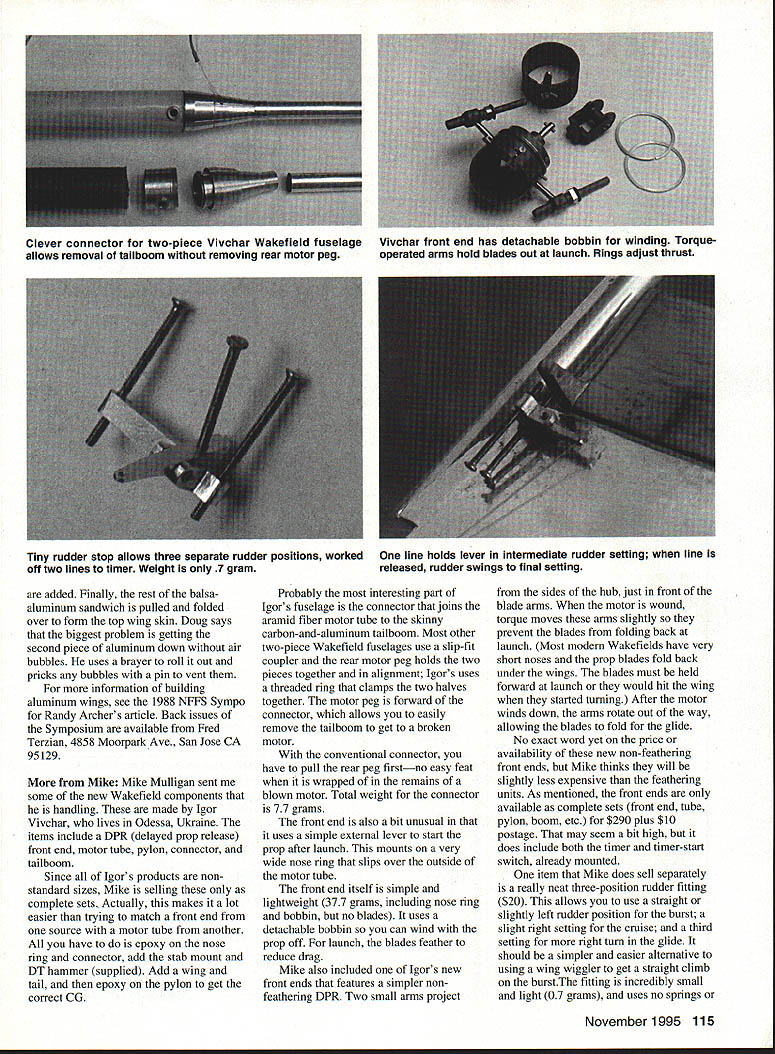
Common practice is to use a simple winch to reel up the line between flights. After the line is stretched out, it is unhooked from the winch. Most fliers store the winch during tow by sticking it into the back waistband of their pants. The rules permit a small button to be attached to the end of the line to keep it from slipping through the flier’s hand.
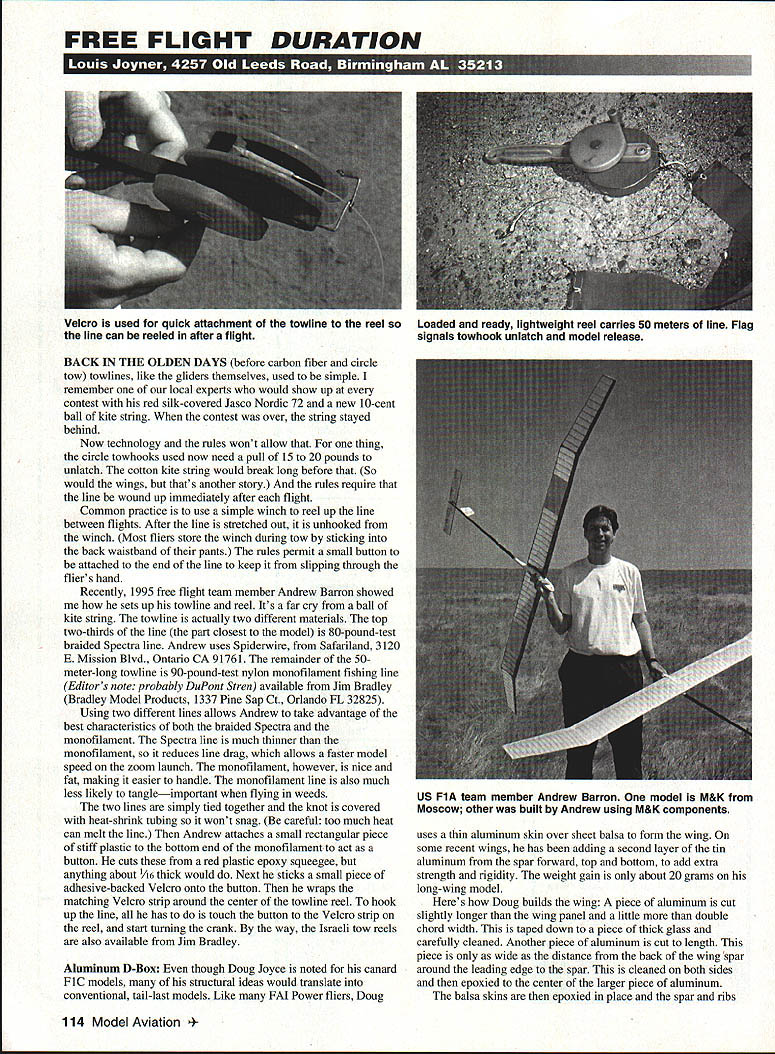
Andrew Barron (1995 free flight team member) uses a two‑material towline and a simple Velcro‑button reel hookup. Details:
- Line materials:
- Top two‑thirds (closest to the model): 80‑lb test braided Spectra (Andrew uses SpiderWire). Supplier: Safariland, 3120 E. Mission Blvd., Ontario, CA 91761.
- Remaining length: 90‑lb test nylon monofilament fishing line (approx. 50 m). Editor’s note: probably DuPont Stren, available from Jim Bradley, Bradley Model Products, 1337 Pine Sap Ct., Orlando, FL 32825.
- Why two materials:
- Spectra is much thinner, reducing line drag and allowing a faster model speed on the zoom launch.
- Monofilament is thicker and easier to handle, and is much less likely to tangle — important when flying in weeds.
- Assembly and reel hookup:
- Tie the two lines together; cover the knot with heat‑shrink tubing to prevent snagging (be careful — too much heat can melt the line).
- Attach a small rectangular piece of stiff plastic to the bottom end of the monofilament to act as a button (Andrew cuts these from a red plastic epoxy squeegee; anything about 1/16 inch thick will do).
- Stick a small piece of adhesive‑backed Velcro onto the button and wrap the matching Velcro strip around the center of the towline reel.
- To hook up, touch the button to the Velcro strip on the reel and start turning the crank.
Israeli tow reels are also available from Jim Bradley.
Aluminum D‑Box (Doug Joyce)
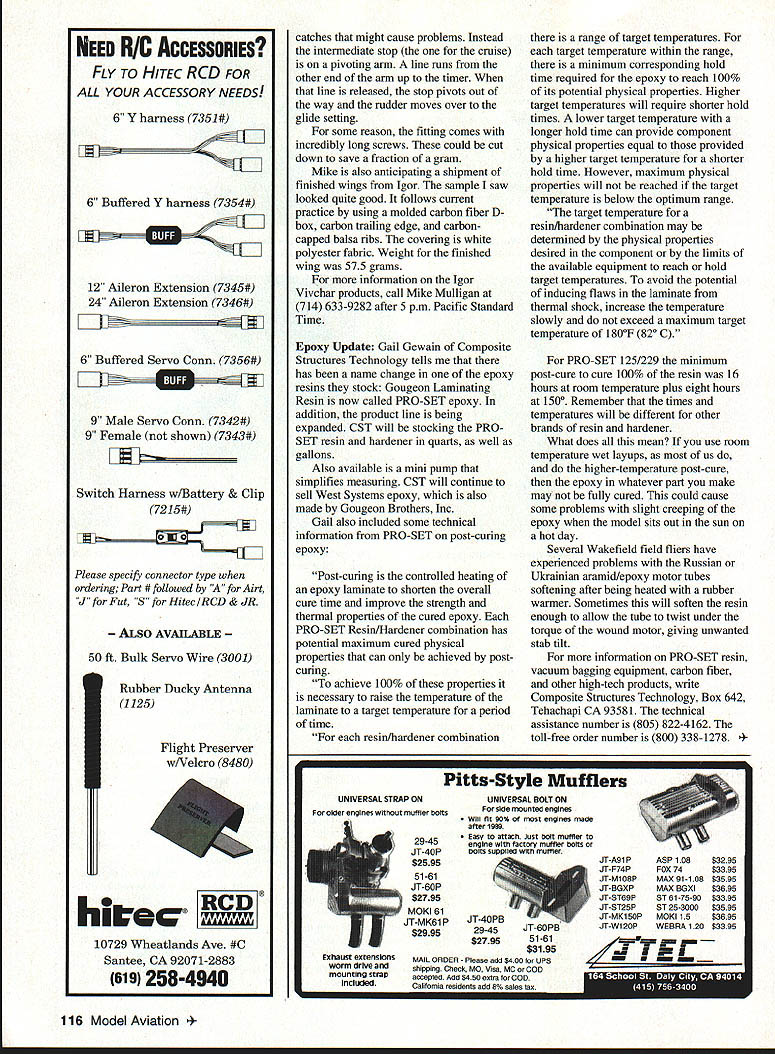
Many of Doug Joyce’s structural ideas for canard F1C models translate to conventional, tail‑last models. He uses a thin aluminum skin over sheet balsa to form wings and, on some recent wings, adds a second layer of thin aluminum from the spar forward (top and bottom) to add strength and rigidity. Weight gain is only about 20 grams on his long‑wing model.
Doug’s wing‑building method:
- Cut a piece of aluminum slightly longer than the wing panel and a little more than double the chord width. Tape this down to a piece of thick glass and clean carefully.
- Cut another piece of aluminum a little more than the distance from the back of the spar around the leading edge to the spar. Clean both sides and epoxy this smaller piece to the center of the larger piece.
- Epoxy the balsa skins in place, then add the spar and ribs.
- Pull and fold the rest of the balsa‑aluminum sandwich over to form the top wing skin.
Doug says the biggest problem is getting the second piece of aluminum down without air bubbles. He uses a brayer to roll it out and pricks any bubbles with a pin to vent them.
For more information on building aluminum wings, see the 1988 NFFS Symposium article by Randy Archer. Back issues of the Symposium are available from Fred Terzian, 4858 Moorpark Ave., San Jose, CA 95129.
More from Mike (Wakefield components)
Mike Mulligan sent some new Wakefield components made by Igor Vivchar (Odessa, Ukraine). Items include a DPR (delayed prop release) front end, motor tube, pylon, connector, and tailboom. Because Igor’s products are non‑standard sizes, Mike is selling them only as complete sets — which simplifies matching components from different sources.
- Assembly notes:
- Epoxy on the nose or tail connector, add the supplied stab mount and DT hammer, attach wing and tail, then epoxy on the pylon to achieve the correct CG.
- Fuselage connector:
- Igor’s connector joins an aramid fiber motor tube to a skinny carbon‑and‑aluminum tailboom.
- Most two‑piece Wakefield fuselages use a slip‑fit coupler with a rear motor peg to hold alignment; Igor uses a threaded ring that clamps the two halves together.
- The motor peg is forward of the connector, allowing easy removal of the tailboom to access a broken motor.
- Connector weight: 7.7 grams.
- Front ends:
- One front end uses an external lever to start the prop after launch; it mounts on a wide nose ring that slips over the outside of the motor tube.
- The front end is lightweight (37.7 grams, including nose ring and bobbin, no blades). It uses a detachable bobbin so you can wind with the prop off; at launch the blades feather to reduce drag.
- Another front end is a simpler non‑feathering DPR: two small arms project from the hub just in front of the blade arms. When the motor is wound, torque moves these arms slightly to prevent the blades from folding back at launch. After the motor winds down, the arms rotate out of the way and the blades fold for the glide.
- Price/availability: sets (front end, tube, pylon, boom, etc.) are $290 plus $10 postage. The price includes both the timer and timer‑start switch already mounted.
- Separate item:
- A three‑position rudder fitting is available for $20. It allows:
- a straight or slightly left rudder position for the burst,
- a slight right setting for the cruise,
- and a third setting for more right turn in the glide.
- This fitting is a simpler alternative to using a wiggler to achieve a straight climb on the burst. It is very small and light (0.7 grams) and uses no springs or extra components.
Transcribed from original scans by AI. Minor OCR errors may remain.

