
Free Flight: Duration
Bob Meuser
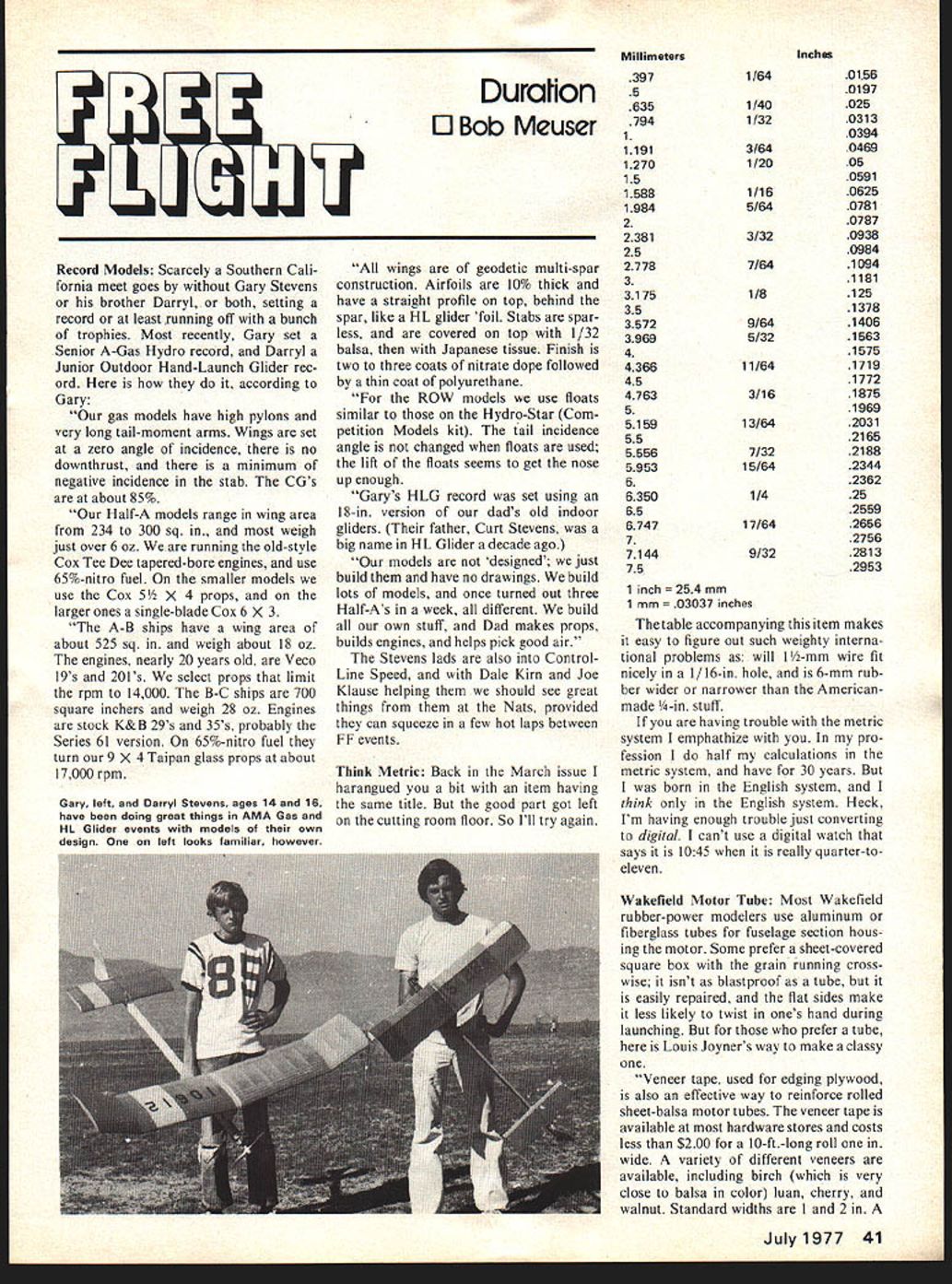
Record Models: Scarcely a Southern California meet goes by without Gary Stevens or his brother Darryl, or both, setting a record or at least running off with a bunch of trophies. Most recently, Gary set a Senior A-Gas Hydro record, and Darryl a Junior Outdoor Hand-Launch Glider record. Here is how they do it, according to Gary:
"Our gas models have high pylons and very long tail-moment arms. Wings are set at a zero angle of incidence, there is no downthrust, and there is a minimum of negative incidence in the stab. The CG's are at about 85%."
"Our Half-A models range in wing area from 234 to 300 sq. in., and most weigh just over 6 oz. We are running the old-style Cox Tee Dee tapered-bore engines, and use 65%-nitro fuel. On the smaller models we use the Cox 5½ x 4 props, and on the larger ones a single-blade Cox 6 x 3."
"The A-B ships have a wing area of about 525 sq. in., and weigh about 18 oz. The engines, nearly 20 years old, are Veco 19's and 201's. We select props that limit the rpm to 14,000. The B-C ships are 700 square inchers and weigh 28 oz. Engines are stock K&B 29's and 35's, probably the Series 61 version. On 65%-nitro fuel they turn our 9 x 4 Taipan glass props at about 17,000 rpm."
"All wings are of geodetic multi-spar construction. Airfoils are 10% thick and have a straight profile on top, behind the spar, like a HL glider foil. Stabs are sparless, and are covered on top with 1/32 balsa, then with Japanese tissue. Finish is two to three coats of nitrate dope followed by a thin coat of polyurethane."
"For the ROW models we use floats similar to those on the Hydro-Star (Competition Models kit). The tail incidence angle is not changed when floats are used; the lift of the floats seems to get the nose up enough."
"Gary's HLG record was set using an 18-in. version of our dad's old indoor gliders. (Their father, Curt Stevens, was a big name in HL Glider a decade ago.)"
"Our models are not 'designed'; we just build them and have no drawings. We build lots of models, and once turned out three Half-A's in a week, all different. We build all our own stuff, and Dad makes props, builds engines, and helps pick good air."
The Stevens lads are also into Control-Line Speed, and with Dale Kirn and Joe Klause helping them we should see great things from them at the Nats, provided they can squeeze in a few hot laps between FF events.
Think Metric: Back in the March issue I harangued you a bit with an item having the same title. But the good part got left on the cutting room floor. So I'll try again.
The table accompanying this item makes it easy to figure out such weighty international problems as: will 1-1/2-mm wire fit nicely in a 1/16-in. hole, and is 6-mm rubber wider or narrower than the American-made 1/4-in. stuff.
If you are having trouble with the metric system I empathize with you. In my profession I do half my calculations in the metric system, and have for 30 years. But I was born in the English system, and I think only in the English system. Heck, I'm having enough trouble just converting to digital. I can't use a digital watch that says it is 10:45 when it is really quarter-to-eleven.
Wakefield Motor Tube: Most Wakefield rubber-power modelers use aluminum or fiberglass tubes for fuselage section housing the motor. Some prefer a sheet-covered square box with the grain running crosswise; it isn't as blastproof as a tube, but it is easily repaired, and the flat sides make it less likely to twist in one's hand during launching. But for those who prefer a tube, here is Louis Joyner's way to make a classy one.
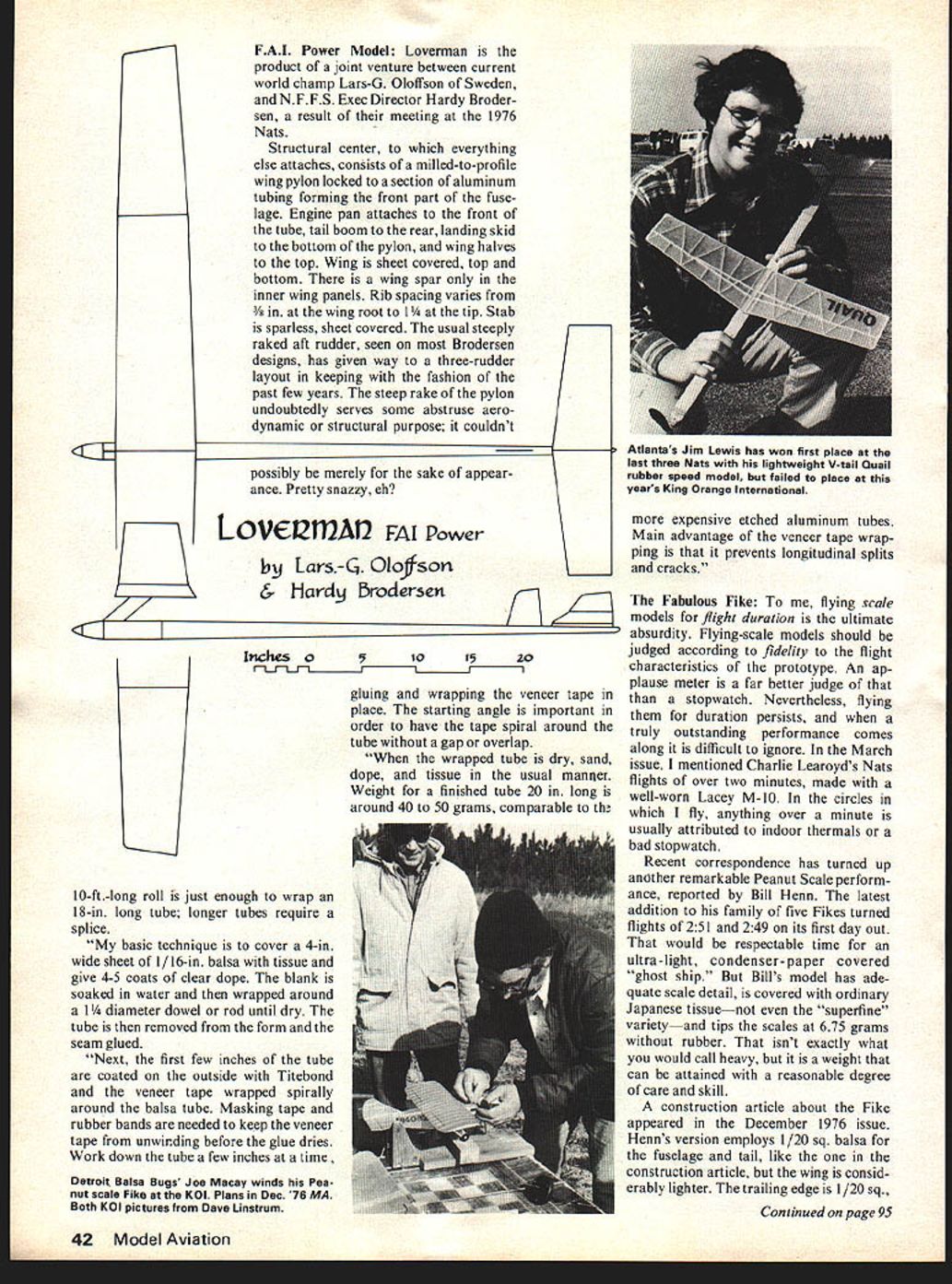
"Veneer tape, used for edging plywood, is also an effective way to reinforce rolled sheet-balsa motor tubes. The veneer tape is available at most hardware stores and costs less than $2.00 for a 10-ft.-long roll one inch wide. A variety of different veneers are available, including birch (which is very close to balsa in color) luan, cherry and walnut. Standard widths are 1 and 2 in. A" F.A.I. Power Model: Loverman is the product of a joint venture between current world champ Lars-G. Olofsson of Sweden, and N.F.F.S. Exec Director Hardy Brodersen, a result of their meeting at the 1976 Nats.
Structural center, to which everything else attaches, consists of a milled-to-profile wing pylon locked to a section of aluminum tubing forming the front part of the fuselage. Engine pan attaches to the front of the tube, tail boom to the rear, landing skid to the bottom of the pylon, and wing halves to the top. Wing is sheet covered, top and bottom. There is a wing spar only in the inner wing panels. Rib spacing varies from 3/8 in. at the wing root to 1/4 at the tip. Stab is sparless, sheet covered. The usual steeply raked aft rudder, seen on most Brodersen designs, has given way to a three-rudder layout in keeping with the fashion of the past few years. The steep rake of the pylon undoubtedly serves some abstruse aerodynamic or structural purpose; it couldn't possibly be merely for the sake of appearance. Pretty snazzy, eh?
LOVERMAN FAI Power
by Lars-G. Olofsson & Hardy Brodersen
gluing and wrapping the veneer tape in place. The starting angle is important in order to have the tape spiral around the tube without a gap or overlap.
"When the wrapped tube is dry, sand, dope, and tissue in the usual manner. Weight for a finished tube 20 in. long is around 40 to 50 grams, comparable to the more expensive etched aluminum tubes. Main advantage of the veneer tape wrapping is that it prevents longitudinal splits and cracks."
10-ft.-long roll is just enough to wrap an 18-in. long tube; longer tubes require a splice.
"My basic technique is to cover a 4-in. wide sheet of 1/16-in. balsa with tissue and give 4-5 coats of clear dope. The blank is soaked in water and then wrapped around a 1/4 diameter dowel or rod until dry. The tube is then removed from the form and the seam glued.
"Next, the first few inches of the tube are coated on the outside with Titebond and the veneer tape wrapped spirally around the balsa tube. Masking tape and rubber bands are needed to keep the veneer tape from unwinding before the glue dries. Work down the tube a few inches at a time,"
The Fabulous Fike: To me, flying scale models for flight duration is the ultimate absurdity. Flying-scale models should be judged according to fidelity to the flight characteristics of the prototype. An applause meter is a far better judge of that than a stopwatch. Nevertheless, flying them for duration persists, and when a truly outstanding performance comes along it is difficult to ignore. In the March issue, I mentioned Charlie Learoyd's Nats flights of over two minutes, made with a well-worn Lacey M-10. In the circles in which I fly, anything over a minute is usually attributed to indoor thermals or a bad stopwatch.
Recent correspondence has turned up another remarkable Peanut Scale performance, reported by Bill Henn. The latest addition to his family of five Fikes turned flights of 2:51 and 2:49 on its first day out. That would be respectable time for an ultra-light, condenser-paper covered "ghost ship." But Bill's model has adequate scale detail, is covered with ordinary Japanese tissue—not even the "superfine" variety—and tips the scales at 6.75 grams without rubber. That isn't exactly what you would call heavy, but it is a weight that can be attained with a reasonable degree of care and skill.
A construction article about the Fike appeared in the December 1976 issue. Henn's version employs 1/20 sq. balsa for the fuselage and tail, like the one in the construction article, but the wing is considerably lighter. The trailing edge is 1/20 sq. and the wing has a single top-surface spar, also of 1/20-sq. material. Leading edge is 1/16 sq. The eight ribs are cut from sanded-down 1/32 sheet. A 22-in. loop of .075-in. rubber, stripped from material obtained from FAI Supply, was used. The hand-carved prop has a diameter of 7 in., a pitch of 13.3 in., and elliptical blades. The model has no dihedral, and flies in right-hand circles.
Without doubt, the Fike and the Lacey are excellent subjects for Peanut Scale models if flight duration is the goal. The virtual domination of the event by these two models has led some to suggest that they be put into a class by themselves. A more rational approach has taken the form of an official rules-change proposal now before the Scale Contest Board. In a cross-proposal — SC-78-30A — Bob Clemens proposes that the chord of peanut-scale models be limited to a maximum of 3.5 inches. The Fikes and Laceys have chords larger than that, if built to the full 13-in. span limitation, and at first blush it would seem that the proposed rule would prohibit such models from competition. Well, not quite. To meet the rule, the span of the Fike would have to be reduced to 10.6 in. That would still give a wing area of 37 sq. in., which would still be more than the average Peanut monoplane. Chances of this cross-proposal passing seem slim, especially in view of the fact that it doesn't address the subject of the basic proposal it is intended to modify. But it nevertheless makes a lot of sense if you agree that the event should not be dominated in competition by low-aspect-ratio models.
It will be interesting to see what Henn's Fike will do with a bit of vintage Pirelli after he gets it properly adjusted.
Free Flight: Duration
It has been found that it is possible for the lines to take up a position in flight such that their combined stiffness can provide sufficient springiness to lift the hook out of the ring with a slack tow line. The situation is entirely dependent on the relative disposition of the timer switch and Maxaid unit and the lengths of the nylon tails.
"It is in fact difficult to reproduce the condition on the ground and the chances of it occurring in flight must be remote. But it can, and has, happened in flight and just one unintentional release is one too many. Fortunately, a complete cure is very easily and quickly effected. Simply interpose a length of flexible line between the nylon tails and the hook, such that it then becomes impossible for the stiff nylon tails to spring the hook from the ring, no matter how the tow line is inclined relative to the model.
"I feel confident that this modification renders the 'twang hook' as safe as any other attachment system, indeed probably safer, and I would recommend its adoption by any twang hook user. Even if one has never experienced any problems there's always a first time and one can be sure that if it's going to happen it will occur at the worst possible moment."
The Maxaid unit is available from NFFS Supplies, 9525 Achates Circle, Sacramento, CA 95826 for $8.50 postpaid, and was described in the January and September, 1976, issues in this column.
Bob Meuser, 4200 Gregory St., Oakland, CA 94619.
Transcribed from original scans by AI. Minor OCR errors may remain.

