
FREE FLIGHT DURATION
Louis Joyner, 4257 Old Leeds Road, Birmingham, AL 35213
NIBBLE 300
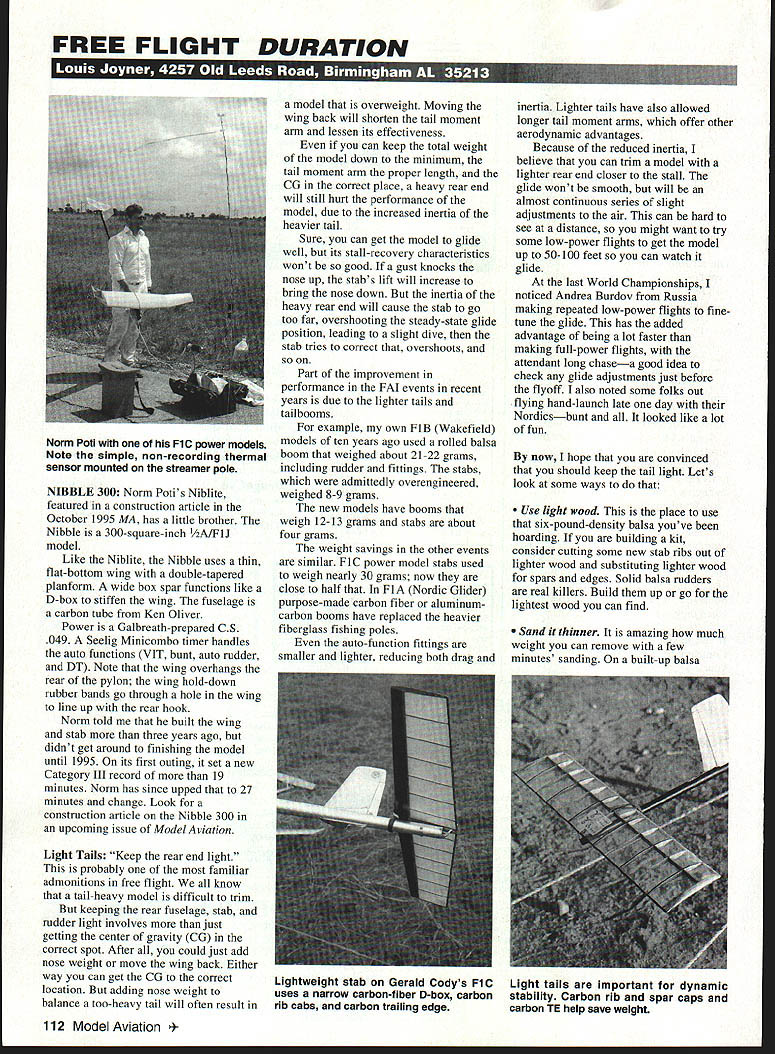
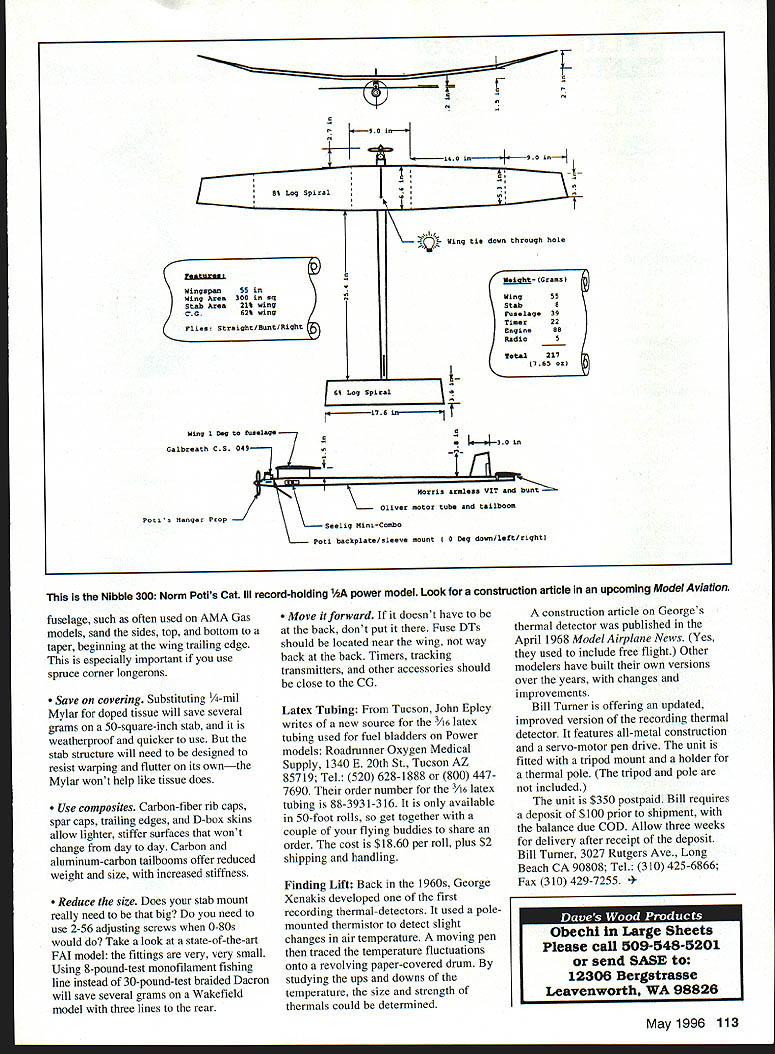
NIBBLE 300: Norm Poti's Niblite, featured in a construction article in the October 1995 Model Aviation, has a little brother. The Nibble is a 300-square-inch 1/2A F1J model.
Like the Niblite, the Nibble uses a thin, flat-bottom wing with a double-tapered planform. A wide box spar functions like a D-box to stiffen the wing. The fuselage is a carbon tube from Ken Oliver.
Power is a Galbreath-prepared C.S. .049. A Seelig Minicombo timer handles the auto functions (VIT, bunt, auto rudder, and DT). Note that the wing overhangs the rear of the pylon; the wing hold-down rubber bands go through a hole in the wing to line up with the rear hook.
Norm told me that he built the wing and stab more than three years ago but didn't get around to finishing the model until 1995. On its first outing it set a new Category III record of more than 19 minutes. Norm has since upped that to 27 minutes and change. Look for a construction article on the Nibble 300 in an upcoming issue of Model Aviation.
LIGHT TAILS
"Keep the rear end light." This is probably one of the most familiar admonitions in free flight. We all know that a tail-heavy model is difficult to trim.
But keeping the rear fuselage, stab, and rudder light involves more than just getting the center of gravity (CG) in the correct spot. After all, you could just add nose weight or move the wing back. Either way you can get the CG to the correct location. But adding nose weight to balance a too-heavy tail will often result in a model that is overweight. Moving the wing back will shorten the tail moment arm and lessen its effectiveness.
Even if you can keep the total weight of the model down to the minimum, the tail moment arm the proper length, and the CG in the correct place, a heavy rear end will still hurt the performance of the model due to the increased inertia of the heavier tail.
Sure, you can get the model to glide well, but its stall-recovery characteristics won't be so good. If a gust knocks the nose up, the stab's lift will increase to bring the nose down. But the inertia of the heavy rear end will cause the stab to go too far, overshooting the steady-state glide position, leading to a slight dive, then the stab tries to correct that, overshoots, and so on.
Part of the improvement in performance in FAI events in recent years is due to the lighter tails and tailbooms.
For example, my own F1B (Wakefield) models of ten years ago used a rolled balsa boom that weighed about 21–22 grams, including rudder and fittings. The stabs, which were admittedly overengineered, weighed 8–9 grams.
The new models have booms that weigh 12–13 grams and stabs about 4 grams.
The weight savings in the other events are similar. F1C power model stabs used to weigh nearly 30 grams; now they are close to half that. In F1A (Nordic Glider) purpose-made carbon fiber or aluminum/carbon booms have replaced the heavier fiberglass fishing poles.
Even the auto-function fittings are smaller and lighter, reducing both drag and inertia. Lighter tails have also allowed longer tail moment arms, which offer other aerodynamic advantages.
Because of the reduced inertia, I believe that you can trim a model with a lighter rear end closer to the stall. The glide won't be smooth, but will be an almost continuous series of slight adjustments to the air. This can be hard to see at a distance, so you might want to try some low-power flights to get the model up to 50–100 feet so you can watch it glide.
At the last World Championships, I noticed Andrea Burdov from Russia making repeated low-power flights to finetune the glide. This has the added advantage of being a lot faster than making full-power flights, with the attendant long chase — a good idea to check any glide adjustments just before the flyoff. I also noted some folks out flying hand-launch late one day with their Nordics — bunt and all. It looked like a lot of fun.
By now, I hope that you are convinced that you should keep the tail light. Let's look at some ways to do that:
- Use light wood. This is the place to use that six-pound-density balsa you've been hoarding. If you are building a kit, consider cutting some new stab ribs out of lighter wood and substituting lighter wood for spars and edges. Solid balsa rudders are real killers. Build them up or go for the lightest wood you can find.
- Sand it thinner. It is amazing how much weight you can remove with a few minutes' sanding. On a built-up balsa fuselage, such as often used on AMA Gas models, sand the sides, top, and bottom to a taper beginning at the wing trailing edge. This is especially important if you use spruce corner longerons.
- Save on covering. Substituting 1/4-mil Mylar for doped tissue will save several grams on a 50-square-inch stab, and it is weatherproof and quicker to use. But the stab structure will need to be designed to resist warping and flutter on its own — the Mylar won't help like tissue does.
- Use composites. Carbon-fiber rib caps, spar caps, trailing edges, and D-box skins allow lighter, stiffer surfaces that won't change from day to day. Carbon and aluminum-carbon tailbooms offer reduced weight and size, with increased stiffness.
- Reduce the size. Does your stab mount really need to be that big? Do you need to use 2-56 adjusting screws when 0-80s would do? Take a look at a state-of-the-art FAI model: the fittings are tiny. Using 8-pound-test monofilament fishing line instead of 30-pound-test braided Dacron will save several grams on a Wakefield model with three lines to the rear.
- Move it forward. If it doesn't have to be at the back, don't put it there. Fuselage DTs should be located near the wing, not way back at the tail. Timers, tracking transmitters, and other accessories should be close to the CG.
LATEX TUBING
From Tucson, John Epley writes of a new source for the 3/16" latex tubing used for fuel bladders on power models: Roadrunner Oxygen Medical Supply, 1340 E. 20th St., Tucson, AZ 85719; Tel.: (520) 628-1888 or (800) 447-7690. Their order number for the 3/16" latex tubing is 88-3931-316. It is only available in 50-foot rolls, so get together with a couple of your flying buddies to share an order. The cost is $18.60 per roll, plus $2 shipping and handling.
FINDING LIFT
Back in the 1960s, George Xenakis developed one of the first recorded thermal detectors. It used a pole-mounted thermistor to detect slight changes in air temperature. A moving pen then traced the temperature fluctuations onto a revolving paper-covered drum. By studying the ups and downs of the temperature, the size and strength of thermals could be determined.
A construction article on George's thermal detector was published in the April 1986 Model Airplane News (yes, they used to include free flight). Other modelers have built their own versions over the years, with changes and improvements.
Bill Turner is offering an updated, improved version of the recording thermal detector. It features all-metal construction and a servo-motor pen drive. The unit is fitted with a tripod mount and a holder for a thermal pole. (The tripod and pole are not included.) The unit is $350 postpaid. Bill requires a deposit of $100 prior to shipment, with the balance due COD. Allow three weeks for delivery after receipt of the deposit.
Bill Turner, 3027 Rutgers Ave., Long Beach, CA 90808; Tel.: (310) 425-6866; Fax: (310) 429-7255.
Transcribed from original scans by AI. Minor OCR errors may remain.

