
FREE FLIGHT DURATION
Louis Joyner 4257 Old Leeds Road, Birmingham, AL 35213
RE-ENTRY VEHICLE
For most of us, Free Flight is a lifetime hobby and sport. We get hooked in our youth, perhaps drift away for a while, and then return. Statistics, and a look around the field at any contest, will show that many of us are well into middle age. As often as not, the beginner in Free Flight isn't really beginning, but picking up where he left off some 20 or 30 years earlier.
The memories and experiences of youth were, hopefully, one of the things that pulled this middle-aged "beginner" back to Free Flight. Certainly many of the techniques and skills learned years ago will come in handy. But it is important to get up to speed on the new tools, materials, and methods we use today. Where to start?
Unfortunately, a visit to the average hobby shop is going to be next to useless. Sure you can pick up some balsa, new X-Acto blades, and some of that new instant glue, but you probably won't find much else. Free Flight has become almost entirely a mail-order proposition. So the first step to get back into Free Flight is to order some catalogs.
I'd suggest starting with Campbell's and FAI Model Supply. Although there is some overlap, these two should be able to provide most of the stuff you'll need to get started.
- Campbell's Custom Kits, 7233 Signature Lane, San Antonio, TX 78263 ($3 for catalog)
- FAI Model Supply, Box 366, Sayre, PA 18840-0366 ($2 for catalog)
For a more comprehensive list of Free Flight suppliers (more than 100 cottage-industry sources), send a dollar bill and a stamped, self-addressed envelope to Jim O'Reilly, 213 Wyndmere Pl., Garden City, GA 31408. Ask for a catalog of his plans as well. $2.
While you are waiting for the catalogs to arrive, join The National Free Flight Society (NFFS). This is the Special Interest Group that promotes Free Flight in this country. For your $15 membership, you'll receive the monthly digest Free Flight. This publication, now in its 30th year, includes articles on all aspects of Free Flight, as well as plans, contest reports, and advertisements for Free Flight supplies.
Your NFFS membership will also entitle you to discounts on some of the other NFFS publications, such as the annual Symposium. The Symposium is a compilation of technical articles, building methods, and flying techniques. It also includes the annual 10 Models of the Year plans. To join NFFS, send a check for $15 to NFFS, 19 Frederick Drive, Newport News, VA 23601. Be sure to include your AMA number. Ages 18 and under can join for $7.50 (ages are as of July 1 of the current year).
WHAT TO BUILD?
Probably the hardest thing for a person re-entering Free Flight is to resist the temptation to build every type of model that you wanted to build when you were a kid. You'll just end up spreading your time, energy, and money impossibly thin. You'll be a lot better off picking one or two events and concentrating on those. Here are a few suggestions of events and models that should produce some measure of success quickly:
- Catapult Glider
- P-30
- Mulvihill Rubber (Unlimited Rubber)
- Nostalgia Gas
#### Catapult Glider
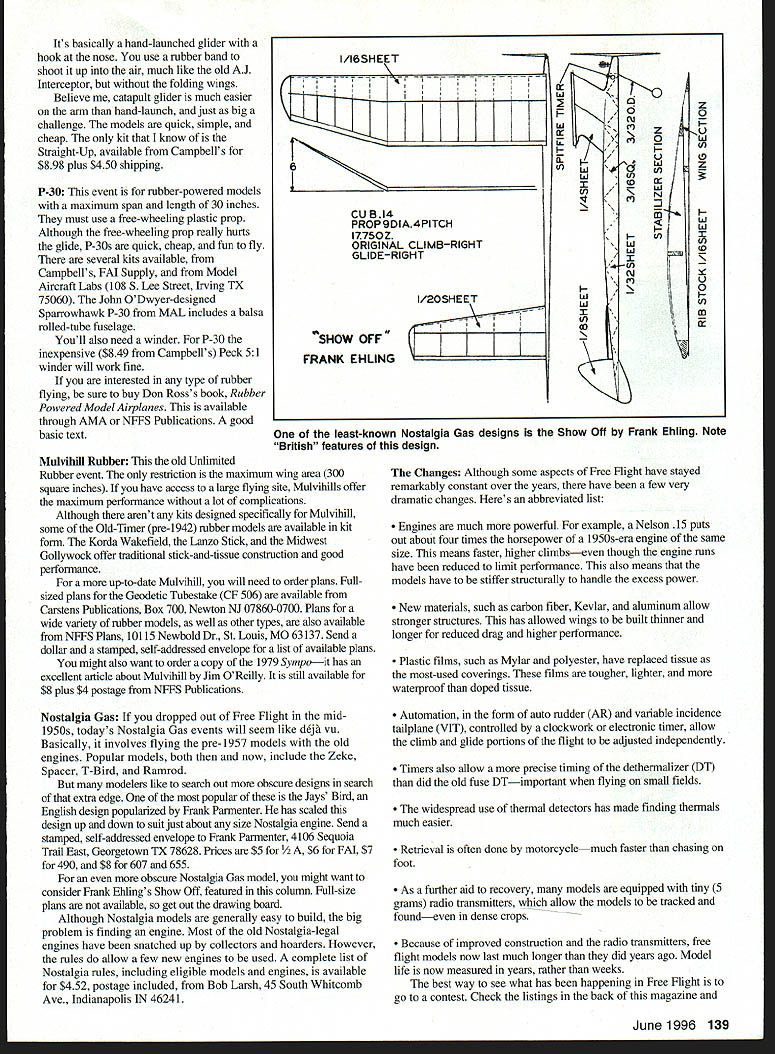
If you were like me, you spent most of your summer evenings at the local park throwing hand-launched gliders. And, if you are like me, you couldn't throw one ten feet today without ending up at the local sports-medicine clinic. That's why they've invented catapult gliders. It's basically a hand-launched glider with a hook on the nose; you use a rubber band to shoot it up into the air, much like the old AJ Interceptor folding wings.
Catapult gliders are much easier to trim and hand-launch than the larger gliders. The real challenge with these models is making them quick, simple, and cheap. A well-known kit is Straight-Up, available from Campbell's, $8.98 plus $4.50 shipping.
#### P-30
The P-30 event is rubber-powered models with a maximum span of 30 inches and must use a free-wheeling plastic prop. Although a free-wheeling prop really hurts the glide, P-30s are quick, cheap fun. Several kits are available from Campbell's, FAI, and Model Aircraft Labs (MAL), 1085 Lee Street, Irving, TX 75060. The John O'Dwyer–designed Sparrowhawk P-30 from MAL includes a balsa rolled-tube fuselage. You'll also need a winder. P-30s are inexpensive; kits around $8.49. Campbell's Peck 51 winder will work fine.
If you're interested in this type of rubber flying, be sure to buy Don Ross's book Rubber Powered Model Airplanes, available through AMA/NFFS Publications — a good basic text.
MULVIHILL RUBBER
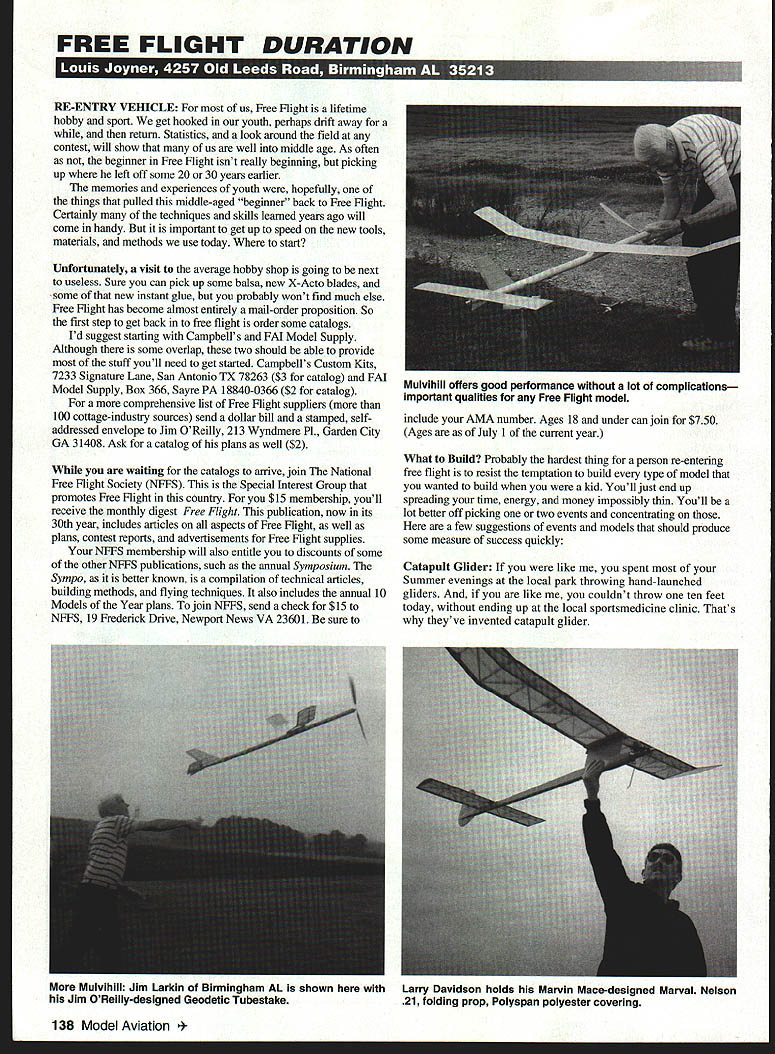
This is the old Unlimited Rubber event. The only restriction is the maximum wing area (300 square inches). If you have access to a large flying site, Mulvihills offer the maximum performance without a lot of complications.
Although there aren't any kits designed specifically for Mulvihill, some Old-Timer (pre-1942) rubber models are available in kit form. The Korda Wakefield, the Lanzo Stick, and the Midwest Gollywock offer traditional stick-and-tissue construction and good performance.
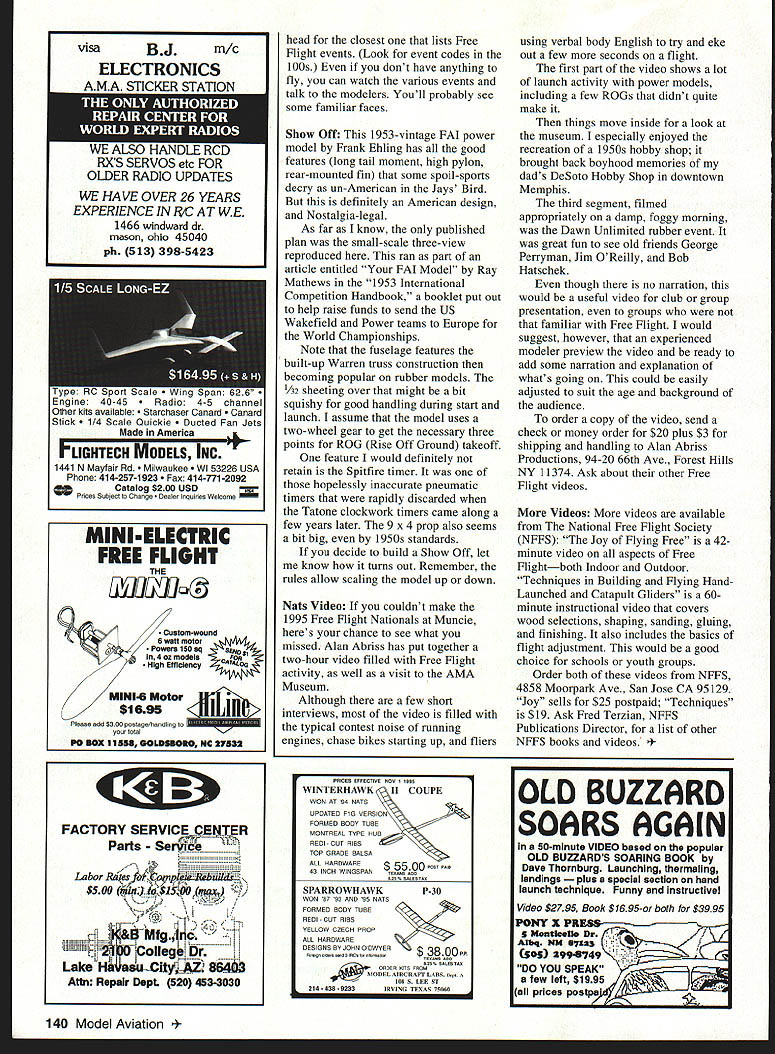
For a more up-to-date Mulvihill, you will need to order plans. Full-sized plans for the Geodetic Tubestake (CF 506) are available from Carstens Publications, Box 700, Newton, NJ 07860-0700. Plans for a wide variety of rubber models, as well as other types, are also available from NFFS Plans, 10115 Newbold Dr., St. Louis, MO 63137. Send a dollar and a stamped, self-addressed envelope for a list of available plans.
You might also want to order a copy of the 1979 Symposium — it has an excellent article about Mulvihill by Jim O'Reilly. It is still available for $8 plus $4 postage from NFFS Publications.
NOSTALGIA GAS
If you dropped out of Free Flight in the mid-1950s, today's Nostalgia Gas events will seem like déjà vu. Basically, it involves flying the pre-1957 models with the old engines. Popular models, both then and now, include the Zeke, Spacer, T-Bird, and Ramrod.
Many modelers like to search out more obscure designs in search of that extra edge. One of the most popular of these is the Jays' Bird, an English design popularized by Frank Parmenter. He has scaled this design up and down to suit just about any size Nostalgia engine. Send a stamped, self-addressed envelope to Frank Parmenter, 4106 Sequoia Trail East, Georgetown, TX 78626. Prices are $5 for 1/2A, $6 for FAI, $7 for .049, and $8 for .061 and .095.
For an even more obscure Nostalgia Gas model, you might want to consider Frank Ehling's Show Off, featured in this column. Full-size plans are not available, so get out the drawing board.
Although Nostalgia models are generally easy to build, the big problem is finding an engine. Most of the old Nostalgia-legal engines have been snatched up by collectors and hoarders. However, the rules do allow a few new engines to be used. A complete list of Nostalgia rules, including eligible models and engines, is available for $4.52 (postage included) from Bob Larsh, 45 South Whitcomb Ave., Indianapolis, IN 46241.
THE CHANGES
Although some aspects of Free Flight have stayed remarkably constant over the years, there have been a few very dramatic changes. Here's an abbreviated list:
- Engines are much more powerful. For example, a Nelson .15 puts out about four times the horsepower of a 1950s-era engine of the same size. This means faster, higher climbs—even though the engine runs have been reduced to limit performance. It also means that models have to be stiffer structurally to handle the extra power.
- New materials, such as carbon fiber, Kevlar, and aluminum, allow stronger structures. This has allowed wings to be built thinner and longer for reduced drag and higher performance.
- Plastic films, such as Mylar and polyester, have replaced tissue as the most-used coverings. These films are tougher, lighter, and more waterproof than doped tissue.
- Automation, in the form of auto rudder (AR) and variable incidence tailplane (VIT), controlled by a clockwork or electronic timer, allow the climb and glide portions of the flight to be adjusted independently.
- Timers also allow a more precise timing of the dethermalizer (DT) than did the old fuse DT — important when flying on small fields.
- The widespread use of thermal detectors has made finding thermals much easier.
- Retrieval is often done by motorcycle — much faster than chasing on foot.
- As a further aid to recovery, many models are equipped with tiny (5-gram) radio transmitters, which allow models to be tracked and found — even in dense crops.
- Because of improved construction and the radio transmitters, free flight models now last much longer than they did years ago. Model life is now measured in years, rather than weeks.
The best way to see what has been happening in Free Flight is to go to a contest. Check the listings in the back of this magazine and head for the closest one that lists Free Flight events (look for event codes in the 100s). Even if you don't have anything to fly, you can watch the various events and talk to the modelers. You'll probably see some familiar faces.
SHOW OFF
This 1953-vintage FAI power model by Frank Ehling has all the good features (long tail moment, high pylon, rear-mounted fin) that some spoil-sports decry as un-American in the Jays' Bird. But this is definitely an American design, and Nostalgia-legal.
As far as I know, the only published plan was the small-scale three-view reproduced in the 1953 International Competition Handbook as part of an article entitled "Your FAI Model" by Ray Mathews. That booklet was put out to help raise funds to send the U.S. Wakefield and Power teams to Europe for the World Championships.
Note that the fuselage features the built-up Warren truss construction then becoming popular on rubber models. The 1/32" sheeting over that might be a bit squishy for good handling during start and launch. I assume that the model uses a two-wheel gear to get the necessary three points for ROG (rise off ground) takeoff.
One feature I would definitely not retain is the Spitfire timer. It was one of those hopelessly inaccurate pneumatic timers that were rapidly discarded when the Tatone clockwork timers came along a few years later. The 9 x 4 prop also seems a bit big, even by 1950s standards.
If you decide to build a Show Off, let me know how it turns out. Remember, the rules allow scaling the model up or down.
NATS VIDEO
If you couldn't make the 1995 Free Flight Nationals at Muncie, here's your chance to see what you missed. Alan Abriss has put together a two-hour video filled with Free Flight activity, as well as a visit to the AMA Museum.
Although there are a few short interviews, most of the video is filled with the typical contest noise of running engines, chase bikes starting up, and fliers using verbal body English to try and eke out a few more seconds on a flight.
The first part of the video shows a lot of launch activity with power models, including a few ROGs that didn't quite make it. Then things move inside for a look at the museum. The recreation of a 1950s hobby shop is especially enjoyable; it brings back boyhood memories of many of us.
The third segment, filmed appropriately on a damp, foggy morning, was the Dawn Unlimited rubber event. It was great fun to see old friends George Perryman, Jim O'Reilly, and Bob Hartsheck.
Even though there is no narration, this would be a useful video for club or group presentation, even to audiences not familiar with Free Flight. I would suggest, however, that an experienced modeler preview the video and be ready to add some narration and explanation of what's going on. This could be easily adjusted to suit the age and background of the audience.
To order a copy of the video, send a check or money order for $20 plus $3 for shipping and handling to Alan Abriss Productions, 94-20 66th Ave., Forest Hills, NY 11374. Ask about their other Free Flight videos.
MORE VIDEOS
More videos are available from The National Free Flight Society (NFFS):
- "The Joy of Flying Free" — a 42-minute video on all aspects of Free Flight (both Indoor and Outdoor).
- "Techniques in Building and Flying Hand-Launched and Catapult Gliders" — a 60-minute instructional video that covers wood selection, shaping, sanding, gluing, and finishing; it also includes the basics of flight adjustment. This would be a good choice for schools or youth groups.
Order both of these videos from NFFS, 4858 Moorpark Ave., San Jose, CA 95129. "Joy" sells for $25 postpaid; "Techniques" is $19. Ask Fred Terzian, NFFS Publications Director, for a list of other NFFS books and videos.
Transcribed from original scans by AI. Minor OCR errors may remain.

