
FREE FLIGHT DURATION
Louis Joyner, 4257 Old Leeds Road, Birmingham, AL 35213
SHOW OFF — Part Two
Last month this column featured three-view drawings of Frank Ehling's Show Off, a 1953-vintage FAI power model. It's an attractive design that looks like it could make a potent Nostalgia model. To find out a bit more about the model, I went right to the source and sent a letter off to Frank. Here's the reply I received:
"Dear Louis:
My name is Joe Harris, and I am so happy to answer your letter to Frank because I was at Norfolk, VA, competing in FAI with my good friend Carl Wheeley. I remember it well because this was the first time I ever met Frank. The Show Off was vastly underpowered with the Cub. But the glide was so good (like a City Boy) that it truly was the best at that elimination. Frank was USA-minded, so he only wanted a US engine. The only other .15 engine that was available was the Thimble Drome car engine that had to be modified for aircraft use. There was one owned by Darrel Dalgner. He lost it on an overrun. Frank just missed making the team.
I am pleased that someone has found this three-view. You won't be sorry building this model. It has impressed me more than the Sweet 15.
When I asked Frank about any corrections, he said no, but keep it light. The model was covered with light silkspan and given 5 to 7 coats of nitrate dope, then colored with yellow aniline dye dissolved in alcohol and applied with a cotton ball. Then a coat of hot fuel proofer over the whole model.
You may have an engine in mind, but I would use one of the early O.S. Max .15s. Frank says he later put an Oliver Cub .09 diesel in the model and said it did quite well. But that was the most powerful .091 I ever ran.
I was so impressed I designed a couple of models using this thinking.
In case you are wondering who I am, I am Joseph W. Harris and was on the 1953 FAI Nordic team. I am a good friend of Frank's and have taken care of him since his stroke.
His memory is good, but he has very poor sight. I try to help him with some model projects, but my interpretations of what he is trying to say loses something.
You may or may not have seen any of Frank's original models, but they were fantastic. Chet Lanzo told me once he was always impressed with Frank's models.
If you get a set of plans finished, please send a picture of you and the model."
I hope that this letter, and last month's plan, will get lots of folks inspired to build the Show Off. To kick things off, Jim O'Reilly has offered to draw up full-sized plans for the Show Off if there is sufficient interest. Drop Jim a line at:
- Jim O'Reilly, 213 Wyndmere Place, Garden City, GA 31408
(Check last month's column for more about Jim's excellent CAD-drawn plans.)
I found it interesting that the only notes or remarks that Frank and Joe made on the small three-view I sent them were the two words "change engine" with an arrow pointing at the Cub .14. If any readers build the Show Off, please drop me a snapshot. I'll run the first one in the column and send the rest along to Frank and Joe.
BRITISH FREE FLIGHT FORUM
Martin Dilly sent along a copy of the latest Free Flight Forum Report. Now in its eleventh year, the Forum Reports are the British equivalent of our own NFFS Sympos. The Forum Reports raise the necessary travel funding to send the British national teams to World and European free flight championships and provide a wealth of in-depth information on the sport of free flight.
The 1995 Forum Report is a real gold mine of information. Being addicted to Wakefield, my favorite article was the very comprehensive piece by Peter King titled "Developments in Wakefield Climb and Duration." In typical Peter King style, he includes graphs for just about every aspect of an F1B model's performance—from the effect of aspect ratio on F1B performance to the optimum cam shape for variable-pitch propellers. I counted 17 graphs and 7 charts.
(It is interesting that the two most prominent Wakefield theoreticians, Peter King and Jean Wanzenriether, are, respectively, a jazz musician and a priest. Now, what does that say about Wakefield?)
Other articles in the 1995 Forum Report include the best explanation of minimum-induced-loss propeller design I have ever seen, by John Barker. This works through the theoretical stuff rather quickly and gets you well on the way to designing a prop for rubber power.
Chris Edge and Mike Fantham have put together a thoroughly practical piece on the construction of carbon-fiber D-box wings. This method has become the standard for Nordic glider and Wakefield construction, and is increasingly finding favor with F1C power fliers. There is no heavy theory here—just lots of tips and techniques. I found several of their jigs and fixtures especially interesting (one of these is reproduced here).
An article by power flier Stafford Screen details the construction of aluminum-balsa-carbon-aluminum tailbooms. It made me very thankful that you can buy these things ready-made.
The report does not limit itself to the three international outdoor events. Mike Woodhouse discusses options available for model covering; Steve Auvache covers the power output of batteries for electric free flight; and Bernard Hunt relates his experience with unbraced F1D indoor models. Other offerings include a paper by Mike Colling on ways to attract young people to the hobby and sport of aeromodelling.
As with most previous forum reports, there is a touch of humor—this time in the form of Paul Chamberlain's recollections about the food at the last World Championships.
Copies of the 1995 Forum Report, as well as previous ones, are available from Martin Dilly:
- Martin Dilly, 20 Links Road, West Wickham, Kent BR4 0QW, England
- Cost: 9.00 pounds sterling
- Checks payable to: "BMFA F/F Team Support Fund" (in pounds sterling only, drawn on a bank with a UK branch)
In the past, NFFS Publications Director Fred Terzian has been able to offer the British Forum Reports through NFFS, which eliminates the problems of international money transfers. Check with Fred about availability:
- NFFS Publications, 4858 Moorpark Ave., San Jose, CA 95129
Editor's note: After this column was submitted, we received word from Martin Dilly that the Forum Reports may now be ordered using VISA or Access credit cards. To order by credit card, send card number, expiration date, and your name and address to:
- BMFA, Chacksfield House, 31 St. Andrews Rd., Leicester, LE2 8RE, England
- Tel: +44 (116) 244 0028
- Fax: +44 (116) 244 0645
WIGGLING WINGS
To get the utmost out of a modern F1B (Wakefield) rubber model, it is vital that the first few seconds of the climb be near-vertical and straight, without power-wasting turns.
The best method to assure a straight burst is to use VIT (Variable Incidence Tail) coupled with either a three-position rudder or a two-position rudder combined with a wing wiggler.
A wing wiggler is a timer-controlled device that holds the left wing at a slightly lower angle of attack during the first part of the power run. After a set time (usually 15 to 30 seconds) the left wing swings back even with the right for the rest of the cruise and the glide.
The only commercially available wing wiggler units in the past were both based on the designs of Russian Wakefield flier Vladimir Feodorev. Although beautifully made, those units had one major drawback: they had to be mounted at the leading edge of the wing. This required that the timer be mounted in front of the wing wiggler, resulting in a very long pylon in front of the wing.
As D-boxes have become narrower, there has been less distance between the wiggler and the wing wire (the wing pivots on the wing wire). This increased the sensitivity of wiggler adjustment screws. To rectify this situation, Sal Fruciano of Starline International worked with some Eastern European suppliers to develop a rear-mounted wing wiggler.
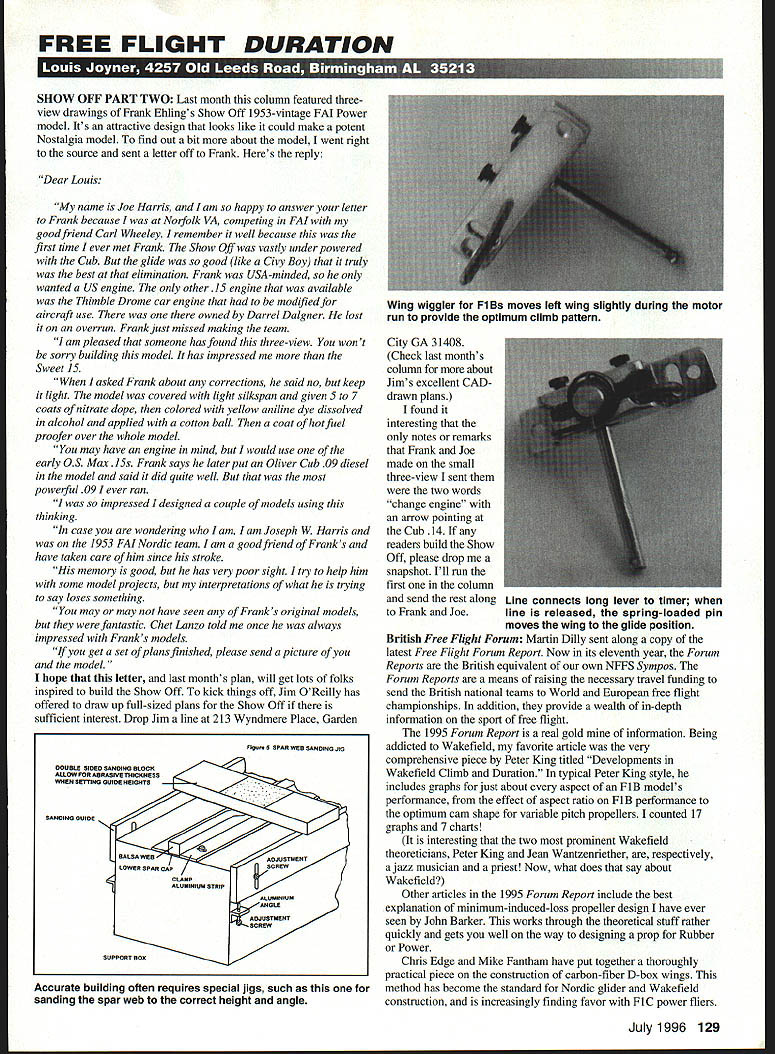
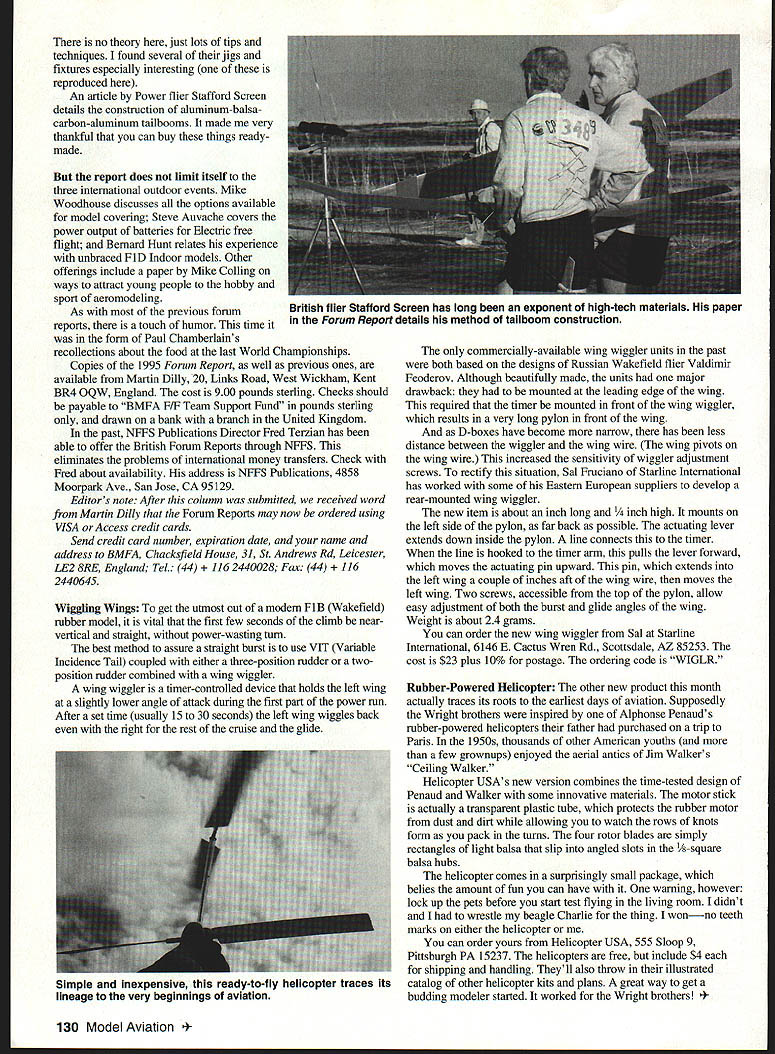
Key features of the new unit:
- Size: about 1-1/4 inches high
- Mounting: left side of the pylon, as far back as possible
- Actuation: lever extends down inside the pylon; a line connects the lever to the timer
- Operation: when the line is hooked to the timer arm, it pulls the lever forward and moves an actuating pin upward; the pin extends into the left wing a couple of inches aft of the wing wire to move the left wing
- Adjustment: two screws accessible from the top of the pylon allow easy adjustment of both burst and glide angles
- Weight: about 2.4 grams
Ordering information:
- Starline International, Sal Fruciano, 6146 E. Cactus Wren Rd., Scottsdale, AZ 85253
- Cost: $23 plus 10% for postage
- Ordering code: "WIGLR"
RUBBER-POWERED HELICOPTER
The other new product this month traces its roots to the earliest days of aviation. Supposedly the Wright brothers were inspired by one of Alphonse Penaud's rubber-powered helicopters after their father purchased one on a trip to Paris. In the 1950s, thousands of American youths (and more than a few grownups) enjoyed the aerial antics of Jim Walker's "Ceiling Walker."
Helicopter USA's new version combines the time-tested design of Penaud and Walker with some innovative materials. The motor stick is a transparent plastic tube, which protects the rubber motor from dust and dirt while allowing you to watch the rows of knots form as you pack in the turns. The four rotor blades are simple rectangles of light balsa that slip into angled slots in the 1/8-square balsa hubs.
The helicopter comes in a surprisingly small package that belies the amount of fun you can have with it. One warning, however: lock up the pets before you start test flying in the living room. I didn't and I had to wrestle my beagle Charlie for the thing. I won—no teeth marks on either the helicopter or me.
Ordering information:
- Helicopter USA, 555 Sloop 9, Pittsburgh, PA 15237
- Price: helicopters are free; include $4 each for shipping and handling
- They also include an illustrated catalog of other helicopter kits and plans
A great way to get a budding modeler started — it worked for the Wright brothers!
Transcribed from original scans by AI. Minor OCR errors may remain.

