
FREE FLIGHT DURATION
Louis Joyner, 4257 Old Leeds Road, Birmingham AL 35213
FAST FIXES
Field repair is one of those inevitable by-products of flying free flight. A moment's inattention readying the model for flight, a bad launch, or a rugged retrieval can result in the same thing: a broken model.
If you are really prepared, you simply pull out one of your backup models and keep on flying. After all, you can do a better job of fixing things back home in your shop.
But sometimes you need to repair the model and keep on flying. Here are some suggestions to speed the process:
- Carefully gather up all the pieces when you "plant" a model. Before you leave the area, inventory the model to make sure that nothing is missing. It's amazing how far parts can fly.
- Handle the model carefully to avoid any further damage from loose parts flapping in the breeze. This is especially important if you are retrieving on a motorcycle.
- Examine the entire model, checking for loose parts, hidden breaks, tears, or other problems. I like to use a pair of binocular magnifiers so I can really see what I'm doing. Use your ears to check for loose ribs, cracked spars, or other hidden damage while lightly twisting the wing, tail, or fuselage.
- Get inside. Cut away the covering so you can get to the broken or damaged area. It's a lot easier to make a good repair with the tissue out of the way. Continue checking for damage until you are satisfied that all the problems are located.
- (This is the hard one.) Decide whether the damage is reparable at the field, at home, or at all. My rule of thumb on this is to limit field repairs to things that can be fixed with cyanoacrylate (CyA) and where the model's alignment won't be affected. Anything that requires epoxy, careful alignment, or a lot of concentration gets fixed back at the motel.
- Keep it straight. Even the strongest repair is no good if you glue it back together wrong. Use the lid of your model box as a flat surface for field repairs; back at the motel, a mirror is probably a better, and flatter, choice. Carry along some plastic wrap so you don't glue the wing down permanently. For round fuselages, use a pair of aluminum angles.
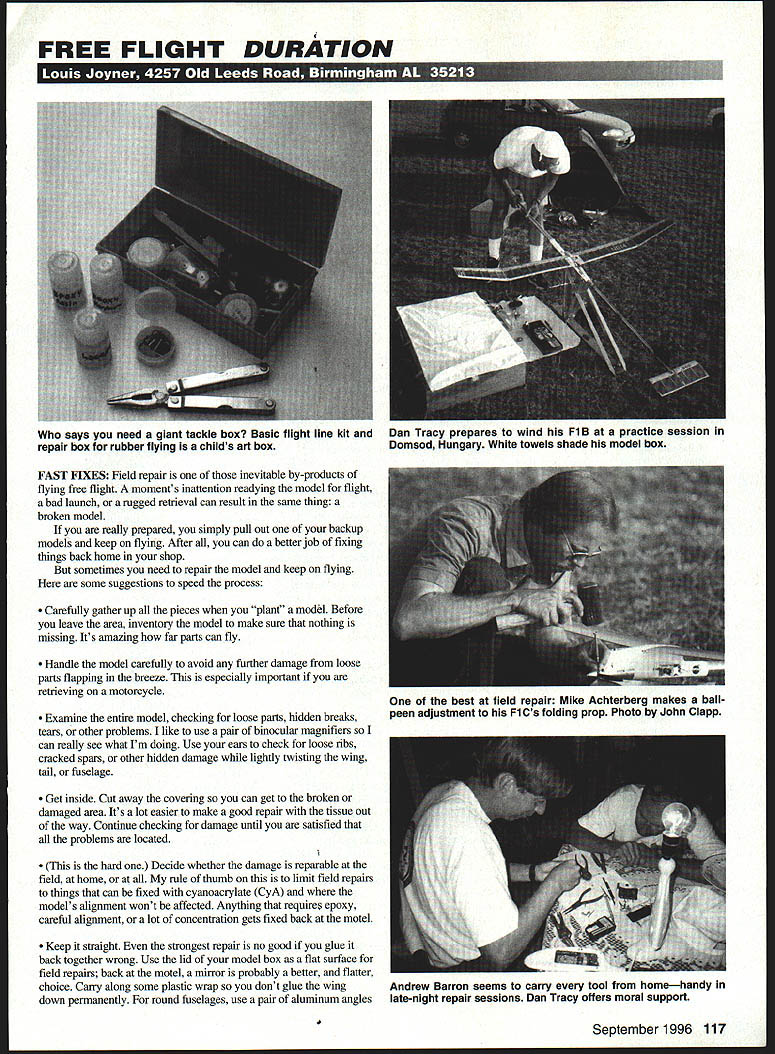
You don't need a giant tackle box. A basic flight-line kit and repair box for rubber flying is a child's art box.
A few items help make fast field repairs possible. Have a dedicated repair kit. Mine doubles as my flight box. It's an inexpensive plastic box grade-school kids use to hold art supplies. In addition to spare bobbins, wing wires and other flying oddments, it also holds:
- A few new single-edged razor blades.
- A short length of fine stainless-steel wire.
- A couple of small plastic containers for spare parts (I used Fuji see-through film containers but now prefer flip-top containers from a camp-and-hike store because they keep lids on better).
- Containers holding nothing but screws — at least three or four sizes used on my models.
- A container for support equipment — extra hooks, springs, and special fittings. Whenever I bend a wire hook for a model I always make an extra; the extra goes in the container.
For liquids, I found some one-ounce screw-top plastic bottles at the camping store for less than two dollars. They hold epoxy resin and hardener, clear dope; to be safe, label them "dope" and "lacquer." When traveling, put them inside a heavy-duty freezer bag just in case of spills. Never carry an opened bottle of CyA — chances are it will spill.
An all-purpose tool is the biggest space/time saver. Use a Leatherman tool (about $35 at sporting-goods stores and home centers); it contains pliers, a file, screwdrivers, a knife, an awl, and a can opener. Instead of leaving the tool in the box, carry it in the sheath on your belt.
Some other items don't go in the flight box. Instead, store them in plastic bags stuffed into odd corners of the model box. These include:
- A range of scrap pieces — balsa, spruce and plywood.
- Scraps of carbon-fiber spars and trailing edges. Store them in a separate bag; they make great splints for repairing broken parts.
- Kevlar thread for wrapping splints.
Tissue, Polyspan and Mylar covering materials should be rolled separately and placed in plastic bags. Carry scrap pieces of carbon-fiber D-box skins for patching inevitable encounters with fences, guy wires and streamer poles. For really serious damage to a carbon-fiber wing, also carry a specially made molded D-box skin with an inner layer of 19-ounce Kevlar cloth and a 450 outer layer of Russian unidirectional carbon cloth. Sure, it's heavy, but it's the quickest, strongest way I know to fix a broken main spar on a composite wing.
Last summer I had the pleasure of rooming with glider flier Andrew Barron at team practice and the World Championships in Hungary. Now, being a glider flier, you would think that Andrew would travel light: just the model box and a few spare tow reels. Wrong! He brought along one of those wheeled, hard-sided suitcases with what seemed to be every tool, part, and supply item in his home shop, all well-organized into divided plastic boxes. I kidded him about all the tools, but they did come in handy.
Another team member, power flier Mike Achterberg, is probably the best I've seen at field repairs. He fixed a broken carbon-and-Rohacell Wakefield prop blade of mine in just a few minutes, carefully straightening each little piece of carbon along the break, then reinforcing everything with a couple of strips of thicker carbon. A neat job that now works as good as new.
Dan Tracy also showed me a few interesting repair ideas. One of his favorites is to use a patch of dressmaker's lining material (it looks like a heavy version of Polyspan) to reinforce breaks. Dan simply puts the patch in place and adds a few drops of CyA. He also uses a clear adhesive-coated Mylar for patching holes in wings and stabs. Quick and easy.
More from Melis:
Jos Melis is a Belgian glider flier and purveyor of free flight goodies from the former Iron Curtain countries. His latest A-B-C Free Flight Supplies catalog lists several new sources, including Victor Rossonoks and Igor Vichvar. Of particular interest were the variable-pitch, delayed-prop-release Wakefield front end from Vichvar (330 German Marks—about $220) and tubular spars for F1A and F1B stabilizers from Germany. These are available in 3, 3.5, and 4 mm diameter and weigh 1 to 1.2 grams for a 420–450 mm long piece. Price is $9.50 each.
Also listed in the catalog are the excellent F1G (Coupe) parts from Andrey Burdov of Russia. These include front end, prop blades, aramid motor tube, pylon, aluminum/carbon tail boom, timer, and even finished wings and stabs. The complete model is also available for $370. I've seen Andrew's fly and it climbs just like a Wakefield. Since the Builder of the Model rule was eliminated for F1G and F1H, F1J, and F1K at the last CIAM meeting, we may be seeing some of these potent models showing up at contests over here.
For a copy of the new catalog, write Jos Melis, Winterbeekstraat 1, 3730 Hoeselt, Belgium. Include a couple of international reply coupons (or a couple of dollar bills) to cover the postage.
Groovin' High:
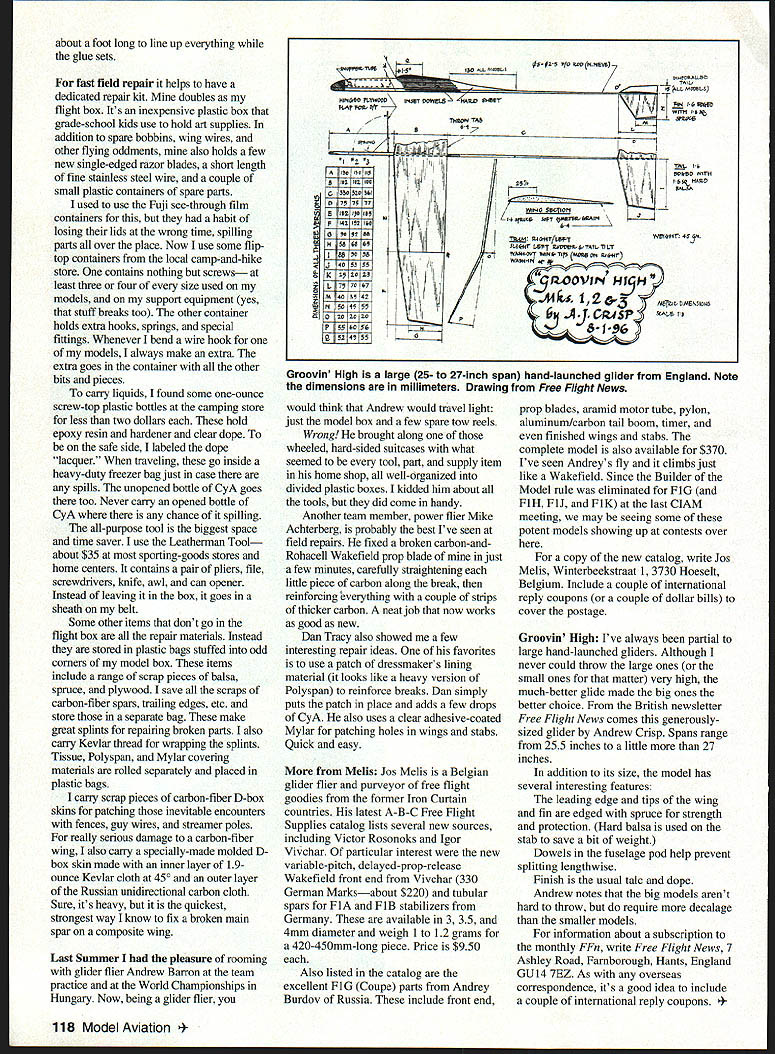
I've always been partial to large hand-launched glider designs. Although I never could throw the large ones (or the small ones for that matter) very high, the much-better glide made the big ones the better choice. From the British newsletter Free Flight News comes this generously sized glider by Andrew Crisp. Spans range from 25.5 inches to a little more than 27 inches.
In addition to its size, the model has several interesting refinements. The leading edge and tips of the wing and fin are edged with spruce for strength and protection. (Hard balsa is used on the stab to save a bit of weight.) Dowels in the fuselage pod help prevent splitting lengthwise.
Finish is the usual tissue and dope. Andrew notes that the big models aren't hard to throw, but do require more decalage than the smaller models.
For information about a subscription to their monthly FFN, write Free Flight News, 7 Ashley Road, Farnborough, Hants, England GU14 7EZ. As with any overseas correspondence, it's a good idea to include a couple of international reply coupons.
Transcribed from original scans by AI. Minor OCR errors may remain.

