
FREE FLIGHT DURATION
Louis Joyner, 4257 Old Leeds Road, Birmingham AL 35213
SYMPO '96
The Symposium of the National Free Flight Society, better known as the Sympo, is an annual publication that combines technical and practical articles on all aspects of free flight design and construction. The 1996 Sympo, the 29th, was edited by Bill Bogart and is available from NFFS Publications Director Fred Terzian, 4858 Moorpark Ave., San Jose CA 95129-2132. The cost is $20 for NFFS members, $24 for non-members. Postage is $3.
Some of the papers in the 1996 Sympo are:
- "Playing with P-30 Models" — John O'Dwyer traces some of his experiments with his popular P-30 rubber class.
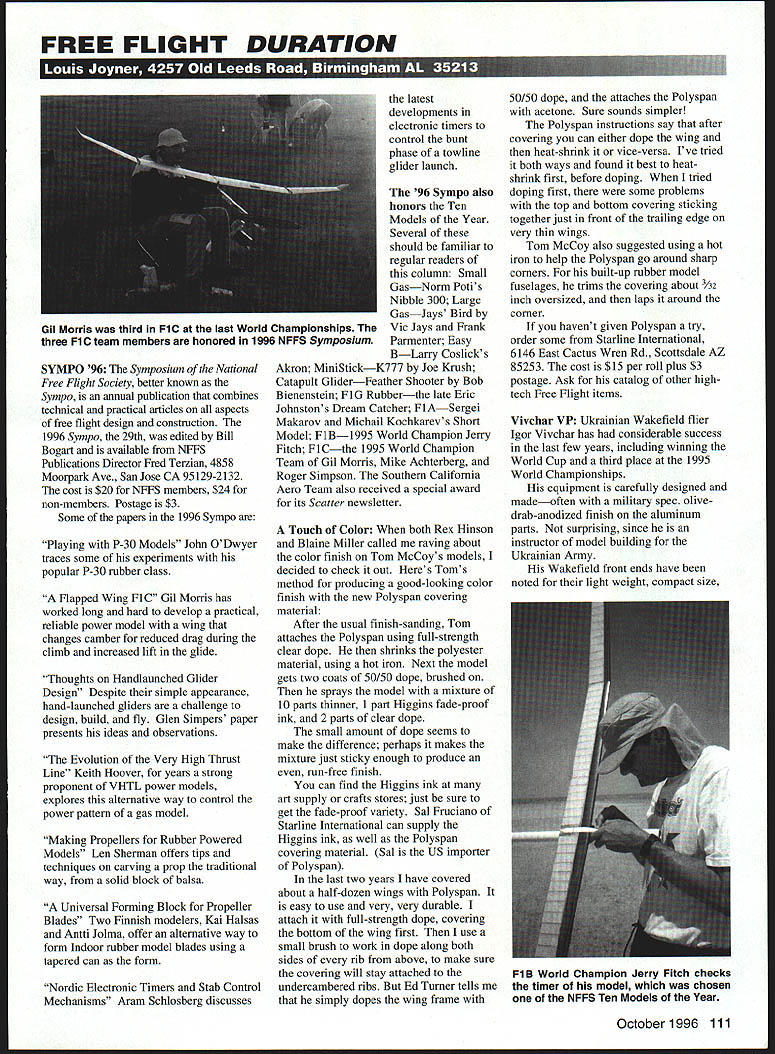
- "A Flapped Wing F1C" — Gil Morris has worked long and hard to develop a practical, reliable power model with a wing that changes camber for reduced drag during the climb and increased lift in the glide.
- "Thoughts on Handlaunched Glider Design" — Despite their simple appearance, hand-launched gliders are a challenge to design, build, and fly. Glen Simpers' paper presents his ideas and observations.
- "The Evolution of the Very High Thrust Line" — Keith Hoover, for years a strong proponent of VHTL power models, explores this alternative way to control the power pattern of a gas model.
- "Making Propellers for Rubber Powered Models" — Len Sherman offers tips and techniques on carving a prop the traditional way, from a solid block of balsa.
- "A Universal Forming Block for Propeller Blades" — Two Finnish modelers, Kai Halsas and Antti Jolma, offer an alternative way to form indoor rubber model blades using a tapered can as the form.
- "Nordic Electronic Timers and Stab Control Mechanisms" — Aram Schlosberg discusses the latest developments in electronic timers to control the bunt phase of a towline glider launch.
The '96 Sympo also honors the Ten Models of the Year. Several of these should be familiar to regular readers of this column:
- Small Gas — Norm Poti's Nibble 300
- Large Gas — Jay's Bird by Vic Jay and Frank Parmenter
- Easy B — Larry Coslick's Akron
- MiniStick — K777 by Joe Krush
- Catapult Glider — Feather Shooter by Bob Bienenstein
- F1G Rubber — the late Eric Johnston's Dream Catcher
- F1A — Sergei Makarov and Michail Kochkarev's Short Model
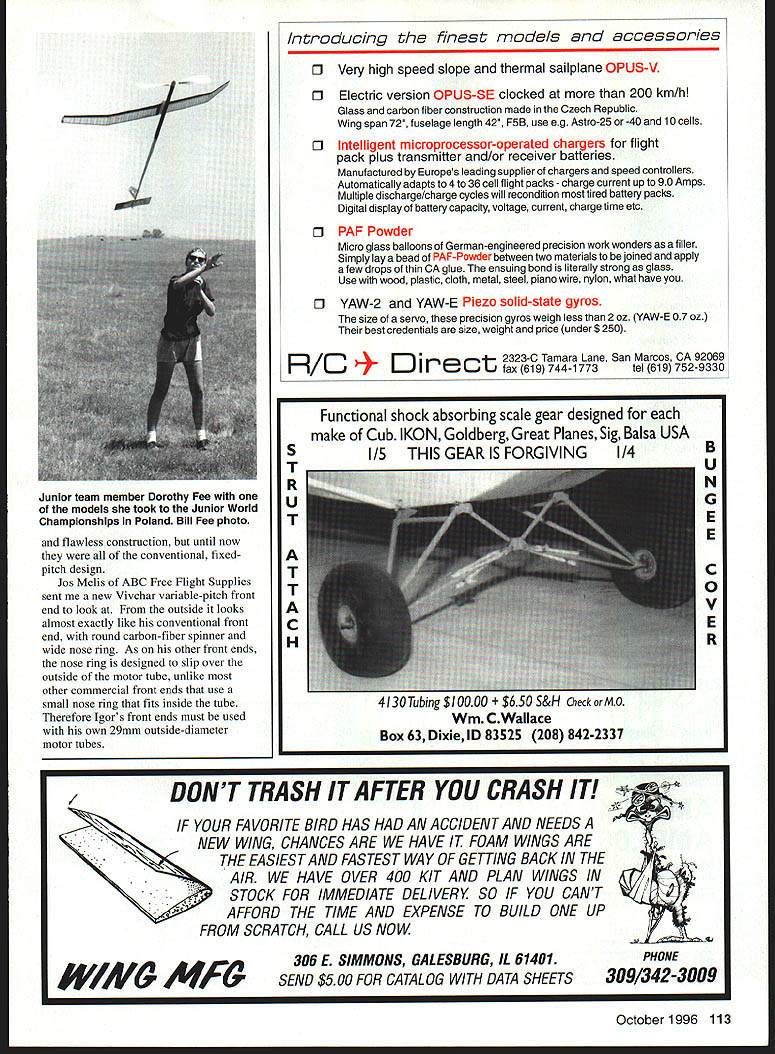
- F1B — 1995 World Champion Jerry Fitch
- F1C — the 1995 World Champion Team: Gil Morris, Mike Achterberg, Roger Simpson
The Southern California Aero Team also received a special award for its Scatter newsletter.
A Touch of Color
When both Rex Hinson and Blaine Miller called me raving about the color finish on Tom McCoy's models, I decided to check it out. Here's Tom's method for producing a good-looking color finish with the new Polyspan covering material.
After the usual finish-sanding, Tom attaches the Polyspan using full-strength clear dope. He then shrinks the polyester material using a hot iron. Next the model gets two coats of 50/50 dope, brushed on. Then he sprays the model with a mixture of 10 parts thinner, 1 part Higgins fade-proof ink, and 2 parts clear dope. The small amount of dope seems to make the mixture just sticky enough to produce an even, run-free finish.
You can find the Higgins ink at many art supply or crafts stores; just be sure to get the fade-proof variety. Sal Fruciano of Starline International can supply the Higgins ink as well as the Polyspan covering material. (Sal is the U.S. importer of Polyspan.)
In the last two years I have covered about a half-dozen wings with Polyspan. It is easy to use and very, very durable. I attach it with full-strength dope, covering the bottom of the wing first. Then I use a small brush to work in dope along both sides of every rib from above, to make sure the covering will stay attached to the undercambered ribs. Ed Turner, however, tells me that he simply dopes the wing frame with 50/50 dope and attaches the Polyspan with acetone — sure sounds simpler!
The Polyspan instructions say that after covering you can either dope the wing and then heat-shrink it or vice versa. I've tried both ways and found it best to heat-shrink first, before doping. When I tried doping first, there were some problems with the top and bottom covering sticking together just in front of the trailing edge on very thin wings.
Tom McCoy also suggested using a hot iron to help the Polyspan go around sharp corners. For his built-up rubber model fuselages, he trims the covering about 3/32-inch oversized, then laps it around the corner.
If you haven't given Polyspan a try, order some from Starline International, 6146 East Cactus Wren Rd., Scottsdale AZ 85253. The cost is $15 per roll plus $3 postage. Ask for his catalog of other high-tech free flight items.
Vivchar VP
Ukrainian Wakefield flier Igor Vivchar has had considerable success the last few years, including winning the World Cup and a third place at the 1995 World Championships.
His equipment is carefully designed and made — often with a military-spec, olive-drab-anodized finish on the aluminum parts. Not surprising, since he is an instructor of model building for the Ukrainian Army. His Wakefield front ends have been noted for their light weight, compact size, and flawless construction, but until now they were all of the conventional, fixed-pitch design.
Jos Melis of ABC Free Flight Supplies sent me a new Vivchar variable-pitch (VP) front end to look at. From the outside it looks almost exactly like his conventional front end, with a round carbon-fiber spinner and wide nose ring. As on his other front ends, the nose ring is designed to slip over the outside of the motor tube, unlike most other commercial front ends that use a small nose ring that fits inside the tube. Therefore Igor's front ends must be used with his own 29 mm outside-diameter motor tubes.
The big difference is in the back of the front end, where a short piece of clear nylon line joins the rear of the nose ring to a small 1/2-inch (13 mm) diameter Delrin rubber anchor. With the right cut of motor the anchor grips the rubber band and the spinner rides up and actuates the variable-pitch hub. Release tension or reverse the motor cut and the anchor will slip on the rubber allowing the rubber to unwind on the hub. This system seems particularly well suited to Wakefield engines.
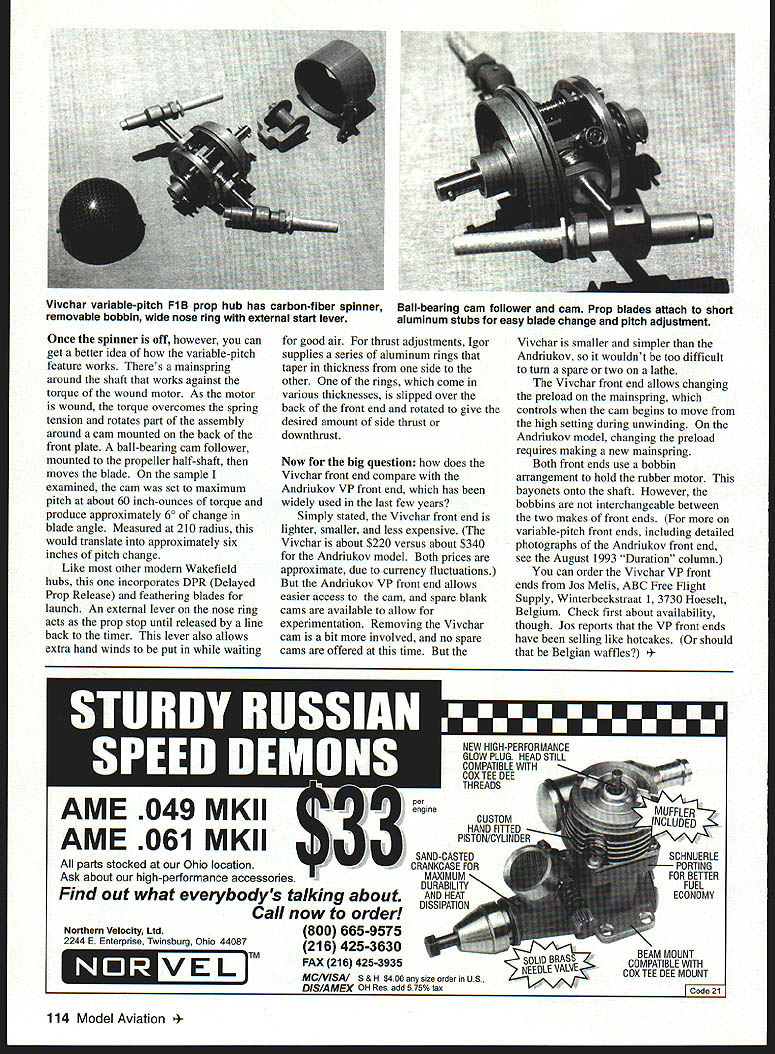
Once the spinner is off, you can get a better idea of how the variable-pitch feature works. There's a mainspring around the shaft that works against the torque of the wound motor. As the motor is wound, the torque overcomes the spring tension and rotates part of the assembly around a cam mounted on the back of the front plate. A ball-bearing cam follower, mounted to the propeller half-shaft, then moves the blade. On the sample I examined, the cam was set to maximum pitch at about 60 inch-ounces of torque and produced approximately 6° of change in blade angle. Measured at a 210 mm radius, this would translate into approximately six inches of pitch change.
Like most other modern Wakefield hubs, this one incorporates DPR (Delayed Prop Release) and feathering blades for launch. An external lever on the nose ring acts as the prop stop until released by a line back to the timer. This lever also allows extra hand winds to be put in while waiting for good air. For thrust adjustments, Igor supplies a series of aluminum rings that taper in thickness from one side to the other. One of the rings, which come in various thicknesses, is slipped over the back of the front end and rotated to give the desired amount of side thrust or downthrust.
Now for the big question: how does the Vivchar front end compare with the Andriukov VP front end, which has been widely used in the last few years?
Simply stated, the Vivchar front end is lighter, smaller, and less expensive (about $220 versus about $340 for the Andriukov model; both prices are approximate due to currency fluctuations). But the Andriukov VP front end allows easier access to the cam, and spare blank cams are available to allow for experimentation. Removing the Vivchar cam is a bit more involved, and no spare cams are offered at this time. The Vivchar is smaller and simpler than the Andriukov, so it wouldn't be too difficult to turn a spare or two on a lathe.
The Vivchar front end allows changing the preload on the mainspring, which controls when the cam begins to move from the high setting during unwinding. On the Andriukov model, changing the preload requires making a new mainspring.
Both front ends use a bobbin arrangement to hold the rubber motor against bayonets on the shaft. However, the bobbins are not interchangeable between the two makes of front ends. (For more on variable-pitch front ends, including detailed photographs of the Andriukov front end, see the August 1993 "Duration" column.)
You can order the Vivchar VP front ends from Jos Melis, ABC Free Flight Supply, Winterbeekstraat 1, 3730 Hoeselt, Belgium. Check first about availability, though — Jos reports that the VP front ends have been selling like hotcakes. (Or should that be Belgian waffles?)
Transcribed from original scans by AI. Minor OCR errors may remain.

