
FREE FLIGHT DURATION
Louis Joyner, 4257 Old Leeds Road, Birmingham AL 35213
Introduction
I hate to admit it, but this was my first Nats in almost 20 years and my first contest at the AMA Muncie site. Compared with the Nats of my youth, this was a much smaller contest, without the three-ring circus atmosphere of Control Line and RC being flown at the same time.
As with any Free Flight contest, the best part was the opportunity to see old friends and make new ones. The AMA staff were helpful and the museum provided a delightful break from the day's flying. If you haven't been, you need to go.
Rather than a blow-by-blow, day-by-day account, I've jotted down some observations.
Site and conditions
- The site was certainly adequate for two-minute maxes, but three-minute flights in the FAI events and flyoffs were stretched to the limit on the windier days. Trees and crops downwind provided the usual retrieval hazards. The field itself was a bit rough for bicycle chasing, but no problem on motorcycles.
- Since modelers, as well as models, get wet, it is important to be prepared for damp conditions. The first day saw everything from British-style "Wellies" to plastic bags used to keep feet dry. The unexpected cold weather also had many fliers checking out the local stores for bargain sweatshirts.
- George Perryman was resplendent all week in his patriotic red, white, and blue warmup suit — appropriate for a Georgia native at a contest held at the same time as the Atlanta Olympics.
Power events and model trends
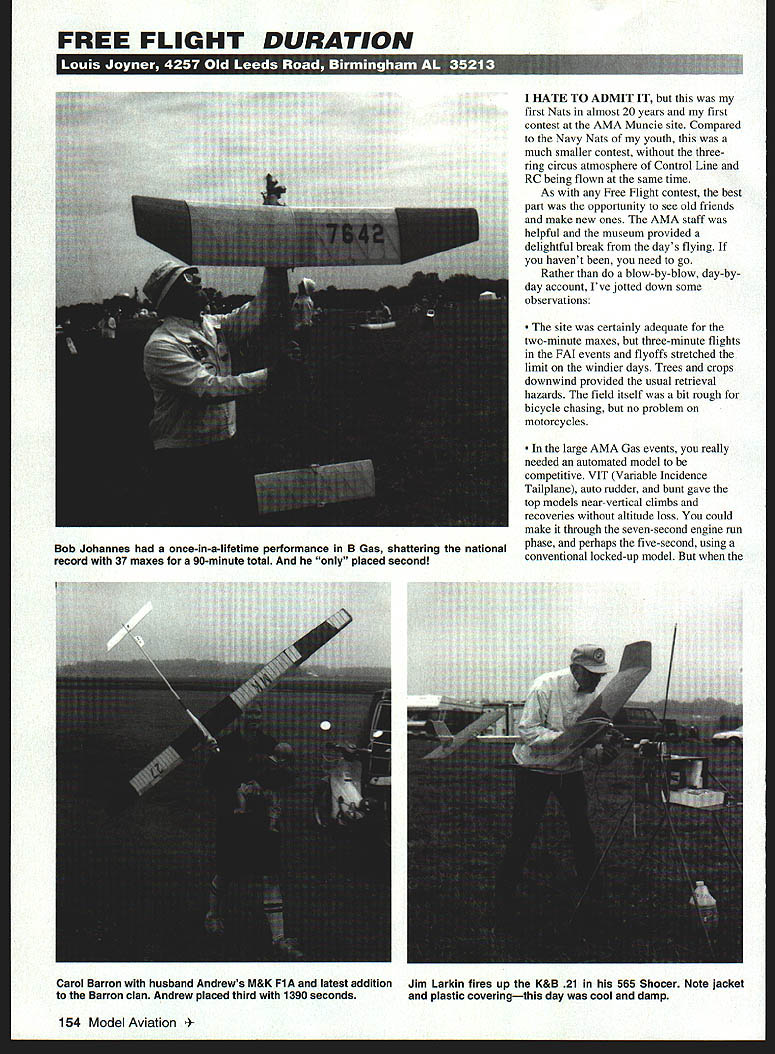
- In the large AMA Gas events, you really needed an automated model to be competitive. VIT (Variable Incidence Tailplane), auto rudder, and bunt gave the top models near-vertical climbs and recoveries without altitude loss. You could make it through the seven-second engine-run phase, and perhaps the five-second, using a conventional locked-up model. But when the engine run went to four seconds, the locked-up models were no longer able to compete with the faster-climbing bunt models.
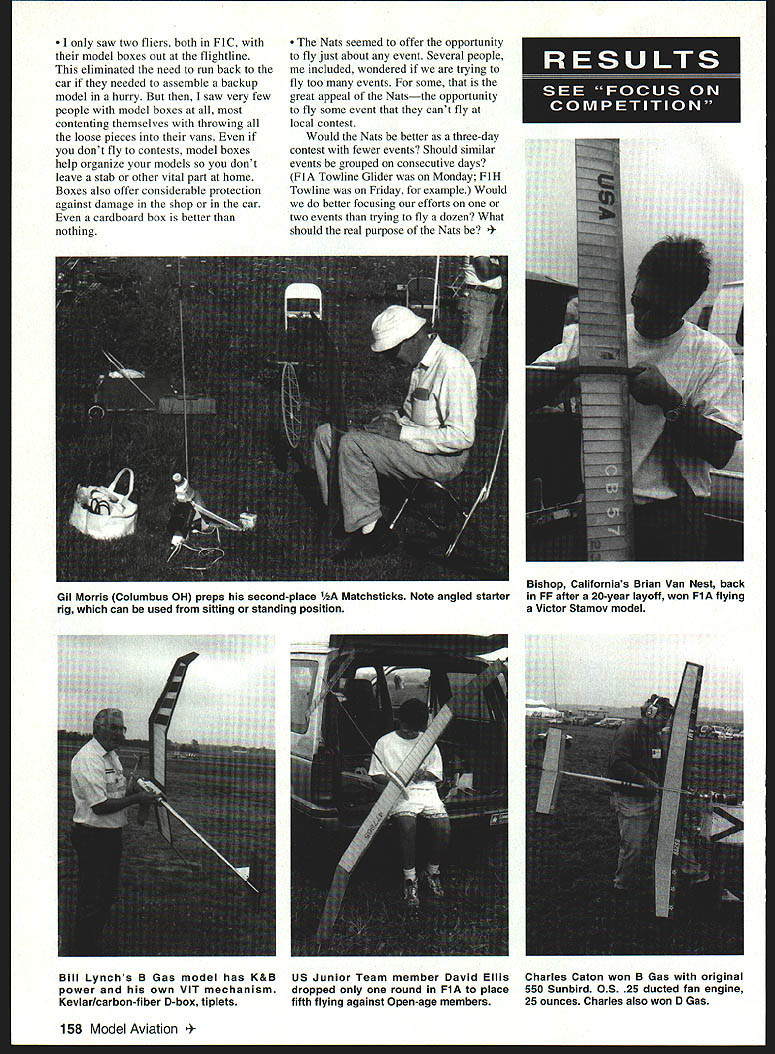
- As a by-product of VIT and bunt, the newer power models featured longer fuselages and smaller stabs. This follows current F1C practice. Charles Caton's winning B Gas model, for example, uses a 23% stab and a 60% center of gravity (CG).
- Although the Power event continued to be a horsepower race, some fliers are detuning their engines slightly for easier starting and more reliable runs. A very slight reduction in compression, for example, might cost a few hundred rpm but make for easier setting.
Launches and handling
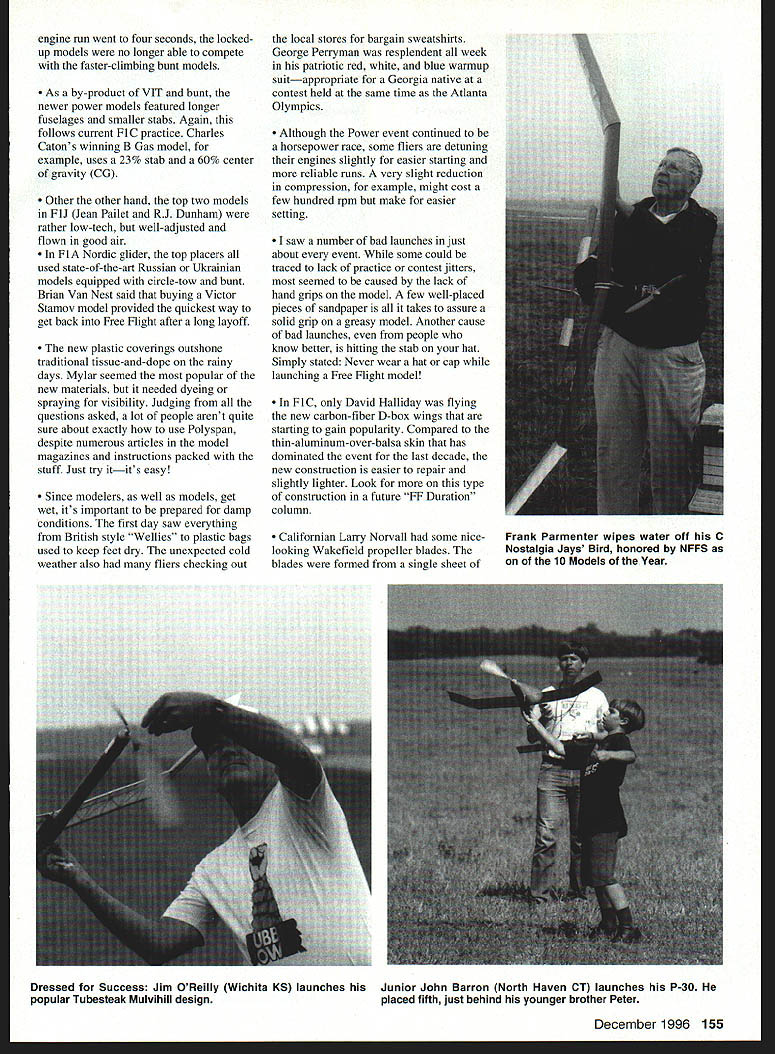
- I saw a number of bad launches in just about every event. While some could be traced to lack of practice or contest jitters, most seemed to be caused by the lack of hand grips on the model. A few well-placed pieces of sandpaper are all it takes to assure a solid grip on a greasy model.
- Another cause of bad launches, even from people who know better, is hitting the stab with your hat. Simply stated: never wear a hat or cap while launching a Free Flight model!
F1 classes and construction trends
- In F1C, only David Halliday was flying the new carbon-fiber D-box wings that are starting to gain popularity. Compared to the thin-aluminum-over-balsa skin that has dominated the event for the last decade, the new construction is easier to repair and slightly lighter. Look for more on this type of construction in a future "FF Duration" column.
- On the other hand, the top two models in F1J (Jean Pailet and R.J. Dunham) were rather low-tech, but well-adjusted and flown in good air.
- In F1A Nordic glider, the top placers all used state-of-the-art Russian or Ukrainian models equipped with circle-tow and bunt. Brian Van Nest said that buying a Victor Stamov model provided the quickest way to get back into Free Flight after a long layoff.
Coverings and materials
- New plastic coverings outshone traditional tissue-and-dope on the rainy days. Mylar seemed the most popular of the new materials, but it needed dyeing or spraying for visibility.
- Judging from the questions asked, a lot of people aren't quite sure exactly how to use Polyspan, despite numerous articles and instructions in the model magazines. Just try it — it's easy!
Coupe, thermals, and spotting
- Coupe, in particular, had problems with turbulence caused by trees located immediately upwind of the launch area. Surprisingly, I saw no VIT-equipped Coupes, which are common in Europe. This was the day to have a small, fast-climbing model with a relatively short motor run.
- Streamer poles and thermistors were the most common means of picking air. A few bubble machines were also in use, but I only spotted one recording thermistor and no remote sensors located upwind. The turbulence from the upwind trees made spotting thermals difficult, especially in the wind. Most people I watched simply waited for a long lull and went.
Hand-Launched Glider — visitors from Japan
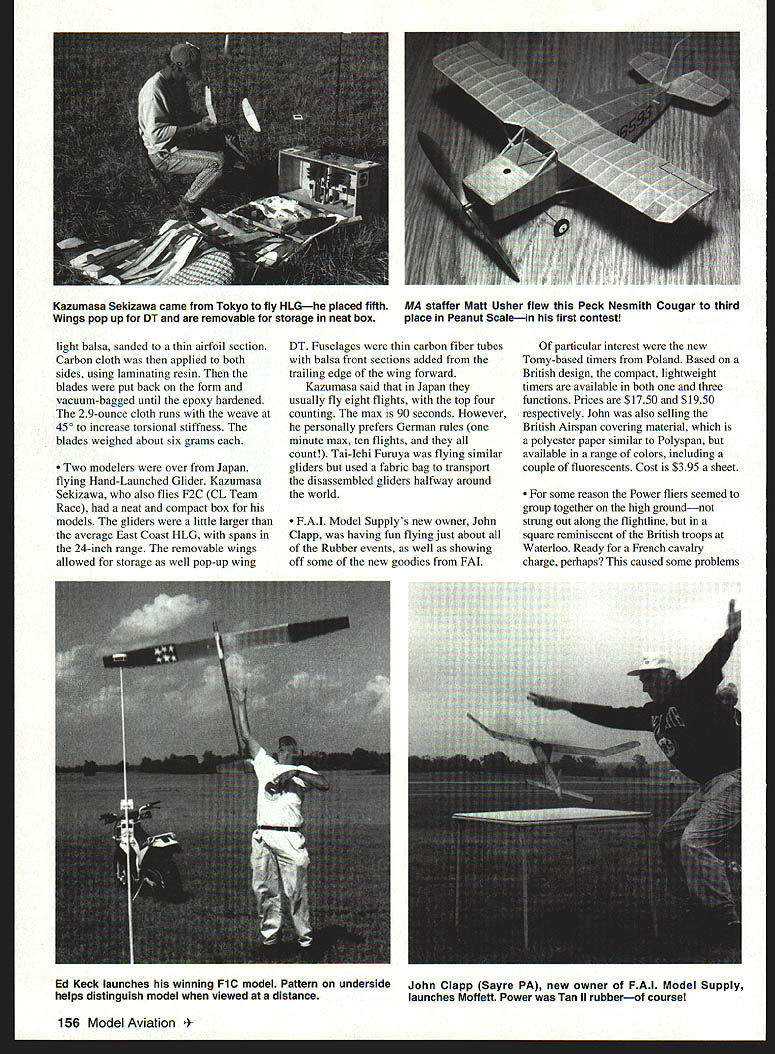
- Two modelers were over from Japan flying Hand-Launched Glider. Kazumasa Sekizawa, who also flies F2C (CL Team Race), had a neat and compact box for his models. The gliders were a little larger than the average East Coast HLG, with spans in the 24-inch range. The removable wings allowed for storage as well as pop-up wing D/T. Fuselages were thin carbon-fiber tubes with balsa front sections added from the trailing edge of the wing forward.
- Kazumasa said that in Japan they usually fly eight flights, with the top four counting. The max is 90 seconds. However, he personally prefers the German rules (one-minute max, ten flights, and they all count).
- Tai-ichi Furuhya was flying similar gliders but used a fabric bag to transport the disassembled gliders halfway around the world.
Props and construction details
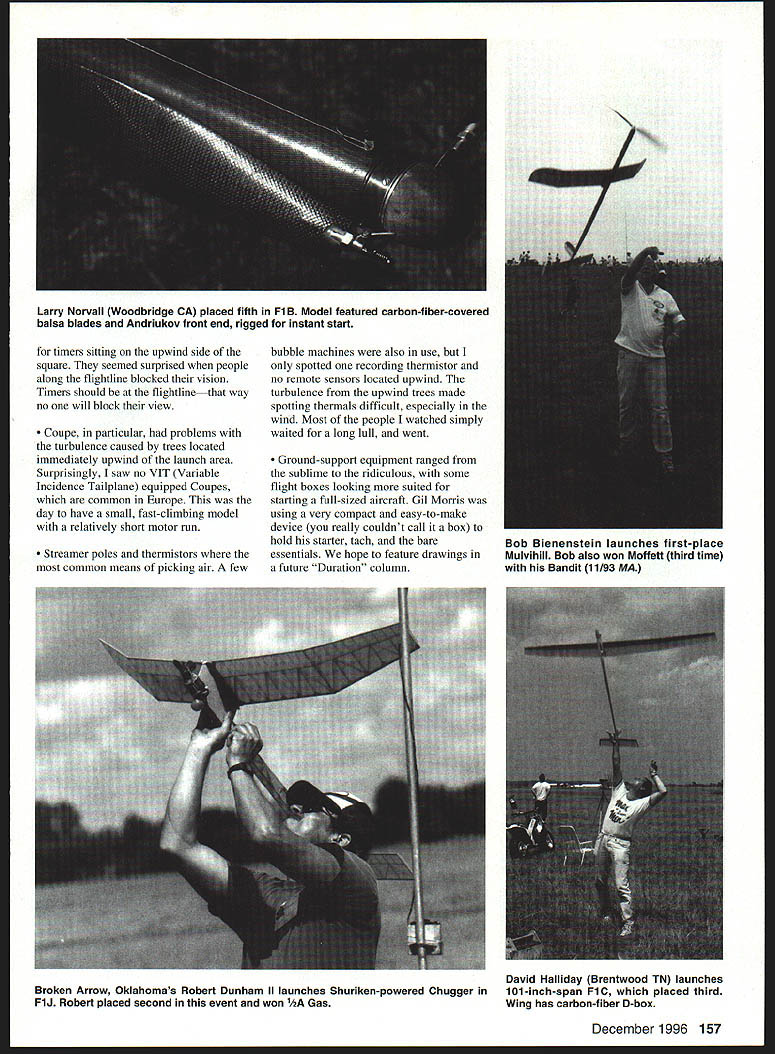
- Californian Larry Norvall had some nice-looking Wakefield propeller blades. The blades were formed from a single sheet of light balsa, sanded to a thin airfoil section. Carbon cloth was then applied to both sides, using laminating resin. Then the blades were put back on the form and vacuum-bagged until the epoxy hardened. The 29-ounce cloth runs with the weave at 45° to increase torsional stiffness. The blades weighed about six grams each.
Supplies, timers, and vendors
- F.A.I. Model Supply's new owner, John Clapp, was having fun flying just about all of the Rubber events, as well as showing off some of the new goodies from FAI.
- Of particular interest were new timers from Poland. Based on a British design, the compact, lightweight timers are available in both one- and three-function versions. Prices are $17.50 and $19.50 respectively.
- John was also selling the British Airspan covering material, which is a polyester paper similar to Polyspan, but available in a range of colors, including a couple of fluorescents. Cost is $3.95 a sheet.
Flightline layout and timing
- For some reason the Power fliers seemed to group together on the high ground — not strung out along the flightline, but in a square reminiscent of British troops at Waterloo. This caused some problems for the D/T guys who had difficulty retrieving models that came down in the center of the group.
- Timers sitting on the upwind side of the square seemed surprised when people along the flightline blocked their vision. Timers should be at the flightline — that way no one will block their view.
Ground support and model boxes
- Ground-support equipment ranged from the sublime to the ridiculous, with some flight boxes looking more suited for starting a full-sized aircraft. Gil Morris was using a very compact and easy-to-make device (you really couldn't call it a box) to hold his starter, tach, and the bare essentials. We hope to feature drawings in a future "Duration" column.
- I only saw two fliers, both in F1C, with their model boxes out at the flightline. This eliminated the need to run back to the car if they needed to assemble a backup model in a hurry. Most people, however, contented themselves with throwing all the loose pieces into their vans. Even if you don't fly to contests, model boxes help organize your models so you don't leave a stab or other vital part at home. Boxes also offer considerable protection against damage in the shop or in the car. Even a cardboard box is better than nothing.
Events, scheduling, and purpose of the Nats
- The Nats seemed to offer the opportunity to fly just about any event. Several people, me included, wondered if we are trying to fly too many events. For some, that is the great appeal of the Nats — the opportunity to fly an event they can't fly at a local contest.
- Would the Nats be better as a three-day contest with fewer events? Should similar events be grouped on consecutive days? (F1A Towline Glider was on Monday; F1H Towline was on Friday, for example.) Would we do better focusing our efforts on one or two events than trying to fly a dozen? What should the real purpose of the Nats be?
Closing
Compared with those early Nats, today's event felt smaller and more spread out. As a Free Flight contest, the best part remained the opportunity to see old friends and make new ones. The AMA staff were helpful, and the museum provided a delightful break on days when we needed it. I look forward to seeing how the evolving equipment and organization shape future contests.
Transcribed from original scans by AI. Minor OCR errors may remain.

