
Free Flight: Duration
Louis Joyner 4221 Old Leeds Road, Birmingham AL 35213
For almost two decades, aluminum-skinned balsa has been the dominant wing construction method for F1C Power models.
The first documented use I can find was by Soviet flier Eugene Verbitsky at the 1977 World Championships in Denmark. (The models were proxy-flown by Igor Ziljberg for a snake-bit Verbitsky.) At least one other Soviet modeler, Sergey Sharron, also used aluminum-foil-covered wings. I also remember seeing a Wakefield by the late Jim Patterson in the early 1960s that used thin aluminum covering over a solid balsa wing.
The aluminum used for wings isn't the same stuff you wrap turkey in. It is a very hard, very thin (.009–.013 inch) material that feels about as stiff as a manila folder. Rumors swirled about the source and intended use of the material — some said it was developed in the USSR for covering full-scale helicopter blades; others said it was made here but only available via Iron Curtain contacts. Buying a roll of the so-called "Russian" aluminum could take on the aspects of a spy thriller: whispered conversations, midnight meetings, and cloak-and-dagger routines. After the fall of the Berlin Wall, aluminum became much easier to find, though it never became a hobby-shop staple.
Most who tried it found that aluminum skinning could yield a stronger, stiffer wing with less trouble than older methods such as fiberglass cloth over a sheeted wing. Typical construction went like this:
Aluminum-skinned balsa wing construction (typical)
- Glue up and cut top and bottom sheeting (usually 1/8 or 1/20 balsa) to size.
- Cut the aluminum slightly longer than the wing panel and a little more than double the chord width.
- Tape the aluminum sheets to a piece of glass and carefully clean them (rinsing and wiping with degreasers/solvents to assure a good bond with epoxy).
- Apply a thin layer of epoxy to the aluminum, position the balsa sheeting on the aluminum with a slight gap between the leading edges of the upper and lower sheets.
- Move the aluminum-covered balsa to an undercamber form; add a full-depth spar and ribs.
- Pull the top sheeting down to complete the panel and allow epoxy to cure.
(For a much more detailed explanation see Randy Archer's "Aluminum Skin Wings" in the 1988 NFFS Symposium.)
The result was a shiny wing that looked like it had been milled from a solid block of aluminum — no finish, no fuel-proofing required. But aluminum wings had drawbacks: weight distribution tends to be uniform and can be excessive if balsa selection and epoxy application aren't careful; dings and punctures are hard to patch; and when the wings broke, they tended to fail catastrophically — a wrinkled aluminum skin usually meant the wing was done.
Carbon D-box construction
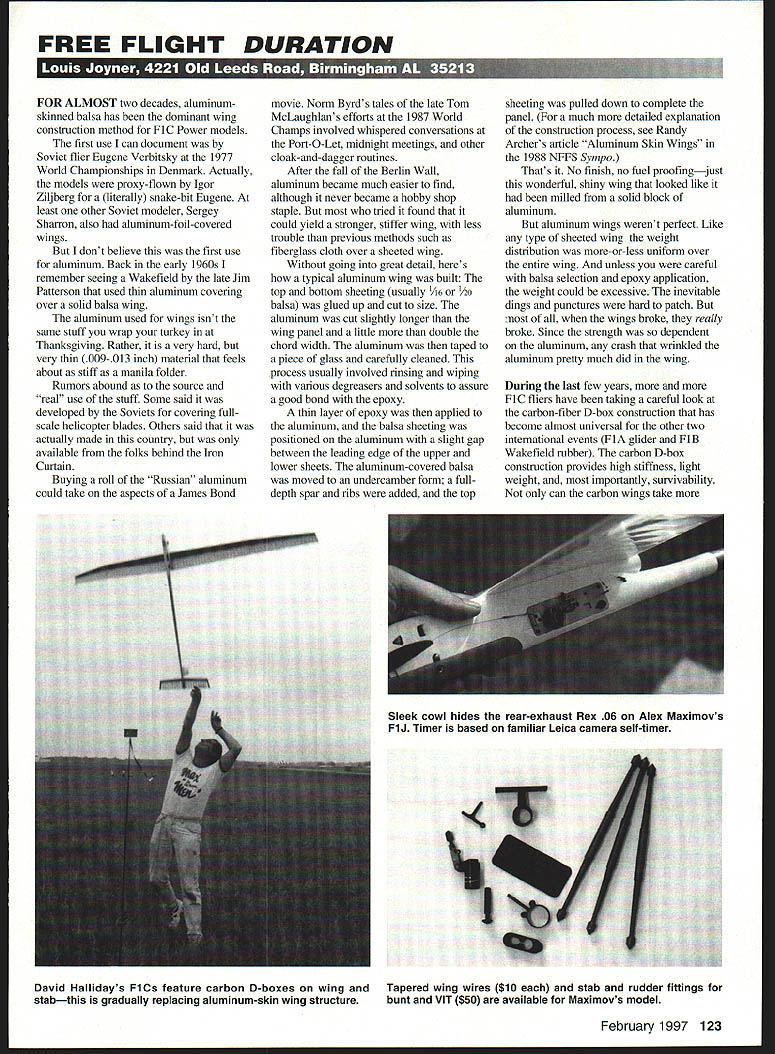
In recent years many F1C fliers have adopted carbon-fiber D-box construction, already common in F1A glider and F1B Wakefield. Carbon D-box wings offer high stiffness, low weight, and — importantly — survivability. Carbon wings can take more abuse and are easier to repair.
Key elements of a carbon D-box wing:
- Full-depth spar to carry bending loads. A typical spar consists of top and bottom pieces cut from carbon-fiber sheet with solid balsa webbing between; Kevlar thread wrapping holds the spar pieces together.
- Molded carbon-fiber cloth D-box shell to carry torsional loads. The shell is usually one or two layers of carbon-fiber cloth arranged with the weave at 45°/0° for torsional strength, molded over a male form and cured under vacuum bagging.
- Full-depth front ribs, fairly closely spaced, attached to the spar (this subassembly is often called the "fishbone"). The D-box shell is epoxied to the fishbone, producing a very stiff D-box.
- Aft ribs and a carbon trailing edge are added; thin carbon capstrips on top and bottom of the ribs extend forward slightly over the D-box to lock everything in place.
- Because the wing is inherently strong, a light plastic covering may be used instead of the classic balsa-and-tissue finish.
Carbon fiber is easy to work with, consistent in weight, and always straight. Vacuum-bagging is simple to do, and equipment and supplies are readily available from several mail-order sources.
Further reading and supplies
- Aram Schlosberg, "Notes on High-Tech Wing Construction" (1995 NFFS Symposium).
- Chris Edge and Mike Farnham, "Quicker Composite Structures" (1995 Free Flight Forum, British Model Flying Association).
For these and other NFFS publications contact: Fred Terzian, Publications Director 4858 Moorpark Ave., San Jose CA 95129-2132 (Drop a stamped, self-addressed envelope for a list of available publications.)
If you prefer ready-made wings, W-Hobby lists a 2295 mm (90.3 in) carbon D-box wing with the Verbitsky 87 airfoil and a finished weight of about 200 g. For information write: W-Hobby — Vidas Nikolajevas Vilniaus 237-24, 5400 Siauliai, Lithuania (Include a couple of international reply coupons.)
Maximov F1J
The new construction methods are also being adapted to the increasingly popular F1J event (a Half-A version of F1C, flown to two-minute maxes). Without the wing-area requirements of larger models, designers can try a variety of approaches.
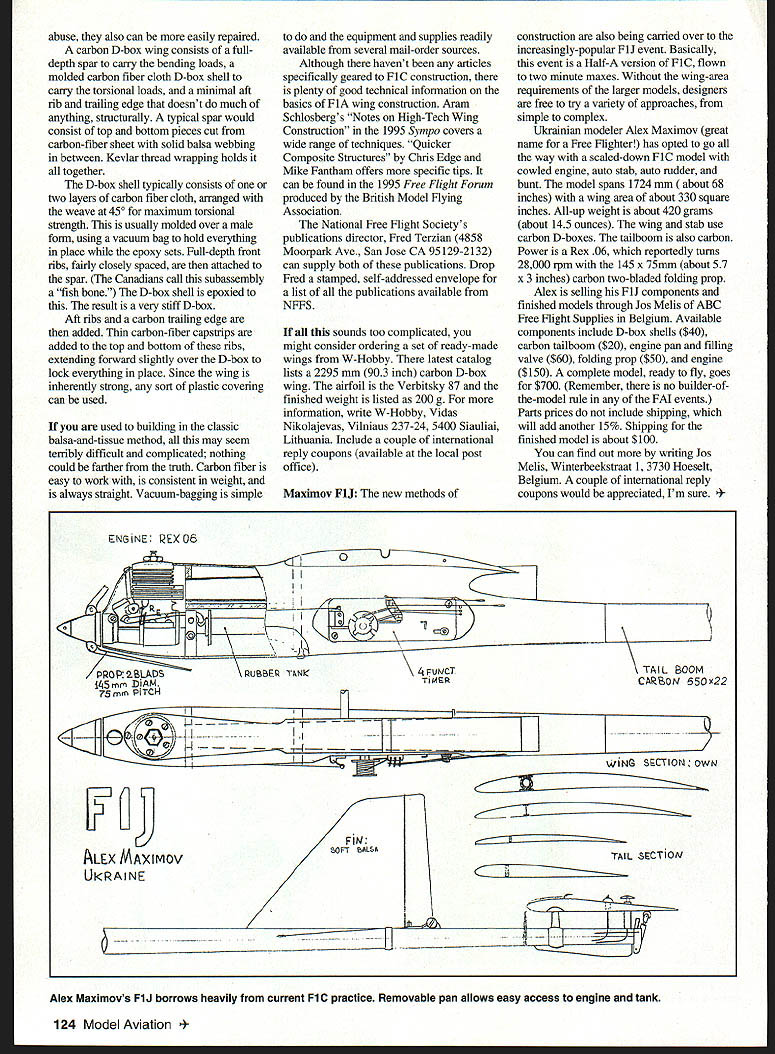
Ukrainian modeler Alex Maximov has built a scaled-down F1C-style F1J with a cowled engine, auto stab, auto rudder, and bunt. Specifications:
- Wingspan: 1724 mm (≈ 68 in)
- Wing area: ≈ 330 in²
- All-up weight: ≈ 420 g (≈ 14.5 oz)
- Wing and stab: carbon D-boxes
- Tailboom: carbon
- Power: Rex .06 (reported ~28,000 rpm with a 145 x 75 mm ≈ 5.7 x 3 in carbon two-bladed folding prop)
Alex is selling components and finished models through Jos Melis of ABC Free Flight Supplies (Belgium). Available items and approximate prices:
- D-box shells: $40
- Carbon tailboom: $20
- Engine mount and filling valve: $60
- Folding prop: $50
- Engine: $150
- Complete, ready-to-fly model: $700
(Parts prices do not include shipping; add about 15% for parts. Shipping for a finished model is about $100.)
For more information write: Jos Melis Winterbeekstraat 1, 3730 Hoeselt, Belgium (A couple of international reply coupons would be appreciated.)
Transcribed from original scans by AI. Minor OCR errors may remain.

