
Free Flight: Duration
Gil's Box
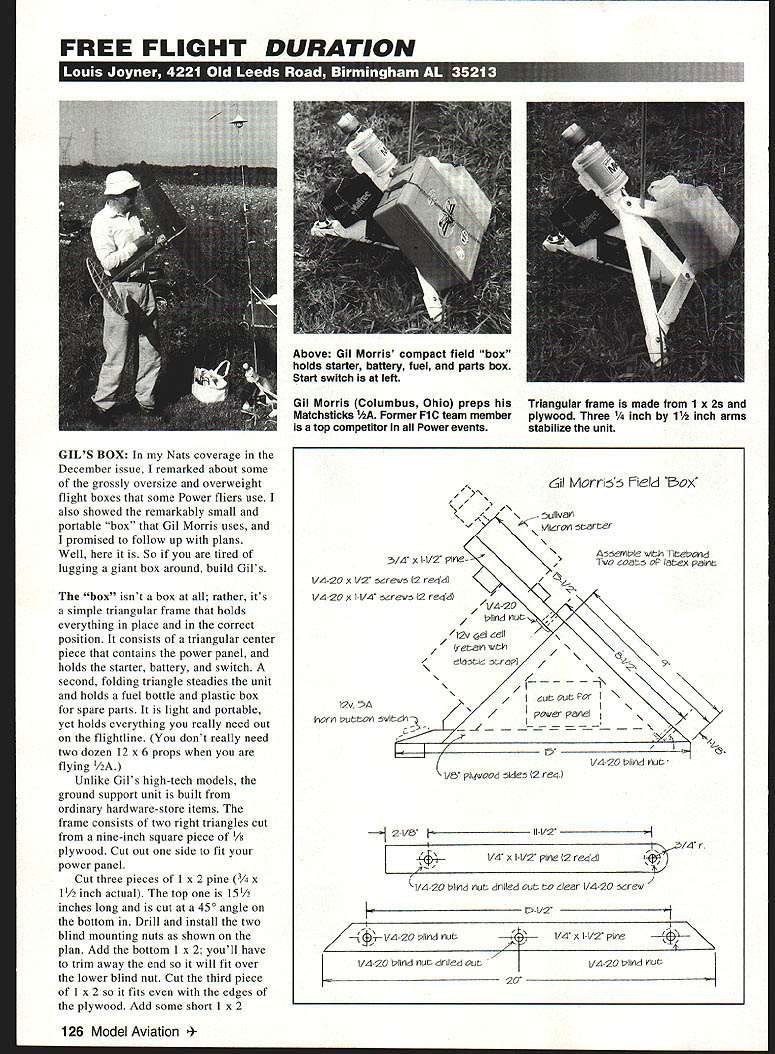
In my Nats coverage in the December issue I remarked about some grossly oversize, overweight flight boxes that some power fliers use. I also showed the remarkably small, portable "box" that Gil Morris uses and promised to follow up with plans. Here it is — if you are tired of lugging a giant box around, build Gil's.
The "box" isn't a box at all but a simple triangular frame that holds everything in the correct position. It consists of a triangular center piece that contains the power panel and holds the starter, battery, and switch. A second, folding triangle steadies the unit and holds a fuel bottle and a plastic spare-parts box. It is light and portable, yet holds everything you really need out on the flightline. (You don't really need two dozen 12 x 6 props when flying 1/2 A.)
Materials and hardware
- Two right triangles cut from a 9-inch square piece of 1/8" plywood (cut out one side to fit your power panel).
- Three pieces of 1 x 2 pine (actual 3/4" x 1-1/2"):
- Top piece: 15-1/2" long, cut with a 45° angle on the bottom; drill and install two blind mounting nuts.
- Bottom piece: trimmed at one end so it will fit over the lower blind nut.
- Third piece: cut to fit even with the edges of the plywood.
- Short 1 x 2 arms to stabilize the unit.
- Three legs of 3/4" x 1-1/2" pine; install blind mounting nuts as shown in the plan. Note: some blind mounting nuts must be drilled out to clear 1/4-20 screws.
- Two longer 1/4-20 screws for the center and shorter 1/4-20 screws for the sides (for assembly).
- A couple strips of aluminum angle to support the fuel holder and spares box.
- Hooks and rubber bands to hold items in place.
- Plastic containers: a plastic drink container (fuel bottle) and a larger plastic container cut for the spare-parts box; a small plastic box (e.g., for canceled checks) for spare parts.
- Starter switch: an automotive horn switch.
- Finish: two coats of latex paint.
Construction notes and tips
- Cut the plywood triangles and fit the power panel opening before assembly.
- Mount the top 1 x 2 (15-1/2") with the blind nuts installed; trim the bottom piece so it clears the lower blind nut.
- Attach the third 1 x 2 and the short stabilizing arms to square up the frame.
- Make and install the three legs with their blind nuts; assemble the frame using the longer 1/4-20 screws in the center and the shorter ones on the sides.
- Add aluminum angle strips to support the fuel holder and spare-parts box; drill through the diagonals if you need to support a thermistor pole.
- Fit the fuel container into the holder. If using a larger container, enlarge the holder and cut off the top of the container. Use hooks and rubber bands to secure items.
- Finish with two coats of latex paint.
Gil Morris' compact field box holds starter battery, fuel bottle, and spare-parts box. The starter switch at left is an automotive horn switch. General #45200.
Infant Plugs
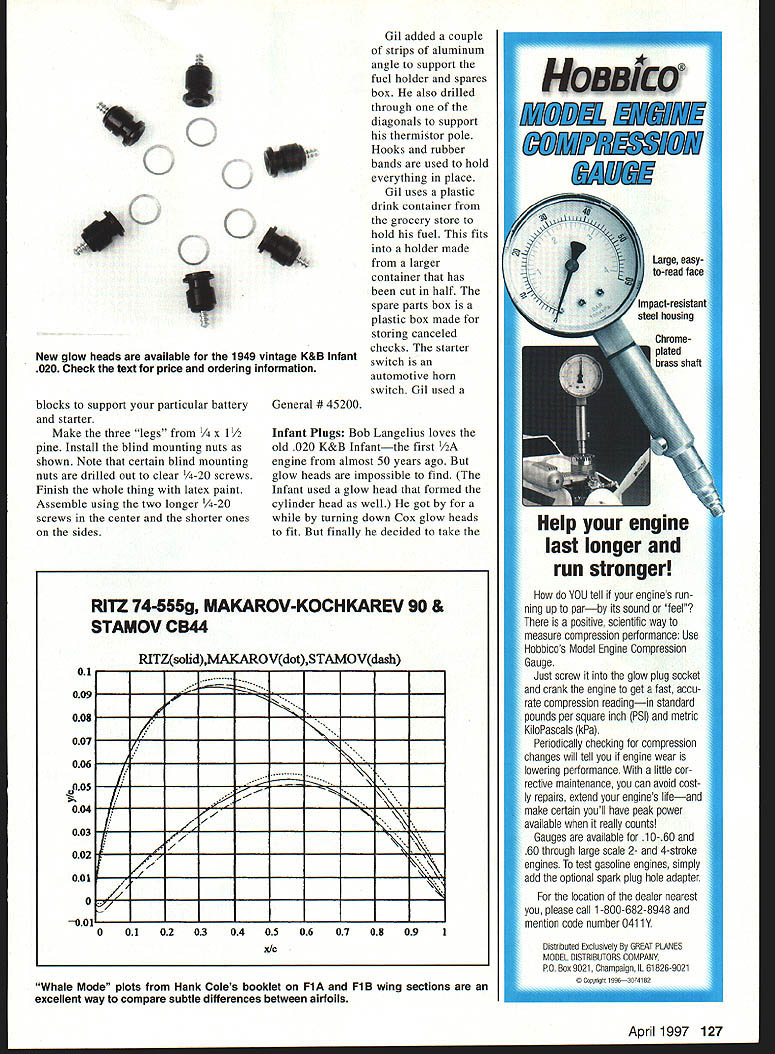
Bob Langelius loves the old .020 K&B Infant — the first 1/2 A engine from almost 50 years ago. Glow heads for the Infant are impossible to find (the Infant used a glow head that formed the cylinder head). For a while Bob turned down Cox glow heads to fit, but eventually he had a batch of new glow heads made. The new plugs are black-oxidized steel with platinum coils and come with a .004" copper washer. Bob says they start well and turn up fast, faster than the original glow heads.
They sell for $5 for three; $12 shipping and handling; another dollar either. To order: Bob Langelius, 32 Clinton St., White Plains, NY 10603.
The old Infant was far outclassed by Atwoods and Coxes when I started flying in the mid-1950s, but I have fond memories of many summer afternoons at Audubon Park in Memphis watching the late Bob Gross fly his .020 Infant sport model. As best I recall, it was a biplane made from two old hand-launched glider wings connected by a solid balsa profile fuselage. It would putter around at about 20–30 feet until the fuel ran out and then go into a steep glide.
I remember Bob winning a club scramble flying that model. A scramble is an accumulated-airtime event: whoever has the most total seconds in the air during a given period wins. I believe we flew a 1/2-hour window, with unlimited flights. Since Bob's little sport model never went far, he could rack up flight time while the rest of us chased our better-performing models.
Another time, Bob tied about 50 feet of heavy thread to one wingtip and flew the model in a crazy cross between Control Line and Free Flight. It would fly its normal circling pattern until it reached the end of the thread, at which point it would jerk around and start off in another direction — great for small fields.
Hank's Foils
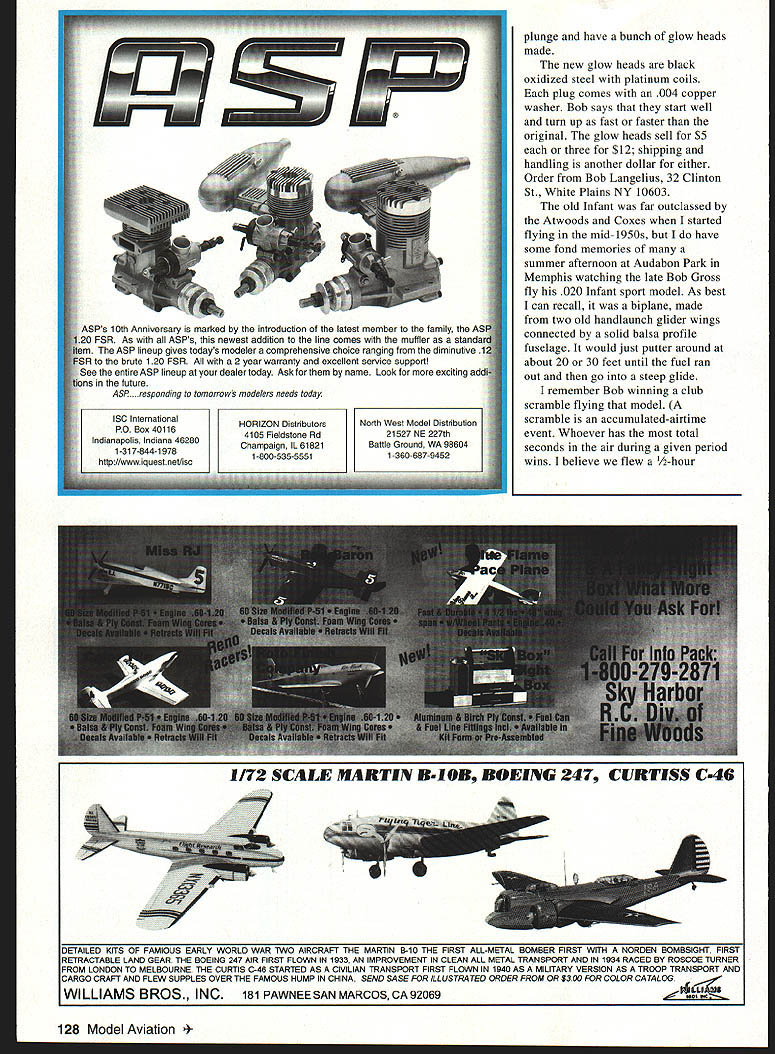
Regular readers of the NFFS symposia will recall Hank Cole's articles on airfoils. Recently he put together an inexpensive little collection called "Selected Wing Designs for F1A and F1B." As the name implies, it looks at wing airfoils for the FAI towline and rubber classes — events where fliers around the world try to wring maximum performance from limited wing area.
The booklet shows the usual profile and coordinates for some two dozen airfoils, but it also does a lot more for those interested in high-performance wing design.
Transcribed from original scans by AI. Minor OCR errors may remain.

