
FREE FLIGHT: DURATION
Louis Joyner, 4221 Old Leeds Road, Birmingham AL 35213
JUNIORS
"As the mother of a former Junior Free Flight Team member, I would like to encourage Junior modelers, their families, and their fellow modelers to become involved in this program. This program has so much to offer kids: terrific role models, healthy competition, skill-building, friendship, family activity—it's hard to find a reason not to be involved.
"When Jody became a member of the program at age 13, Jim Bradley and others took Jody under their wings (so to speak). Obviously, Jody benefited greatly from the attention, as well as their modeling expertise. Our family put time and effort into building, practice flying, and traveling to contests together. We have memories of a lot of special weekends with friends; we even look back with smiles on those escapades involving models stuck in treetops!
"Jody was fortunate enough to make the '92 and '94 Junior teams, so he traveled to Slovakia and to Ukraine to fly in those Championships. No Social Studies class can compete with the chance to see firsthand other cultures and ways of living. Jody has seen opera in Kiev, cathedrals and the scars of World War II shelling in Budapest, and the remnants of Communism in Slovakia.
"He has made friends and acquaintances all over Europe. I'll never forget seeing kids from Britain and several other countries—kids he didn't even know the week before—sprinting down the runway, whipping their shirts in the air to help Jody's last-round flight to max in '92.
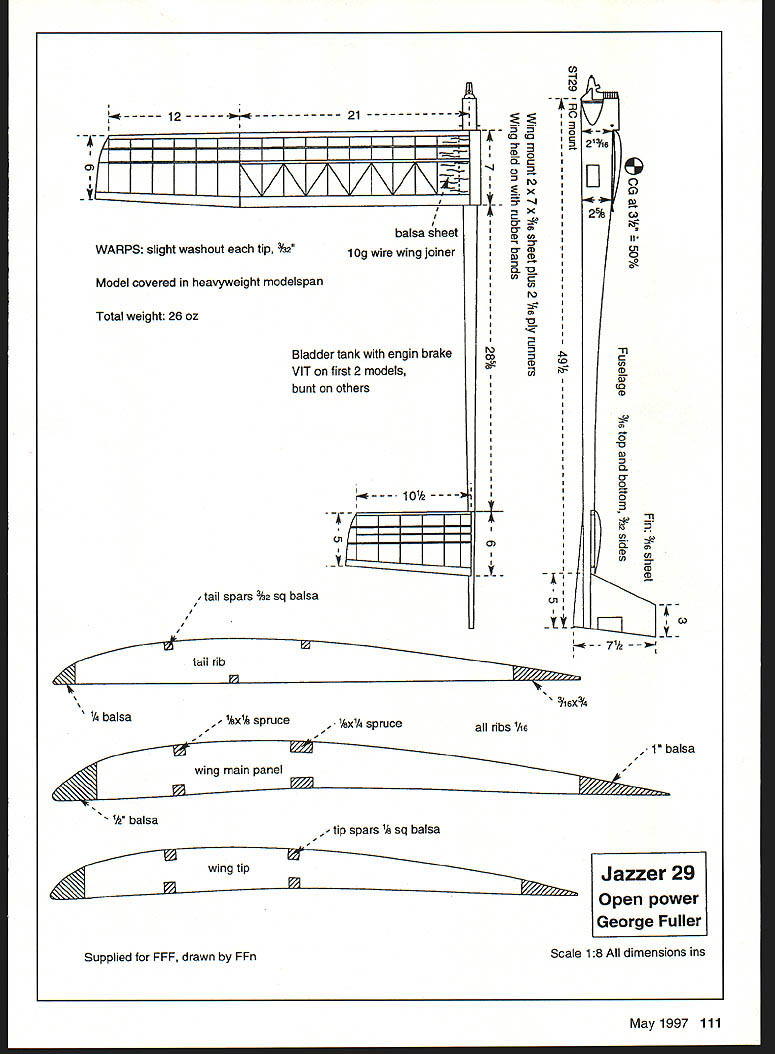
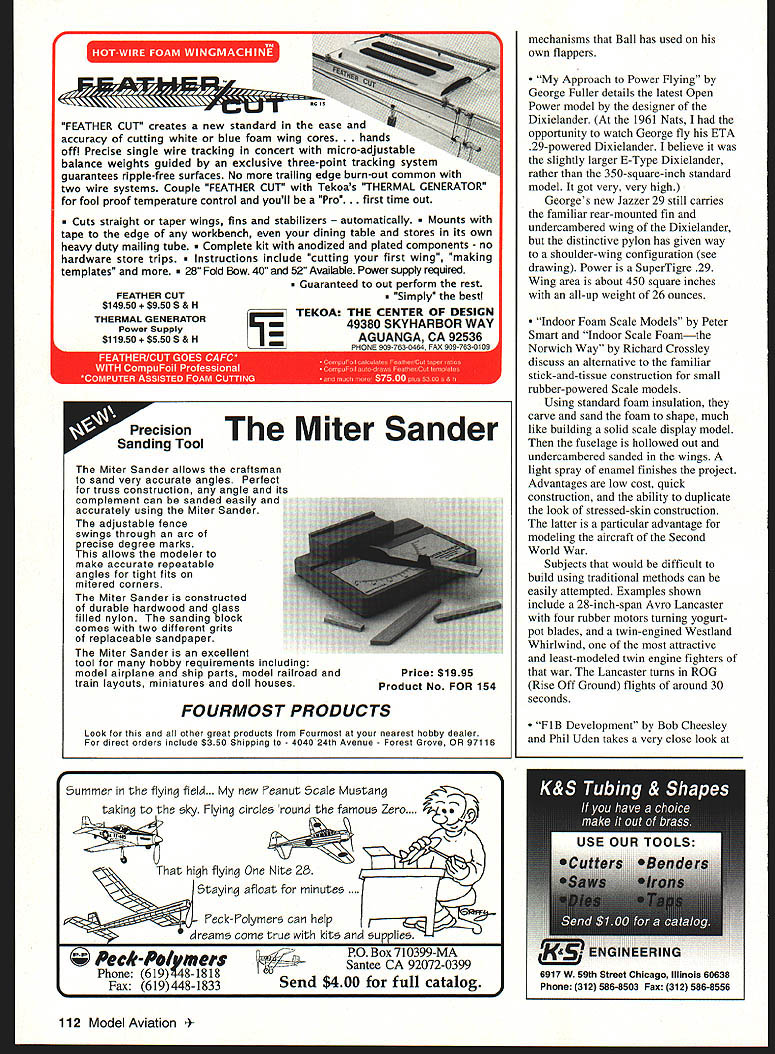
"The program has meant so much to him that he paid his own way to go to Poland with the '96 team as assistant manager. He advised, patched planes, chased, and helped in whatever way he could, but I can see that he gained as much as he gave. Members of this team placed second and sixth in Wakefield, progressing all the way to the seven-minute flyoff round. Another member of the team, David Ellis, just won the King Orange in F1A in a flyoff against the Open competitors. The entire modeling community will continue to benefit from these young, serious competitors fostered by the Junior Free Flight Program.
"The program needs the time, effort, and dollars of modelers all over the country. Our numbers have dwindled, so getting new modelers involved is a good idea. Please give a hand to a young competitor in your area and send a contribution to AMA so another team can go to the Junior Champs. The rewards will be enormous."
Blaine Miller (Sandy's husband and Jody's dad) is one of the program administrators working to select the 1998 U.S. Junior Team. Jim Parker heads the Subcommittee for Junior Team Selection; Bob Sifleet is also a committee member. Blaine points out that the big rules change for the next Junior Champs will be the substitution of F1J for the larger F1C power models. (Most 1/2A models meet F1J rules.) F1A (Nordic glider) and F1B (Wakefield rubber power) will continue to be flown.
The Junior Free Flight Team receives no official funds; it is dependent on contributions by supportive and caring modelers. Any contributions should be sent directly to AMA with a note specially identifying the contribution for the Junior Free Flight Program.
Free Flight Forum
The British "Free Flight Forum" (the equivalent of our National Free Flight Society Symposium) covers a wide variety of topics from Scale to F1C power. Highlights include:
- "Flapped Power Models," by Phil Ball — explores the history and future of variable-camber wings for F1C. The article is short on theory and long on practical, firsthand information. Included are details of various hinge techniques and flap mechanisms that Ball has used on his own flappers.
- "My Approach to Power Flying," by George Fuller — details the latest Open Power model by the designer of the Dixielander. Fuller's new Jazzer .29 retains the rear-mounted fin and undercambered wing of the Dixielander but uses a shoulder-wing configuration instead of a pylon. Power is a SuperTiger .29; wing area is about 450 square inches with an all-up weight of roughly 26 ounces.
- "Indoor Foam Models," by Peter Smart and "Indoor Scale Foam," by Richard Crossley — discuss carving standard foam insulation to shape for small rubber-powered Scale models. Fuselages are hollowed and wings undercambered, then finished with a light spray of enamel. Advantages are low cost, quick construction, and the ability to reproduce stressed-skin details. Examples include a 28-inch-span Avro Lancaster with four rubber motors driving yoyo-type props and a twin-engined Westland Whirlwind. The Lancaster achieves ROG flights of around 30 seconds.
- "F1B Development," by Bob Cheesley and Phil Uden — a 12-page look at Wakefield-class rubber models, heavy on construction techniques and component fabrication (including ideas for casting carbon-fiber stab mounts and other parts).
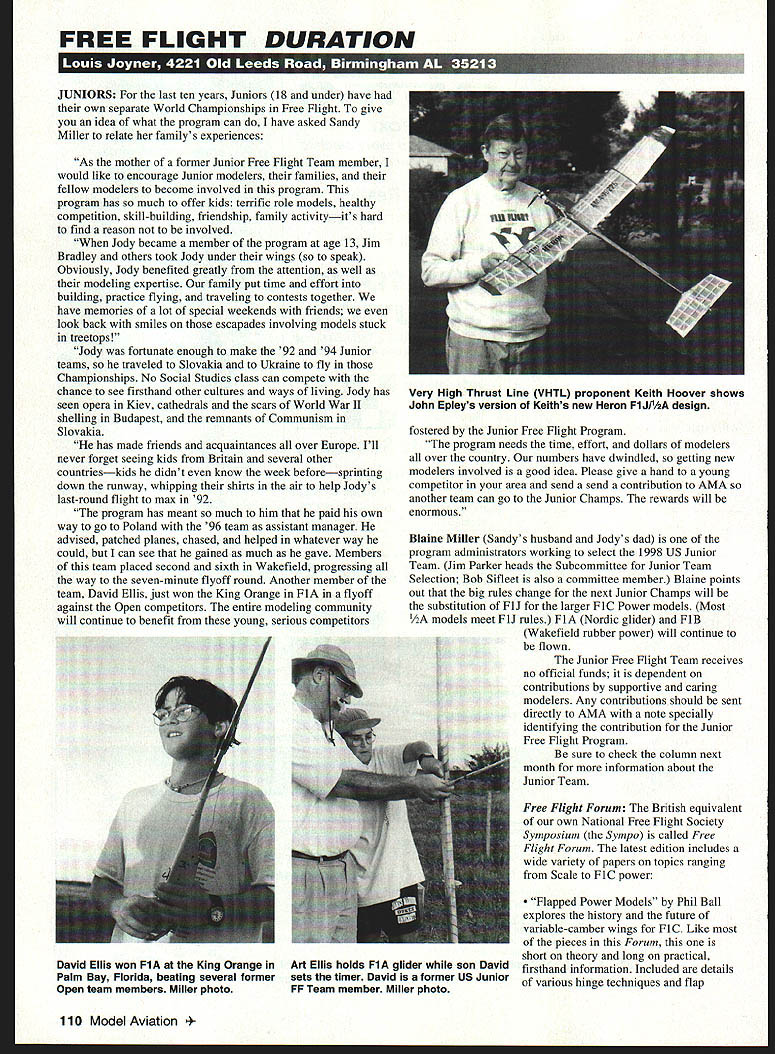
- "Simplicity for Free Flight Power," by Keith Hoover — examines the Very High Thrust Line (VHTL) as an alternative to timer-operated Variable Incidence Tailplanes (VIT). The basic idea is to mount the engine well above the wing to create a nose-down moment that counteracts increased lift under power, thereby avoiding mechanical gadgets.
The Forum also contains a lively debate between Martin Dilly and John O'Donnell over the "Builder of the Model" rule. Internationally, the requirement that the flier build his own models was eliminated for the FAI classes, but in Britain and the United States the rule remains enforced for many domestic classes. Martin argues for eliminating the rule—it's hard to enforce and the emphasis should be on flying—while John defends the broader concept of aeromodeling as including designing, building, trimming, and competing. Both make persuasive points.
To order Free Flight Forum 1996, write to Martin Dilly, 20 Links Road, West Wickham, Kent BR4 0QW, England. Cost is 7.70 pounds sterling, which includes airmail postage. Checks should be payable to "BMFA F/F Team Support Fund" in pounds sterling and drawn on a bank with a branch in the U.K.
Keith Hoover, author of the VHTL piece in the British forum, also edited the NFFS book on Power Models. If you fly power (from .020 Replica to F1C), this book is highly recommended. Order from Fred Terzian, NFFS Publications, 4858 Moorpark Ave., San Jose CA 95129. Fred may also have some copies of Free Flight Forum 1996 available, which can save you the trouble of international drafts or money orders.
NFFS News
NFFS = National Free Flight Society, the official Special Interest Group for Free Flight in the U.S.
- New president: Bob Stalick (former Free Flight columnist for Model Builder).
- New membership director: Hank Nystrom (of Texas Times fame). Thanks to Ed Sullivan for previous service.
Dues are $20 per year, which includes a year's subscription to the Free Flight Digest (10 issues per year) covering all aspects of Free Flight design, construction, and flying. Send membership applications to Hank Nystrom, NFFS Membership Chairman, 3317 Pine Timbers Dr., Johnson City TN 37604. Make checks payable to NFFS and be sure to include your AMA number.
If you're not an NFFS member but are interested in Free Flight, there is a special offer on back issues: $20 will get you approximately 30 different back issues — a great way to get up to speed or to distribute at club meetings and hobby shops. Order from NFFS Publications; supplies are limited.
Better Bits
For the last few years I have been using brad-point bits for drilling balsa, plywood, and basswood. Brad-point bits resemble standard twist drills but have two small spurs at the outer edges and a much sharper center point.
- Advantages:
- The long, sharp center point allows precise location when starting a hole.
- The spurs give a cleaner cut with very little breakout on the back side.
- They are excellent for drilling Kevlar motor tubes and pylons with minimal fraying.
- Availability:
- Inch sizes: 1/8" to 1/2" in 1/16" increments; available at good hardware or home-center stores.
- Metric sizes: 3, 4, 5, 6, 7, 8, 9, 10 mm; available from some mail-order woodworking suppliers (handy for European hardware such as wing wires or rear pegs).
One source for both inch and metric brad-point bits is Woodcraft, 210 Wood County Industrial Park, Box 1686, Parkersburg, WV 26102-1686. Toll-free for credit-card orders: (800) 225-1153; customer service: (800) 535-4482.
Transcribed from original scans by AI. Minor OCR errors may remain.

