
FREE FLIGHT DURATION
Louis Joyner, 4221 Old Leeds Road, Birmingham, AL 35213
Innovations
Free Flight, like most other sporting endeavors, is fueled by the desire to win—to prove that you and your model can fly better than the competition. We try to win in many ways: by designing better models, by improving engines and propellers, by trying new construction materials, by trimming our models more carefully, and by flying smarter than the other guys.
Often the improvements are incremental—slight changes made over years and many models—each one, hopefully, a little better than the last. Sometimes the changes are so subtle that it takes a very close look to see any change at all. But the cumulative effect, over time, of a series of small changes can be marked.
Other improvements are more dramatic, or even revolutionary. A major development, such as the glow plug or the pylon, can change the game of Free Flight forever.
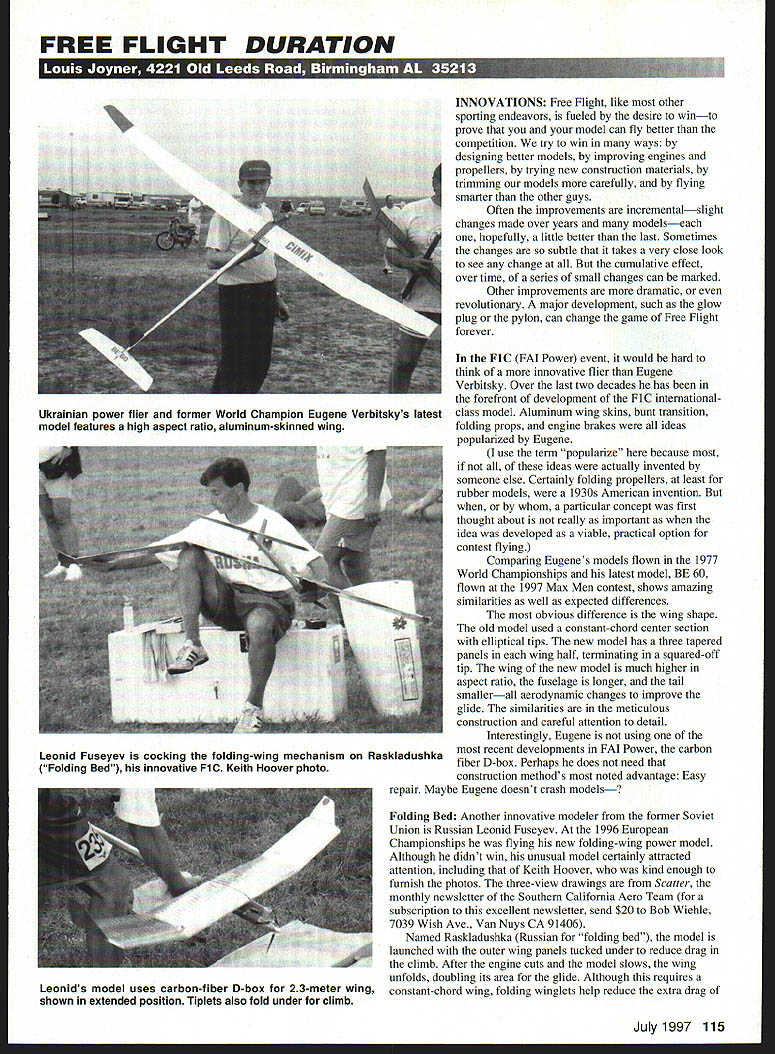
In the F1C (FAI Power) event, it would be hard to think of a more innovative flier than Eugene Verbitsky. Over the last two decades he has been at the forefront of development of the F1C international-class model. Aluminum wing skins, built transition, folding props, and engine brakes were all ideas popularized by Eugene.
(I use the term "popularize" here because most, if not all, of these ideas were actually invented by someone else. Certainly folding propellers, at least for rubber models, were a 1930s American invention. But when, or by whom, a particular concept was first thought about is not really as important as when the idea was developed as a viable, practical option for contest flying.)
Comparing Eugene's models flown in the 1977 World Championships and his later BE-60 model flown at the 1997 Max Men contest shows both striking similarities and expected differences. The most obvious difference is the wing shape. The older model used a constant-chord center section with elliptical tips. The newer model has three tapered panels in each wing half, terminating in a squared-off tip. The new wing is much higher in aspect ratio; the fuselage is longer, and the tail smaller—these are all aerodynamic changes to improve glide. The similarities are in the meticulous construction and careful attention to detail.
Interestingly, Eugene is not using one of the most recent developments in FAI Power, the carbon-fiber D-box. Perhaps he does not need that construction method's most noted advantage: easy repair. Maybe Eugene doesn't crash models—?
Folding Bed
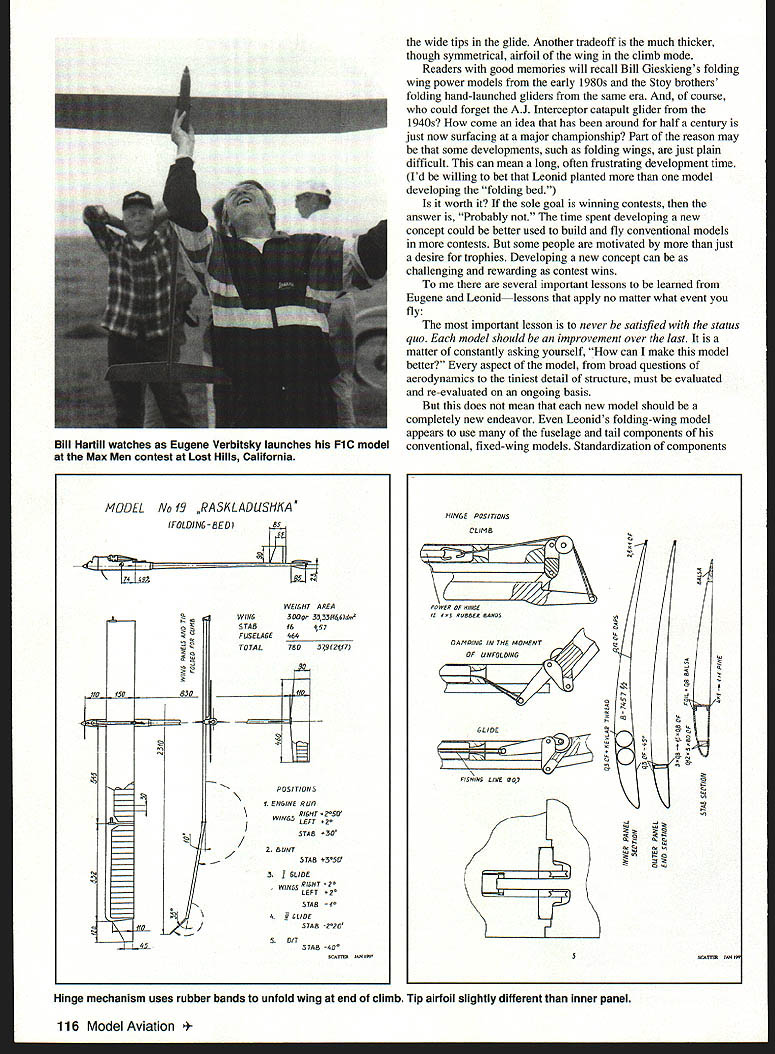
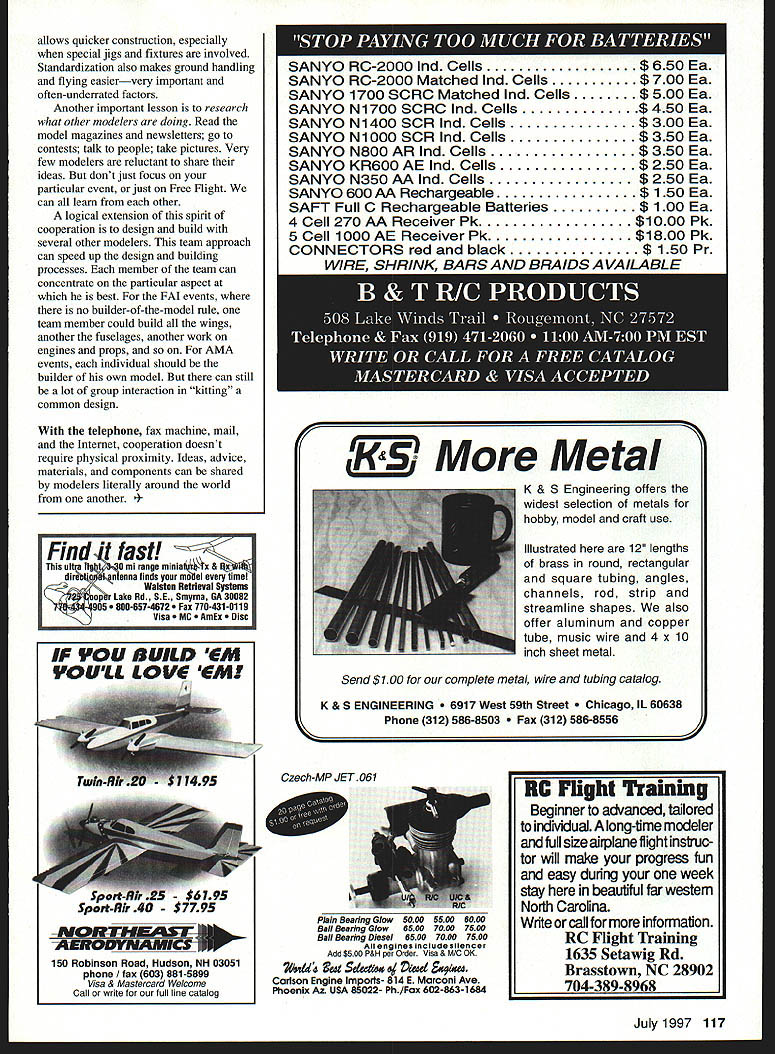
Another innovative modeler from the former Soviet Union is Russian Leonid Fuseyev. At the 1996 European Championships he flew his new folding-wing power model. Although he didn't win, his unusual model certainly attracted attention, including that of Keith Hoover, who supplied photos. The three-view drawings are from Scatter, the monthly newsletter of the Southern California Aero Team (for a subscription to this excellent newsletter, send $20 to Bob Wiehle, 7039 Wish Ave., Van Nuys, CA 91406).
Named Raskladushka (Russian for "folding bed"), the model is launched with the outer wing panels tucked under to reduce drag during the climb. After the engine cuts and the model slows, the wing unfolds, doubling its area for the glide. Although this requires a constant-chord wing, folding winglets help reduce the extra drag of a constant-chord wing in climb mode.
Readers with good memories will recall Bill Gieskieng's folding-wing power models of the early 1980s and the Stoy brothers' folding hand-launched gliders from the same era. And, of course, who could forget the A.J. Interceptor catapult glider from the 1940s? The idea has been around for half a century and is just now resurfacing at major championships.
Development and tradeoffs
Part of the reason folding wings and similar developments take so long to appear in top competition is that they are simply difficult. Development can mean long, often frustrating months of trial and error. Leonid likely planted more than one model developing the "folding bed."
There are design tradeoffs with folding wings. Making a wing foldable often forces a constant-chord center section, which increases drag in climb mode. Folding winglets help reduce that extra drag, but other compromises remain: the need for mechanisms and latches, potential weight penalties, and compromises in airfoil selection. One possible tradeoff is a thicker, more symmetrical airfoil optimized for climb when the wing is tucked, while relying on wider tips and higher aspect ratio in the unfolded glide to regain performance.
Is the extra development time worth it? If the sole goal is winning contests, the answer is probably not—time spent developing a novel concept could often be better used building and flying conventional models in more contests. But many designers are motivated by more than trophies; developing a new concept can be challenging and rewarding in its own right and can teach valuable lessons even without contest wins.
Lessons
Eugene's and Leonid's experiences offer lessons that apply no matter what event you fly:
- Never be satisfied with the status quo. Each model should be an improvement over the last. Constantly ask, "How can I make this model better?" Evaluate and re-evaluate every aspect, from aerodynamics to the tiniest structural detail.
- Standardize components where practical. This does not mean every model must be completely new. Even Leonid's folding-wing model appears to use many of the same fuselage and tail components as his fixed-wing models. Standardization allows quicker construction, especially when special jigs and fixtures are involved, and it simplifies ground handling and flying—often underrated factors.
- Research what other modelers are doing. Read magazines and newsletters; go to contests; talk to people; take pictures. Very few modelers are reluctant to share their ideas. Don't limit your focus to a single event—designs and techniques from other classes and disciplines can be instructive.
- Collaborate. Designing and building with other modelers can speed up the process. Each team member can concentrate on what he does best. For FAI events, where there is no builder-of-the-model rule, one member could build wings, another fuselages, another work on engines and props. For AMA events, individuals should build their own models, but group interaction—"kitting" a common design—can still be valuable.
- Use modern communications. With telephone, fax, mail, and the Internet, cooperation doesn't require physical proximity. Ideas, advice, materials, and components can be shared worldwide.
The ongoing spirit of improvement, study, and cooperation will continue to push Free Flight development forward—whether through incremental refinements or the occasional revolutionary idea.
Transcribed from original scans by AI. Minor OCR errors may remain.

