
FREE FLIGHT — DURATION
Louis Joyner, 4221 Old Leeds Road, Birmingham, AL 35213
World Championships
The World Championships for FIA (glider), FIB (Wakefield rubber), and FIC (power) will be held in Sazena, Czech Republic, August 18–24.
U.S. team members:
- FIA (glider): Randy Weiler, Don Zink, Martyn Cowley
- FIB (Wakefield rubber): Blake Jensen, Roger Morrell, Fred Pearce
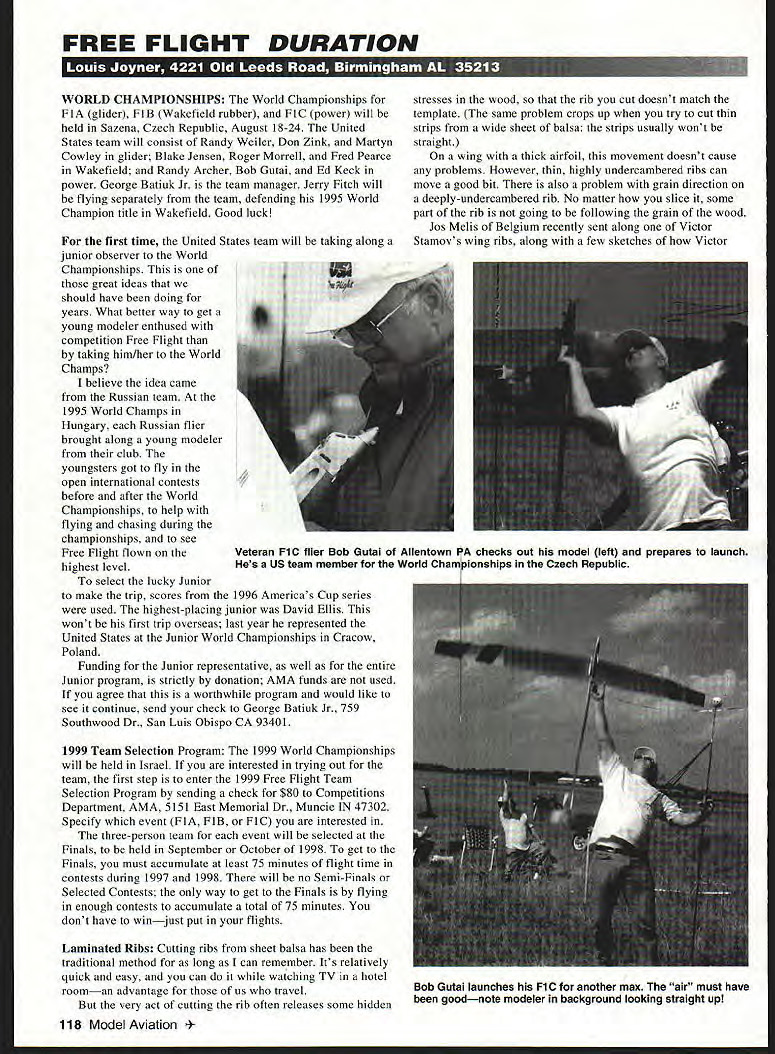
- FIC (power): Randy Archer, Bob Gutai, Ed Keck
- Team manager: George Batiuk Jr.
Jerry Fitch will be flying separately from the team to defend his 1995 World Champion title in Wakefield. Good luck to all!
Junior Observer
For the first time, the United States team will be taking along a junior observer to the World Championships. This is a great idea for encouraging young modelers to get involved with competitive Free Flight. The concept was inspired by the Russian team at the 1995 World Championships in Hungary, where each Russian flier brought a young modeler from their club to fly in open international contests, help with flying and chasing during the championships, and observe top-level Free Flight.
Selection for the U.S. junior representative used scores from the 1996 America's Cup series. The highest-placing junior was David Ellis, who previously represented the United States at the Junior World Championships in Cracow, Poland.
Funding for the junior representative and the entire junior program is strictly by donation; AMA funds are not used. If you would like to support the program, send donations to: George Batiuk Jr. 759 Southwood Dr. San Luis Obispo, CA 93401
1999 Team Selection Program
The 1999 World Championships will be held in Israel. To try out for the U.S. team, enter the 1999 Free Flight Team Selection Program by sending a check for $80 to: Competitions Department, AMA 5151 East Memorial Dr. Muncie, IN 47302 Specify which event (FIA, FIB, or FIC) you are entering.
Selection details:
- The three-person team for each event will be selected at the Finals, to be held in September or October 1998.
- To qualify for the Finals, you must accumulate at least 75 minutes of flight time in contests during 1997 and 1998.
- There will be no Semi-Finals or Selected Contests; the only way to reach the Finals is by flying in enough contests to total 75 minutes.
- You do not have to win contests—just record flights to reach the required total.
Laminated Ribs
Cutting ribs from sheet balsa has been the traditional method for many years. It’s quick and convenient, but cutting often releases hidden stresses in the wood so that the cut rib doesn’t exactly match the template. This is especially a problem with thin, highly undercambered ribs; parts of a deep undercamber may not follow the grain, causing movement and warpage.
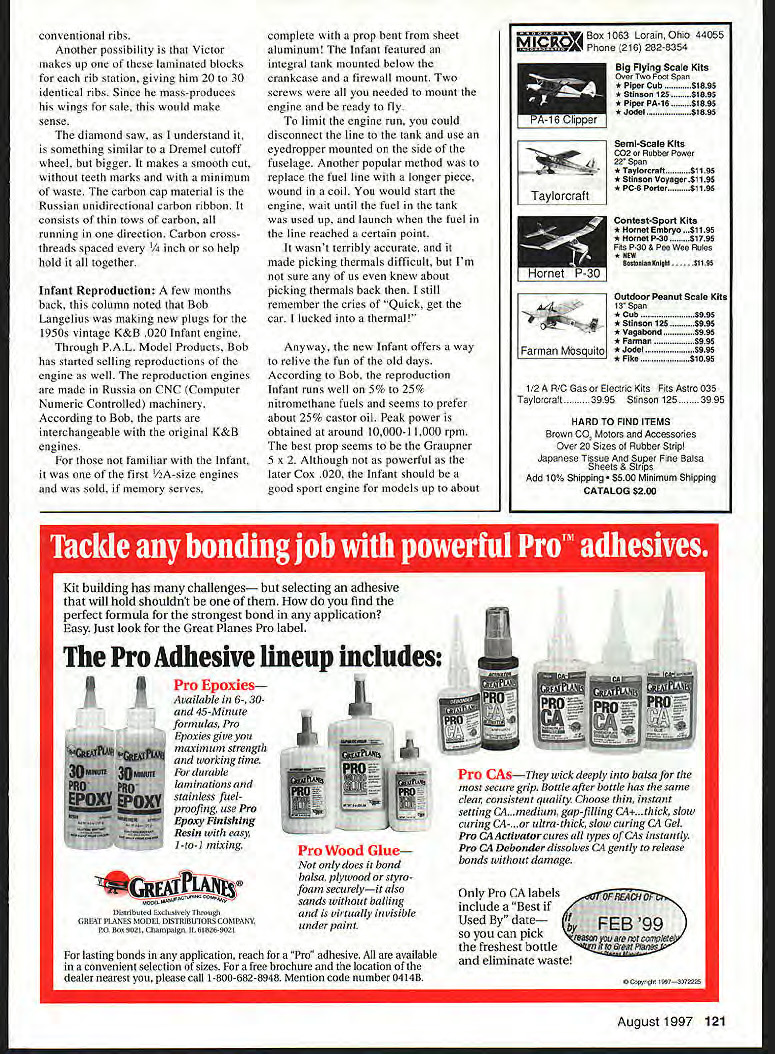
Jos Melis of Belgium recently sent one of Victor Stamov’s wing ribs and sketches showing how Victor laminates balsa with the grain chordwise. Victor’s method (summarized) is:
- Laminate narrow stacks from 1/16" (1.5 mm) sheet balsa with the grain running chordwise.
- Epoxy the stacked sheets to the desired total thickness.
- Bend and glue the laminated stack over a form to match the undercamber.
- After the epoxy cures, carve and sand the upper part to shape and add a carbon cap.
- Finally slice the ribs off “salami-style” to the desired thickness.
Notes on Victor’s construction:
- These ribs are for the aft part of an F1A Nordic glider wing, which typically uses a full-depth carbon-fiber spar and a carbon D-box as the main structure. The aft ribs and carbon trailing edge are added after that. Thin carbon-fiber caps help lock the structure together, creating a strong, light wing.
- The wing planform has tapered main and tip panels. Victor may produce a laminated block for each rib station (mass-producing identical ribs) or sand the top of a full block to produce taper—similar to stacked-rib methods used with conventional ribs.
- Victor uses a diamond saw (similar to a larger Dremel cutoff wheel) to make smooth, low-waste cuts.
- The carbon cap material is Russian unidirectional carbon ribbon: thin tows running in one direction with cross-threads spaced about 1/4" to hold the bundle together.
Infant Reproduction
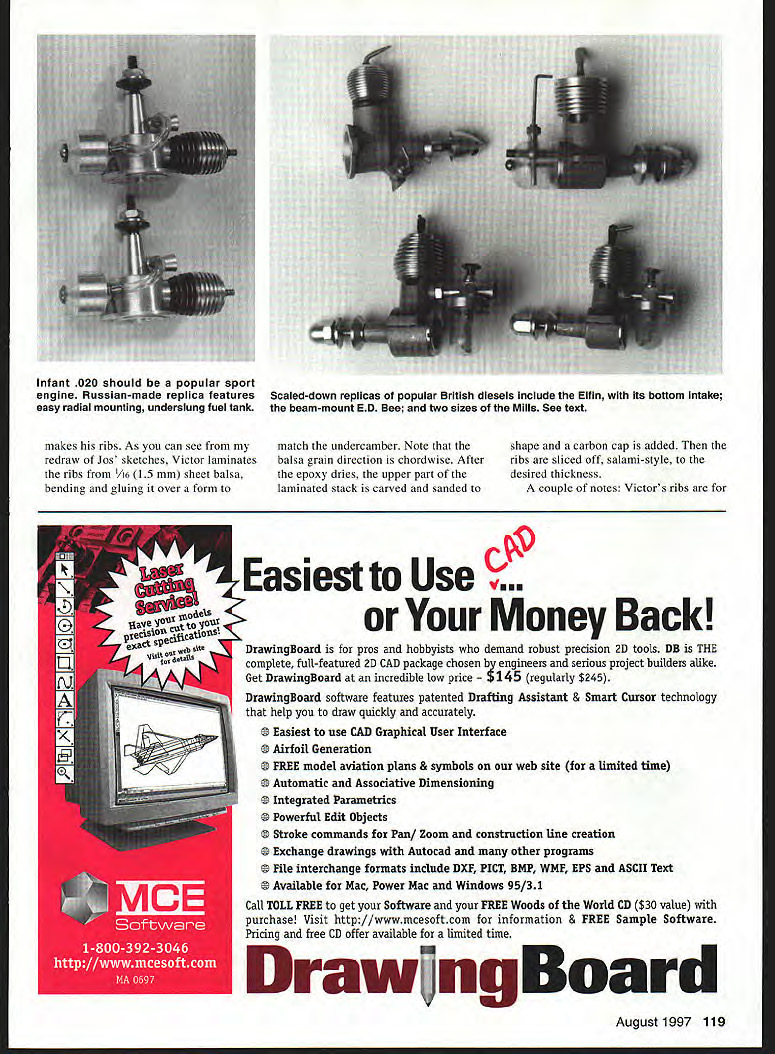
A few months back this column noted that Bob Langeluis was making new plugs for the 1950s vintage K&B .020 Infant engine. Through P.A.L. Model Products, Bob has started selling reproductions of the engine made in Russia on CNC machinery. According to Bob, parts are interchangeable with the original K&B engines.
About the Infant:
- One of the first 1/2A-size engines, originally sold with a prop bent from sheet aluminum.
- Featured an integral tank mounted below the crankcase and a firewall mount; two screws were all that was needed to mount it.
- Fuel limitation methods included disconnecting the tank line and using an eyedropper, or using a long coiled fuel line and timing launch when the fuel ran out.
The new reproduction:
- Runs well on 5%–25% nitromethane fuels and seems to prefer ~25% castor oil.
- Peak power around 10,000–11,000 rpm.
- Best prop appears to be the Graupner 5 x 2.
- Suitable as a sport engine for models up to about 36" wingspan and ~8 oz weight.
Ordering:
- P.A.L. Model Products Infant .020 replica: $75 + $4.50 shipping.
- Plastic display box: additional $5.
- New York residents add sales tax ($6.16 or $6.54 with the display box).
- P.A.L. Model Products, 32 Clinton Street, White Plains, NY 10603
- Tel: (914) 949-6083 (call between 9 a.m. and 7 p.m. Eastern). Visa and MasterCard accepted.
More Repros
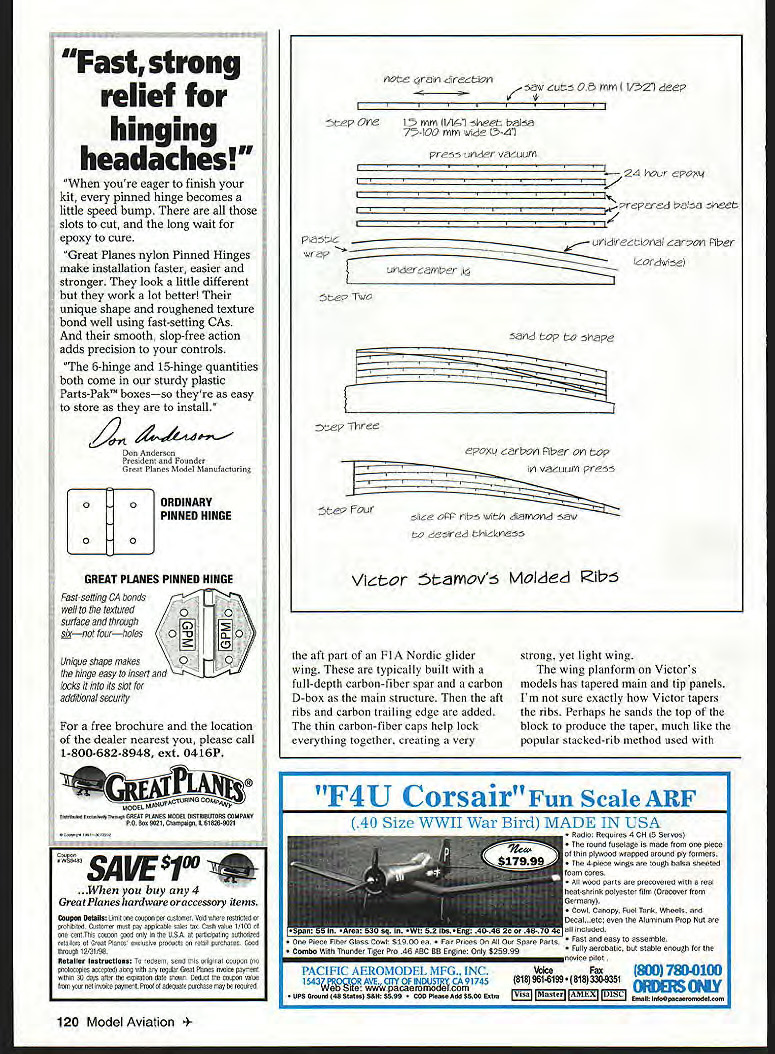
Richard Palmer reports on four new sport diesel replicas imported from Russia, produced by the same makers of the V.A. .049 competition engines. The engines:
- E.D. Bee — 0.47 cc (.030 ci) — $86
- Elfin — 0.3266 cc (.020 ci) — $82
- Mills — 0.40 cc (.024 ci) — $86
- Mills — 0.25 cc (.014 ci) — $90
- Shipping: $3 (New York residents add sales tax)
Performance note: The Elfin replica turns a Graupner 5 x 2 prop at 16,200–16,400 rpm, which compares favorably to a TD .020 turning 19,000 rpm on a Cox 4 x 2½ prop.
Ordering: R. N. Palmer Box 609 Palisades, NY 10964-0609 Tel/Fax: (914) 359-9240
Polyspan Update
Starline International’s Polyspan covering material is a white non-woven polyester that resembles silkspan but requires slightly different techniques. I’ve found it among the easiest covering materials to use. Sal Franciano, owner of Starline, offers these suggestions:
Key points:
- Orientation: Put the material on right-side up (shiny side out). Rolls are labeled; the shiny side will be outside.
- Grain: Polyspan has a grain that should run spanwise on the model (the grain runs the long way on the roll). Tear a small sample to check—Polyspan tears easier with the grain, like tissue.
- Adhesive: Best adhesive is nitrate dope (stickier than butyrate). Sig nitrate straight from the can works well.
- Covering sequence: Cover the bottom of the wing first so you can ensure the covering is attached to every rib on an undercambered wing. Brush a narrow band of dope on each side of every rib (working from above) to prevent the covering from pulling away.
- For wings with narrow carbon-fiber trailing edges: cover each panel in one piece, starting at the bottom leading edge, go around the trailing edge, and lap slightly over the leading edge. Use a hot iron to help the material form sharp curves at leading and trailing edges.
- Shrinking and finishing: After the dope has dried, use a hot iron to shrink wrinkles, then apply two to three coats of 50/50 nitrate dope. For color, mix dye with the dope and spray. After the dope is thoroughly dry, a hot iron can remove remaining wrinkles or sags.
- Fuelproofing: Sal recommends clear epoxy paint.
- Repairs: Polyspan is tough, but near-invisible patches can be made by feathering patch edges with fine sandpaper before doping in place.
Availability and price:
- Polyspan roll: $15 (20" wide x 12' long) + $3 shipping.
- Available from most mail-order Free Flight suppliers or directly from Starline International:
Starline International 6146 E. Cactus Wren Rd. Scottsdale, AZ 85253
Transcribed from original scans by AI. Minor OCR errors may remain.

