
FREE FLIGHT: DURATION
Louis Joyner, 4221 Old Leeds Road, Birmingham, AL 35213
ONE OF THE SUREST WAYS to stir up a hornet's nest is to start talking about rules changes. A regular stirrer, Aram Schlosberg, has prompted a lot of discussion in recent years about splitting FAI events (F1A towline glider, F1B Wakefield rubber, F1C power) into technical and nontechnical branches. That would allow those who want to opt out of the high‑tech "horsepower" race to enjoy flying at a more relaxed level. The split could be achieved by limiting wingspan (reducing the structural advantage of composite materials) and by restricting automated functions (bunt, auto‑stab, auto‑rudder, variable‑pitch props, delayed prop release, etc.) to reduce model complexity.
Revamping the mini events (Aram's proposal)
Aram's latest suggestion is to make the mini events (F1J power, F1H towline, F1G Coupe) less technically demanding and use them as the nontechnical counterparts to F1A, F1B, and F1C. His specific ideas:
- F1H (mini towline glider)
- Increase total wing area to 24 sq dm (372 sq in.) to make models easier to tow.
- Reduce towline length from 50 m to 35 m.
- Eliminate any weight requirement.
- Keep the maximum flight time at two minutes.
- F1G (Coupe)
- Increase rubber allowance from 10 g to 15 g.
- Eliminate all auto surfaces except auto‑rudder.
- This gives Coupes extra power for windy conditions and discourages turning them into miniature Wakefields with extensive automation.
- F1J (mini power)
- Keep the event as is but provide a parallel nontechnical event permitting only auto‑rudder.
- Rather than create a new event, Aram suggests AMA 1/2A become the nontechnical counterpart (auto‑rudder only).
- Engine displacement for that nontechnical event would increase to 1 cc (0.061 cu in).
- To level the field: .049s allowed a seven‑second engine run; .061s allowed a five‑second run.
Contest format proposals
Aram also suggested changing the contest format for mini events:
- Replace flying in rounds with five flights any time within a five‑hour window. This allows competitors to fly multiple events, accommodates late arrivals and early departures, and generally adds flexibility.
- One of the five regular flights could be designated as a provisional flyoff flight (a "wild card"). The competitor must declare the wild card flight before making it. Time beyond the normal 120‑second max on the wild card would count only if the competitor maxed all five flights.
- Double the time counted in excess of 120 seconds for flights made in nonthermal conditions (before 8 a.m. or after 5 p.m.).
I agree with much of Aram's thinking. Flyoffs staged in the middle of the afternoon often face booming thermals; pushing flyoffs to early evening delays prizegiving and travel home. A simpler approach to achieve similar results would be to use an extended first‑round maximum (for example, 180 seconds for the mini events) and schedule that round early, when thermal activity and drift are minimal. Aram noted that the Israelis have used that idea for years.
I hope these suggestions get your creative juices flowing (or your blood boiling). I would appreciate hearing ideas for developing events and contest formats that increase participation.
Instant Start (Delayed Prop Release and variations)
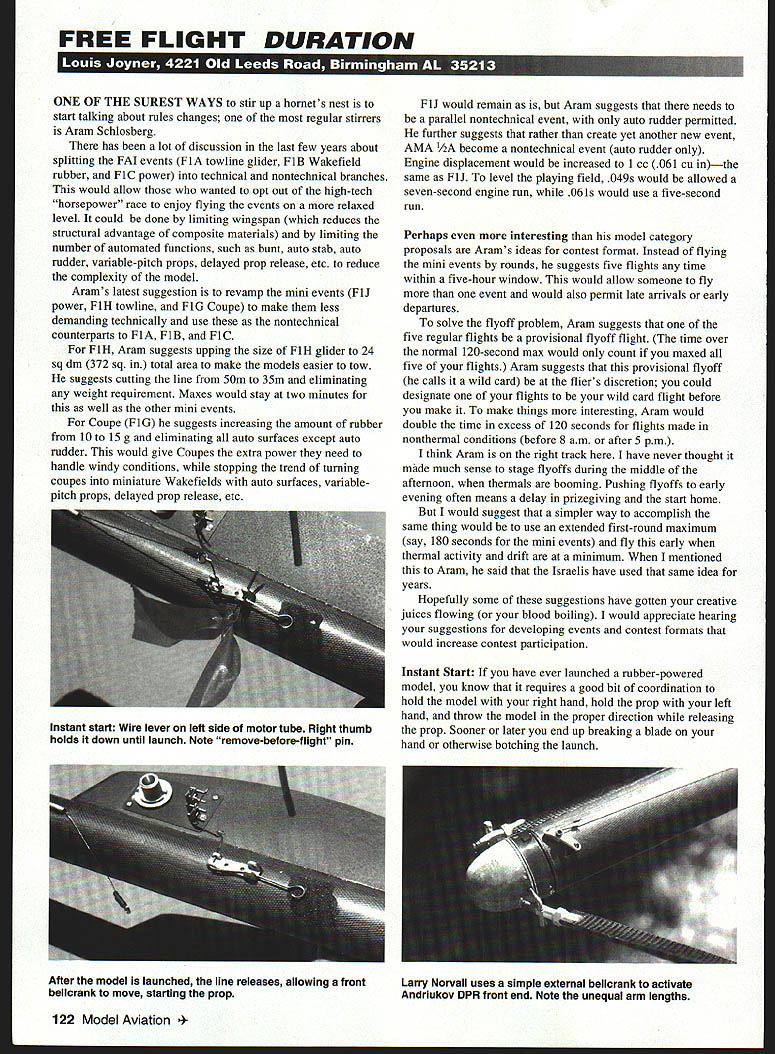
If you've ever launched a rubber‑powered model, you know the coordination required: hold the model in one hand, the prop in the other, and release both correctly. Delayed Prop Release (DPR) offers a one‑handed launch: throw the model hard and straight up; a timer releases the catch and the prop starts turning. Properly done, a DPR launch is spectacular; improperly done, it can be a disaster. If the delay is too long the model can stall and drop its nose — and, as Murphy's law predicts, that's often when the prop will kick in.
Common DPR hardware and practices:
- A timer‑start switch is often mounted on the right side of the pylon; a pull‑pin locks the latch during winding. Failures I've experienced were usually due to forgetting to pull the pin before launch or to sloppy engineering of the release cable that allowed the loop on the end of the cable to catch on an aluminum bracket.
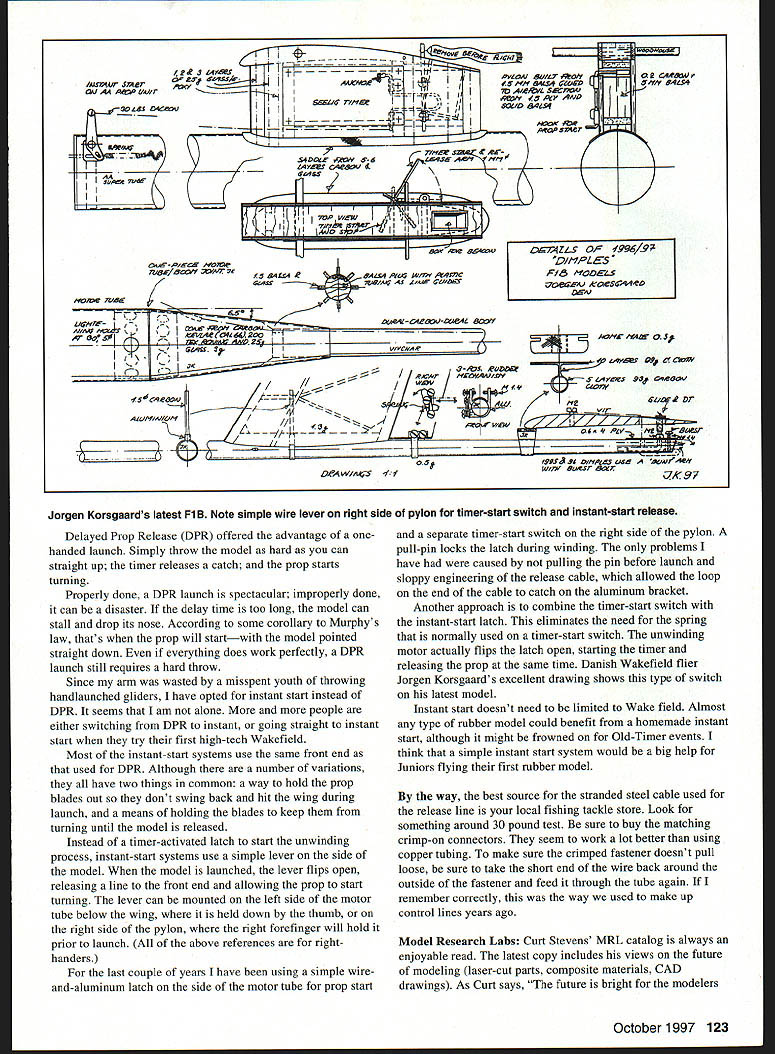
- Another reliable approach is to combine the timer‑start switch with an instant‑start latch. The unwinding motor flips the latch open, which both starts the timer and releases the prop at the same time — eliminating the need for an extra spring. Danish Wakefield flier Jorgen Korsgaard has an excellent drawing of this type of switch on his latest model.
- Instant start systems are not limited to Wakefields; almost any rubber model can benefit. They can be especially helpful for juniors flying their first rubber models, though such systems might be frowned upon in Old‑Timer events.
Practical tip: the best source for stranded steel cable for the release line is a local fishing tackle store; look for about 30‑pound test and buy matching crimp‑on connectors. They generally work better than copper tubing. To ensure the crimped fastener doesn't pull loose, take the short end of the wire back around the outside of the fastener and feed it through the tube again — the same technique used for control lines years ago.
Model Research Labs
Curt Stevens' Model Research Labs (MRL) catalog is always an enjoyable read. The latest copy discusses the future of modeling — laser‑cut parts, composite materials, CAD drawings — and, as Curt says, "The future is bright for the modelers."
Transcribed from original scans by AI. Minor OCR errors may remain.

