
FREE FLIGHT DURATION
Louis Joyner, 4221 Old Leeds Road, Birmingham AL 35213
John O'Dwyer's DPR system
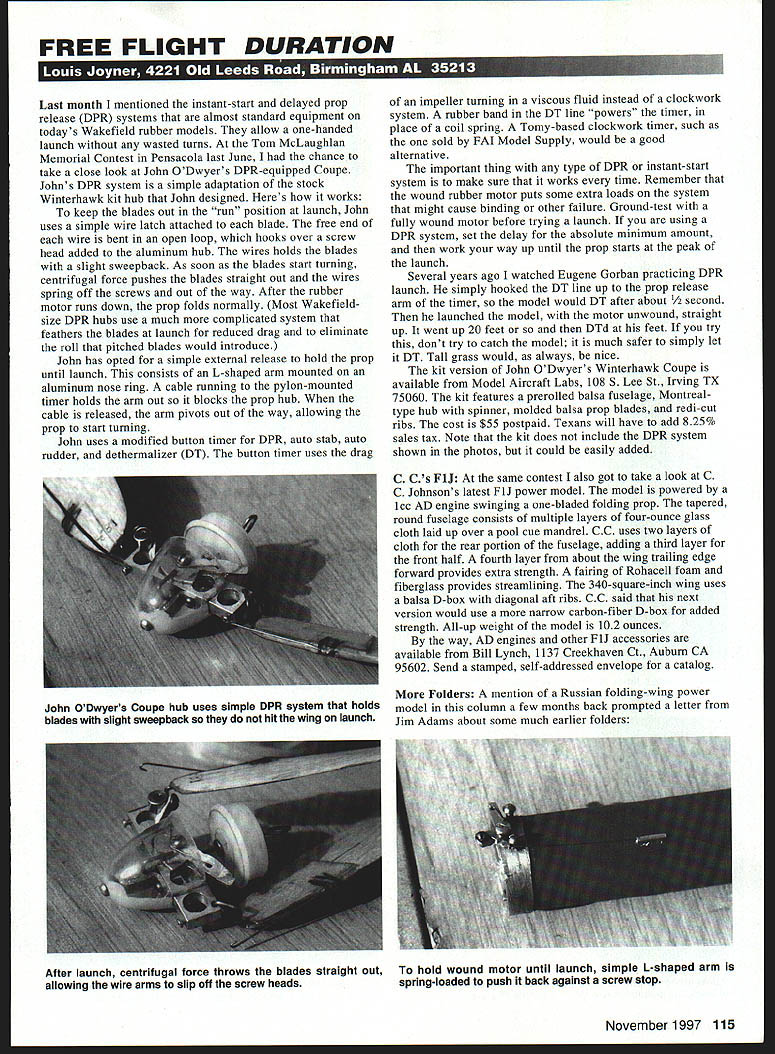
Last month I mentioned the instant-start and delayed prop release (DPR) systems that are almost standard equipment on today's Wakefield rubber models. They allow a one-handed launch without any wasted turns. At the Tom McLaughlan Memorial Contest in Pensacola last June, I had the chance to take a close look at John O'Dwyer's DPR-equipped Coupe. John's DPR system is a simple adaptation of the stock Winterhawk kit hub that he designed. Here's how it works.
- To keep the blades out in the "run" position at launch, John uses a simple wire latch attached to each blade. The free end of each wire is bent into an open loop, which hooks over a screw head added to the aluminum hub. The wires hold the blades with a slight sweepback.
- As soon as the blades start turning, centrifugal force pushes the blades straight out and the wires spring off the screws and out of the way. After the rubber motor runs down, the prop folds normally.
- Most Wakefield-size DPR hubs use a much more complicated system that feathers the blades at launch for reduced drag and to eliminate the roll that pitched blades would introduce. John has opted for a simple external release to hold the prop until launch: an L-shaped arm mounted on an aluminum nose ring. A cable running to the pylon-mounted timer holds the arm out so it blocks the prop hub. When the cable is released, the arm pivots out of the way, allowing the prop to start turning.
Timer and control details
John uses a modified button timer for DPR, auto stab, auto rudder, and dethermalizer (DT). The button timer uses the drag of an impeller turning in a viscous fluid instead of a clockwork system. A rubber band in the DT line "powers" the timer, in place of a coil spring. A Tomy-based clockwork timer, such as the ones sold by FAI Model Supply, would be a good alternative.
The important thing with any type of DPR or instant-start system is to make sure that it works every time. Remember that the wound rubber motor puts some extra loads on the system that might cause binding or other failure.
Ground test and launch tips
- Ground-test with a partially wound motor before trying a live launch.
- If you are using a DPR system, set the delay for the absolute minimum amount and then work your way up until the prop starts at the peak of the launch.
- Do not try novelty tests that may be unsafe. For example, several years ago I watched Eugene Gorban practicing DPR launch: he hooked the DT line up to the prop release arm of the timer so the model would DT after about 1/2 second, launched the model (with the motor unwound) straight up, and it went up 20 feet or so then DT'd at his feet. If you try this, don't try to catch the model; it is much safer to simply let it DT. Tall grass is, as always, useful.
Kit information
The kit version of John O'Dwyer's Winterhawk Coupe is available from Model Aircraft Labs, 108 S. Lee St., Irving, TX 75060. The kit features:
- Prerolled balsa fuselage
- Montreal-type hub with spinner
- Molded balsa prop blades
- Redi-cut ribs
The cost is $55 postpaid (Texans add 8.25% sales tax). Note that the kit does not include the DPR system shown in the photos, but it could be easily added.
C. C.'s F1J
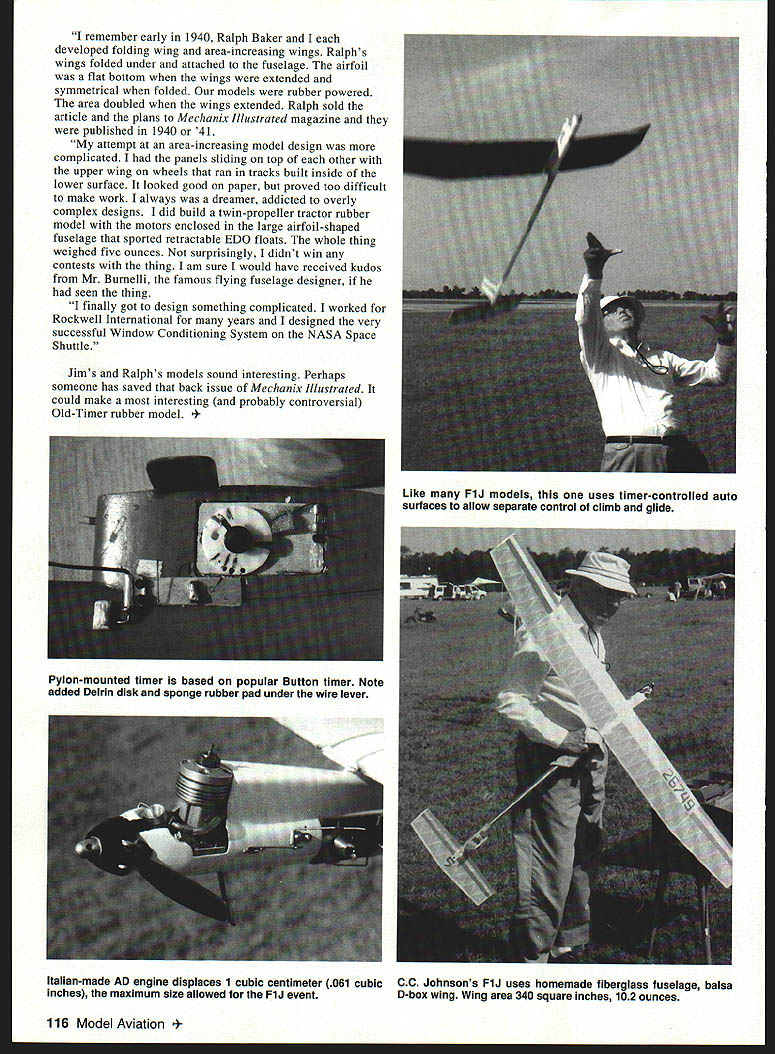
At the same contest I got to take a look at C. C. Johnson's latest F1J power model. The model is powered by a 1 cc AD engine swinging a one-bladed folding prop. Construction details:
- Tapered, round fuselage made from multiple layers of 4-ounce glass cloth laid up over a pool-cue mandrel.
- Two layers of cloth for the rear portion
- A third layer for the front half
- A fourth layer from about the wing trailing edge forward for extra strength
- A fairing of Rohacell foam and fiberglass provides streamlining.
- The 340-square-inch wing uses a balsa D-box with diagonal aft ribs. C. C. said his next version would use a narrow carbon-fiber D-box for added strength.
All-up weight of the model is 10.2 ounces.
By the way, AD engines and other F1J accessories are available from Bill Lynch, 1137 Creekhaven Ct., Auburn CA 95602. Send a stamped, self-addressed envelope for a catalog.
More folders
A mention of a Russian folding-wing power model in this column a few months back prompted a letter from Jim Adams about some much earlier folders:
"I remember early in 1940, Ralph Baker and I each developed folding wing and area-increasing wings. Ralph's wings folded under and attached to the fuselage. The airfoil was a flat bottom when the wings were extended and symmetrical when folded. Our models were rubber powered. The area doubled when the wings extended. Ralph sold the article and the plans to Mechanix Illustrated magazine and they were published in 1940 or '41.
"My attempt at an area-increasing model design was more complicated. I had the panels sliding on top of each other with the upper wing on wheels that ran in tracks built inside of the lower surface. It looked good on paper, but proved too difficult to make work. I always was a dreamer, addicted to overly complex designs. I did build a twin-propeller tractor rubber model with the motors enclosed in the large airfoil-shaped fuselage that sported retractable EDO floats. The whole thing weighed five ounces. Not surprisingly, I didn't win any contests with the thing. I am sure I would have received kudos from Mr. Burnelli, the famous flying fuselage designer, if he had seen the thing.
"I finally got to design something complicated. I worked for Rockwell International for many years and I designed the very successful Window Conditioning System on the NASA Space Shuttle."
Jim's and Ralph's models sound interesting. Perhaps someone has saved that back issue of Mechanix Illustrated. It could make a most interesting (and probably controversial) Old-Timer rubber model.
Transcribed from original scans by AI. Minor OCR errors may remain.

