
FREE FLIGHT DURATION
Louis Joyner, 4221 Old Leeds Road, Birmingham, AL 35213
Why go to the Nats?
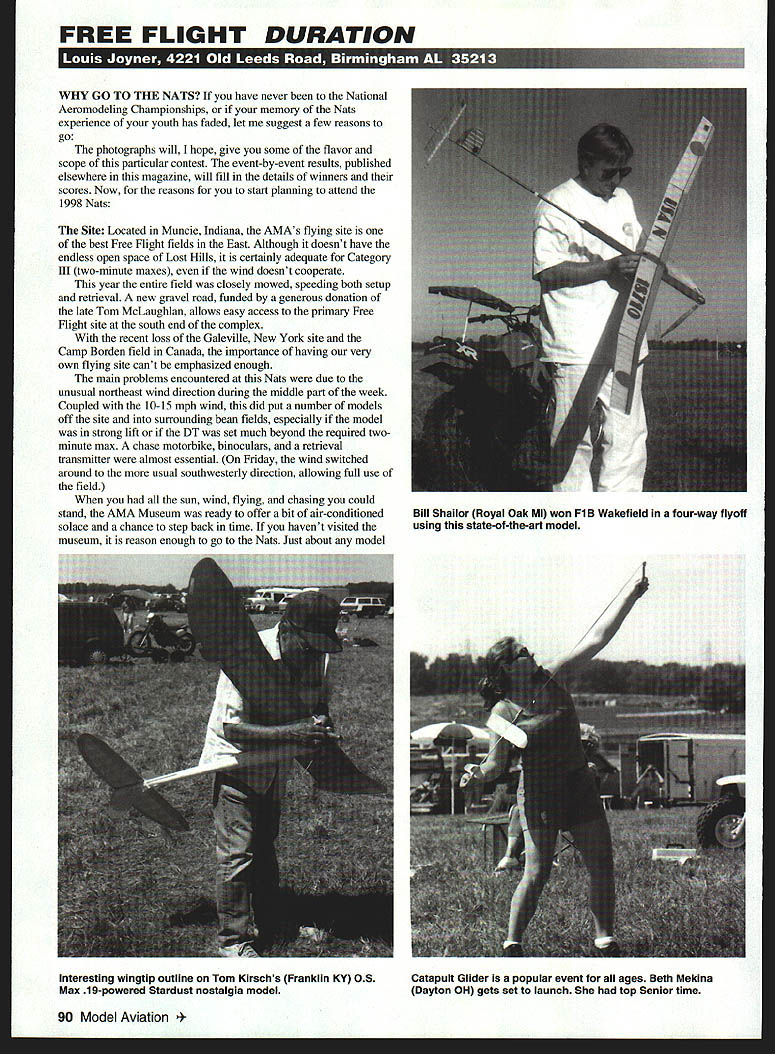
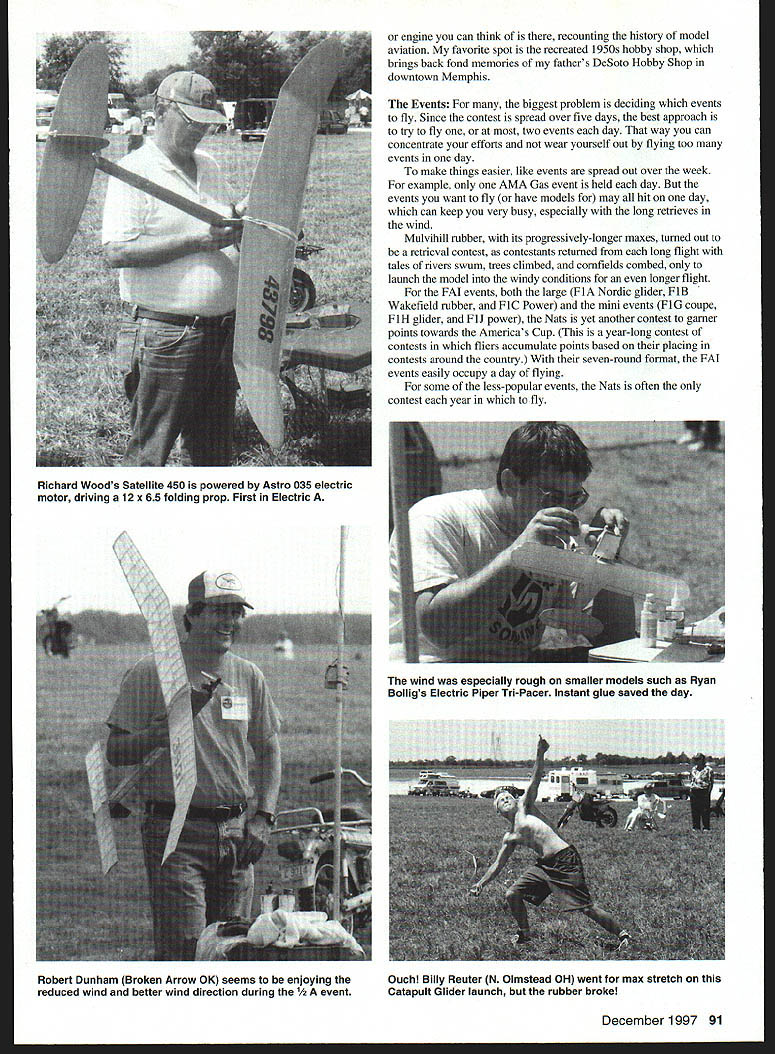
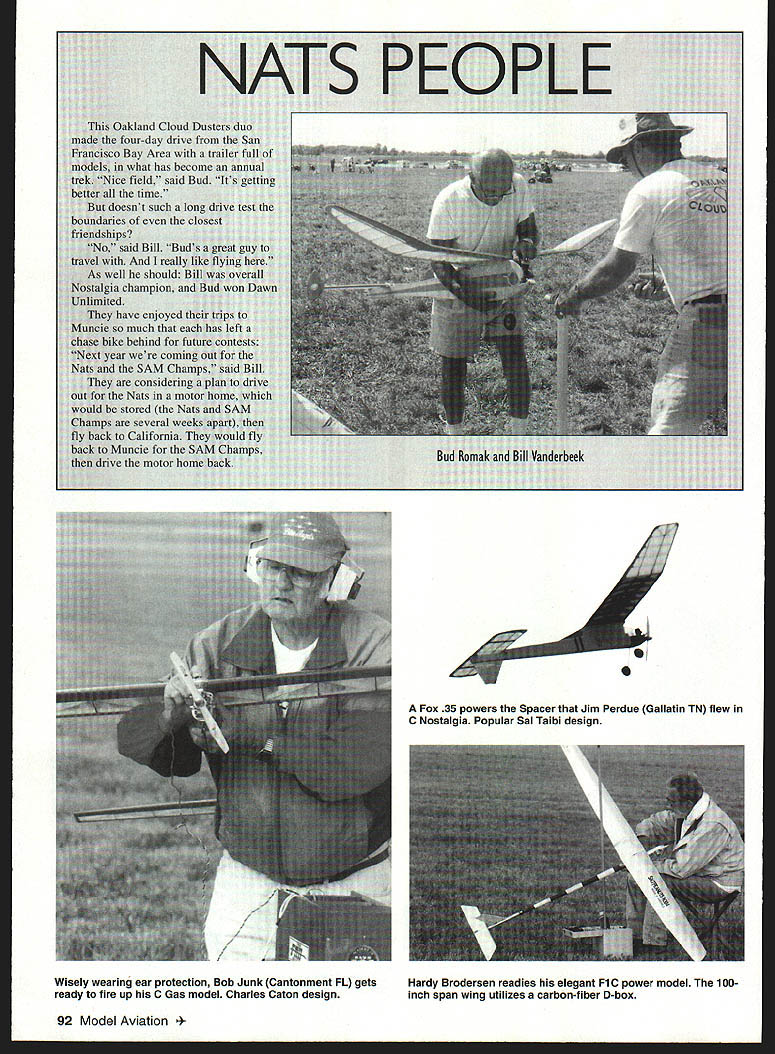
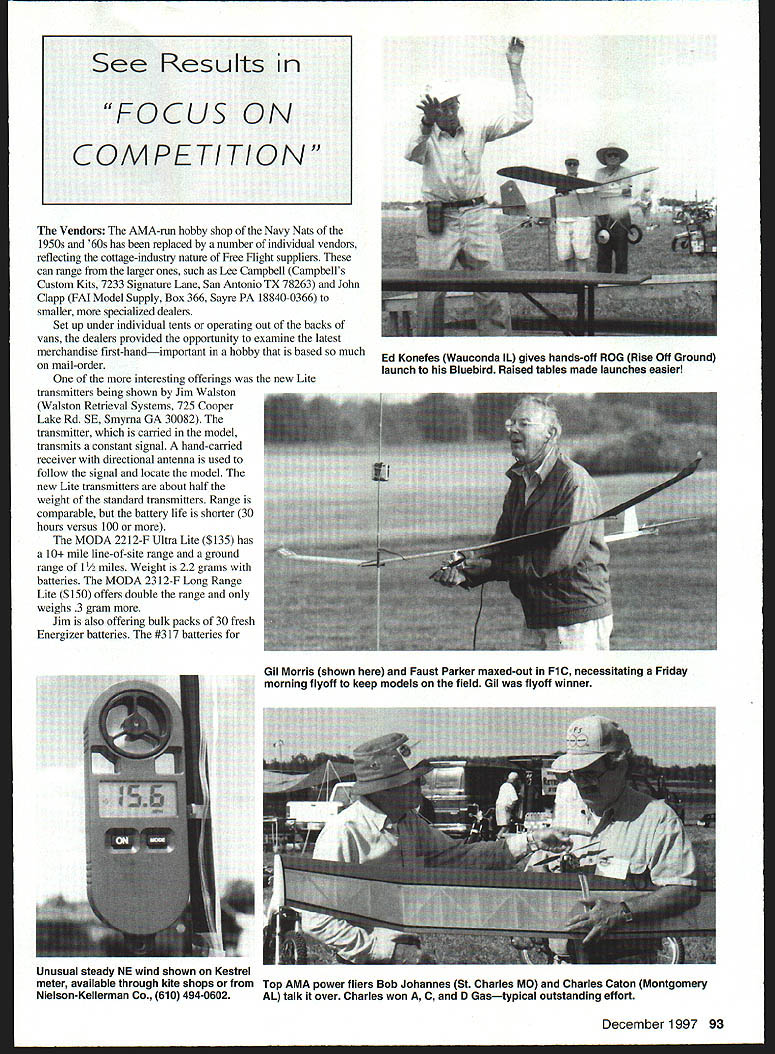
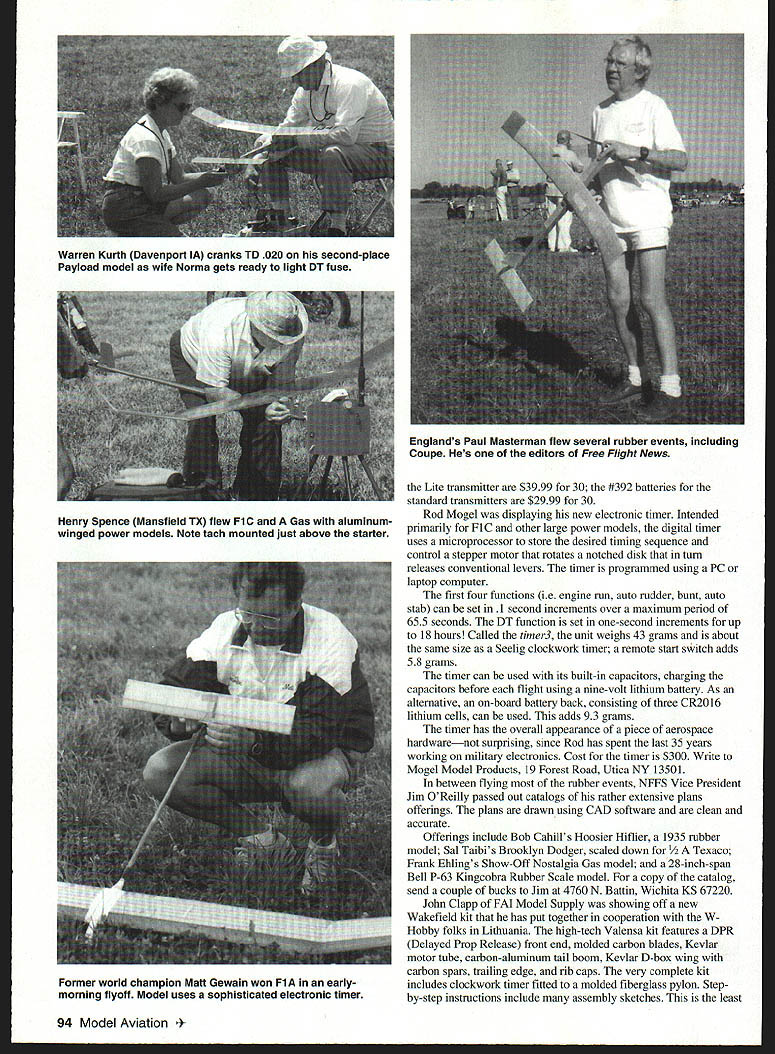
If you have never been to the National Aeromodeling Championships, or if your memory of the Nats experience from your youth has faded, here are a few reasons to go. Photographs can give some of the flavor and scope; event-by-event results (published elsewhere in the magazine) fill in winners and scores. Below are practical reasons to start planning to attend the Nats.
The Site
- Location: Muncie, Indiana — the AMA flying site is one of the best Free Flight fields in the East. While it doesn't have the endless open space of Lost Hills, it is adequate for Category III (two-minute maxes).
- Field improvements: The entire field was closely mowed this year, speeding setup and retrieval. A new gravel road (funded by the late Tom McLaughlan) provides easy access to the primary Free Flight site at the south end of the complex.
- Importance: With the recent loss of the Galeville, NY site and the Camp Borden field in Canada, having our own flying site is increasingly important.
- Wind issues: The main problems this Nats were caused by an unusual northeast wind during the middle of the week. Coupled with 10–15 mph winds, several models were carried off into surrounding bean fields, especially those in strong lift or with DT set beyond the required two-minute max. When that happens, the following items are almost essential:
- chase motorbike
- binoculars
- a retrieval transmitter
On Friday the wind shifted to the usual southwesterly direction, allowing full use of the field.
- AMA Museum: When you need a break from sun, wind, flying, and chasing, the AMA Museum offers air-conditioned respite and a step back in time. If you haven't visited, the museum alone is a reason to go—featuring just about any model or engine you can think of and a recreated 1950s hobby shop.
The Events
- Scheduling: The contest is spread over five days. The best approach is to fly one, or at most two, events each day so you can concentrate and avoid wearing yourself out.
- Event distribution: Many events are spread out over the week (for example, only one AMA Gas event is held each day), but the events you want may cluster on a single day, which can make for long, busy days—especially with long retrieves when the wind is up.
- Mulvihill rubber: With progressively longer maxes, Mulvihill turned into a retrieval contest; contestants returned with stories of rivers crossed, trees climbed, and cornfields combed.
- FAI events: Both large (F1A Nordic glider, F1B Wakefield rubber, F1C power) and mini (F1G coupe, F1H glider, F1J power) FAI events at the Nats contribute points toward the America's Cup—a year-long contest where fliers accumulate points based on placings around the country. The seven-round FAI format can easily occupy a day.
- Less-popular events: For some less-popular events, the Nats is often the only contest each year in which to fly them.
The Vendors
The old AMA-run hobby shop model has been replaced by a number of individual vendors, reflecting the cottage-industry nature of Free Flight suppliers. Vendors set up under tents or out of vans, allowing hands-on inspection of the latest merchandise—important in a hobby heavily based on mail order.
Notable vendors and offerings:
- Campbell's Custom Kits — Lee Campbell, 7233 Signature Lane, San Antonio, TX 78263.
- FAI Model Supply — John Clapp, Box 366, Sayre, PA 18840-0366. Clapp was showing a new Wakefield kit developed with V-Hobby (Lithuania): the Valena kit. Kit features include:
- DPR (Delayed Prop Release) front end
- molded carbon blades
- Kevlar motor tube
- carbon-aluminum mid boom
- Kevlar D-box wing with carbon spars, trailing edge, and rib caps
- clockwork timer fitted to a molded fiberglass pylon (lower complete kit)
- step-by-step instructions with assembly sketches
- Walston Retrieval Systems — Jim Walston, 725 Cooper Lake Rd. SE, Smyrna, GA 30082. New Lite transmitters carry a constant signal from the model; a hand-held receiver with directional antenna is used to locate the model. Key details:
- Lite transmitters are about half the weight of standard transmitters; range is comparable but battery life is shorter (about 30 hours vs. 100+).
- MODA 2212-F Ultra Lite — $135. Line-of-sight range 10+ miles; ground range ~1.5 miles. Weight: 2.2 grams with batteries.
- MODA 2312-F Long Range Lite — $150. About double the range of the 2212-F; weighs ~3 grams more.
- Bulk battery packs: #317 batteries for Lite transmitters — $39.99 for 30; #392 batteries for standard transmitters — $29.99 for 30.
- Mogel Model Products — Rod Mogel, 19 Forest Road, Utica, NY 13501. New electronic timer aimed at F1C and other large power models. Features:
- Digital, microprocessor-controlled; drives a stepper motor to rotate a notched disk that releases conventional levers.
- First four functions (engine run, auto rudder, bunt, auto stab) programmable in 0.1-second increments up to 65.5 seconds.
- DT programmable in one-second increments up to 18 hours.
- Weight: 43 grams (about the size of a Seelig clockwork timer); remote start switch adds 5.8 grams.
- Power: either built-in capacitors charged before each flight with a 9V lithium battery, or an on-board battery pack of three CR2016 cells (adds 9.3 grams).
- Appearance: rugged, aerospace-like (reflecting Rod's background in military electronics).
- Price: $300.
- NFFS plans — Jim O'Reilly. Catalog of CAD-drawn, accurate plans including:
- Bob Cahill's Hoosier Hi-Flier (1935 rubber model)
- Sal Taibi's Brooklyn Dodger (scaled for 1/2A Texaco)
- Frank Ehling's Show-Off (nostalgia gas model)
- 28-inch-span Bell P-63 Kingcobra rubber scale model
- To obtain a catalog, send a couple of dollars to Jim at 4760 N. Battin, Wichita, KS 67220.
Vendors ranged from larger full-line suppliers to smaller, specialized dealers—an excellent opportunity to see new products first-hand.
Transcribed from original scans by AI. Minor OCR errors may remain.

